Back in 2017, I almost bought a Switch just to be able to play Breath of the Wild.
It looked like everything I had been clamouring Nintendo to embrace for years:
- Modern staples of game design
- Large, logical and lived-in open world (GTA III)
- Interactive terrain and buildings (Assassin’s Creed and Skyrim)
- Emergent storytelling (Red Dead Redemption and The Witcher 3)
- No gimmicks, like motion-controls in the combat
- While retaining Nintendo magic, from art direction to creative gameplay engagement
For one reason or another, I postponed the purchase. But, in 2020, I couldn’t resist. It was 3 years of hearing people I highly respect in the gaming space saying that Breath of the Wild, more than the best game of 2017 (a year with greats like NieR:Automata, Persona 5, What Remains of Edith Finch, or even Yakuza 0), was the GREATEST game OF ALL TIME. I had to know…
And… It ended up being a disappointing experience.
Not because I thought that Breath of the Wild was a bad game. Quite the contrary: BotW is probably the best game I have ever played that frustrates me the most. I highly, HIGHLY respect its core design principles, i.e., how they took modern staples, reframed, and used them to recapture a kind of adventuring in a video game world that generally had been lost.
But, to feel that, I had to turn a blind eye to many things that, even in 2017, were no longer excusable for a game with the scale and budget of Breath of the Wild:
- The locomotion in the open world was boring. Riding a horse, for example, was never fun
- The combat (alongside enemy variety) was too basic and repetitive
- The sandbox and puzzle solving in it, despite being good, took me out of the worldbuilding, because it wasn’t using the same visual and narrative grammar as the rest of the grand adventure, creating a sense of 2-games-in-1 – the one of the great hero on a mission, and the one in which you play with some toys
- And the story (main and side missions), despite having an interesting environmentalist theme, was never deep, epic or organized. Which also was not coherent with the sense of adventure the game delivers on a mechanical level
So, whilst I went for BotW with great hype, my approach to its sequel – The Legend of Zelda: Tears of the Kingdom –, the same year it releases, was one of high, HIGH caution.
Is it another frustrating experience? Is it, at least, what I expected of Breath of the Wild in 2020? Or… Is it something better on its own terms?
Firstly, before anything else, I have to ask another question (a rhetorical one, nonetheless):
How does this game run SO WELL on the hardware of a Nintendo Switch?!
Yes, it can be argued that the general structures of Breath of the Wild’s world design are reused in Tears of the Kingdom. However, not only does this new game add a SKY world and an UNDERGROUND world, it looks better, sharper, and with improved draw distance, but also it runs way better than Breath of the Wild (a game targeted for Wii U specs).
I was already pretty enamoured with Breath of the Wild’s overall aesthetic. But, it always felt that it was one step away from being completely comfortable with its audiovisual identity. Like the artists were a bit embarrassed of having had chosen cel-shading as a style, and not wanting to fully commit. Breath of the Wild always had a diminished sharpness that seemed like they were trying to say: “Look, this is NOT QUITE cel-shading. This is a different thing. Our thing.”.
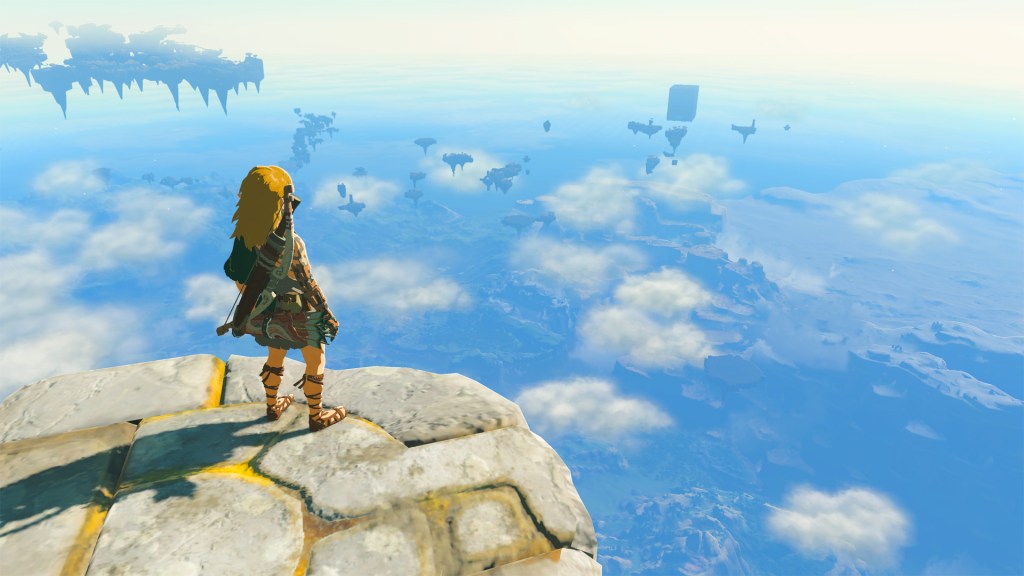
Tears of the Kingdom is a more confident game about its visual art. Colours are more saturated, light and blacks take full advantage of their respective gradients, volumetric effects are more dynamic and feel part of the world, and, with all that, sharpness could be increased, because they found a cel-shaded feel that they feel proud to call ‘their own’.
For example, this is such a confident aesthetic that, even Level-5 games that were done in collaboration with Studio Ghibli, don’t feel as Ghibli as Tears of the Kingdom (in the sense of capturing and transmitting a soul and a vibe, instead of a specific technique in animation).
This game is another proof that good art direction is always more timeless than good graphics.
Seriously, this is running on hardware more obsolete than 2013 state-of-the-art, and it’s not only the most beautiful game I’ve played in the 2020s, but also the most technically impressive. Jumping from the Sky Islands, passing through the full map of Breath of the Wild, and continuing to an entire underworld of the Depths, in a seamless dive with no loading screens is one of the most amazing things I ever done in a video game.
I also would like to give a shout-out to everyone involved with the aural atmosphere of Tears of the Kingdom. We all know that the Zelda franchise is known for its iconic sound effects and jingles. Still, we shouldn’t take them for granted. They continue to give a lot of texture, flavour and identity to the worldbuilding.
And, in the same vein of my appreciation and critique of Breath of the Wild’s visual tone, I highly respect what they went for musically in this duology – minimalism and mood pieces –, but it also felt that something was missing to better relate with the natural ups and downs of a sprawling adventure.
Not in Tears of the Kingdom. The resonance of minimalism with exploring the unknown is aptly maintained, but the soundtrack team now also had the confidence to give us more pronounced tracks in specific moments of gameplay, related to story.
The different stages of music during the advancements in a dungeon are not only thematically appropriate, but also very smart at adding tension and variety to something that, mechanically, was a loop. And the boss music tracks are also pretty epic, without superimposing.
Now, what makes or breaks this game:
Did it correct the wrongs I found inexcusable in Breath of the Wild?
Yes. Yes, on all counts!
“The locomotion in the open world was boring. Riding a horse, for example, was never fun”
Riding a horse is still boring, but now, thanks to Ultrahand, I could build other means of transportation, and it was as fun building them as it was witnessing my own contraptions actually working.
Legitimately, Ultrahand is one of best mechanics ever created for a video game. Yes, it’s an immense joy to use, and it makes us question how can it be so customizable without breaking the rest of the game. But, more importantly, it doesn’t operate in a vacuum: it’s part of a world with other dynamisms, and still makes sense in it.
Continuing regarding traversal, this time, going from point A to point B also didn’t feel as stale because the game itself has other intentions for our travels. While Breath of the Wild has the standard open world in which you journey on a longitudinal axis, Tears of the Kingdom is literally (tears, tiers) a vertical game.
You are constantly alternating between exploring ‘Middle’ Hyrule, being launched above the clouds via Skyview Towers, and diving through giant holes in the ground to reach the Depths of Hyrule. Basically, instead of a flat line linking two points, your itinerary has more resemblance with a very active EKG.
In the Sky Islands, since they are, for the most part, either monuments of ancient Hyrule lore or giant open-air puzzles of separated pieces, you are encouraged to resort to the advanced technology of that ancient civilization to navigate the environment. It’s there in the Sky that we have more opportunities to experiment with vehicle building with Ultrahand. And, not only for flying between islands, but by being so high up we also have a privileged viewpoint to choose our next destination on land – covering way more ground in a shorter time than in Breath of the Wild.
In the Depths, even if we spend most of the time walking, boots on the ground, it is never dull. The combination of it being completely dark with having the toughest threats in the game, who turn your hearts unreplenishable by simply touching you, makes every expedition into this Underworld of Hyrule always very engaging. Later, you can also resort to Ultrahand to build vehicles down there, with luminous plants serving as headlights in the darkness (=D). Of course, the Depths is where you can collect the best resources and equipment in the game.
You know that this is a game more about those layers than traversing large swathes of land when you notice two things: (i) the game puts you in situations for which the ability Ascend (if there’s a ceiling with a floor or hill above, you can use it anywhere without restrictions) is even more efficient than Ultrahanding a vehicle; and (ii) every layer of the game is in dialogue with the others, like luminous plants can only be found in Middle Hyrule, sundelion plants that treat the unreplenishable hearts can only be found in the Sky Islands, and the resources to power advanced technology in the sky can only be found in the Depths.
Genius programming and level design.
“The combat (alongside enemy variety) was too basic and repetitive”
Combat, at its core, continues to be basic. But, the introduction of the new ability Fuse makes everything way more expressive and less repetitive.
You now can Fuse almost anything to your sword and shield. It’s up to your imagination, because crucially, many of the different resources you pick up along the way are not only fusable but also apply different properties to your weapons.
And it’s as delightful to see a plan of complementary attacks come to fruition on an enemy camp, as it is to be completely surprised by the chain reaction resulting from a Fuse with a new exotic material. Blowing yourself up in this game is more fun than frustrating.
Regarding enemy variety, it’s a bit better for the mobs in the overworld. But, where this game got a big bump was in the bosses.
Their design is thematically WAY more creative than Breath of the Wild’s, and the gameplay attached to them was also more diverse, interesting and fun.
The final boss, in particular, was impeccably thought-out to have space for everything: cool design; minimalist phase in a duel of essences; menacing phase in which you have to be very careful and precise; and an over-the-top phase in which the legend in The Legend of Zelda was never more meaningful.
“The sandbox and puzzle solving in it took me out of the worldbuilding, because it wasn’t using the same visual and narrative grammar as the rest of the grand adventure, creating a sense of 2-games-in-1”
To increase your heart containers and stamina vessels you should engage in the gameplay loop of finding shrines in the map and entering them to solve some puzzles in a separate sandbox.
For better or worse, this continues to generate a feeling of 2 games – the one to explore and adventure in, and the one with the toys. But, this time, the narrative and level designers at Nintendo made an effort to give those ‘2 worlds’, at least, the same language, hoping, I guess, that gameplay and narrative conversations could be established between both.
And they are established. More successfully in a typology of puzzle-solving than others, but, for me, it was enough to not break immersion as often.
The category of puzzles in which this now flows really well are the ones encased in the big dungeons related to main story missions. Not only are they architecturally more coherent with the region and the malaise at hand, but they also involve more of the surrounding areas (even sky and depths), which nudges the player to better appreciate how the different subregions connect with each other, either on a gameplay and/or a narrative level.
The shrines, on the other hand, continue to be very discrete. But, this time, at least they were given a narrative coat of paint that relates them on a more structural level to the grand event of the game, in which advanced technology from the ancient world of Hyrulean demi-gods suddenly appeared all over the map. It’s not perfect, but I bought it. Especially the more I uncovered about that old lore.
“And the story was never deep, epic or organized. Which also was not coherent with the sense of adventure the game delivers on a mechanical level”
As you probably have noticed, narrative grandness and the coherence of that with changes in the world, challenges that you face and victories you achieve was a pervasive ethos, focus and solution in Tears of the Kingdom to all the above problems I had had with Breath of the Wild.
Interestingly, the subtextual theme, this time, is not as deep as Breath of the Wild’s (it was a good thing that I wanted for BotW to explore a bit more its environmentalist motifs – it meant I was curious).
Still, Tears of the Kingdom’s narrative and all-encompassing story is indisputably more epic and organized. It maintains its non-linearity (which I enjoy, because it’s coherent with also puzzle-solving lore), but the scale and stakes of everything were just turned up to eleven.
Physically and geographically, the different regions of the world are being affected by extensively different malaises, which, in turn, demand of Link and the player different grandiose conquests.
Chronologically, the glimpses we get of the ancient past of Hyrule (through exploration) also help to put the present phenomena into perspective. The old demi-gods and sages were so powerful they were responsible for the structuring Hyrule has today. On the other hand, the main antagonist that is coming to the present was SO dominant that even those demi-gods could not set him back without sacrificing their own immortality. And Zelda… has been working all this time to guarantee that everyone in the present is ready for his return.
Like I said above, this game gives a new meaning and strength to what really is The Legend of Zelda.
(so, next game, it’s time to give Zelda herself better voice acting, and, more importantly, gameplay co-leading, or even leading!)
To conclude, I feel I need to leave it clear (because of how I structured the sections above) that the final impression that this game left on me is BIGGER and BETTER than the sum of the corrected frustrations I had had with its predecessor.
Yes, it addressed all of them. But, more importantly, it realised the complete potential I had seen in Breath of the Wild, and, by doing so, LAUNCHED itself from that solid ground to the higher skies of the All-Time Greats.
The last third of this game is one of the best third acts I’ve ever experienced in any medium, not only because of how it coalesces all the threads into a plot and vibe that makes sense, but also because of how it risks doing it through complete interactivity. It never wavers from the gameplay freedom and dynamism of the previous acts. And even dares to increase such elasticity to reach a more grandiose culmination.
On a more micro-level, I also have to highlight again how creative and genre-defining the new abilities are. Ultrahand, in particular, brings a paradigm shift. The big dungeons in Tears of the Kingdom are already super organic in their worldbuilding (by extending narrative and gameplay beats to the explorable map), but, the fact that abilities like Ultrahand or Ascend are consistent across scenarios and applicable to any kind of challenge or experimentation gives this game an artistic code to its inner logic that makes it more immersive than its toy-ish sandbox has any right to be.
Another example is the loop of exploring ‘Middle’ Hyrule, being launched above the clouds, and diving to the depths, through giant holes, without any loading screens. This is not only wizardry on the part of these game developers (especially if you take into account all the other systems and physics engines constantly active in the map). This is gameplay in the service of fully transporting you into a world and a story.
And the art… Oh, the art. It’s finally confident and well-defined. When those saturated colours, combined with the sharp draw distance, and the naturalistic tone composition of the landscapes enter into dialogue with the minimalistic (yet expressive) environmental music and with the culturally distinctive silhouettes of great points-of-interest… That’s when you, the player, enter yourself into a FULL contemplative state… and things like gameplay, progression, story or pace either don’t matter, or become the same thing.
All in all, The Legend of Zelda Tears of the Kingdom will go down in history, by its own rights, as an amazing masterpiece for the ages.
And I highly recommend everyone playing it.

 Opinion Seed