For a country that has given so much to the history of cinema, the 21st century has been a big letdown when it comes to the output from the Italian film industry.
In part, this is due to a change in the types of movies being supported by the country’s ministry of culture over the last two decades. Even when governments change, the duds keep being financed.
The biggest players in Italian cinema have been shoehorned into pumping out the same kind of frictionless punching-down comedies, that purport to be wide-appeal states of affairs of the everyday life, but, in a worryingly high ratio, end up serving as vehicles for anti-immigration rhetoric and a normalization of xenophobic stereotypes. (this has also been happening in the other nation of cinema – France).
That being said, things are changing.
Italian cinema has been living a good streak of producing some really good movies in the last 3-to-4 years. A new generation of filmmakers are not only calling back to the techniques that helped define the country’s aesthetic in the ‘canon’, but, more importantly, finding themselves again as meaningful voices in a globalised world. Arts, like cinema, are more important than ever when it comes to engaging with different cultures, different perspectives, and generating empathy for those differences.
The Eight Mountains, despite being written and directed by a pair of Belgian filmmakers, is very much an Italian contribution to this forum.
Not because of it being an adaptation of an Italian novel (of the same name), set in the cinematic beauty of the Alps. But due to how its characters absorb such scenery, how that assimilation transforms their lives throughout the years, and how they give back to the world around them as a result of those events.
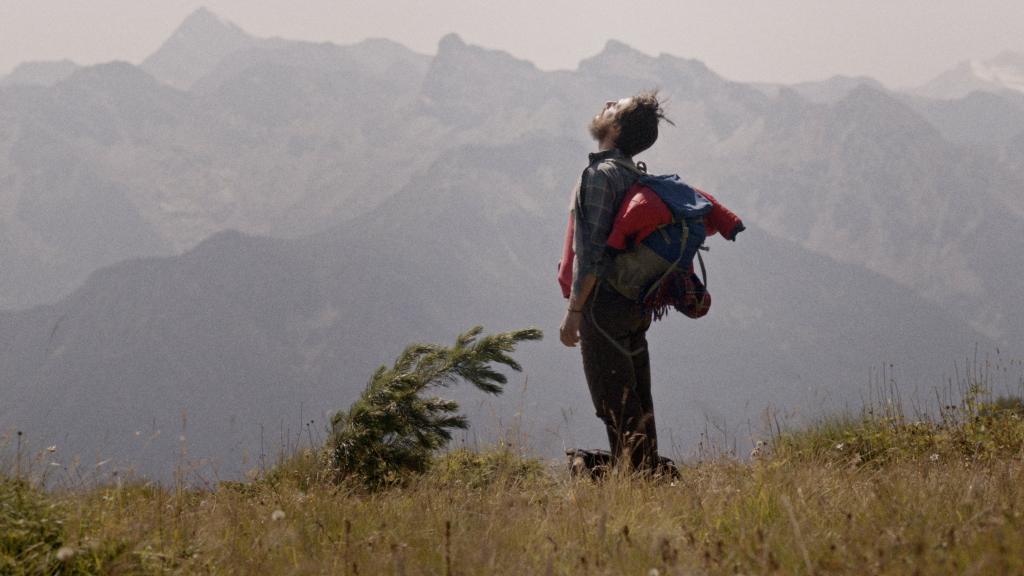
From the very first shots of the Alpine mountains, we know that the engulfing nature of the vistas was not an end in itself for these filmmakers.
Tactilely, the movie projects at a 1.33:1 aspect ratio (4:3, ‘Academy’ ratio), which results in two textures for the audience. The first, and more immediate, is that the visual grammar of this story is more interested in the verticality of the mountains, rather than the panoramic splendour of the ranges. It’s still imposing, mythical and beautiful, but it’s not supposed to be hypnotic or never-ending.
The other, and humanistically linked to the prior, is that such perception – a not never-ending 4:3 bordered reality –, with tremendously high mountains at the centre of the frame, excerpts an equally strong influence on the central characters of the story. Even from an early age.
Eight Mountains, caught at three time-points (kid, teenager, and adulthood), follows the friendship between two men who met and spent their childhood together at a remote Alpine village, and who reconnect years later as adults.
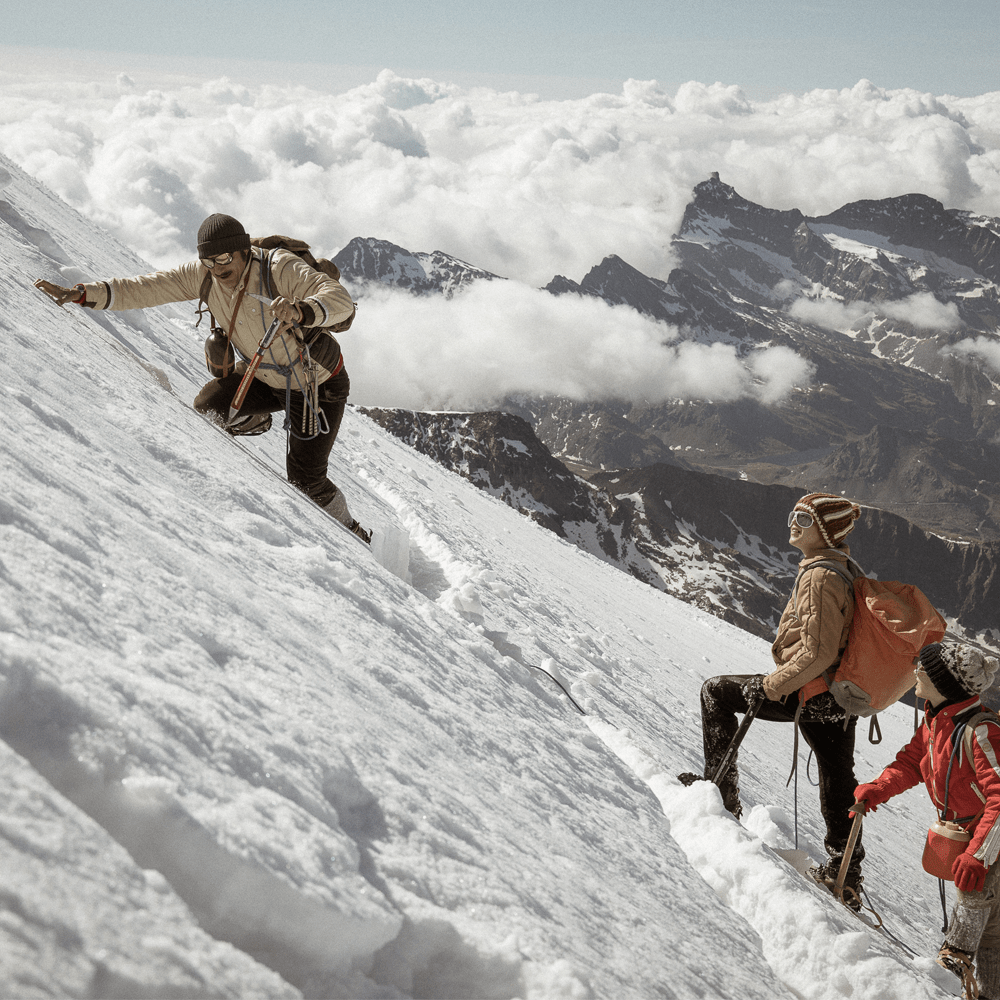
When kids, the mountains are even bigger, and riskier. But, it’s precisely that power and challenge that plants in them the perception of a life worth making plans for. At the same time, the 4:3 ratio concentrates another type of force: the one to break the borders, to leave, to evolve…
This is the character arc of Pietro, portrayed by Luca Marinelli, who gives one of the best performances of the year, as he is so restrained for someone in such a journey of self-discovery. He goes from lost, undecisive, found, a different kind of lost, found again (but now with an acceptance that he won’t be forever that way)… All with zero overacting, but completely perceptible in his eyes.
At the same time, there’s a mini-arc I should highlight, because it also serves these themes, while being one of the best parts of the movie. Filippo Timi, who plays Giovanni, the father, is the person Pietro swears to never become. A blue-collar middle-aged man, whose only friend is the cigarette during breaks at work, and who sends his family every year to an isolated mountainside village as an excuse to eventually find a few days off work to chain-smoke over his other obsession: mountain hiking.
It’s almost a dual performance by Filippo Timi. Not that such contradiction doesn’t coalesce into a believable human being – it does! Giovanni, in the traffic of Turin, is an angry man when taking his kid to school. A nervousness that makes him as quick to curse as he is to dish out certainties about life to his son. However, when he is atop those mountains (away from the industry of Turin), he smiles wide-eyed and the aphorisms no longer come at him so fast.
We know that such duality is what completes him, because, from the great acting by Filippo Timi we notice a common thread: sadness. His eyes can be piercing at a driver, routinely crunching numbers at home after work, enthusiastically drawing up a hiking trail, or smiling at the landscape around him when the top is reached… yet, there’s always that same amount of sadness in them – like a symbiont that will never leave, and that has come to define him.
There’s a scene, around the middle of the movie, when another time skip occurs, in which we see a more aged Giovanni, still working in industrial Turin, and the entire action is just him in a silent conversation with his cigarette, taking a break at a balcony, and looking at somewhere with those accepting eyes filled with that same symbiont still there. We see metal all over the place, but, in the background (even at 4:3), we get a tiny glimpse of the mountains surrounding the city.
And then there’s Bruno, portrayed by Alessandro Borghi. This characterisation is a quintessential embodiment of what people mean when they say things like ‘movie magic’ or ‘it can only had been done by a movie’.
In a mixture of great acting with great screenwriting, we can see him as a fully-fledged person, with his way of viewing the world, or we can see him as a projection of Pietro’s wishful thinking of himself. Both interpretations make the movie work and strong on their respective merits, because this is a film that is interested in precisely that conflict between idealised reality and hard reality.
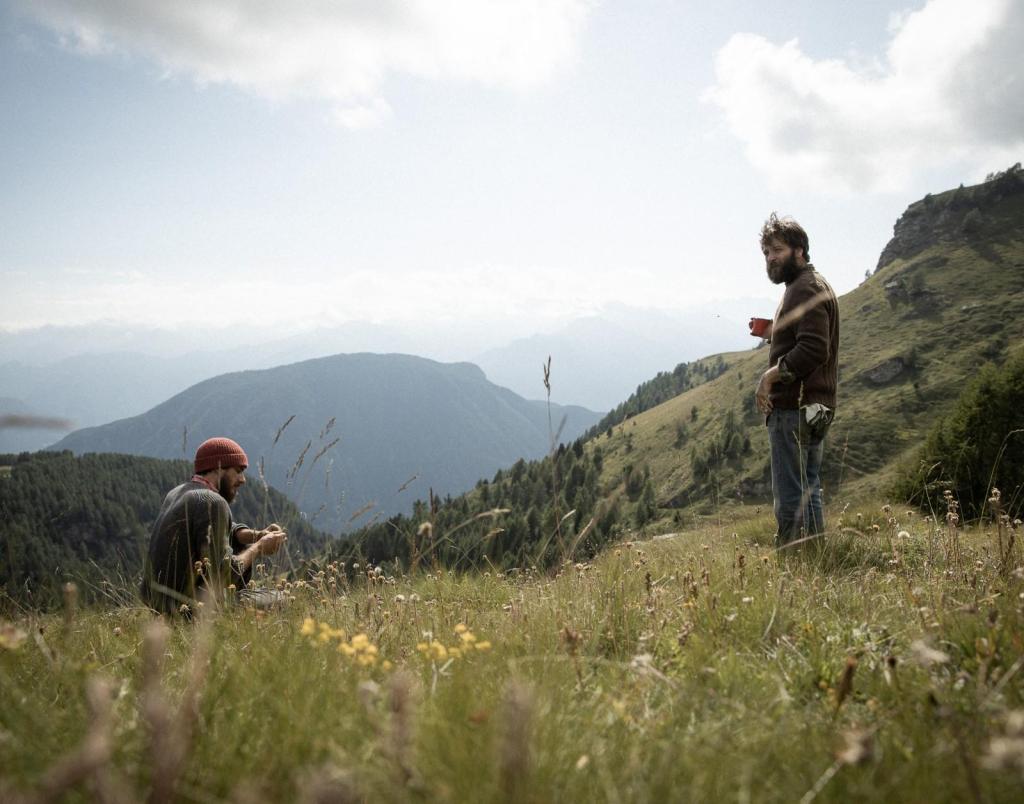
Bruno is a hard figure, and that roughness makes him very literal and believable (irrespective if we find him real or not). At the same time, he is not only firm on his idealised dream of living in the mountains, secluded from all other societal problems, he ACTS on it.
Pietro, on the other hand, since an early age found a passion for that style of living, but always ends up not committing or running away from it. But, once he visualises a reality in which Bruno and his father (who, remember, had no friends) spent the summers living that bucolic dream, something changes inside of him.
And even if his search for that same mission statement of Bruno’s takes him to a different understanding of what societal ‘problems’ really are, and how they connect with our own humanity, the physical and intellectual journey he goes through makes not only the characterisation of his father shine through (like I wrote above), but also Bruno a meaningful entity (real or not) at the crossroads of what’s idyllic and what’s out of our control.
The Eight Mountains is almost a 5-star movie.
What is preventing me from seeing it that way for other people are two nitpicks: I found the musical soundtrack to be a bit on-the-nose (they should’ve let the visuals sing for themselves); and I found the macro structuring of the screenplay to be a bit formulaic (we’ve all seen this progression of a plot many times, and these themes are so good they deserved a more creative editing and evolution).
That being said, I loved this film.
As you probably have noticed, I found its creativity in the way the filmmakers restrained themselves by giving us all the footage and worldbuilding at a 4:3 aspect ratio. They were not enamoured by the sentimental beauty that a wider framing of those mountains could have lent their movie, but focused on the true power of that setting and how it relates to the characters’ positioning in the world and in this specific story and message.
(Mad props to the production, cinematography, camera and lighting crews, who accepted that intentionally truncated perspective of their work, after spending certainly so much time and effort capturing images in those jaw-dropping but dangerous environments).
I also found the acting of the three main performers to be exquisite. Must repeat: Pietro is one of the best portrayals of the year, with Luca Marinelli being one of the best actors in the world right now; and Filippo Timi, who plays the father, leaves such an imprint on the screen and on the story that, even when he is not on a scene, we can’t but feel what he means for this journey.
And, finally, what really made me fall in love with this film was how it used its cinematic language to communicate these themes. Like I said, it might not have the most innovative plotting, but the philosophy being captured through the photography of people and places, distilled through challenging scenarios, and expressed via movement of human action is certainly deep and worth contemplating about.
It’s one of those movies in which the artistry and spirituality of its execution is more important than the innovation it brings to the overall industry (maybe it should be like that for all movies).

 Opinion Seed