It can be argued that large-scale globalisation began in the 19th century. More, in the 1600s, cultural exchange and trade links were enough to maybe call that period proto-globalisation.
And yet, after so many centuries in the making, it can also be said that globalisation is still a state of paradox. On one hand, we are very mature and open to the exchange and assimilation of products, money, technology or data. But, on the other hand, we are still babies in our capacity for taking in ideas, beliefs and culture from our also globalised brothers.
In some ways, it seems that our tiny brains find modern globalisation so rapid and big (it’s global, duh) that we shut down and look for comfort. However, that comforting blanket is hiding some serious monsters underneath: nationalism, xenophobia, discrimination, social exclusion and racism.
Based on the 2020 Ditrău incident, Cristian Mungiu, Palme d’Or winner filmmaker, wrote and directed R.M.N., a thriller that perfectly captures the paradox of globalisation in his own home country of Romania.
At the same time, and despite the specific conditions that contributed to the events of 2020 Ditrău, the crew and cast of R.M.N. filmed everything in a way that is relatable and applicable to any part of the world.
The staging of the situation is framed and sequenced at a level of personal immediacy that, even though they are there, for long minutes we don’t even grasp how the large number of Romanian emigrants, the liberalist-xenophobic Hungarians, the long-expelled Romani minority, and the now Sri Lankan workers connect with each other to shape the plot of the movie.
It was written and filmed in a way that we are immediately involved by the mystery of who or what made Matthias quit his job in Germany to be back with his son, who lost his voice from a big scare in the woods (was it bears? Was it Gypsies?). Or by the question of who or what is taking advantage of his powerful-yet-ill-stricken father and making his sheep disappear. Or the sexual history that exists between Matthias and Csilla, CEO of the bread company that hired the Sri Lankan workers in the first place.
And yet, it’s not plot-manipulative. The script gradually introduces phrasing and visuals that pull you below the surface. That’s why the name “R.M.N.” (Nuclear Magnetic Resonance) is so apt. You are engaged with relatable everyday drama, but the movie makes you feel that something is not alright, something is ill-stricken. And you want to investigate and analyse what seems to be unknown, because it certainly is unsettling.
In not a zombie movie, or even a horror one, by the end, the Transylvanian village reveals itself to be indeed infected by a nefarious parasite: individualism turning people into hostile egocentrics. Which is paradoxical, because each individual might be responding to their low minimum wage or unemployment, but end up succumbing to group-thinking that wants to take even more advantage of them, weaponize their anger, and distract from the true culprit of low wages (or the need to have high ones).
The characters in the movie do point out the contradictions. Sri Lankan immigrants are being nationalistically attacked by a Hungarian minority in a Romanian village, known for its high percentage of national emigrants.
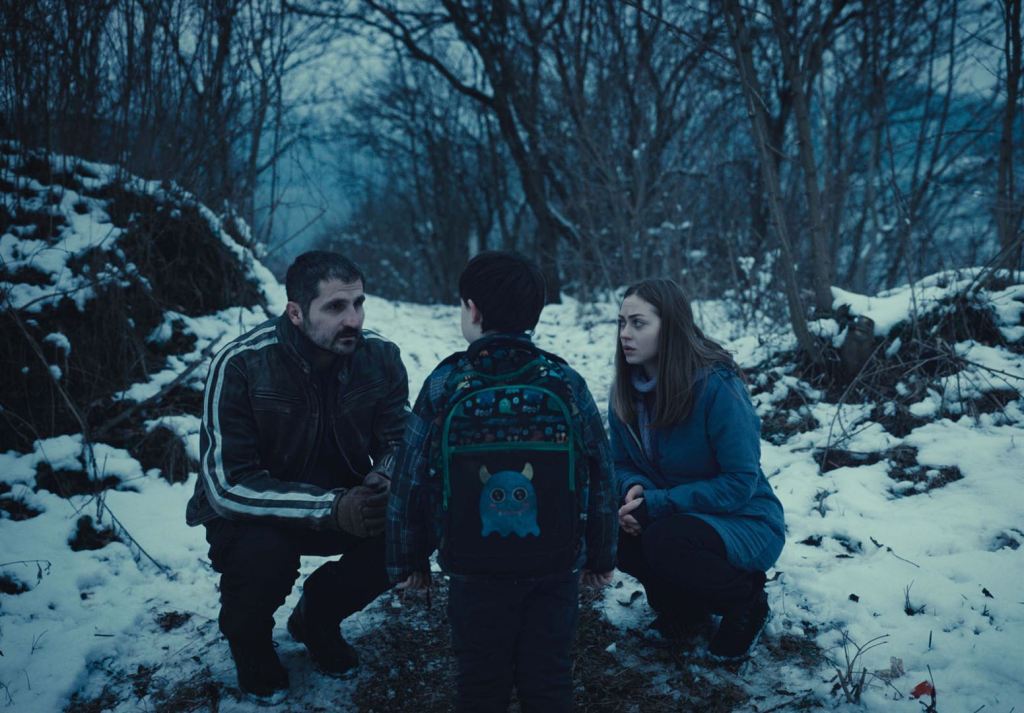
But that’s conversational – “banality of evil” sort of way. The true strength of the film, though, is in how its cinematography creates an atmosphere of winter unpleasantness (it’s not grey-ish, there are contrasts, but they come from the shadows). The camera follows many characters behind their backs (or laterally but with limited view-range for the audience), and then replaces what could be jump-scares in this thriller aesthetic with unconventional symbology.
These symbols mess with your perception. They are glimpses to a world where accepted facts like nationality, race, religion, economic class are not established, and other forces prevail. They are not bizarre or unorderly, but more primal and naturalistic. And the simple fact that they are believable despite not following our human constructs, and probably more powerful, makes us confront those previous driving forces of human behaviour that so much evil bring about.
Perceiving a fellow human being is an open space for the unknown. It takes effort, and it’s sometimes scary. And this film is great at showing how even less defined and scarier things can get if we don’t make that effort.
I also liked how there are two types of locations in the movie that were not enveloped in this tinge of naturalistic dread. Every scene happening at a factory or any place of production or commerce was always shot with very clear imagery – instead of shadows, white and artificial light dominate. Which is, in itself, a thought-provoking meta-contrast, because we know that it is in these places that the Sri Lankan drama starts to brew (even though everything continues to operate as nothing is on the horizon – a capitalistic glass case).
The other sui generis setting is everywhere (besides the factory) the character of Csilla is in. First of all, her portrayal by Judith State is not only the best acting of the movie, but also one of the best in the whole year. It’s unimportant if she is a lead or a supporting performance. The fact is you can’t take your eyes off her. You don’t really know why, but Judith State hypnotically dances around between a confident businesswoman and a musician who is in search of some soulfulness in her life.
As such, everywhere (besides the factory) Csilla’s at was shot with a more idealistically comfortable vibe: more natural light, warmer colours, and even the clothing of the people is cosier. For me, that is also a meta-commentary by the artists who worked on this retelling.
Csilla is the CEO of the company that hires the Sri Lankan workers. She treats them with respect and even warmth. However, she also has to reconcile in her head that the true reason she sought out those human beings was not because of her will to support the migrant cause in her country (she is of the Hungarian minority, by the way, but on the other side of the fence, notably), but because it was the fastest and cheapest way to guarantee that the company met the mandatory quotas on number of employees, so it could be eligible for a higher tier of EU funding.
The fact that Csilla, amidst the unrest that starts to fester, takes refuge every night in the idyllic beauty of her musical instrument and a glass of wine (very dark nights outside her house, like I described above about the ‘winter unpleasantness’) is a compelling character study, and the kind of aesthetic conundrum more movies should use their pleasantness for.
In this case, it makes us face the nuance even more, because in previous scenes we had seen Csilla not only fraternally dine with the Sri Lankans, but also fight for their rights against her Hungarian brethren.
From her point of view, she simply can’t understand how such hypocrisy-fuelled hatred can be mustered against other humans. And yet, she arrives at the end of the day and seeks comfort. Why does she do it, and what kind of comfort, are the questions those divergent scenes ask the audience.
All in all, this is a film about symbols. From out-of-the-box (quasi jump-scare) to subliminal ones, this is stylistic choice that provokes even more reflection on the causes and consequences of the subject matters at hand, than if it was a more literal retelling of the events in the form of a docu-drama.
The film embraces semiotics, not necessarily to expand its meaning, but certainly to take the symbols people created and use to perpetuate these evils, bring them to an old world of bigger and more powerful iconography, and deconstruct them to their meaninglessness.
Like the real context it is based on, over-focusing on patterns, tokens or motifs dehumanises language and communication. Dialect (it’s no longer dialogue) becomes only a transaction of symbols. However, as a wake-up call to real life, the movie is capable of using its technique to turn the dehumanising into ultra-humanisation.
Through shadows and contrasts, in the cacophony of economics trying to be a numerical science, of politics trying to be laws of physics, of religion trying to be non-hypocritically moral and an education of it, of art trying to be experienced and interpreted only through escapism, and of individualism trying to say that its blatant turn for the lack of empathy is rational, efficient and for the good of the Colectiv, a silhouette can be grasped in the cinematography:
A lonely human being in the dark woods of this very ancient, pagan natural world.
We live our lives so focused on following symbolic structures, sole-identifying and sole-defining as supporters of the good ideas for the good of everyone else (if not, others are either enemies or nihilists), and more worried about preaching instead of listening, that time goes by in a flash and suddenly we are at eternal night.
Who used to be fellow humans right in front of our faces are now monsters and spirits haunting us. To face them, this movie suggests something akin to Nietzsche’s declamation:
“I am a forest, and a night of dark trees: but he who is not afraid of my darkness, will find banks full of roses under my cypresses.”

 Opinion Seed