(Bonus 2) Bāhubali: The Epic
Technically, this is a 2025 release.
But, let’s be honest, this is a re-edited and remastered single film version of a two-part saga: The Beginning (2015) and The Conclusion (2017).
Still, I had to give a shout to this experience.
Whether you’re a fan of S.S. Rajamouli (RRR) or don’t know him at all, you owe it to yourself to see this movie.
It runs laps around the entire American industry of action movies. It’s more creative and artistically ambitious than all the combined franchise stories I saw since The Beginning premiered 10 years ago.
Rajamouli is on a league of his own.
(Bonus 1) Nosferatu
I saw this movie in 2024, but, because it was right before the start of 2025, I had already closed the window for more entries to my 2024 list.
Notwithstanding, this new film by Robert Eggers is so good it deserved to be retrieved from my artificial cutoff and get a mention this year.
A powerful portrait of women’s emancipation, with a central rendition by Lily-Rose Depp that is as bold as it is undeniable. And some of the most evocative dark cinematography ever captured on film, by Jarin Blaschke.
Also, it’s coincidently (or not) a very appropriate entry into my 2025 list, since I seem to have found an underlying theme across this year, where storytellers, more than average, called upon horror or horror-adjacent elements to rally their cry.
Maybe it’s a sign of the times that the folk horror of Nosferatu is once again summoned to work as some kind of starting shot.
35. Ocean with David Attenborough
Unfortunately, we won’t be getting many more of these testimonies by David Attenborough.
But this is not a case of elevating a documentary because of that context. This is genuinely a very well filmed work, with technically virtuous cinematography, and a scientific basis that all of us should be aware of.
Additionally, with so many distressing facts shown by David here, plus the years he has been witnessing the decay of our relationship with the natural world, it would be more than justified for him to be quite jaded at this point and to use his renown to pass on a very angry and paternalistic message to us all.
That’s not the case. His scientific mind remains as sharp as ever, because he is fair with the facts. He is accusatory when they present in that direction, but he is also hopeful when there are real methodologies (proven to work) that HAVE TO BE implemented right now for things to get better.
Thank you, Professor Attenborough.
34. Warfare
By definition, it’s very difficult to create an audiovisual work set in war and fully make it anti-war. There will be some angle, some perspective, that will glorify armed conflict. That will objectify and atomize the inevitability of cycles of violence.
Most of the times, the approach directors resort to obscure that glorification and relativization is to dial-up on the gruesomeness and on the body mutilation.
Warfare, written and directed by former Navy SEAL Ray Mendoza, who was in the exact surveillance mission this film recreates, is indeed very graphic.
But what makes it one of the best efforts at the anti-war ethos is the focus on the smallness of a single house. The amount of chaos, destruction, suffering, and violence that happens in just a blip of space and time is impossible to relativize.
It’s a harrowing depiction of the absurd at the core of the human urge to conquer space and territory. And of the pointlessness of it all.
33. The Blue Trail
Usually, there are two types of movies about the elderly.
It’s either the contemplative one, about what we take for granted throughout the years, from an experienced perspective that teaches the audience a couple of life lessons. Or the movie where the story sells the audience unrealistic expectations on not worrying about becoming old people, because they will get to healthily experience all the saved-up dreams of their bucket list.
The director of Blue Trail, Gabriel Mascaro, found the perfect balance between these two templates. Despite a worried backdrop to this story, where older people will become less and less economically valuable, this is a beautiful movie about finding, way later in life, a different and more meaningful sense of self-worth.
It’s precisely this contrast that makes the adventure of Tereza (played splendidly by Denise Weinberg) such a metaphysically astute one. She goes on a trip but does not find herself doing gigantic stunts, but rather experiencing some kind of time compression where the fact that she is more attentive to each detail of life turns those new moments into indeed gigantic and amazing.
32. Misericordia
There’s kind of a bittersweet taste this film produces when laughing at its funny scenes.
Often, I tend to push back on humour made at the expense of provincialism. But this movie does it differently. Yes, I laughed at the lust for creating melodrama, because they are so bored. But Misericordia understands that at the core of that narrow-mindedness there’s a sadness that comes from the gradual shrinking of these communities.
It’s a movie that is as interested in making us laugh at supressed desires, as it is in making us reflect on our own prejudices against prejudiced people.
Félix Kysyl, the main actor, is really good at portraying that kind of walking mirror. By indicting himself, he also indicts the viewer when we are laughing. A very well-written and staged “reversal of the gaze” type of movie.
Also, no surprise, great cinematography by Claire Mathon, one of the very best working today.
31. If I Had Legs I’d Kick You
There are so many elements of this movie that I really liked.
But there’s one central aesthetic pillar that makes me deduct some points from my overall appreciation of this work.
The movie is too pastiche of Uncut Gems. And I acknowledge that this is a combination of my own personal bias, and the circumstance of a director in her first big opportunity calling on a style she had had recent successful learnings (Mary Bronstein is married to Ronald Bronstein, who is the writer and editor of the Safdie brothers’ films).
I also really like Uncut Gems. But there have been too many clones in the last few years. Even if, to be fair, Mary Bronstein probably did the best one of those.
At first glance, this seems to be a movie about motherhood. And it is. But the Ronald Bronstein-Safdie styling and sensibility opened up this work into a much more universal dimensionality.
The close-ups and the pacing of it all turned this movie into a sonic haze of an anthem for all the people who, in phases of their lives, felt like they were the unreliable narrator of their own story because of how big, overwhelming, and uncontrollable the obligations thrown at them were.
There’s a recurring scene of a hole in a ceiling that, again, despite being derivative of the opal imagery in Uncut Gems, is very well staged, and with subliminal complements that make it very effective.
Also, I think the end sequence of If I Had Legs I’d Kick You is one of the most powerful of the year. (Curiously, it’s one of the few moments when the movie frees itself from the Safdie-isms).
And Rose Byrne gives undeniably one of the best performances of recent years.
30. Predator: Badlands
This movie had three things working against my curiosity:
I’m tired of origin stories. One mark of good non-origin storytelling is how the writing stimulates the imagination of the audience to think of what is not in the text – let people exercise their brains without numbing them with constant spoon-feedings.
I’m tired of the trend of us living in a culture where evident bad guys have their time in the sun to superficially spin their badness to the point of people saying “I actually agree with him on two or three subjects”.
And, as such, I’m particularly tired of villain origin stories. I don’t think anyone needs further investigation on babies not being inherently evil.
That’s what the marketing was selling me on for this new entry in the Predator franchise.
Good thing that every movie that Dan Trachtenberg had directed up to this point was, at a minimum, a thought-out subversion of either a franchise or a trend. So, I decided to let Trachtenberg take me to the Badlands, with those reservations.
What a director.
This is not a villain origin story.
Once again, he did not resort to trend-chasing.
Predator Badlands is pure character storytelling, with organic dynamics between a cast, and a high-quality world building that itself serves as the fuel for the premise and the plot, and not some agenda.
It just so happens that the main character is a Yautja. But it could’ve been any other fictional creature. Which itself is a different conversation about the American movie industry not financing talented filmmakers like Trachtenberg to let them tell whole-original stories.
He’s also really good at directing action. As in Prey, you immediately notice how creative Dan is about staging and sequencing set-pieces. His love for video games is clearly helping him in this department, because his encounters and choreographies are designed to be presented as a series of mechanics that all have trade-offs but should flow smoothly and intuitively from one challenge to the other.
Speaking of gamer brain, like Shadow of the Colossus, you are awed by the scale and inventiveness of Dan’s set-pieces, but you start to suspect that the director is using your relationship with spectacle to crack the mask open at a certain point, and reveal how all that player-agency and action, in this case the Yautja Dek, connect with the true purpose of the film’s story.
The movie has many cool action sequences. But you come to understand the message of this project when you notice that the most engaging (and most creative) action sequence is one of non-violence and non-destructive instincts.
Being somewhat of a coming-of-age story, the animating force of the movie was to show that what makes a ‘man’ is not his ability to fire a bow, but the gentleness to undo self-centring from one’s life outlook, and start embracing the roles that others have to play in the world around you.
Dan Trachtenberg, you are on my list man. That group of directors that, whatever you do next, I’ll be there day one.
29. The Order
Two main actors I’m usually quite cold on… I have to admit, they are very good here.
But the other two main reasons to see this movie are:
1) Excellent Pacific Northwestern photography by Australian director Justin Kurzel and his DP Adam Arkapaw (great year for the Arkapaw couple of cinematographers). The look of the film found a really tremendous balance, because it embraces the foggy nature of that region of the US to shadow the thriller elements of the story, while the insistence on capturing the scenes at natural light gives a texture to the facts depicted that puts them close-to-home as certainly intended.
2) And the quality of the adaptation of the non-fiction book The Silent Brotherhood. It’s very very rare for a commercial audiovisual production with this reach of audience to so studiously present the tenets of British Israelism, and how the pseudohistorical tale of the Ten Lost Tribes of Israel has been lending exceptionalism to insecure men all over the world and turning them into fascists.
28. Caught Stealing
Tricky to speak about because I’m not the biggest Darren Aronofsky fan.
So, did I like this movie because it’s the least ‘Aronofsky-ian’ of his filmography?
Well, he did direct it, so technically makes it Aronofsky-ian.
Being real, I think this is a great hang for fans and non-fans alike. It’s him loose and having fun with a script.
If that is not enough to convince you, let me tell you, there are not many films in a year (and believe me, I watch a lot) with scenes with such concentrated doses of magnetism as this one has.
Austin Butler and Zoë Kravitz sharing a camera is just too much. That’s probably why Aronofsky finally relaxed (kidding!).
27. Superboys of Malegaon
Can a movie based on a documentary be emotionally manipulative?
Is that even a fair adjective to qualify what Superboys does with the reality of Supermen of Malegaon?
I knew the real-life story, I was prepared for it, for the dramatization…
And still cried all types of tears. Sadness. And a lot of renewed Hope in humanity.
This dramatization version of those lives is really good, from both the character writing and the camera framing, at laying bare that regional traits like “the community is very passionate about film making” only remain cultural hallmarks because people love each other.
Without that love there is no sense of place. And without that sense of place there are no films.
26. Bugonia
A rare occasion when the remake is better than the original.
Bugonia is an English-language remake of a 2003 South Korean film named Save the Green Planet.
So, this is an even higher higher praise, since I ride the waves of Asian cinema. It’s the same acknowledgment The Departed, by Martin Scorsese, gets from me.
Yorgos Lanthimos directed a better film than the Korean original in almost every facet of a movie (besides the originality).
Jesse Plemons and Emma Stone are dynamite together.
The VistaVision cinematography by Robbie Ryan is spectacular, considering most of the film was shot indoors, and tightly-spaced indoors at that.
And the music by Jerskin Fendrix keeps on surprising you with its wild swings, always completely in tone.
Also, if you’re worried about Lanthimos, a director that dabbles in misanthropy, taking on a story from South Korean cinema, a country known for its misanthropic films, don’t. I actually think that a slight choice that makes Bugonia’s ending differ from Green Planet turns the former into one of the most life-affirming movies in Lanthimos’ filmography.
25. KPop Demon Hunters
Instant inductee to that Hall of Fame of animation movies where the soundtrack are all bangers.
It also helps that the animation itself is very good. Sony Pictures Animation, the same studio that has been blowing people’s minds with the stylization in the Spider-Verse franchise. KPop Demon Hunters is not as bombastic as the Miles Morales movies, and, to be honest, I prefer it. This way, when characters or sceneries are indeed hyper-stylized it is more meaningful.
Finally, and I know I’ve already lauded the songs, but the last 20 minutes of this film are *absolute cinema*.
For me, the two best songs of this movie are ‘Your Idol’ and ‘What It Sounds Like’, musically as they are.
But the fact that they play back-to-back in the culmination of the story, and are thematically harmonious with the message of the film of not letting pernicious forces to isolate individuals by holding hostage each own’s imperfections, is a very empowering audiovisual moment.
24. Weapons
This is the closest we’ll get to having a blockbuster that was made under the David Lynch school of Transcendental Meditation.
I don’t think Zach Cregger set out to make a movie about children mass shootings in the USA.
This is first and foremost a movie about guilty conscience. That feeling of guilt when your last interaction with a person was too confrontational or charged with vitriol because of tertiary things unresolved.
Then, through some kind of Lynchian TM, Cregger probably started noticing that in a society that tends, more than the average, to pit people against each other as winners and losers, those situations when purgative vitriol is spewed there’s a more intense contamination to the next person, and then to the next person, and so on, and so on.
A social fabric like this is, at its ‘advanced’ state, a country where people only feel the argument has concluded with a personal AR-15. And then it’s a chicken-and-egg situation: the same venom that contaminated and culminated via semi-automatic weapons is the same identitarian angriness that breeds mass shooters.
23. Cloud
Kiyoshi Kurosawa is a master of tone.
You notice the director’s mischievous jabs of comically criticizing the gig economy, the cuckoo-chick-shaped internet, and the way the two combined are contributing to social interactions becoming even more transactional.
And you uncomfortably laugh at the way he positions his characters in those predicaments.
But then, those awkward chuckles start being weighted down by a sense of dread for a society that is really being pushed out of the nest by the cuckoo.
So, when Kurosawa postulates that the next step is for human beings to interact with each other like they do in Call of Duty matches, even if the director’s staging of those encounters is darkly comic, you no longer laugh.
22. Sister Midnight
In retrospect, I was kind of a dummy for not guessing what was happening to the protagonist’s body throughout the film. It’s in the title of the movie!!
But hey, it’s brilliant filmmaking. Particularly when the stop-motion animals start to appear to throw you for a loop. This is one of those movies that does a lot with very little. For example, the film gets to be expressionistic because its cinematography was very creative even with a budgeted number of locations.
I remember most of the scenarios not because they were few, but because the shots were assembled and captured with very distinctive designs.
Still, the emotional core of the movie is Radhika Apte’s lead performance. Karan Kandhari is indeed an imaginative writer-director, but the genre-blending of darkness, with comedy, with the very tactile drama of feminine emancipation would never work if Radhika Apte was not able to channel all those vectors into her physicality.
Like feminine emancipation, this is a movie that only gets to start its scenes in rooms holding only light. The crew managed to add texture to the emptiness. But it’s Radhika Apte’s hard edges meeting that quasi-nothingness that light a fire under this movie. Her eyes charge the emptiness; her physical comedy finds grips in spaces defined by boundaries alone; and even her sexuality gives weight to an absence you can only hear your skin in.
It’s an amazing central performance, that even gets more piercing (not one of those situations where a movie’s stylizations are more distracting than additive) when Uma starts embracing her physical transformation. Really, Radhika Apte’s Uma is one of the most badass characters I’ve seen in cinema in quite some time.
21. The Mastermind
I honestly don’t know why I was surprised by this film.
I read the log line “Heist movie during the years of the Vietnam War”, and I thought “Nice, a change of pace for Kelly Reichardt”.
Ahahah
Leave it to Reichardt to continue to subvert not only genre, but also the American myth.
You know that counterculture slogan “Make love, not war”. The Mastermind is “Make art, not war” the movie.
This is a masterfully crafted bait-and-switch of a screenplay. Even the rascally jazz soundtrack in the first half of the movie, ingeniously composed and improvised by Rob Mazurek, is Reichardt charming you into the myth.
And, speaking of charm, Josh O’Connor continues to cement himself as one of the best actors working right now.
In the end, The Mastermind engages your brain, not due to the heist, but because it is a character study of the USA. How two of its most deep-rooted identitarian ways of thinking – self-actualization equated to earning money; and signalling (moral and cultural) superiority to the world by placing their overbudgeted army wherever it pleases them –, according to Reichardt, has had two major aftereffects in the young men the country raises:
They either are destroyed (physically and/or mentally) in War.
Or grow up to become completely desensitized to social life, social causes, and the morality of sharing a planet with other beings not so fundamentally different from them, because they are too alienated and atomized in order to be able to compete in the rat race to earn money.
Kelly Reichardt is not manipulating us into thinking James Blaine Mooney is a tragic figure because Josh O’Connor is a riveting performer. He is as tragic as he is a crook because Josh O’Connor can reach deeper to the soul of a man and show us that, before the identitarian American system defeated him, he was a soulful young man who wanted to make Art.
Not War, in the rat trenches of accumulating capital.
20. Happyend
There’s a meta-layer to this movie about it being one of the sincerest yet biting depictions I’ve ever seen about the progeny of a stabilized middle-class that told their children that they should follow their dreams, while the writer-director, Neo Sora, being himself son of more than well-stabilized, the legendary (and late, rest in peace) film composer Ryuichi Sakamoto.
After directing the beautiful documentary about his father’s art – Ryuichi Sakamoto: Opus –, Sora seems to be channelling his filmmaking into a different type of personal.
There’s a theme of death also present in Happyend, but from the frame of reference of a young person. In Sakamoto Opus, Sora just ‘let’ his father play the piano in what was knowingly his final concert film before passing away. While this can be interpreted as forward-looking as the ‘end’ in Happyend, this new movie by Sora is more about the uncertainty of a destructive force (an earthquake) moving certain young people to think (and act) about what they didn’t do for society before, and another cohort of youngsters to entrench themselves even more in their dreams, passions, and fun.
The idea that life is short, from the standpoint a young person, is a very interesting subject to study via film. Such force literally creates a visual divide that is compelling to follow along in a narrative of character interactions and in the staging of action and consequence.
Add to that the fact that Neo Sora clearly absorbed his father’s sensibilities for music, and Happyend’s visual divide is expertly complemented with choices in soundtrack that also feel like a common heart beating in two different directions.
19. Die My Love
When a subject matter is as serious as Postpartum depression, commercial art tends to be didactic first, humanistic second.
Lynne Ramsay did one of the best directorial works of the year, not only because this film has some of the most interesting choices for image composition and character staging I’ve seen in a while, but, above all, also because she never, and I mean never, gives in to the temptation of being academic or paternalistic (or maternalistic) about PPD.
She uses those staggering choices of image-making and cinematography to try (as best as a movie can ultimately get to) and render a sensorial outlook of what one woman might be looking at when suffering through this mood disorder.
One choice I particularly respected was how Ramsay never used possible camera tricks (or post-production) to try to replicate the interiority of Grace. That part was for behind the eyes of Jennifer Lawrence. Ramsay took care of the torpedoed canvas, and Lawrence of the humanistic side. And it was another elite directing moment, trusting your actor to take care of half of the feeling of your film (the inner half).
Because Jennifer Lawrence just delivered the best acting of her career up until now.
Also, speaking of actors, a word of praise for Robert Pattinson. This guy is incapable of being mid. Even in a movie like this, where the weight of the responsibility is on his co-star, he is there. Fully there. Completely embodying a multifaceted human being. Low-key also one of the best works of his filmography.
18. Sirāt
It’s a breath of fresh air to see a film that suddenly questions its own thesis.
Unlike many works of art, even good works of art, Sirāt was not constructed to express a view of the world. This movie is not even postulating a hypothesis.
It starts as an ode to sensorial art, like rave music for example, and how certain forms of expression are not meant to be sung, but to be danced to. To let our bodies carry our minds into escaping from the metric world, and go to the primordial ooze.
The first act of the film, without being judgmental, asks why humans don’t genuinely escape from their tragedies more often.
Then, the only formulaic thing you’ll see in this movie, a tragedy happens in the second act, and the screenplay stages our characters in a context for which indeed escapism seems to be the only solution. But how to escape truly and fully?
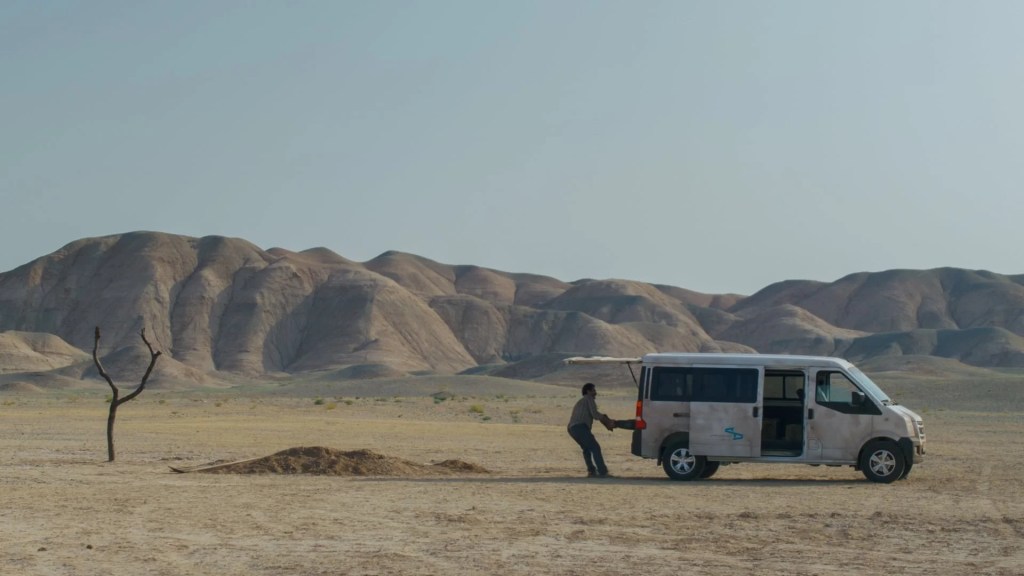
Finally, the third act wins out against the thesis the movie had been building up to. Even if it’s more comfortable for you to see the movie as a dream scenario, it’s unassailable that the wall of rocky Nature of this planet is the barrier, visually and philosophically, this story can’t escape from or to, to reach a resolution in spirit.
I honestly think that, with this movie, the director Oliver Laxe set out to exorcize some evil spirits from the desert. There, he found some bigger exterior monsters and a different kind of individual fragility. I bet this project didn’t give him the answers he was looking for, the freedom he was yearning. But there’s a part in freedom, a part in peace, that comes from knowing that you’ll never fully possess it. It’s not meant to be possessed.
A bombastic movie that has a lot of soul-searching in its negative spaces.
17. Frankenstein
Why watch another adaptation of Mary Shelley’s gothic novel?
The Modern Prometheus is, after all, directly or indirectly, one of the most referenced cautionary tales of the last two centuries.
My answer to that introductory question is: because Guillermo del Toro is a director with a big, big heart.
Throughout the years, Shelley’s Frankenstein has been diluted by the fascination with the combination of macabre and science. A lot of what people were retaining from her book was the iconography of body horror and of Galvanism. Visual spectacle, so to speak.
Don’t get me wrong, this new adaptation of Frankenstein is visually stunning. Some of the best art direction, cinematography, set, costume, and makeup design of the year. All these disciples cohere to give this film a look that feels as otherworldly as it exudes tactility.
And I know this elevation of fine and plastic arts in cinema is one of this director’s calling cards. But the most important work Guillermo did for this new adaptation was in how he took the original myth, that had been desensitized in modern culture, and distilled it to the core sentiment Mary Shelley was trying to convey in the first place.
Crucial to that was the partnership between Guillermo and the actor portraying Frankenstein’s Monster. Jacob Elordi as The Creature is one of the best acting works I’ve seen in a while, particularly for such a young performer. I had seen potential in him previously, but I would never guess he would reach this level so soon in his career.
Elordi’s acting behind the eyes is of someone who has lived a long and experienced life. So soulful. And, as stated, this was crucial. Because, yes, Guillermo went back to what Shelley meant with the parable of The Modern Prometheus. But, while many storytellers are content in exploring the hubris of always wanting to discover new things, Guillermo went even deeper into Shelley’s message: the people that influenced the discoverer to be this way, and the people he loses touch with because he doesn’t stop.
Without Elordi’s interpretation, filled with humanity, this more refined character study would have difficulty, again, standing out among the very mesmerizing iconography. This time, the spectacle are not the sparks in Victor’s contraptions, but the spark of The Creature’s curiosity to discover the world in a different way than his creator.
A more humane way.
16. Universal Language
It’s the best I’ve seen someone be inspired by Wes Anderson.
And it’s the best because it understands that what makes Wes Anderson is not the aspect of his frames, but the way the composition is not only a description but also a verb in his cinematic language.
The composition in Matthew Rankin’s Universal Language shares the verbs of Anderson, even if the shots are visually different. And it’s good that Rankin referenced Anderson. Because this story of immigrant identity stuck in a limbo is something the latter’s language was born to express.
Yes, there’s deadpan humour, British comedy influence, and even some Roy Andersson to boot. That being said, this is ultimately an emotional story of someone who did everything ‘right’ to be integrated into his new country and culture, but who, after a while, notices that the immigrant condition is like an always ill-fitted bed blanket.
You pull the blanket towards your face to feel more secure and accommodated. But, at the same time, you start feeling cold in your feet. You start missing the warmth of your roots.
The dream-like tone of the last 20 minutes of this movie is some of the best of the year. And they completely recontextualize the diorama quality of the first two acts.
15. Eephus
Making a purely good and realistic sports movie is very difficult.
Making a purely good and realistic sports movie, that also works as a very nuanced metaphor for life, is even more difficult.
Making all of that as your first feature film… What?!
Look, you can discard the allegorical side of this film and still have a great time if you like sports. I, too, was ready to do it.
But, in the last couple of years, my back and hip started to hurt the more I play in my rec-games of football. And I started to be more contemplative about that whole routine, and the value of it in my life.
Those encounters are composed of people with different professions, very different ages, different physical fitness, different talent for the sport, etc etc. It doesn’t matter. When we are all there, even if the reason to go is also different for each one of us, there’s a subconscious thread that connects us. Like a natural craving for some kind of tabula rasa.
And, while there, time has no meaning. Other, more important things, have meaning.
So, even if I wanted to just have a good time watching a sports movie, I understand what Carson Lund is getting at with this story.
And it’s really quality writing for such a realistic sports scripting. For instance, the premise is that this is their last game because the field is being replaced by a school. So, no dramatization of evil to manipulate the stakes.
Just some small nudges in dialogue, and pointing actors’ delivery and physical expression in a certain direction, and all the other elevation is done by just trusting the universality of the specificities I described above for my case (and all other people around the world who take part in rec-games).
The construct of the game is there, filmed with the attention to detail of someone who loves a sport. The characters feel like human beings we all know. And, as a spectator, my connection to their unspoken companionship is established by noticing that they also share a longing for some kind of tabula rasa.
They literally keep stretching the game. Even if it was already “pointless” or “over”. It’s the absence of that predetermination that this movie is interested in. As should we.
Kudos, Carson Lund.
14. 28 Years Later
The biggest (positive) surprise of the year to me.
I respected the proto-ideas that were in 28 Days Later, but I was not a part of the contingency of fans that were clamouring for another film in the franchise.
Then, it surprised me by how writer Alex Garland took his own proto-ideas of the 2002 movie and fully opened them up about the fall of the British empire, and how chauvinism and isolationism were the main culprits of that. (Great selection of musical tracks to accompany that writing).
Add to that an amazingly shot sequence on a bridge that, dependent of the tide, is not always accessible, and even action scenes are metaphoric in this script.
Finally, what makes this film even more special are the last 20-25 minutes. Out of nowhere, we are presented with one of the best performances of Ralph Fiennes’ career, and the last big staging of the screenplay is in a Bone Temple where Fiennes gives a very enlightened elegy on the unifying power of death.
The way death is a respite from all that infighting. And why the infighting, the artificial divisions, if, in the end, we all become bone.
The image itself of building a Bone Temple is the full realization of Garland’s latest intensification on his filmography about the pointlessness of divisions and destruction. A symbol of his bigger interest in the repetitive and continuous effort of rebuilding bridges, trying to understand the commonalities between very different humans, and how a memento mori is the ultimate counterargument against violence.
He has written some thought-provoking stories in the last 25 years. But I believe this movie has by far his best screenplay yet.
13. Sorry, Baby
You simultaneously ask ‘How can this be Eva Victor’s first written and directed film’, while being certain that, if she wants, she will be a writer-director of many more quality movies.
How do I know that? Because it’s very rare for any writer (even the ones with a lot more experience) to create a story with abuse as its central cog and not immediately be reductive about the multilayered and multifaceted dimensions a victim of such crime has to also contend with, just because such tonal shifts are very hard to pull off in commercial media.
At the same time, Victor also doesn’t ‘elevate’ it. She focuses on the human being (holistically depicted by her as well as an actor), not on the event or the societal ramifications branching from the others who know. And then she lets her empathy guide that character through all the elements of life: tasks, interests, pathos, and even comedy.
And, let me be clear, she accompanies the character in what naturally comes at her not with just a sensible control of tone. But also with an eye for very cinematic images. So, if Agnes is ready to feel passion again (either for things or people), the filmmaking makes it feel also earned.
Shoutout to two other performances that are at this same high level of Victor. Naomi Ackie, who I’ve yet to see a work where she isn’t a very interesting human being. And John Carroll Lynch, with the scene of this film.
12. No Other Choice
Park Chan-wook is, in my opinion, the most creative director working on this scale.
I would recommend this movie just for people to see what he does with a camera, the places he puts it in, the composition of the images he creates, what he chooses to film, and in which angle he frames each choice. Also, how he and his long-time partner Kim Sang-beom decide to edit and transition between all this footage.
He is a genius.
But, of course, I would even recommend more this geniality because of the why in his choices. Why did he choose to create that image? What is he trying to communicate with all that variety? Because, I guarantee, his most impressive magical trick is in how everything coalesces into a thematically rich world of images that is firm ground (and not a gelatinous collage of a single man’s subconscious) for equally well-developed characters to live the complex lives of real human beings.
For example, in No Other Choice, his latest, you will find the most intricately rendered study on the paradox of the labour market in advanced capitalist societies. Man-su, played thrillingly by Lee Byung-hun, is judgmental (and has pity) of his peers’ inability to reinvent themselves to rediscover happiness and a different job than the one they did for 20+ years. At the same time, the system itself, despite proclaiming reinvention, does not mean people. And Man-su rapidly starts to see a lot of obelisks raising in front of his reinvention.
Some are monoliths raising from a numbers-going-up out-of-touch corporate world. But others are more nuanced. Like, for instance, the level (and life) of consumption he was used to, and all the other socioeconomic forces that push the people in his life to want to maintain that standard of living.
This might be a satirical movie, but if nothing is done about robotization and the encroachment of AI, it won’t take long for such a dark comedy to not be funny at all. (And I don’t believe that this promise of self-sufficient technological substitution is for people to stop needing to work).
11. Sentimental Value
If you like film with its action moved by dialogue, you won’t see a better one from 2025.
I prefer Joachim Trier’s previous movie (The Worst Person in the World) because it didn’t need as much character confrontation for the inner conflicts to be felt. But it is undeniable that Trier, and his writing partner Eskil Vogt, write human interactions and the words that come out of our mouths with the precision and depth only the best psychologists in the world have access to.
Still, Sentimental Value has many scenes “for me”. The way Trier filmed a house – the house of the family – is cinema also at its best in capturing invisible forces, like the force of time on an object, or, in this case, the force of familial trauma through time.
For me, that’s the strength of this screenplay. It uses the cinematic staging to say something about what objects (not necessarily material) make people unable to let go from each other. And it doesn’t shy away from the complication that is reconnecting for the good things also comes with the bad ones. So, there’s a chance that that aspect of life is not solvable.
All that being said, I should note that these very nuanced dialogues (even the ones with unspoken words) would only be made justice with top-tier actors. And we are talking about them here.
Renate Reinsve is one of the best performers of her generation (even if I preferred the previous movie, she might be even better here). Elle Fanning is a big step up from other things I’ve seen her in. Stellan Skarsgård is the core of the whole tone of the movie, since he chose an acting style that all the other main cast derived from – externalize robustness, but internalize suffering.
And Inga Ibsdotter Lilleaas. Probably the best supporting performance I’ve seen all year.
10. Train Dreams
We all have experienced it before.
You are watching a movie, and you are not quite sure if the story lived in on the screen is as profound as the cinematography is affirming it to be.
And then, the last couple of scenes unlock everything for you.
That was Train Dreams for me this year.
Maybe because I like too much Malickian cinematography, and was being obnoxiously protective of that reference… I was not able to see the forest for the trees during the first pass of the movie. I didn’t even fully appreciate how the cinematography itself was indeed poetic.
And it was a flashback montage, something I usually do not like, that completely destroyed me. Destroyed all the smugness and protective barriers I so effortfully had erected.
This film has amazing line reading. From Will Patton in the Denis Johnson narration, to William H. Macy with a supporting appearance mid movie I will never forget. But it was the last dialogue said by an actress we don’t even know, “You better hold on to something”, then cut to flashback, that changed my entire perception of what I had witnessed up to that point.
Then, these filmmakers even add a very heartfelt song written and performed by Nick Cave… I don’t remember the last time I cried so much. Not tears of sadness. Tears of feeling alive.
Train Dreams is one of the best movies I’ve ever seen about the lives we deem non-aspirational or (worse) uninteresting.
9. Holy Cow
I’m gonna be honest, I think we as a species would also have a much needed coming-of-age again if we reconnected to a more bucolic style of living.
Louise Courvoisier, as a first-time filmmaker, is someone who I’ll be very much looking forward to her next work. She is not taking advantage of the countryside or of the country life to serve the narrative or the aesthetic she wanted to express. She is procedural.
And it’s that attention to detail that created an artistic environment that certainly allowed for both Clément Faveau and Maïwène Barthélémy to give two of the best young actor performances I’ve seen in many many years.
8. The Shrouds
Even if the premise of the plot is provocative, I don’t think David Cronenberg wrote this story because he wanted to make one of those movies about technology where the central question is “Just because we could, does it mean we should?”.
I might be wrong, but I think Cronenberg is more interested in questioning the process of mourning the dead, especially those who were dear to us.
There’s a very interesting character study at the centre of this movie. Karsh, played by Vincent Cassel, is a grieving widower who finds himself channelling his entrepreneurial skills to develop and curate a series of devices that allow the living to connect with their dear departed in their graves.
Cronenberg is pointing his camera at a phantom feeling of guilt that is there when we are mourning someone who was close to us. That sense that pushes us to externalize an altruistic mission in honour of the person we loved, improving ourselves and the world in their memory.
But then, our “original” self sooner or later takes over again. You can even call it our primal self (because true self is too dismissive of the pure energy that was indeed there when the ghost dominated). Biological needs come knocking again.
And what Cronenberg seems to be interested in is that third reframing of the dead person. The first was when they were alive. The second in the early days after their death. Now, in the third stage, how do we perceive that person’s existence after a while? Particularly in relation to us, so we can justify to ourselves (and to the ghost) the new life our body and mind want to have post them.
Diane Kruger gives one of the best supporting performances of the year.
7. Soundtrack to a Coup d’Etat
This documentary is astounding!
I honestly don’t know how director Johan Grimonprez managed and achieved the tone of this entire project. It’s simultaneously a very in-depth work of investigative journalism on assassinations ordered by former presidents of the United States, while being scathingly playful to mock grown men playing at politics with other people’s lives at stake.
The central toy for these grown men in this documentary was (and still is) the minerals in the soil of the Democratic Republic of the Congo.
But this documentary has an extra level of artistry and human connection. While studying appropriation, particularly African appropriation, the film is not really interested in the crude fact that Louis Armstrong’s music was used to assassinate Patrice Lumumba (which would be more than enough for most audience-seeking documentaries), but rather the cognitive inhumanity of western men using the African American trauma of Armstrong’s jazz to amuse themselves.
That’s why the soundtrack of this documentary is so poignant. Because, at a macro level, it shows how people listen to music to distract themselves from the other dances occurring in the other halls of power. And, at a micro level, the soundtrack also studies the pain in the lyrics and in the compositions of these legendary musicians. How the same people who have so much fun with these sounds don’t pay attention to (or care about) the cry beneath.
And help perpetuate it, by whitewashing colonial atrocities throughout history.
There’s something perverse in the human psyche when it comes to these facts. A kind of primeval common thread with gladiator times. A wicked instinct of getting entertainment out of the suffering of others.
6. On Becoming a Guinea Fowl
A renewed demonstration, by young Zambian filmmaker Rungano Nyoni, that the use of time, costuming, and light are more than enough tools for the cinematic art to express deep struggle.
In this movie, the depiction was of the different kind of suffering that the absurdity of life puts former victims in, by being the only ones with strength to help newer victims.
The script is initially very concerned with the sorrow still lingering on the former’s heart, as well as their attitude towards life and their surrounding culture. However, via naturalistic writing, the character development in combination with the staging start to turn that person’s mind towards a different kind of pathos – helping a newer victim, and exposing the reason why a cultural system creates protective taboos for all kinds of pillagers.
It’s really impressive how this movie gradually divulges the true feedback loop that perpetuates the existence of predators: an economic core gives people around it what little (material and cultural) stability they can have in their lives; they concede for this asymmetrical power dynamic to exist; and, from this concentration of power, money and sexual pillagers arise.
It should be noted that Nyoni, despite being very critical of that aspect of her culture, never uses that as a self-sufficient agenda for this movie. The only self-sufficient energy of her screenplay is human and character energy. Where will the people take this narrative to?
As a matter of fact, the most powerful scene of On Becoming a Guinea Fowl is composed of the life stories of the older women Nyoni’s camera initially seemed to be judgmental of. In that moment you understand that the camera (legitimately also) was operating with the same traumatic tunnel vision as the main character’s. And, like her, tears begin to form.
Susan Chardy, playing the main character Shula, gives one of the best performances of the year. And also, a note to Elizabeth Chisela, playing her cousin, with one of the most underrated supporting turns I saw in 2025. In the first act, Nyoni uses Chisela’s comedic skill to energize the dark comedy that is also crucial to these women’s liberation. But then, Chisela reveals herself as way more than comic relief. And it’s not binary. She is really good at revealing layers of her character.
5. The Secret Agent
No matter how dire things get in this movie, The Secret Agent is one of the most beautiful juxtapositions painted in film in the last decade.
Despite taking place during the tragic years of the Brazilian military dictatorship (with support from the United States government – where have I heard of this?), the villain of the movie is not anyone from the army this time. But rather the most underestimated promoters, hypocrites, opportunists, brutes, and evildoers during authoritarian regimes – libertarian capitalists.
And The Secret Agent is a beautiful juxtaposition because it shows why libertarian capitalism supported/turned fascism will never prevail. It shows the indelible power in the colour and pluralism of people congregating in collectivities, the number one thing neoliberal executives hate.
The story in The Secret Agent is not about an atomized individual who in a cool way vanquishes the bad guys. It’s rather an ode to collective memory. A cinematic tribute to how these informal intermediate structures, these communities, are the real heroes of democracy. Where individuals from all walks of life and cultures exchange ideas, trauma, stories, and catharsis. And, from that, democratic values become even stronger and gain a type of legendary (folkloric) aura that travels through history and, indeed, will always fight back the opportunism and maleficence of those who want to pit the atomized individual against ‘the other’.
In keeping with the theme of diversity as a vital force for civilizational richness, the film itself is a masterclass in genre-blending, while showcasing an acute control of pace and tone. Kleber Mendonça Filho, writer-director, is so dexterous with the facets of cinematic language throughout history that he is even playful with all of it. What was a big risk of such an ambitious project (and serious subject) succumbing to its own weight, immediately becomes apparent how transportive the movie is to its place and time.
The cinematography and production design are crucial in generating that immersive quality. The use of colour, for example, is some of the best of the year. Levity. Yes, the times are trying and the events are dark. But these characters do not deserve a gloomy palette. Add to that the amazing Brazilian music of the period, and, with a touch of a feather, you’re there. You feel like you are in those communities. And, more importantly, you assimilate the legend of Marcelo and take that folklore with you to the future present.
Wagner Moura is very understated here. He plays a character across very different moments in time and that works magnificently on two levels.
The first is on how the differences in disposition are mild enough to present as a multilayered personality, while also being punctuated by some marks in facial register or body movement that are enough clues to understand what happened between two moments in time.
The second is even deeper. The level at which Wagner’s totality of choices for the character create a believable human being that also manages to extend to the audience the proposition of this movie (without having to be a character-symbol, or a metaphor personified).
And that proposition is of people being stuck in stasis between the past and present when an authoritarian regime cross-sects between the two periods, and how that stasis takes a different kind of shape even in the future.
This is a very sophisticated (and playful) screenplay about that eternal drama of what can a single person do when an entire country is governed by an evil force.
I don’t even like monologues that much, but Wagner has probably the best one of the year. Also, like Brazilian Portuguese constantly does, this movie just delivered an expression that is perfect to explain the eternal love story between libertarian capitalism and fascism: “Banho de indústria”.
4. One Battle After Another
After so many era-defining masterpieces, Paul Thomas Anderson’s films should no longer surprise me the way this movie did.
It surprised me for having some of the best action cinematography I’ve ever seen in my life. I know PTA is a great director, and I know he can stage and shoot action like the best of them. But, what he and his DP, Michael Bauman, did for this film is on a whole nother level. Its true power is its understatedness, its precision and sensibility to focus on characters, even when blood-pumping shit is happening.
It surprised me for being such a middle finger to himself, to his fellow directors of his generation, and to Hollywood in general for spending the last 25 years taking shelter in / running way to period pieces of the past or science-fiction worlds where superpowers or magic always end up saving the day.
But, above everything else, and the reason this film is already an instant classic, what surprised me the most about OBAA is how down-to-earth sweet and optimistic this screenplay is about the new generations.
When I heard that PTA was writing and directing a new movie about the current state of affairs of western countries’ politics and the ideologies that are gaining dominance, I thought we were about to get full-potential PTA, his most cynical movie ever.
This might end up becoming the most important film of his career. Not because he decided to not escape to the past, nor because he used his craft to capture the life philosophy of the present. But because it’s the most of his movies where the non-director, the human being, messed (positive) with the director. And that’s really potential-unlocked PTA. The next journey of a true artist.
PTA has always been a humanist. You just need to look at the way he has always framed faces in his movies. But the way he is hopeful about people in this one unlocked an extra level in his storytelling and world building.
Of course, he couldn’t have done this without actors willing to personify that hope and humanist belief. And, oh boy, do we have a cast here. Teyana Taylor’s Perfidia Beverly Hills is more than unforgettable, she’s the beating (of the complex revolutionary) heart that is felt throughout this whole movie. How is this Chase Infiniti’s first film credit?! (And she is not great “for a first-timer”. She is great great). Sean Penn’s frighteningly idiotic portrayal of a masculinity that attracts so many men today is that – a perfect representation of men that are frighteningly and idiotically very real (and in positions of power).
But the proof that the moral compass of this PTA script was interested in something more than just mocking and satirizing is expressed via three of the best performances of the year, and, in my opinion, the three best works of these actors’ careers.
First is Regina Hall. You know this is a different tone of a movie in PTA filmography when you account for zero laugh lines in a Regina Hall casting (probably one of the most suited performers out there to deliver PTA laugh lines). She is amazing, and kind of a calibration instrument every time she appears on screen.
And then we a have a duo that instantly walked into the Hall of Fame of cinematic duos. Leonardo DiCaprio’s Bob and Benicio Del Toro’s Sensei Sergio St. Carlos.
Benicio will forever be associated with Sensei Sergio. At first will be because of his mannerisms. But, as this film sits with people in the years to come, Benicio’s Sensei will be remembered as the inflection point of One Battle After Another. To be honest, I am fairly certain that this iconic performance will live way beyond the movie, especially in the coming decades when the fight against fascism will be long and hard. His delivery of lines like “It’s time to play defence” or “Don’t be selfish” are more than just positive reinforcement mantras, they are humanely contagious to the point of Benicio inspiring PTA to redirect his own movie.
Another person Benicio’s energy reshaped was Leonardo DiCaprio. I’ve seen a lot of Leo roles throughout the years, a LOT of scenes. Even so, there are two scenes in this movie that not only I’ve never seen DiCaprio risking going there, as they are some of the best acting I’ve ever seen in my life. And they are about a Leonardo DiCaprio character being a dad. A truly affectionate dad.
When I say this movie surprised me because PTA chose tenderness over cynicism or bitterness, Leo’s Bob is the carrier of that message.
Final note to Jonny Greenwood. The best musical score of the year.
3. All We Imagine as Light
A nouvelle vague is in full swing in Indian cinema. Led by woman filmmakers.
What makes this movie remarkable is how it connects its very specific first act to a culmination filled with universal honesty.
The film starts by empathizing with its characters from the approach to edit their stories almost solely focused on the wear and tear of an Indian woman’s daily grind. It’s presented nonchalantly (almost mellow), but we start noticing the fatigue, and, above all, the sadness in our characters.
As we enter the second act of the movie, small sparks of nonconformity start to occur in their lives. Most of them are not actively sought out, but are a combination of chance encounters, angry boredom, and an underestimated openness to view your surrounding circumstances in a different light.
This then transitions very naturalistically into a third act of exploration. The essential first move was showing these characters finding themselves traversing out of the miasma of a gentrified metropolis. And, this is core to the universal message of the film, the moment these people start breathing non-rarefied air, start having a horizon without blocking and stratified skyscrapers, it’s the moment they start discovering and connecting to deeper dimensions of life and of their own selves.
The third act of All We Imagine as Light is one of the most poetically beautiful stagings of a journey culmination (and start hopefully) I’ve seen in a while. We have characters finding out caves of ancient humans, and the connection to Nature that was lost along the way. We have another character (Kani Kusruti with one of the best performances of the decade) finding herself amidst a trance of another overworking task, but, this time, the supernatural qualities of her context transform that moment into a liberating one.
And, finally, we find our characters on the beach. Clear skies, getting their feet wet on the importance of nothingness and on possibility. And Payal Kapadia, the director, sets that portion of the story so that all our characters are there together, being their full selves for what it seems to be the first time in a while, to the point of not even noticing the day turning into night. Kapadia even films it in a way that it’s not demarcated. Like them, we enjoy their company. As humans tend to find their true purpose when free of caste systems, and by just being there for each other, living in the moment, fully.
The openness to truly get to know new people. Not new professionals, not new members of a hierarchy, not new positions defined by gender, race, religion, or money. People. Others, and yourself.
Shout out to Topshe, the composer, whose 10-minute musical conclusion that accompanies these scenes I just described is some of the best music I’ve ever heard in my life. “Imagined Light” is the track.
2. Sinners
At first I thought this was a horror movie.
Then, the marketing sold me an action flick with vampires.
Then, while watching the first 20 minutes, I thought this was an allegory for African American trauma.
It is all that.
But then, after a prodigiously patient first act of character introduction and word building for an original story (these days), Sinners becomes a whole different beast of a special special allegorical movie.
This is a tale about music. About art, the creation of original art, being the last bastion against both economic cultural appropriation and spiritual consolidation/erasure at the altar of faux-progress, velocity, and harmonized efficiency.
It might not be a musical. But Sinners full-heartedly earns its place among the best films to ever put original score and cinematography dancing so beautifully and thematically with each other.
We already knew that Ludwig Göransson is a musical genius, yet these compositions might be the most creatively ludic he’s ever been. And, yes, the images by Autumn Durald Arkapaw are technically irreproachable, but it’s the poetic adventures she took in colour, light, angles, and movement that reverberate the soul of this film out of the screen.
Ryan Coogler…
Ryan Coogler..
Ryan Coogler.
I’ve been hearing this name since college. And even though I highly respected the reframing of a Marvel movie as the story of Martin Luther King Jr. and Malcom X, I had yet to believe the hype.
Now I do.
For me, Sinners is the most well written and well directed original blockbuster since Inception, by Christopher Nolan in 2010. This is no small praise coming from me, as Inception is my favourite movie of all time.
And I affirm this assuredly because of two ingredients of this movie that are as difficult to incorporate as they are essential to build a big blockbuster that is simultaneously entertaining, surprising, deep, intelligent, and artistic.
The first one is research. Coogler did extraordinary research on the history of the Blues and of the South of the United States. And he did not stop there. Like I said, this is a film about music/art as the last stronghold against spiritual erasure. So, Coogler also wanted to understand what happened in (what we currently know as) the island of Ireland when the first Christian invaders arrived there.
The second ingredient is passion. And, from the choice of the film stock to the first shot of the movie to the life-affirming message still present in the mid-credits’ scene, it is undeniable that Coogler, as an artist, and, above all, as a human, put all his heart and soul into this project.
Speaking of another artist that I’ve been seeing a lot of work that had yet to deeply resonate… Michael B. Jordan is exceptional in this film. Even more for me, because I tend to actively dislike these dual-roles. He is phenomenal. Yes, the costume design by Ruth E. Carter is, as usual, storytelling and characterization in the form of fabric. But Michael completely convinced me about how similar and different the twins Smoke and Stack were.
This is a movie with lots of top tier performances. But I would like to also highlight Wunmi Mosaku. One of the best supporting turns I’ve seen in quite a while. She achieves the rare feat of being a secondary character with gravitational pull without ever overacting.
Finally, I must mention that even by the end END, Sinners continued to astound me. The credits song (something I also tend to feel forced and tacked on), “Last Time (I See the Sun)”, is one of the most beautiful and thematically rich I’ve ever seen being originally written for a movie.
1. It Was Just an Accident
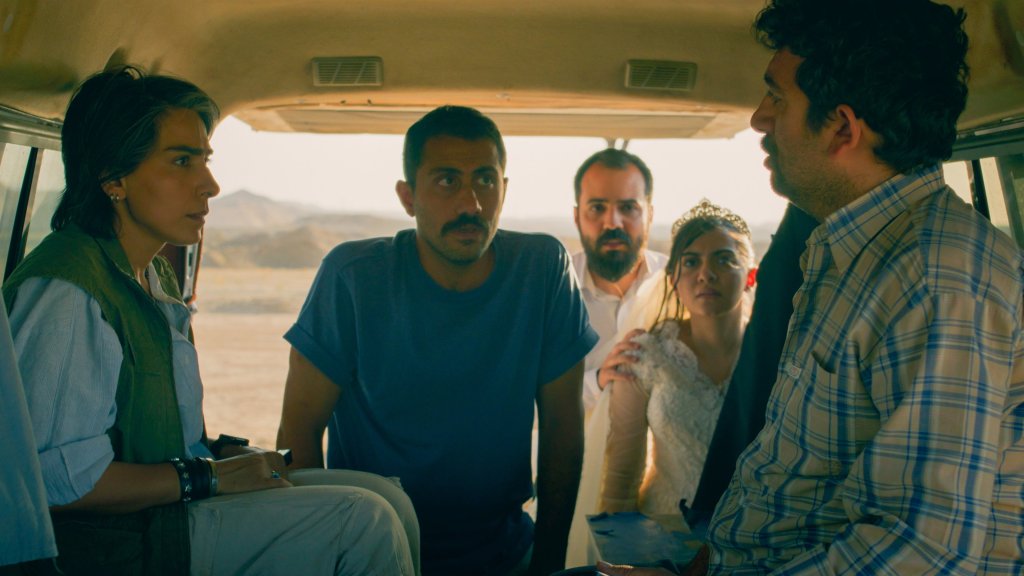
The most important conversation to be had about Iranian cinema, and culture, is one about freedom of the country, and, in this specific element, about the role of the Iranian director and storyteller in the moment of freedom and peace.
That is a very complex and heavy discussion to engage in in this venue. As such, and as inseparable as it is, I’ll try to write about the merits of this film (or any other Iranian expression of art) on their own, because they are many to celebrate, even if I am profoundly sad when thinking about the context.
Jafar Panahi wrote here a story that immediately goes to the pillars of the Hall of Cinema. Specifically, the pillar of the power of fiction, more than non-fiction, to make us engage with torment and darkness on a deeper and more cathartic way. This is a screenplay with much more funny moments than I would ever venture to guess from its context. That level of pathos from fiction is only possible if the director knows first-hand the realest of humanity in his characters.
Seriously, this screenplay is humanist writing of the highest quality and depth. The plot and the characters are at a pinpoint perfect level of formalism to invite the audience into this very tormented world, without ever crossing into the too-much-comfort of archetypes.
Panahi trusts the emotional intelligence and empathy of his audience by allowing the thin veil, that separates the metaphor from the cruel reality of the scenarios, to be curiosity enough to trigger that cathartic connection. Either from the laughs or the tension.
He trusts so much the humanism in his characters (and has control of tone, of course) that the film becomes even better by how him and editor Amir Etminan cut to many scenes in medias res. The audience have all the pieces needed to solve the verisimilitude of the plot. And then, the most important artistic and cultural expression comes aboard everyone’s hearts, because of what is staged and how the poignantly understated cinematography (Amin Jafari) encapsulates it all.
It Was Just an Accident, in addition to being a thoughtful plot exercise on the operational relationship of justice systems to power, is ultimately one of the best renditions I’ve ever seen on screen about something that has been pervasive across all human cultures throughout history: the consequence to our civilizations of shifts in the ratio between the amount of people who have a guilty conscience, but don’t get used to it, versus the ones who get used to it.
These shifts occur thanks to a complex combination of anthropological and sociological factors, but, among them, there are pernicious political and economic forces that take advantage of these waves to exert conscious (and subconscious) control over the rights and freedoms of fellow human beings.
Panahi is not interested in pitting one group against the other. He’s curious yes about the behavioural root. What makes an individual transition from one cohort to the other. Via filmmaking, he explores the small actions and behaviours that they have in common, and the ones that they no longer have.
Cinematically, and narratively, he indelibly succeeds. I’ll never forget the last 20 minutes of this film. Never.
- It Was Just an Accident
- Sinners
- All We Imagine as Light
- One Battle After Another
- The Secret Agent
- On Becoming a Guinea Fowl
- Soundtrack to a Coup d’Etat
- The Shrouds
- Holy Cow
- Train Dreams
- Sentimental Value
- No Other Choice
- Sorry, Baby
- 28 Years Later
- Eephus
- Universal Language
- Frankenstein
- Sirāt
- Die My Love
- Happyend
- The Mastermind
- Sister Midnight
- Cloud
- Weapons
- KPop Demon Hunters
- Bugonia
- Superboys of Malegaon
- Caught Stealing
- The Order
- Predator: Badlands
- If I Had Legs I’d Kick You
- Misericordia
- The Blue Trail
- Warfare
- Ocean with David Attenborough
- (Bonus 1) Nosferatu
- (Bonus 2) Bāhubali: The Epic
 Opinion Seed