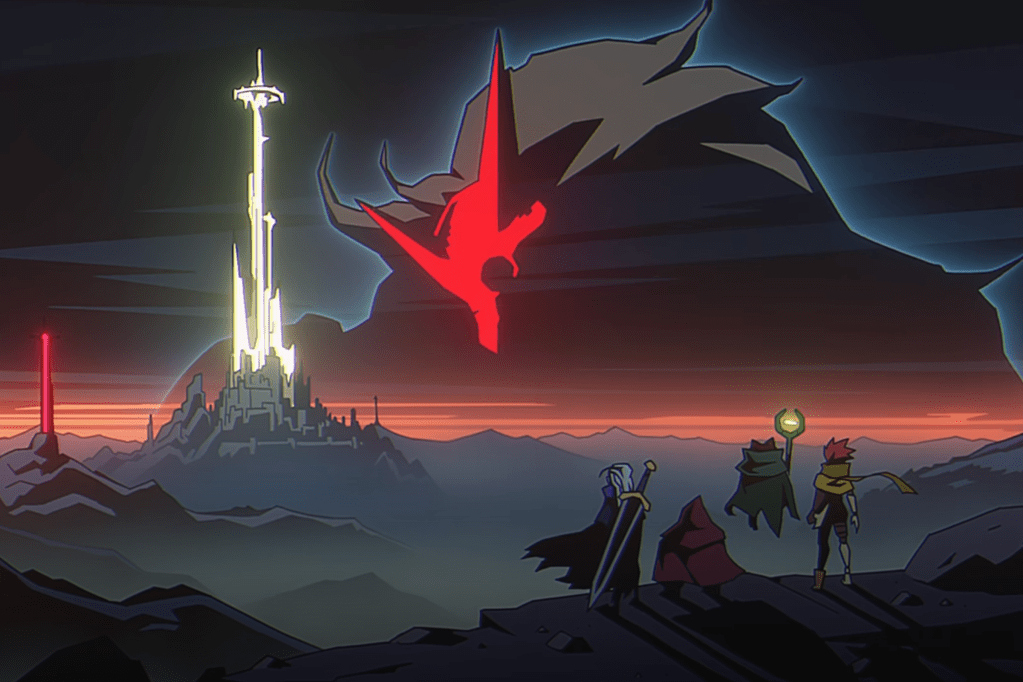
15. Blade Chimera
A standard metroidvania in map design and progression, with some surprises along the way in terms of combat mechanics, power unlocks, and story.
But two things immediately standout: the background art and parallaxing are astonishing; while the enemy designs are worse than pastiche (the bosses no, the bosses are cool).
Then, reiterating, it surprised me that the combat plays a bit like the new DOOM games, with resource management being entirely player-dependent, since the weapons, health bar, mana, all feed each other by how and when you use them.
The typical metroidvania unlocks are more than just empowering skills for player movement. They have dual-roles of serving as tools to solve lite environmental puzzles.
And the story, while not very deep, as a twisty plot with some imagination.
14. Like a Dragon: Pirate Yakuza in Hawaii
Look, art doesn’t need to be coherent to be good art. It only needs to be saying something about incoherence.
One way or the other, I never perceived Pirate Yakuza to be an incoherent work. As I interpreted it as a very life-affirming use of the video game medium to stage a comment on the futility of trying to lead a life presenting (precisely) a coherent persona.
What is missing from Pirate Yakuza is neither more coherence nor more incoherence. It’s a game that does everything right, but in almost everything there’s some small thing that’s missing.
The combat, for example, despite introducing more variety with the pirate abilities and summons, still lacks the depth wanted for the way this studio scopes its histrionics.
The sailing is also a welcomed addition, since there are so few pirate games in the history of video games, but I never felt like I was buccaneering in the high seas. The ocean felt like a corridor, and those moments played more like a mini-game instead of THE game.
Also, the zones of the game world where the pirate story takes place are creatively idiosyncratic, but feel small for such power on display.
(There’s an interpretation that that everything related to pirating looks and feels constricted and disjointed from the rest of the game because Majima is dreaming. I think that’s giving too much credit to the developers, and, honestly, I don’t know how I would feel about the genuinely poignant message of this game if “it was all a dream”. The more probable explanation is that the devs wanted to recreate the feeling of entering into a SEGA arcade parlour (Madlantis) and of losing yourself in two or three of its arcade games (sailing the ‘corridor’ sea, the boat coliseum, or the Musou-like pirate battles).
Honolulu, on the other hand, is perfect. Chill vibes, chill stores, and peculiar mini-games that are seamlessly integrated into the town’s day-to-day activities.
Oh, and this game has one of the best musical sequences I’ve ever seen coming from this industry.
13. Neon Inferno
You can immediately purchase this game if you think you would like this combination: Blade Runner, Matrix, Run ‘n Gun, and Time Crisis.
Then, Neon Inferno will still positively surprise you with its two extra main mechanics (besides running and gunning). The first extra is a parry, which by name is no revelation in the current games’ landscape, but the trick here is that parry-able shots can be redirected to any enemy on the screen. And this leads me to the second extra mechanic: any enemy on the screen means background as well. Yes, you can shoot at enemies in the foreground and in the background, and have to contend with their concurrency.
That’s why I name-dropped Time Crisis in the first sentence. Neon Inferno has no on-rails sections, but the background shooting operates like Time Crisis. With the added improvement of modern-day game design like a cover system (for both foreground and background gunning), or, like I said, a parry system that, Yes, allows to parry a foreground salvo into the background, and vice-versa.
The combination of these two mechanics allowed the devs to conjure up some pretty creative sequences in the side-scroller. With the highlight being how the bosses were designed to take advantage (for them, and the player) of the dynamism resulting from this multi-dimensionality.
The only thing underbaked in this game is the progression system. It’s so poor it could’ve hurt the replay-value of the overall experience. But it doesn’t. One run of the story takes around just 3 hours, and the combination of the audiovisual quality with the multi-axis variety that the core mechanics give the scenarios encourage multiple playthroughs.
And, if you choose the sexy girl first, you owe it to yourself to do a second run with who apparently is the long-lost brother of Jin Kazama.
12. Metroid Prime 4: Beyond
Prime 4 is this year’s entry for the semi-coveted title of “The highs are high, but the lows are low”.
Honestly, the translation of the 2D metroidvania design language to a 3D space by the Prime franchise continues to be the gold standard.
Add to that something that is rarer in 2D – the environmental puzzles – and the overall design becomes even more integrated and immersive.
ADD to that the simultaneously beautiful and sober art direction of Retro Studios, and we get here not only one of Nintendo’s best-looking games ever made, but also one of the most atmospheric. This tone won’t age a day.
On the other hand, the combat is very very pedestrian. The bosses are part of the highs. Their puzzle-like nature makes them some of the most interesting combat encounters in the entire industry. But bosses are, by design, uncommon moments. All other enemy types are boring in their visual identity and in their attacks, with the most egregious ones being the robots which were outright bad.
There’s also some criticism to be levied at the small number of weapon types that Samus gets to unlock. This ‘focus’ shines through in the bosses combat puzzles, since it probably allowed the devs to design interesting trade-offs around that weapon wheel. However, in the common encounters against normal enemies, that lack of variety on Samus’ side also contributes to the staleness of everything else combat-related in Metroid Prime 4.
To sum up, this is the closest a Metroid game has ever been to a Zelda game. At the same time, it took the best and worst of Zelda. The moment-to-moment combat is unjustifiably basic for a 2025 game. But, I’ll never forget the Zelda-like main dungeons, particularly when a big puzzle is solved or a narrative beat is triggered, and suddenly the entire dungeon changes in activity, music, and overall tone and aesthetic.
11. Shinobi: Art of Vengeance
The movement, progression of mechanics unlocked, and how all of that is staged, via enemy placement, their aggression, and their own defensive mechanisms, makes the combat of this game very satisfying and expressive to play and tinker around in.
That component of the game is so good that it almost made this reawakening of Shinobi be in my Top 10 of the year. The thing is: that’s the only great praise I can give to this work.
The visuals are, at a first glance, very show-y. But, the more you play the game the more you start to feel that they lack the punch and grit needed for the vibes the story is trying to set. In the same vein, it’s a shame that the devs chose such “zoomed-out” camera for the 2D perspective. The animations of the mechanics are so detailed and their comboing so visually creative that the game would greatly benefit from a more zoomed-in camera.
Also, the level aesthetics and layouts gradually lose their lustre, even if the colours continue to pop. And the soundtrack is not that memorable.
Hm… I know I said that I only had 1 great praise to give Art of Vengeance. That’s not entirely true. The fact that Joe Musashi, the protagonist, only says “Hn!” in all dialogue interactions is pretty great. You do you Joe, be your best monosyllabic self xD.
10. Dynasty Warriors: Origins
I firmly believe that video games’ true potential will be unlocked the more the medium focuses itself less on pushing technology and more on telling stories for adults.
That being said, there are moments in video game history when technology breakthroughs did allow creators to finally realize their vision. I will always remember fondly how the CD-ROM was a catalyst for a frenzy of game designers in the 90’s all wanting to create their own open world RPGs.
On a micro scale, I think that’s what just happened with Dynasty Warriors Origins.
Crowds is a big thing for the Musou genre, and DW, being the OG, has been deserving of crowd-tech that does justice to the staging they’ve been improving on for years. Now, in DW Origins, when you take the risk of clearing all the sub-fortresses around a main one in a level, and all your troops, now established in those sub-camps, come to form one big, unified army to charge the big event… Damn… I think it was seeing so many cavalry units running down a mountain without breaking frame rate that made me blurt that artistically meaningless notion: “Next-Gen, baby”.
And DW Origins is way more than a tech showcase. It’s the best a Musou game has played ever.
By focusing on a single character, they got to hone down on base mechanics and animations, as well as specials that play as more than just spectacle (their execution is more distinctive allowing you to employ them for different trades – anti-air, zoning, guard-crush, counter, etc.).
This makes the hack-and-slash of mobs much more engaging, because you are no longer button mashing. And, above all, confrontations with sub or main bosses now feel like proper duels (as they have the same core mechanics as you do). With these new parry and battle arts systems, the 1-to-1 combat is legitimately deeper, more precise, and more reactive from one side to the other.
There’s a conversation to be had about a single protagonist in a Dynasty Warriors game. And I admit I’ve come to this genre of games in the past to get to play with a myriad of historical figures I know of. You still get to play with them, but in shorter stints, as they now work as a side-character you get to summon when you build a meter up in battle. They don’t feel tacked on, though, as they have the same depth of core mechanics as the protagonist, and (for most of the game) feel way more powerful than him (it’s interesting noticing the moment when that character reaches their level – and even surpasses – during the game progression).
It’s hard for me to be totally objective about DW being better with a focus on 1 character, vs the insanely large roster we got to choose from in the later entries. But, there’s also a conversation to be had about this WAY smaller number of side-characters, evolving the relationship with one by choosing him/her over others before battle, the protagonist getting to learn his/her powers because of those choices, and associating those very important historical characters with powerful (controllable) summons in critical moments of big battles. As well as a more fleshed-out structuring for narrative character development outside of battles, where a bond/companion system is more closely integrated with branching choices in the story.
With all these improvements and changes, I highly recommend you give this game a chance. I know the Musou genre comes with a series of prejudices, but, believe me, this is no longer a disposable experience to just turn your brain off. The combat is very precise and full of intentionality, your character can also order strategic battlefield commands, and your relationship with these historical figures is more fleshed-out, in and out of combat.
9. Marvel Cosmic Invasion
There’s something about tag-teaming in fighting games that rubs me the wrong way. Maybe that’s because one of the reasons I love them so much comes from the clarity of footsies and neutral poking in 1 character vs another.
Tag-teams make everything immediately more chaotic. Because of that, I was a bit hesitant about Marvel Cosmic Invasion. Even if I don’t have the same love/inflexibility about beat ’em ups as I do about fighters, I generally am pickier when games are by-design chaotic. And that’s why Cosmic Invasion cracked the Top 10.
The chaos here is fun without losing any precision (particularly for a beat ’em up). I was genuinely surprised by how like a fighter this game plays. The normals have clear animations and land with umpf, and the specials have to be considered to maximize spacing and number of hits. And, of course, the roster of characters have distinctive groups with respective strengths and weaknesses.
Tagging was also a nice surprise. I know I said I don’t like it in fighting games. And, yes, the tagging works here like in fighters – you extend combos and juggles by summoning the second character, and you even do more powerful and ‘screen-filling’ specials by combining the two characters’ meters. But, for me, it’s at home here, in a genre that not only has more space for but also thrives in expressing itself via the chaos of mobs and of chain reactions.
Lastly, to not miss the obvious, even if you are like me and are fatigued by the Marvel industrial complex, it’s pretty undeniable that the sprite work and the background artistry are top-notch in Cosmic Invasion.
8. DOOM: The Dark Ages
DOOM continues to be the best First-Person franchise of the last 10 years.
id Software could’ve easily had a very different run of games here since 2016. We could have 5 games, instead of 3, where they were all much more similar to 2016’s entry. It was so fundamentally good that they could’ve simply kept on milking that formula with 1 new mechanic a sequel. On the other end of the spectrum, The Dark Ages could’ve been the second game of the studio in 10 years, and be such a departure from the fundamentals of 2016’s that, if bombed, we could be looking at one the industry’s studios with more institutional knowledge on the brink of closing.
This is the most sustainable balance.
DOOM Eternal was an underrated step up in mechanics and options available to the player for just a 4-year dev cycle. It felt different to play on the sticks, but retained 2016’s core design elements in a way that allowed players to draw on that knowledge to maximize the new tools available in that sequel.
On the other end, The Dark Ages dials the velocity of Eternal way down, to a Slayer that is even firmer to the ground than 2016’s rendition. And the devs achieve this without removing any tools from the belt. Rather the opposite. These are the best FPS of the last 10 years because they keep adding new mechanics (with depth – not just for the sake of it) that make each entry feel considerably different to play with, while very intentionally retaining a certain baseline and common threads that allow the studio to non-randomly develop for that depth, mechanically and even narratively (!) (yup, the lore codex keeps getting better and funnier).
These are games that entirely trust the player.
You never used swing bars or did a combat puzzle in a DOOM game (or in any FPS for that matter)? We don’t care. Here’s DOOM Eternal, you’ll learn those new mechanics, and you’ll love them because they are so well implemented in-game and elevate the experience.
You never used a shield or a flail in a DOOM game? Here’s The Dark Ages.
And, again, everything is so well implemented. The Slayer really feels like a properly weighted powerful tank. The devs pulled a magic trick. He feels authoritatively heavy, but never slow. Every land on the ground is like a meteor (forceful space rock, but fast). Every parry is fast to execute but leaves even bigger enemies looking for balance. And melee attacks are completely worthy of a DOOM game where you have non-melee weapons like a rail spike rifle, a “Super Shotgun”, or even a skull-shard launcher that sprays bone fragments in an arc (and it’s so difficult to do melee right in First-Person).
The combat puzzle ethos of Eternal is also back, but this time expresses itself in a less “overly-designed” way (the only negative I had to say about that game, if you read my review from 2020). And I think that that what helped alleviate that sense of ‘a bit too much orchestration’ was the decision to expand the arenas, almost like medieval battlefields. In Eternal it was incredible, but the size of the arenas made the puppeteer strings somewhat visible, as, by transitioning more quickly between the different mechanics tied to health/armour/ammo, there was a thinner line between entering more rapidly (than The Dark Ages) a flow-state or seeing the matrix.
With these ampler battlefields you get more time to think of (and appreciate) the next step in the combat puzzle. Not much more time, because you are incentivized to take advantage of weapons overcharging, but you get to peer the horizon for different groups of enemies that will give you something different in the resource management loop, and you get to the extra dimension of drawing a mental map, plan ahead, and make conscious choices.
This makes everything more meaningful and sensorially more impactful: the mechanic/weapon chosen for that step in the puzzle gets more time shine; the enemies that give the resources have more space to showcase their own attacks and animations; and even the level design will stay in your mind longer, since geometry and landmarks (obstacles xD) have to be considered for the choice of route in this puzzle of thoughtful mayhem.
Finally, just a praise about the story.
We spent the last two games finding a series of codexes that, alongside the main plot of each one, built up the lore and myth of the Slayer as a demon-hunting legend that even the most ancient monsters of Hell fear dearly. And, to be honest, I didn’t need to see the times when those facts became fable. I believed them.
But, the story team here did a great job. The codex development didn’t stop, allowing the player to learn the conditions that necessitated the creation of such a puzzle-mayhem-machine. And the plot even has some surprises outside of a reinterpretation of “Hell in the Middle Ages” that make even the Slayer myth seem small in comparison.
7. Donkey Kong Bananza
The most incredible and cutting-edge feature of Donkey Kong Bananza is, ironically, the biggest responsible for this new game from the Mario Odyssey studio not being as good as Mario Odyssey.
Again, it not only is inspiring that the Odyssey team decided to not do a straight-up sequel to one of the best games ever made, nor a Donkey Kong skin over the Odyssey formula, but that they literally decided to blow things up. And design open levels upon open levels that are completely destructible by the player.
I can’t begin to comprehend how a mechanic like this works without breaking either the engineering of the build or the sense of progression of the player. But it didn’t. It never did. The game runs very smoothly for the amount of physics, simulations, and particles happening on screen. And I never felt lost or confused to where I should go next.
However, I think all this technology and player freedom ultimately hurt the inventiveness I know this team is capable of.
I don’t know if the devs painted themselves into a corner with so much agency given to the player, were creatively more than satisfied by giving this immediate wow-factor of the destructibility, or a melding of both… but the fact is that, no matter how imaginative the surprises or the puzzles are in Bananza (and they are!), they are no where near the explosion of dreams that is every nook and cranny of Odyssey.
Punching and destroying the terrain to uncover mysteries has inherently a shorter shelf-life than puzzles thought specifically for a particular mechanic from an ‘infinite’ pool of enemy designs you can transform into by throwing Mario’s hat.
Even if DK gets additional abilities by mid-game, like building instead of destroying, or powers coming from different animals like a Zebra or an Ostrich, it was destined to not be able to compete with Odyssey’s million bespoke ideas, because these same devs now had to accommodate for more player freedom.
Still, amazing game. The tech is mind-blowing. And that would even be inconsequential if the game didn’t feel great to control, and the levels gratifying to interact with. And it does. It all does. DK does everything you want on the sticks (even if I preferred for him to feel a bit heavier, I acknowledge that most gamers tend to frown upon heavy-movement main characters). And the open levels are very memorable, full of colours (that make sense), playfully drawn geometry to punch around, and distinctive landmarks that cohere in surprising ways with the theme of that level.
Finally, I must talk about the music. It’s a Donkey Kong staple. And it’s great here as well. Not Tropical Freeze GREAT GREAT. But, since music is an integral part of the story in Bananza, because Pauline is a singer, I was always with a smile in my face every time her songs were utilized in the game. I will never forget the different tracks that play when you transform into the different animals thanks to Pauline’s powers.
DK Bananza is not Mario Odyssey. And that’s good and commendable. Yes, it’s not as good as well. But, I would recommend this game for many reasons beyond the wow-factor of everything being destructible. Like previous projects of this studio, it has butter-smooth gameplay from start to finish, non-stop surprises in level design, and, above all, you’ll be smiling the whole time from so much whimsical and creativity in world building.
6. Ninja Gaiden: Ragebound
Playing with Kenji instead of Hayabusa, to be honest, is irrelevant when a game controls with so much intentionality and fluidity.
As well as having some of the most beautiful (and advanced) pixel art ever drawn on screen. And a soundtrack by Sergio de Prado that makes the king of this genre (Tee Lopes) not have the best of the year.
But what truly makes this game special are two extra components.
First, the Hypercharge mechanic.
Basically, while playing you’ll come across some enemies that have a flaming glow to them (different colour of the glow, different version of the mechanic). When you kill that specific enemy, you yourself become imbued with the glow (Hypercharged). And then, your next slash is a one-hit-kill. However, in the frenzy of pixel-perfect platforming while enemies come at you from all angles of the screen, you slash. Then, in the next jump there’s an even stronger enemy that deflects your attacks. Aaah… the Hypercharge was meant for him.
This reads quite simplistic, but I bet this combination of level design and enemy sequencing was very hard to pull off, particularly in such a fast-paced game, and in a way that presents itself very ‘naturalistically’ and never on-rails-y. Which is precisely why it feels so good to Hypercharge: the game is already fast; you have to use the glow because it recedes, but you should save it for that strong enemy you don’t know when and where it will appear; so, you are simultaneously encouraged to go fast and to be strategic; all in a sequence of jumps, platforms, slashes and enemies that are very dynamic and rarely mechanistic.
The other component that elevates this game to top-tier status in its genre is the second playable character – Kumori. She plays differently from Kenji, as her attacks are better suited for the long-range (kunai, instead of katana). Nothing new here, but the smart choice from the devs was to turn Kenji and Kumori into a single ‘entity’, which makes the player having to choose between their different strengths during the unfolding of each level. No bespoke missions for one or the other. Nope. You have to be on your toes, because suddenly the design requires you to jump back-and-forth between them.
This makes the levels even more dynamic than I described above, and has the additional effect of heightening your relationship with both characters.
Finally, just a quick word about the bosses. They are as tough as they are amazingly designed. However, despite the difficulty spike, they always felt fair and presented as learning opportunities for the challenges ahead in the game, rather than frustrating ends of level, because you get to try again immediately after dying without any runbacks.
Modernization of retro should look, sound, and play like this.
5. Death Stranding 2: On the Beach
My biggest surprise of the year.
Not because I didn’t think the sequel to Death Stranding couldn’t be a positive experience. I didn’t love the first game, but I highly respected it for disrupting, in a mechanically rich way, the expectations players have about locomotion and friction when going from point A to point B in an open world. I saw the skeleton of a great game there, if Kojima was not so bogged down in trying to justify his new ideas. He simultaneously was free of Metal Gear and was not.
What surprised me the most about DS2 was how I found myself playing it.
At some point during my playthrough, I noticed that I wasn’t playing the game like I did in DS1. Maybe I was playing it like Metal Gear Solid V? Nope, quite the contrary.
I played most of DS2 like Journey or Abzû.
Going from point A to point B, despite expressing itself with the same verbs of the first game, was no longer governed by ‘order of operations’ gamified, but a dominant feeling of flow state. Of even catharsis in connecting on a deeper level with the landscape and terrain of a place (because of the mechanics), but, much more than the first game, with also a comforting hand nudging you to open your heart and mind to also take in the beauty of the world and the music around you.
To be there fully, not only because the mechanics demand concentration, but mainly because DS2 had a different vision for its gameplay loop of doing deliveries.
At first, I thought I was projecting some kind of defence mechanism, where, because in DS1 I had become bored with that loop, I was trying to ‘force’ myself to play this new one in a different way.
But then, the story of DS2 starts to reveal itself, and I realized that that comforting hand was not my own, but Kojima’s.
There’s much to talk about the narrative of DS2 and its intentions. There’s even a whole separate conversation about its own meta-ness. What I can say, without spoilers, is that Kojima seems finally free (in a healthy way) from the phantom of Metal Gear.
The meta-ness, always very present in Hideo Kojima games (which, legitimately, can hinder people’s connection to his storytelling and writing), is the strongest artistic achievement of Death Stranding 2. It’s like all that ‘training’ (try-hardness for some audiences) has finally allowed Kojima to reach a nirvana-state where he can summon that technique to not only stage some funny gags or nostradamus-like predictions about the future, but, more importantly (and artistically), to exorcise some demons of his own.
In essence, Kojima is getting old (in a good way). It’s not apparent by looking at him xD, like it’s not apparent by looking at the trailers (quite the contrary) that DS2 is him finally letting go of Metal Gear.
Death Stranding 2 is not Kojima’s best game. But it’s the most I’ve seen him comfortable with his own art. The wisest. And that wisdom allowed him to make one of the most beautiful odes to life in video game form I’ve ever experienced.
4. Clair Obscur: Expedition 33
The pitch for this game was catnip for me.
A ‘spiritual successor’ to Lost Odyssey, created by people whose favourite game of all time is Final Fantasy VIII, my favourite of all time. With a turn-based UI inspired by Persona 5, the trailblazer in that design space. And with a combat system that learned from the school of Sekiro, the game I consider the current king of game-feel.
So, why isn’t E33 my 2025 GOTY?
I have some nitpicks that altogether deducted some points from my, in any case, total enchantment with this world, premise, and gameplay loop.
Let’s get the negatives out of the way first. I know this was probably an Unreal Engine thing, but this game should’ve never been an over-the-shoulder adventure when outside of combat. These turn-based RPGs that are the story and journey of a party of characters should always position the camera in a way that the player feels there’s a group of people adventuring together. The devs allowed for swapping the character at the centre of the frame. It’s not the same feeling.
The art direction. Love the designs and, even if pastiche of Belle Époque, love how imaginative and creative this world looks. Still, there was no need for the visual language to be so constantly dark. I get it, this is a dark game with dark themes. I don’t need the aesthetic to also beat me over the head with that vibe. As a matter of fact, if the game was a bit more colourful and luminous, the dark areas and moments would hit harder. Probably another Unreal Engine thing.
Aside from those blemishes, I adore everything else about this game.
The turn-based encounters even surpassed my expectations. After all, the secret sauce was not in the good implementation of Sekiro parrying, but in the fact that each character feels really unique to play with (which I bet was very difficult to pull off when developing for menu-driven combat). Even with an underlying system of common perks (the Pictos), the characters take advantage of them on their own terms, complementing skill trees that never redounded in archetypes, and empowering mechanics that legitimately can convert even turn-based haters into fans.
How is this the first musical credit by composer Lorien Testard?! We are talking about 7h+ of diverse music with an immaculate control of tone that immediately gained a place in the hall of great game scores.
And the story. What thematically rich writing by (also first timers) Jennifer Svedberg-Yen and Guillaume Broche. One could fall prey to the immediacy of saying that the designs and the music do a lot of heavy lifting in the world building. But, above all, this is a very humanist video game. And the humans in here are written with a complexity and maturity that is rare to witness in any media.
Their conundrums are not plays with words by writer’s ego, but organic with no elegant solutions. And the overall message that the game leaves us with is one of the best representations I’ve ever seen about the moral legitimacy of imaginary worlds and characters feeling real to us and accompanying us all our lives, versus the trade-off of disconnecting from other real people to escape into the art and hobbies we love.
A flawed masterpiece.
3. Ghost of Yōtei
There was a time when iterative sequels were some of the most appreciated games in the industry. I bet you’ll notice those numbers come up if you try to name the best games ever made. And they are the best precisely because those teams got to iterate on their original yet undercooked ideas.
What changed in gamers expectations in regard to sequels? Probably not much. But game length (for the same price) did. While those classic sequels took 2-3 years to develop, because studios were working on 8-to-12-hour iterations, now, because consumers were trained to expect more hours than the euros they pay, game development takes more than the double the time (which, curiously, is still delivering more hours of game per year of labour).
This vicious cycle is too complex to explain in just one paragraph, or by just pointing fingers, but the fact is that our relationship with iterative sequels did change.
Yōtei is a better game than Tsushima in almost every way, but it’s not a revolutionizing sequel.
For that, it probably would’ve taken Sucker Punch 10 years, and not 5, of development time. And, to be honest, I prefer it this way. It’s more sustainable for everyone involved.
They were actually pretty smart in the ways they changed this game from Tsushima
It’s still an open world with points-of-interest on a map. But, instead of unlocking them as checklist chunks you cross off one by one, the discoverability of those p-o-i’s is connected to a clue system. By roaming the world, you come across NPCs or villages with whom you can decide to interact with. If you decide to talk to people, the game presents you a dialogue tree for which you have to choose which topic to get a clue on: main story; side activities; curios; etc.
Being a wandering samurai game, the action part in action-adventure is still mainly driven by combat. And Yōtei’s combat has more variety because they took the stance system of Tsushima and transformed it into different weapons more efficient against different types of enemies. In essence, it’s the same logic, but it gives players a bigger breadth of animations and a more distinctive set of moves to express. Personally, I preferred the ‘realism’ of the just-1-sword of Jin in Tsushima, but I can’t deny that Atsu is way ‘cooler’ to play with.
Also, you still have a cast of supporting characters along the main story and to do side missions with. And, again, the devs were smart with their time because, instead of raising the number of bespoke NPCs, they decided to focus and flesh-out a smaller group of way more interesting and memorable personalities. For instance, those weapons in the combat system? Now you have a sensei for each one, and you are always reminded of that character (and his lessons) every time you draw his unique weapon. Or, instead of trying to replicate Mass Effect in the main story, you have two really memorable companions that are much better woven into the threads of the plot the devs constructed.
Speaking of character and story… While a revenge tale is, on paper, not as ingenious as an external invasion forcing a samurai to rethink his doctrine and, thus, become the ‘first shinobi’, the execution and depth of Atsu’s narrative journey is much more multidimensional and sensitive than Jin’s.
Yes, I always had a moment’s hesitation before using my ‘ninja powers’ with Jin. And that’s a storytelling quality only video games can elicit. But… I used them. With Atsu, what happened in-game was more profound.
These Ghost games, outside of combat, have activities that engage you in exploring mountainous regions, with some lite platforming, to reach a shrine or other curio. In one of these excursions, after a series of meaningful events had happened in Atsu’s character development, I found myself mid-mountain just doing nothing. Just looking at the horizon. Just breathing in the minimalistic musical score they script for those treks. Just contemplating.
I don’t know if I was thinking like Atsu, or thinking about her, or an indiscernible mix of both. And I know that the visuals here are mesmerizing, and the soundtrack is genuinely the best I’ve heard this year. But, video games are almost always very action-oriented experiences. For me to decide to just stand there reflecting on the themes of her story, not in a cutscene, but mid an unrelated activity to plot, subconsciously (but actively) choosing to do nothing but breathe and think, is so rare in this medium.
Whether you like more or less the degree of iteration in Yōtei in comparison to Tsushima, Atsu is a badass that contains multitudes, and, from her acting by Erika Ishii to the writing of her internal journey, we have here one of the best studies on human emotion this industry has ever seen.
2. Metal Gear Solid Delta: Snake Eater
Disclaimer: Metal Gear Solid 3 is one of my favourite games of all time, and, as such, I have great nostalgia for it (to the point of remembering exactly where and when I was the first time I played it – I ‘marathoned’ it because of its page-turner quality and because I was going on vacation with my parents and couldn’t bring the PS2 with me xD).
Now, in defence of this ranking on the GOTY list, the fact that I love so much the original could make me very jaded and demanding when it came to this remaster.
It’s perfect.
It’s not a remake like Resident Evil 2 or Final Fantasy VII, because visually and mechanically MGS3 still doesn’t need it for today’s standards. However, I’m not of the opinion that remasters like this one are unnecessary. If a project like this (particularly in the context of a Konami who was almost out of games) is the spark needed for a new generation of gamers to play one of the best games ever made, it is very welcomed.
Hideo Kojima is no longer at the company, but the people responsible for this remaster were very respectful of his original authorship and vision. The cinematography of Delta is almost shot-for-shot recreated in Unreal Engine, and, even if the colour palette is slightly different (there’s a menu option to ‘force it’ to the original scheme), the framing, composition, and visual communication of each scene remain as poignant as intended. Good cinema is good forever.
Really. Cinematic storytelling in video games has come a long way since MGS3 was created. And still… The use of camera in this game remains state-of-the-art.
Another aspect of ‘old’ MGS that Delta brings to 2025, and that (honestly) many current AAA game development teams should re-adopt, is the level design. Kojima himself has been at fault in this department as of late. Since modern gamers are demanding open/contiguous worlds like the ones in MGS V or Death Stranding, the outpost solution is never as minutiously designed (because of its very nature of having to conform to the surrounding landscape) as the bespoke ‘rooms’ representing sections of a ‘world’ in something like Snake Eater.
The levels might be isolated from each other by loading screens, but that’s a negligeable tax on immersion in exchange for some of the most creatively in-world puzzle boxes I have ever experienced. Like I said, this game is perfect, and it’s perfect precisely because it finds the perfect balance between allowing the player to experiment with the tools and not designing the puzzle box too game-y, to the point of the experience becoming only a toy and no longer resembling a world with spies and Cold War.
MGS Delta, on a macro level, is also perfectly balanced. It introduces new control schemes and in-game camera allowances that make the feeling on the sticks palatable for modern audiences, without compromising the original design of puzzle-solving in each room. As such, it achieves the rare agreeability of being a must-play for newcomers to MGS or Snake Eater, and an amazing walk down memory lane for original fans like me. And, in the end, I think both groups will come out of this experience with a bigger appreciation for this older ethos of level and game design.
1. Absolum
Since I started gaming on the Mega Drive, I have had an almost-imposed relationship with beat ’em ups. And, even if I like them, it’s not like I’ve been clamouring for more projects in the subgenre. With the exception of the Yakuza series of games (if you consider them so), beat ’em ups have not evolved much since those early days.
At the same time, injecting rogue-like elements into the beat ’em up design structure was not the evolution I was asking for. I’ve been also a bit tired of the rogue-like formula, even if I understand why indie developers resort to that crutch (to inflate the longevity of their games, as they are pressured by a AAA-dominated market that conditioned gamers in the rationale that money well-spent is the one that trades for 60+ hours of ‘content’).
All that being said, it worked!
After Absolum, I will inevitably compare new beat ’em ups to it. It’s the new gold standard.
It’s so good that it’s even better than its main inspiration: Hades.
The rogue-like elements shake up the stagnated beat ’em up formula, while making so much sense in a gameplay loop that has always been about replaying stages (and even the game in its entirety). Simultaneously, the beat ’em up core of weighty animations, precise move-set, and intentionality when you trade attacks with each mob adversary turns the ‘Hades’ experience into something much more readable and better paced.
Even when completely god-like with almost game-breaking combinations of boons, Absolum still plays like a fighting game. You trade blows with as much awareness of what a mob enemy is doing as a boss, and you’re not i-framing everywhere with a blur of dashes that vanquish your enemies for you with a trail of thunder summons, tidal waves, and flaming steps.
You clash attacks with bosses like you do with mobs; you juggle them in the air like you’re playing 1v1 in Tekken; and you even command grab them like if you were Zangief vs Bison.
As a last comparison to Hades, and this genuinely surprised me since Supergiant Games have some of the best writing in the industry, Absolum uses the rogue-like structure better than Hades to tell a story and build a world.
Instead of bombarding you with new exposition in the hub area every time you die in a run, Absolum tells its story, promotes its characters’ interactions, and makes you privy to its (very interesting) lore of places (and times) in context.
Sure, it doesn’t have that Hades feeling of ‘reward for death’. But Absolum’s approach always made me much more interested to see what was around the corner along the different paths I ventured into in each run.
To envelop everything in an experience that cemented itself as my GOTY of 2025, Absolum has an amazing musical score. Composed by Gareth Coker, who, despite already being one of the best in the industry, did here one of his best works. Add to this the fact that many of the boss themes were composed by FromSoftware legends Yuka Kitamura and Motoi Sakuraba, as well as DOOM king Mick Gordon, and I have here a playlist that will accompany me for years to come.

- Absolum
- Metal Gear Solid Delta: Snake Eater
- Ghost of Yōtei
- Clair Obscur: Expedition 33
- Death Stranding 2: On the Beach
- Ninja Gaiden: Ragebound
- Donkey Kong Bananza
- DOOM: The Dark Ages
- Marvel Cosmic Invasion
- Dynasty Warriors: Origins
- Shinobi: Art of Vengeance
- Metroid Prime 4: Beyond
- Neon Inferno
- Like a Dragon: Pirate Yakuza in Hawaii
- Blade Chimera
 Opinion Seed