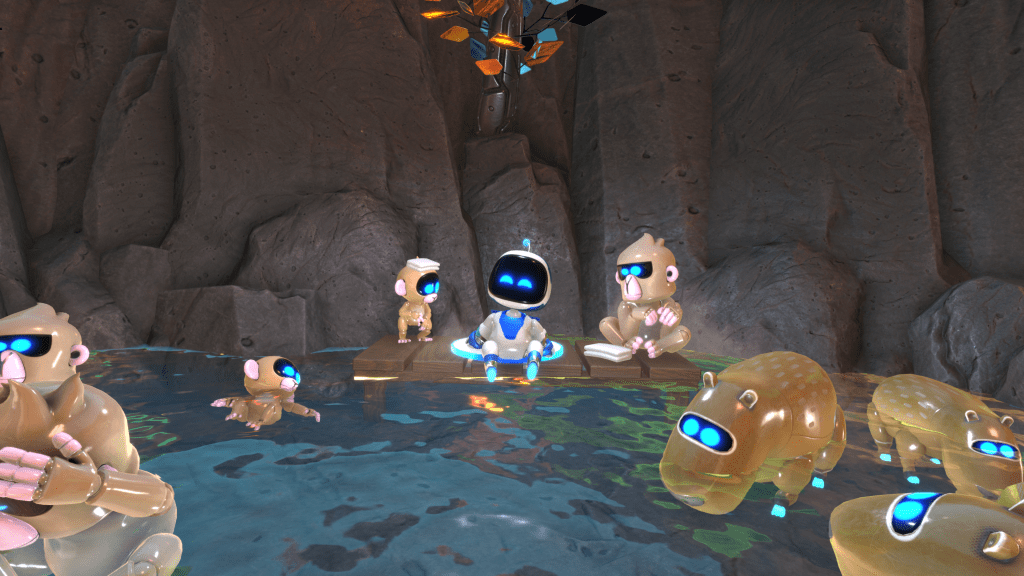
10. Pepper Grinder
Bit biased against this type of games.
Wouldn’t call it ‘on-rails’, because here the freedom of movement is not taken away. But I wouldn’t describe it solely as a ‘guided experience’ either.
In essence, due to the core mechanic decided for the game, Pepper Grinder ends up feeling on-rails-y because the main way of traversing the levels is by drilling portions of geometry and, when doing it, the character is in mandatory movement.
Yes, you can move about without drilling. But most of the levels are non-navigable by foot. You have to drill, and when you are drilling geometry you cannot stop until you drill out of that block. And what makes it on-rails-y is the fact that most levels are designed for you to not be able to drill out of a block without having to drill into the next portion of geometry.
That’s what makes the game good.
The levels were designed to cater to that forward momentum, and the mechanic is really satisfying. Like I said, I admit that I am biased against this way of structuring a game. I feel like I am losing a lot of agency in the relationship with an artistic product whose main draw is its interactivity.
Trying to be as objective as possible, Pepper Grinder is a really good game. It knows what it is good at, expresses itself very confidently around that, and doesn’t overstay its welcome. It’s basically 1 or 2 mechanics really well polished, levels creatively designed to make those mechanics shine, and it peaks at around 4 hours when the game ends. The difficulty also paces itself well, with some skill checks along the way to prepare you for the tough final boss.
I particularly enjoyed the pixel art, the groovy soundtrack that is perfectly in tune with the always-on-the-move rhythms of the gameplay, and particularly the detail that the drill mechanic is intentionally not 360-precise on the sticks.
It’s this unwieldiness that makes the game creep up on you. At first it might be a bit frustrating, but it’s one of those that make you suddenly see the hours go by. It has that pinpoint perfect degree of edginess that makes you feel that the misses are yours and not the controls’ fault, makes you want to get better, and makes landing a sequence of drills without pauses or fails even more satisfying.
If you find this mechanic cool in games, I recommend Pepper Grinder, even if I am biased against its design ethos.
9. BAKERU
It’s a good thing that the best levels of this game come by around its final third, because it would be tempting to call it bloated.
Not bloated in the sense of dozens of unnecessary hours. This is a 12-to-15 hours experience, that is on par with other traditional 3D platformers. However, the relationship between the main mechanics and the level design of the beginning of the game doesn’t justify so many levels.
I understand that one of the core ideas of BAKERU is to present a level for each of the main cities of Japan. Which is quite neat, since so many levels do indeed capture the different flavour of each city and/or region. Still, this game needed a more pragmatic producer who would cut some of those levels out of the final build. The highs are really high, but the lower-quality levels simply dilute the experience.
For instance, the main mechanic of using the Left and Right Bumpers in the controller to beat the taiko drum sticks to clean evil spirits is always very satisfying (amazing sound to accompany it). Add to that the Mega Man-like transformations you get from purifying three main bosses in the first act of the game, and the gameplay is overall always punchy throughout the full duration of BAKERU.
But, when you are doing it in uninteresting levels that don’t engage with the different mechanics at your disposal, and you only end up using the powers when a tougher enemy shows up… those moments are blemishes in an otherwise really joyful journey.
And what a journey it is. For people who like Japanese culture and curios, BAKERU is a very smart idea for a 3D collectathon. Instead of just collecting coins and in-game-world objects and power-ups, each level of BAKERU, that is a stylized version of a city in Japan, presents the player with 3 souvenirs typical of the city (that require venturing into side paths of the level) and 5 well-hidden ninjas that tell you trivia of that region. It’s really smart. You never feel like you are collecting stuff just for the sake of collecting, and makes you engage with the level in a more attentive way.
BAKERU is basically stylized travel guide ™ The Game. Which could easily have resulted in something very sterile and lazy. Quite the contrary. It’s the heart and personality of everything, from designs in the levels (with the exception of the minority of uninteresting ones I mentioned), to the trivia the developers decided to share of their home country, that makes BAKERU be one of the most unique and soulful 3D platformers of the last 20 years.
The studio that worked on BAKERU is called Goöd Feël? I could’ve not thought of a more suiting name.
8. Berserk Boy
Ironic that a game about going fast takes a bit to get going.
The first levels are a bit too much simplistic. Also ironically, this is a consequence to one of the best aspects of Berserk Boy: levels that are designed to make you feel really cool and snappy by using different Mega Man powers you gradually unlock.
You can ask “wouldn’t that make only the last levels good?”. Well, the last levels are really good, but after the first 3 or 4 they also start to be very interactive and diverse. You see, from early on levels already have areas only reachable with late powers.
Berserk Boy found a very engaging way of ‘forcing’ replayability. To face the final boss you have to replay certain levels because you need a certain number of a type of collectible. The thing is.. the only way to reach that number is by replaying levels to reach areas you were not privy to before, due to metroidvania-like roadblocks only unlockable by later powers.
So, what ends up happening is that you rapidly recognize that in your first pass through a level you can take advantage of the Sonic-like mobility and have fun going fast. Then, you will come back with new powers, explore more slowly, and unlock the final boss collectibles.
It’s like each level has two personalities. Which is quite impressive by these developers, because the majority of the levels are indeed really fun to play in the two different ways.
The first 3 or 4 levels are the exception because I bet the developers did not want the player to have to backtrack so much, so they designed them a bit more simplistic.
All in all, this is a very good game for people who like games like Mega Man, Sonic, Metroid, and even the more recent Gunvolt. The powers are very cool and different to use. And they NEED to be used. From the level design to the enemies or bosses, there are challenges that can only be overcome with a specific power. And, since they are snappy, it never feels like a mandate.
Oh, and the soundtrack is also very cool. Which should not be a surprise, coming from Tee Lopes.
7. Stellar Blade
Why is the main character of this game so sexualized?
Well, I know the literal answer: because the developers are mainly juvenile horny men.
But the “Why” could have been more justifiable, because there is nothing wrong with a character being sexy, as long as it is the character themselves reclaiming that appeal power.
Think of Bayonetta. Yes, the developers at PlatinumGames are also horny men, but it’s Cereza herself that, more than feeling good by presenting sexiness, uses her care for her appearance to exert power over the ones who want to objectify it.
Eve, the protagonist of Stellar Blade, not only never self-identifies with the wardrobe of sexy outfits at her disposable, nor does she self-express much reclaiming for anything in the world around her. C’mon guys, you can do better than that. She’s not much more than a doll, with the occasional overacting.
Other than this very big blemish, which I completely understand to be more than an enough turn-off for many intellectually mature gamers, Stellar Blade is a very good game.
It’s a bit too pastiche of big names like The Matrix, NieR Automata, and Sekiro, but those are big names for a reason. And, even if it also takes a bit to be worthy of those references, by the third act the story does go in some intellectually stimulating directions (of course not as philosophically refined as those influences).
The way the game weaves around expressions about religiosity throughout its worldbuilding, and then, in its culmination, doesn’t shy away from reflecting seriously on the constant clash between control/certainty and faith was a compelling conclusion to a work I thought was just going to be a product of predictable and superficial marvel at profundity.
Still, man… Is this game NieR Automata-coded XD
From the sexy android discussed above; the plot about being in an Earth that most humans have left; what should the robots do with it; a small robot companion that both dispenses words of wisdom and bullets; the upgrades to Eve are not cumulative but rather require decisions on what to allocate to the limited slots in the exoskeleton; to even the Music…
Think of Stellar Blade as a NieR Automata with a not as nuanced and academically sound storytelling, a way less fleshed-out main character, but with an even better combat system.
The inspiration from Sekiro in this department bore its fruits. The parry mechanic is very satisfying on the controller, since everything is properly weighty, from animation, recoil, visuals effects, to sound itself.
And, like Sekiro, it never gets old, because the developers gradually introduce new special attacks and enemy designs tailored to them. These special moves are indeed the salvation of the game, since the parry is not as good as Sekiro’s. The specials are really cool to pull-off and all feel very different to execute and distinct to look at. And, since everything in Stellar Blade is very deliberately animated and choreographed, the mix and match of these dances never collapse to a blur after doing them so many times.
Even the gunplay was a pleasant surprise for something so ancillary. They even designed some areas where the robot-gun gets to shine.
It could have used more set pieces, not because I think that’s a fair thing to ask of a studio, knowing the amount of money and effort it costs any dev team to deliver just one, but because the ones it has are all spectacular and very gratifying.
Still, the big bosses more than make up for it. They have cool designs, and are well orchestrated skill checks that demand attention, patience, and an understanding of all the special moves you have at your disposal up to that point.
The settings are also good. There is a section in the middle that is a bit bloated with the desert aesthetic, but most of the meandering through it is optional, and the conclusions of some of the side missions end up giving more subtlety to the overall expression of the game, since the texts you discover along the way are never said out loud during the main missions (I liked this, because it rewards player agency). And the areas we get to visit in the third act become more and more imaginative. It’s a bit of a pity that the proportion is not as well balanced.
To sum up, Stellar Blade has a big problem with its unreclaimed horniness. In parallel, it also is a game with very good moment-to-moment gameplay, controls, and gripping combat encounters, as well as very good narrative influences that (even if not as diligently) lead the player to confront thought-provoking themes. The music is also clearly NieR Automata-inspired, and, despite being leagues behind, its highs are also very good.
This is not a Souls-like. But be careful with the normal enemies. They are very well designed in their powers and animations, and, if you don’t respect their existence, you’ll end up losing hit points that can be useful for more bigger ones down the corridor.
6. TEKKEN 8
Since Tekken 7 released in Arcades back in 2015, TEKKEN has been pretty clearly back as the best fighting game in the market.
Their first foot back in the door was guaranteeing at the eyes of lapsed fans that TEKKEN was once again the leader in visuals, like it had been for almost a decade after Tekken 3.
Even so, what makes these last two entries of TEKKEN very special is that such leading edge in technology and polish doesn’t come down to just baller graphics. This time, more than ever in any fighting game I would argue, that quality sheen serves a gameplay purpose above just flexing polygons. You really feel the graphics heightening your sensorial experience of duelling.
The character models have more presence than ever, with the extra detail in their limbs and hit boxes lending to a more meaningful and tactile relationship between button pushing and consequence on the screen. Action and reaction have never felt so impactful in any fighting game.
These game developers really pulled a magic trick. Tekken characters have never felt so muscularly weighty, while also feeling the snappiest ever. This combination of sensations is another contribution to the game being so engaging to play: animations have had added to them more degrees of heftiness, while, counterintuitively, the journey between idea and execution has become shorter and more satisfyingly sequential to the player.
Add to that the fact that the types of improvements they have been giving to the in-battle cinematography are more focused on the gravity generated by relative positioning, and on the ponderousness of certain momentum-swing moves, rather than a pyrotechnic camerawork, TEKKEN 8 duels now put us in the realm of action-movie greatness, without ever deviating from its core of being a fighting game that is at its best when player execution is more tactical than theatrical.
The atmosphere of the stages is also very good. Lively, nearing a dystopian/utopian over-the-topness, but never losing the tactility needed to connect to the characters’ identity. Even if all those elements seem to speak a cacophony of aesthetic languages, the art team achieved the impossible: the most cogently cool fighting game Tower of Babel.
Ok, the soundtrack is shamelessly over-the-top. But, even there, there are silver linings. It’s not always overdone, it has dynamic crescendos that are coherent with the momentum-swings of the duel, and only forces its presence when the microcosmos of the encounter has reached a zenith where everybody is locked-in and the action-movie excessiveness is more stimulating than distracting.
Speaking of excess… The story mode is even more bonkers than Tekken 7’s. Even if it’s, for the most part, just cut-scene, fight, cut-scene, fight, the narrative team managed to make those fights matter. They not only transition seamlessly from the context where the cinematic was filmed, but also the context and the cinematic are themselves written and choreographed in ways that make them action-movie systemic. Ie, why there was going to be a duel in that moment matters.
(and there will be moments that completely toy around with those years of expectations, making you more pumped for what’s about to happen)
By the end, TEKKEN continues to be the best fighting game franchise for everybody: best graphics; memorable characters with the most varied playstyles; explosive arenas; pump it up music; and a gameplay that is very fun for complete newcomers and very rewarding for people with years of experience with fighting games.
5. Neva
Even if I knew what I was walking into – tone poem-like adventure, light on combat, with art and message inspired by Studio Ghibli –…
Movies like Princess Mononoke, Spirited Away or Nausicaä are the opposite of an uninspired way of studying the way moving pictures can be empathy vessels towards a better understanding of life (and death). After all, it’s not by chance that Ghibli have become synonymous to simply “masters of art”.
Still, Neva managed to surprise me in many ways.
First, the game is much more than a mood piece walking simulator. You immediately suspect that because the controllable character has a double jump and an air dash. More than that, she has a very good-feeling and pinpoint precise double jump and air dash. It meant a call to action was afoot.
And it was. Even if the game is light on combat, what it has is more than enough to maximize the available animations, introduce some mechanical surprises, and never grow minimalistically repetitive. The dev team achieved this by putting common enemies interacting differently with the environment, which makes us think on our feet and not just slash mindlessly. And also some evolution throughout the game to Neva (the “wolf”) herself, and how she becomes an active element in these puzzle-encounters.
Additionally, the platforming and environmental puzzles are also very satisfying. The platforming is more adventurous than it presents itself in the first hour, ending up taking full advantage of the stick precision given to the double jump and air dash. And the puzzles, even if not challenging at all, are from the INSIDE school of design-thinking, where their greatest contribution to the player-game relationship is in how they integrate perfectly with the world visual lexicon, deepening the interactive immersion to an atmosphere that otherwise could feel too surrealistic.
Yes, it’s another of the many ways this game managed to surprise me – its intense dive into Surrealism.
I know that part of what makes Ghibli artistically sound is how it knows the fundamentals of Naturalism, AND the fundamentals of Surrealism, and then establishes a bridge between them so they can dialogue, and from that conversation new life-affirming discoveries are made.
However, the way Neva starts to progress, with levels being the different Natural seasons of the year, I was assuming that the devs took most of the inspiration from the more naturalistic side of Ghibli.
It’s funny, because I was clearly not thinking about the origins of Ghibli’s own artistic references. Spanish Surrealism, particularly Catalan Surrealism.
Well, Nomada Studio, the people who created Neva, are from Barcelona, Catalunya.
This game, much more than simply pastiche, is like a return to home for a dialogue between schools of artistic expression.
The result? One of the best looking games ever created.
(with an also excellent soundtrack that manages to stay at the same high level of the visuals)
I very much recommend Neva. We might know what we are in for, but if what we suspect is inspired by quality reference points, why not jump in? You might get one or two surprises 😉
4. Prince of Persia: The Lost Crown
One of the most underrated duologies of the last 15 years in gaming are the Rayman Origins and Legends entries. Developed my Ubisoft Montpellier, they played so great, while bringing tons of new ideas to the 2D platformer space.
So, when I read that they were the developers behind this new Prince of Persia entry, I knew the franchise was in amazing hands.
Being their next big project after Rayman Legends, that institutional knowledge acquired throughout the years is very noticeable in every facet of The Lost Crown. From gameplay options and mechanics to fun geometry and contraptions in the level design, this big game has the correct idea of polish.
Ie, everything has perfect game-feel, but not at the expense of losing edginess in the interactivity. It’s a great feat. New ideas or different takes to the gameplay tools of a metroidvania (mixed with challenging platforming sections), and yet the player can combine them all up with a game-logic familiarity, whilst feeling tremendously cool by being able to pull off sequences of the mind thanks to how well exotic mechanics speak to exotic level scenarios.
You know you are in a presence of a great game when you have trouble deciding which of its two coolest ways of expression you had more fun with. A priori, I would’ve guessed the platforming sections using time-shift powers. But, I was completely surprised by how good the air-juggles and combos were for a 2D game; particularly when there are several enemies on screen and we can treat them like platforms, and use those same time powers I thought were reserved only for the platforming sections.
I should also note that I am not the biggest fan of the design ethos of the metroidvania subgenre. I don’t like being pushed to backtrack in a very regimented path. That being said, Lost Crown is a special metroidvania, because, yes, requires a lot of backtracking, but gives you an open map for you to decide the order of your steps’ retracing.
Even more important than that, I enjoyed how the gatekeeping was designed. In most metroidvanias, you have gates in a portion of the map that only open when you get a power from another part of the world. And, more often than not, the area beyond that gate is usually pretty small and less interesting than the majority of that area (that already captivated you with its uniqueness while exploring until the gate). The Ubisoft Montpellier team, once again, know what makes portions of levels fun. So, the gates, instead of blocking a smaller area with just goodies and more story, they block appreciably/sensitively around half of each biome.
More.. sometimes that other half has its own twist on the aesthetic, geometry, and types of challenges and contraptions. So, when you see a blocked gate, you don’t just think “ok, I will have to come back here to collect the treasure”. No, you suddenly realize that you are curious to know what remix to the biome the developers concocted this time. Really smart.
In summary, Prince of Persia The Lost Crown is a video game ass video game that keeps engaging you with new creative time-abilities, fun dynamic level sectioning, and, above all, pristine controls that allow players to surprise themselves by how the cool ideas are actually executable.
At the same time, not that surprising. These are the magician developers that gave us Rayman Origins and Legends.
Studios like these should be financially protected and artistically cherished by the industry.
3. Rise of the Rōnin
I try that these lists have a nice balance between what I liked and what I think other people might like.
For Rise of the Rōnin, I did not try that. It’s all ME.
Bakumatsu is one of the periods in History I have studied more about in my life. So, when it was announced that one of my currently favourite Japanese teams was developing a fully explorable open world game set in Bakumatsu Yokohama, Kyoto, and Edo… I mean… most anticipated release of 2024.
It did not disappoint.
The game is, activity-wise, not the most diverse. In essence, the majority of missions and side missions end up in combat. The silver lining? Team Ninja is probably the current developer with most diverse ideas on how to create simultaneously realistic and self-expressively fun combat.
And they outdid themselves once again. Back in 2017, they did something quite impressive by negating any possible mean-spirited bias against the fact that they had retrofitted their new original IP Nioh from a Final Fantasy-inspired JRPG to a more en vogue Souls-like. How? By making Nioh’s combat better than Dark Souls’ and Bloodborne’s in many ways.
Now, with Rise of the Rōnin, it is immediately apparent that this is their Assassin’s Creed-like, or, to be more precise, Ghost of Tsushima-like, since Ubisoft has yet to ship a Japan-set AC game, despite all the clamouring for one. And, to be fair, and despite Tsushima’s first-mover advantage, I think Rise of the Rōnin is way more the game people have been asking Ubisoft to make. (Because in Rōnin you get to actually visit big Japanese cities).
So, it could’ve happened again to Team Ninja – underestimate their work because they decided on a “-like” approach to their new IP. Well, being combat and traversal the main activities we do in Tsushima and AC-games, Rōnin’s combat and traversal are better than those two franchises’ in many ways.
Rōnin’s combat is inspired by Sekiro, and, even if it’s not as good as that #1 status, it’s the second-best parry system out there. It’s different enough from Sekiro’s to have its own signature and feel on the controller. Add to that the amazing options and martial-arts-inspired skill tree the studio coined with Nioh… and we are talking about one of the most satisfying and engaging samurai combat gameplays ever simulated in a game.
Speaking of simulation, it was not the combat that surprised me in Rise of the Rōnin (I would’ve been surprised by Team Ninja if the combat wasn’t top – like I was for Wo Long Fallen Dynasty). What really elevated the game to meet my high expectations was the Bakumatsu simulation.
The recreation of mid-19th century Yokohama, Kyoto, and Tokyo, with all the ‘visitable’ monuments is a work not to underestimate. Particularly the art direction transporting us to that time and place. The art team managed to give those polygons and textures a lot of regional specificity, whilst painting everything with the atmosphere of a country with a lot of History.
Then, we have the historical figures. They are ALL there. It’s quite impressive. We even meet Jigorō Kanō, the founder of Judo, when he was younger. (And get to play with! – his own mechanics included) (As a matter of fact, we get to play with ALL the characters we meet). With the icing on the cake being the amazing cast of highly regarded Japanese actors that give both voice and face to these recreations of personalities of the Bakumatsu, that changed Japan forever. I was genuinely shocked by some actors’ appearances.
Finally, the missions. For someone like me who has read a lot about those years, the events in the timeline are all there. And the developers at Team Ninja decided to be adventurous with that offering to the player.
On very non-nuanced anthropological terms, the Bakumatsu years in Japan are known for its ideological-political divide between pro-imperial nationalists and the shogunate forces who had been in power for more than 200 years. And, since in today’s Japan (once again, very simplistically) those two groups are perceived as two wrongs that came together (put aside their differences) to make a right, the devs at Team Ninja decided to give the player the opportunity to play both sides.
This creates some nonsensical encounters where we are now doing a mission for a character in a faction we were fighting against when we were doing a mission for the other faction. Still, the suspension of disbelief is not that insurmountable for the trade-off of actually (and interactively – the power of games!) be responsible for crucial changes in the History of Japan, or the what-if scenario of making the faction that had lost that specific mission win.
To sum up, Rise of the Rōnin has a setting and a gameplay in that setting I’ve been looking for many, many years. That being said, for people not like me, there’s still a lot to recommend: the combat never tires for so many hours and missions, with a lot to experiment with and self-express from; the art direction in the recreation of 19th century Japan is beautiful with weight; and the character acting is really, really good, with some of the best Japanese actors today delivering quality work (in many cases it is noticeable that this was a project that culturally spoke to him or her).
2. Final Fantasy VII Rebirth
Yes, this game is bloated, and the plot is very thin.
But, the gameplay progression never drags because the devs always introduce some completely new and (importantly) fun activity to do when the bloat could start to be felt. And, even if the plot does not advance much since the last game, the characters and the dynamics between them do, in meaningful and profound ways.
Look, I did not love Final Fantasy VII Remake that much. Now, Rebirth feels like a true adventure. And one of the best in gaming ever, to be honest. That’s why it’s so long. Because we are indeed travelling through a fully realized world with a cast of interesting characters that react differently to the culture and personality of the places we get to visit. And we see all those reactions, and the way they lead to character development, in front of our eyes.
AND, even if you do not care for any of that in games, Final Fantasy VII Rebirth is one of the best playing videogames out there. The controls are snappy, the moves are cool and diverse, the strategy is there for tackling harder challenges, the cinematography makes everything more spectacular, and the music is probably the best a videogame score has ever sounded.
Final Fantasy VII Rebirth is a lot of game. Yet, every town, every synergy attack, mini-game, or musical note makes it worth your time. It’s experiences like this that make us love the fantasy genre – a party of charismatic protagonists that evolve at the same pace as us by learning new things from never visited locales.
It’s videogames’ own epic saga, that everyone who loves the medium should experience.
1. ASTRO BOT
Without playing Astro Bot or Astro’s Playroom, it is tempting to say that what makes these games are the cameos.
Nope.
In contrast to what seems to be a lazy fan service trend in entertainment nowadays, the celebrity references are not why you experience Astro Bot. They are so not the point that the developers do not even say what game they are from. And believe me, there are a lot of esoteric references, even for someone like me who has been gaming on PlayStation consoles since day One.
The point of playing Astro games are the mechanics. And how the levels are designed to take the most advantage of each one, and yet constantly surprise you. That’s the pedigree of this studio – mechanics.
Team Asobi’s DNA is this relationship between mechanics and level design because they started in tech demos. By cutting their teeth in developing mechanics for showcasing the interactive and gameplay potential a certain device could offer (camera, Virtual Reality headset, controller), the studio really improved their skills on how to design virtual spaces that are best suited for those imaginative applications.
All these years later, Astro Bot Rescue Mission continues to be one of the best VR experiences ever created. And Astro’s Playroom is still the second most creative usage of all the game-changing specs the DualSense brings to the table (second because this latest Astro Bot game is even more innovative).
Like I said, I’ve been gaming on PlayStation for 30 years, so I’ve seen too much to not make it justice by resorting to hyperbole. ASTRO BOT is one of the best games Sony has ever created. It not only is the closest any other gaming company has ever been to speak the same goated design language of Nintendo, but also, and I would affirm this again without hyperbole, completely fits in alongside the best Mario games ever made.
The controls are immaculate, even when using esoterically fun new mechanics. The levels are so diverse and imaginative, always incentivizing interactivity, experimentation, and exploration. Always a surprise down the corner. The comedy is very good (something so difficult to time in games). The challenge is pin-point perfect. And even the music is more than catchy – it makes sense for each environment!
Yes, there are cameos, and they are additive to the experience if you have 30 years of history with PlayStation. However, and also like Nintendo, in particular Super Smash Bros, what makes those games All-Timers are not the skins of some familiar faces, but the fact that the Smash devs made each moment of gameplay unique and tactile.
ASTRO BOT is one of the best games ever made because it controls and plays great. That’s its identity – the fun, surprise, and diversity in gameplay scenarios and interactivity. Everything around that is like a theatrical troupe of PlayStation actors.
Trust me, they are cute, but you’ll stay for the machinations of the Play itself.
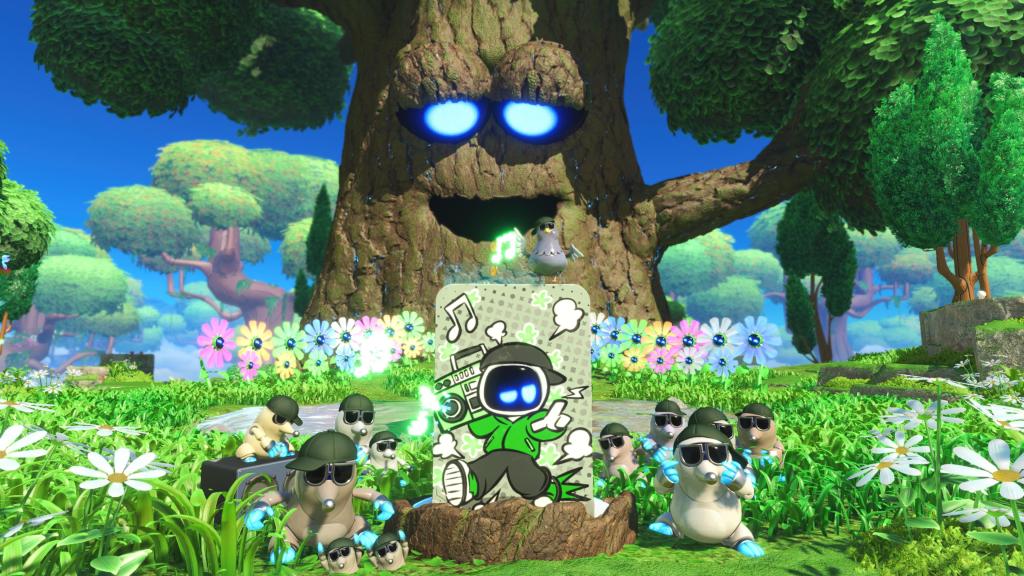
- ASTRO BOT
- Final Fantasy VII Rebirth
- Rise of the Rōnin
- Prince of Persia: The Lost Crown
- Neva
- TEKKEN 8
- Stellar Blade
- Berserk Boy
- BAKERU
- Pepper Grinder
 Opinion Seed