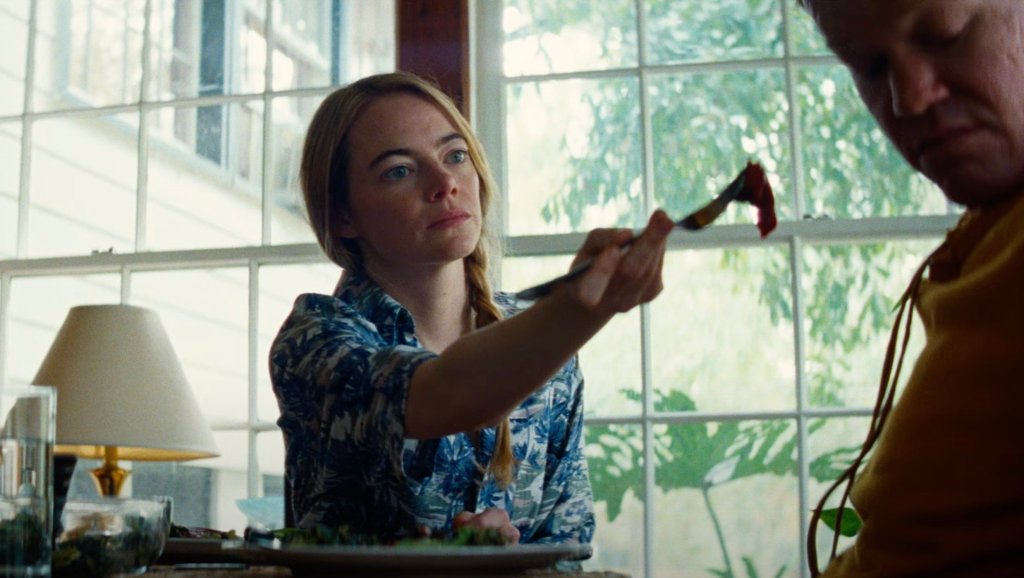
If dictators love sacred cows to simplify the life of their followers, Yorgos Lanthimos loves to destroy those porcelains.
For example, here in Portugal, when one of the longest-lasting far-right dictatorships was in power, the pillars for the people’s disaffectation towards the country’s politics were the three Fs – “Fátima, Futebol e Fado”.
On the other side of the spectrum of an audience’s willingness to engage with conventions and altogether deconstruct them on both intellectual and emotional levels, Lanthimos seems also particularly interested in 3: Capitalism, Marriage and Religion.
He had already scrutinized these structures in previous of his movies, alongside others like Medicine or Privilege, but the fact that he decided to go back to one of his oldest collaborators, the screenwriter Efthimis Filippou, to create a single anthology feature consisting of 3 complete, distinct, but connected smaller films about those 3 specific sacred cows again, suggests that Lanthimos is zeroing down on what really moves him to express art.
And it doesn’t get more “co-written by Lanthimos and Filippou” than this. By being divided into distinct sections, it becomes even more apparent the ‘near-ridiculous’ of their storytelling. I call it this way because the ridiculousness we see in their movies is not that far from happening in our present real lives, but we are too comfortable with the sacred cows to acknowledge it.
That’s the point of their movies. And they are masters at that.
In Kinds of Kindness, due to its discrete nature, one doesn’t have time to accommodate to the rules of each of these 3 worlds (so-slightly different than ours). And this seems to be, once again, a very intentional (and differentiated from their previous works) proposition for experiencing and interpreting what is being communicated.
We never develop antibodies to the bizarre, making it jump more and, crucially, be a kind of rule-disturbance that inconveniences us.
Even if the respective sacred cows of each of the 3 panels are quite explicit, I must admit that I did not understand each of the 3 fables in their totality. Their side-adventures of scrutiny, and the other results of those investigations, besides the analyses on the 3 main themes.
Particularly story number 2. I was dumbfounded while watching it (even if greatly entertained), and I was even more confused by its twist ending.
(still thinking about it) (which, when good, is a mark of quality art)
The other two stories are a bit easier to parse out. However, an extra layer of challenge comes your way if you decide to explore how the 3 connect to each other, and work as a whole. Speaking for myself, I’m still a ways off. That being said, the title itself – Kinds of Kindness – seems to be a good starting point: how the different types of kindnesses needed to be given to receive other types of kindnesses in each of the 3 monoliths are connected, and how that connection says something about how we are not as rational as we think we are – even if our rationality judges the scenarios in Kinds of Kindness as ‘ridiculous’.
(love that in story number 2, the one I had more trouble with, there is a world where dogs govern humans)

By the end, I came out of the movie really engrossed by it. I think story number 3 does a lot of heavy-lifting, not only with the best script and film-editing of the triptych, but also with its substance being written and paced in ways that pull together threads of the previous two while sticking the landing of the entire project.
I should also give the audiovisual teams their flowers. Despite the scope likeness to the smaller movies of Lanthimos’ filmography, Kinds of Kindness appreciably benefited from the craft and aesthetic learnings he attained while making The Favourite and Poor Things.
The cinematography by Robbie Ryan is very good. It’s not immediately noticeable, but the texture is there, and it is in an evocative dialogue with the expression of each scene.
And the soundtrack by Jerskin Fendrix is also very good. Contrary to the cinematography, it is noticeable, but it is that way because it acts as an additional character and other functions. In some shots it is indeed an entity living in that moment and speaking the bizarre of that world when the actors are not. While in other shots the music can be a type of narrator that wanders across the 3 stories and connects them via melodic phrases.
Lastly, but certainly not least, I have to talk about Jesse Plemons and Emma Stone.
Jesse is rapidly being confirmed as one of the best and most trusted performers by our biggest auteurs. And this is his best performance to date.
And you know what’s more incredible? When a movie has a performance as special as Jesse’s and suddenly you realize that there is someone at an even higher level. Emma Stone is probably our greatest living actor nowadays. I came to that hyperbolic conclusion when she becomes the lead of the screenplay midway through the second story.
(Margaret Qualley, also, has to be in more, and more movies)
Really enjoyed this film; the how and the why it is structured the way it is; the acting in it; the ideas it expresses and challenges; and, above all, how it took me (and it’s still taking) out of my comfort zone.
 Opinion Seed