
This might have been the best year in cinema since I started making these lists and writing about movies and analysing them more critically. And I say this not to hype up the list, but because, while thinking about it, organizing it, and actually seeing it take shape, I realized that there were like 20 movies that are not going to be mentioned here that, for one reason or another, I would still recommend to people, and a next group of also 20 that I will be mentioning (but not describing) that I found a good time at the theatre or at home.
So, everything that I detail with a blurb of text was a work of filmmaking even more interesting.
Thanks to a combination of events, 2023 will be remembered as a year when it seemed like all big-name directors had talked amongst themselves to have a movie ready for us. Even the octogenarians. At the same time, it was also a year when many fresh new voices, particularly from non-English countries, rose above many titans of industry through the merit of their technical innovation and storytelling differentiation.
I hope you enjoy reading this list as much I enjoyed thinking about it throughout the year. Cinema is so varied that I bet you’ll find something to like, empathize, or even challenge yourself in the coming lines.
But first, to my promise, let me start by sharing a group of honourable mentions 🙂
- Dungeons & Dragons: Honor Among Thieves
- How to Have Sex
- Fallen Leaves
- All That Breathes
- Maestro
- Reality
- Barbie
- Bottoms
- Napoleon
- Spider-Man: Across the Spider-Verse
- Polite Society
- Flora and Son
- Nostalgia
- BlackBerry
- Joy Ride
- Kill Bok-soon
- Athena
- After the Bite
- Wild Life
- Mission: Impossible – Dead Reckoning
Happy to describe
Pacifiction
The paternalism of colonialism, until you find out you are in the same boat.
Go through the easy road of exploiting and feeling like a very smart boss, and then power dynamics change and you are caught with your “intellectual superiority” in your hand, blaming others for the comforting walls you erected no longer working.
Benoît Magimel gives one of the best performances of the year. And Artur Tort one of the best directions of cinematography.
Sanctuary
Brilliant and funny set-up to audit on how overrated it is the job functionality of a C-suite.
Decision-making, delegating, ordering around, and selling truths, while cashing some truly disturbingly large pay checks (for which they will spend most of their life chasing, not ending up with time to actually live it)? Sounds sexy…
Margaret Qualley and Christopher Abbott are extraordinary and should never stop doing independent films.
They Cloned Tyrone
It is thoroughly by design that this is one of the most stylish movies of the year.
On one hand, this sense of style is a reclaiming of a culture that is unapologetically sexy and powerful.
On the other hand, the use of this style by the filmmakers, while re-framing it through the lens of genre and conspiracy, is about unearthing the inhumanity of people who don’t live in these communities finding it extremely cool and exotic to culturally appropriate, but at arm’s length working it in their favour that different humans are conspicuously different on the outside.
Not only every time something doesn’t go according to plan, let’s blame it on the exotics, even though they are ghettoized and with zero influence on the big reasons why the plan is failing. But, moreover, let’s make sure they are kept in there expressing images of rage against the machine, so it’s more colourful who the troublemakers are.
I don’t know what’s the message behind They Cloned Tyrone. What I do know is that there is a group of very powerful people content with the failing of the plan. And, every time in History things needed to get done for the machine to be working more for the many and less for the few, indeed troublemakers were the ones making the difference.
By the way, first time I really really liked a John Boyega casting. He is tremendous.
The Royal Hotel
The Assistant was a movie I respected more than I liked. Kitty Green, writer-director, showed immense potential, and I only thought that the style was restraining too much the expression.
In this second narrative feature, The Royal Hotel, her direction is confidently looser, but not at the expense of what starts to seem like an artistic signature. So, of course, I’m happy to say that I both respected and liked it. The action filmmaking, in particular, is a nice addition to her repertoire, exhibiting good integration in a non-action movie and great chops if she wants to explore the genre one day.
Green is now, in my head, part of a group of creatives for whom I will watch their next work without having to know much in advance. She has the mark of a great artiste. The subject in The Assistant was abuse of power, and, like it or not, she framed it in a novel way, without losing any truth from the storytelling.
Now, with The Royal Hotel, her pen and her camera are focused on the topic of alcohol, but what makes this contribution meaningful to a conversation we should all be having as a society is how she, again, frames it as a nature versus nurture non-excuse.
If these men are evil, and alcohol just unlocks it for them, why have such a large industry around these beverages? Or..
If these men are not evil, and it was only the alcohol, why have such a large industry around these beverages?
John Wick: Chapter 4
From day one, almost a decade ago, I’ve been saying that the John Wick movies should be in best of the year lists every time they come out. I believe I even had Chapter 2 in my Top 10 back in 2017, and I don’t regret it in the slightest – still the best in the franchise.
Honestly, I believe the only reason these films are not recognized by awards bodies or other guilds is because there is a bias against action blockbusters. Fair, there are a lot of uninteresting stuff making a lot of money. But that’s not the case for John Wick. At the least, you consistently get one of the best shot movies of its year – still amazing that Dan Laustsen has been the cinematographer since 2.
And, even if they have been losing it since Chapter 3, the first two movies had genuinely good stories, with intriguing lore adapted from Greco-Roman mythology.
That’s my biggest complaint since 3. Why the move away from the worldbuilding? We don’t need for characters, organizations, or settings to be literally contextualized every time. Give some room for audiences to interpret and imagine things. Between 2019 and Chapter 4, I had the hope that the reason why the story didn’t end in a trilogy was because they noticed mid production of 3 that the narrative was no longer larger than life.
I was mistaken. Chapter 4 continues with its predecessor’s trend of abandoning lore and interpretative-based storytelling. Well.. it is what it is. And we’ll always have the mysteries of Chapter 2.
That being said, Chapter 4 also continues with its predecessor’s trend of having the best boss fights not only of the franchise, but of action movie History. They were the saving grace of Chapter 3, and now 4 maintains the level, adds even more creative cinematography, and a rival for the ages.
When Donnie Yen was announced as part of the cast, I knew this movie wasn’t just another money grab like many of these franchises tend to become. He is a legend and wouldn’t accept the role if it wasn’t to bring something to the table.
I was not expecting THIS. Holy sh*t. From characterization to choreography, Caine is an instant classic of action movie making.
The fight between him and Shimazu, played by another legend Hiroyuki Sanada, is fanservice done right. As a matter of fact, Chapter 4 in almost its entirety is a film about not knowing it was possible to want so many moments out of John Wick.
I don’t know if this was the final chapter or not. For me, it could’ve been, and I would be a day one happy fan. Keanu Reeves, in my mind, is now more Wick than Neo. And the only disappointment I have about this run is that, even with all that they do in these films, there’s still not an Oscar category for Stunt coordination and work.
The Five Devils
Such a clever combination of concepts.
And, more than the mixture, it’s how pouring them in this sequence enhances each contribution and the whole.
Magical realism – > Voodoo – > Discriminated people using their inner power to reclaim control over cycles.
This progression makes so much sense when watching the movie. I.e., in good magical realism fashion, there’s a point we no longer question the fantasy elements, because the people reacting to them becomes the core of the experience.
The cinematography perfectly mirrors this expression as well: neither hyper real, nor tempted by the exoticism of the supernatural. Additionally, Adèle Exarchopoulos is so back.
The Creator
Being a collage of other films’ ideas doesn’t make you automatically an uninteresting movie.
Especially if those ideas are great, and the collage is well done.
And, honestly, if this is what filmmakers have to do to get Hollywood to modestly bankroll epic original movies, instead of 200–300-Million-dollar sequels or known IP, I’m all for it.
That’s the case here: the themes are not breaking ground, but there is still much artistic and cohesive vision. For its budget, The Creator has stunning visuals that speak the same language, from cinematography, special effects, to production design. It’s a take, but the worldbuilding is still wholeheartedly innovative and, more importantly, immersive.
And the writing, even if not profoundly deep for the potential of its topics, is preferable this way, in which the plot threads don’t become too entangled in ramifications. More often than not, in science-fiction, if not well curated, this leads to a word salad instead of any semblance of philosophical solidity.
In The Creator, the story doesn’t superimpose with mumbo-jumbo or lofty metaphors, and accepts that its biggest strength could be in just connecting the common points between so many interesting and important ideas.
I never thought a film could have an ending similar to Inception, and me not being all high-and-mighty about it. Serves The Creator’s message pretty well, actually.
Smoking Causes Coughing
The most a movie made me laugh in 2023 =D =D =D
A very good comedy because it is not too high on its own supply of satire.
And making fun of superhero movies is not easy. They were very smart at making sure of that. That’s why the MCU killed the studio comedy: for the price of 1 ticket, we get to see an action blockbuster, and a movie with quipping and entertaining self-awareness.
Smoking Causes Coughing is a bigger joy because it circumvents those humble brags. Yes, the framing starts at superheroes, but then the telling is all about the people in those movies never doing mistakes that are not predestined parts of a Campbell-ian journey, namely a crisis not serving to transform our hero, but rather a result of cumulative random laziness.
Finally, the punchline of this film is amazing, because it no longer cares about superheroes. The camera is now facing the millions of audience members that make those movies a flag of self-identity, but then are content with that moral comfort to not even try to be part of movements of heroic world change or activism.
Ice Merchants
Best Portuguese film since Tabu (2012).
And one of the best usages of the power of animation I have ever seen. With just four colours of ink, and no words, Ice Merchants tells a story about very specific daily routines that escalate to a thundering third act on the universality of familial bonds, and their ability to give us strength to move on from rituals that end.
Genuinely, Ice Merchants is so good that it inspired me to write short stories I hope one day are adapted by awesome animation artists like João Gonzalez.
The Promised Land
Hollywood should learn a thing or two from this movie.
Epics can be done without spending hundreds or even tens of millions. Get scale via cinematography and not computer graphics. Audiences will be more immersed in the world. And get stakes via well-written relatable characters delivering powerful messages, instead of making audiences care via an elicited parasocial relationship with brand-characters.
This is the right kind of theatricality. The drama is clear, and the History not over-adorned. Everything else comes from maximizing the human nuance of each scenario.
Landscapes and castles are eye-catching, but they wouldn’t work without performers at the same level. And despite this is not being a big expensive cast, they are all powerful presences: Mads Mikkelsen and Amanda Collin are the highlights, Simon Bennebjerg a fun villain, and Kristine Kujath Thorp is someone we should all remember (she is going to make many more good movies).
Very good movies
30. May December
Loosely inspired by a real-life crime, this film is about how, even after the courts have deliberated on a person’s disgraceful actions, the search for the truth in society and culture is also very loosely defined.
This is a movie that talks down movies. A performance by Natalie Portman (the best of her career) that talks down performances.
Talking down not in the sense of self-deprecating, but rather from a perspective that movie making, art making, and humans performing should never be with the goal of unmasking the truth. Quite the contrary, May December is a screenplay that proves that cinema, art, and performers are some of the best vehicles we have to explore the definition of truth, and of why people wear masks.
In this free adaptation, the filmmakers explore how there is a dissonance between wanting to know the real truth, but having to get the hands dirty in the messiness, or wanting to rubberneck truth from a distance until it conforms to our own dirty pleasures.
I don’t know if the lisp by Julianne Moore is the most genius meta-commentary of the year, or if it’s just thespian ego. What I do know is that’s not the only reason for us thinking of Gracie as a farce first, and a human second. Yet, what makes this film not hypocritical about its criticism, and thus really good, is how Elizabeth (Natalie Portman) also says to herself that she is interested in the truth behind the human that is Gracie, while her acting transformation is one of also farce and guilty pleasure.
Portman playing a bad actress is the icing on the cake. And the revelation of what type of movie she is researching Gracie for… chef’s kiss*
Should also give flowers to the music and cinematography here on display. I usually prefer an original soundtrack, however, I highly respect the choice of compositing a score from original soundtracks of a certain style of movies. It’s completely in line with both the plot and the story the filmmakers are telling. What also ends up making total sense is the film looking like it was shot in the 90’s, even if the plot is taking place in present day.
May December is about being stuck in the past, wanting to move on, but the voyeurs wanting you to be in the glass cage of already-made opinions, possessive understanding, mean self-care, and even dirty thoughts. Charles Melton is a revelation.
And Todd Haynes expertly directs a film that asks what should be the reason for making true crime movies, and what should be the reason for us watching them. Like in real life, where there are those who are always trying to pick a fight, those who want to watch a fight, those who just watch it, those who try to stop it, and many of us somewhere in between.
29. The Killer
David Fincher’s sense of humour just went up a level.
First, he attaches genre to the punchline – the forbidden fruit of dangerous characters that people associate with his movies. Then, he makes sure loglines, trailers, and everything related to the marketing of The Killer confirms that association. Ideally, play up a little bit the fact that Michael Fassbender is monologuing a lot like Edward Norton, so a narrative starts building that this is a spiritual successor to Fight Club.
Finally, and the most delicious of details, know that the majority of people are going to see your movie via streaming and that, contrary to a theatre where there’s commitment, the majority of streaming audiences give up on your art if the first 2 minutes are not catering to their pleasure… so, design an opening credits scene that is as badass as it is clear about this being a movie about uncivilized stuff.
This is even more delicious when the next 20 minutes ensue to overexpose the buildup of a cool dude, self-confident, methodical, mathematical, and efficient, with some truths and statistics about the world, showing us his Lean Management of Assassination… to the payoff of a failure.
And, the fact that he continues to narrate this Killer Kanban throughout the film, mistake after mistake, makes it even funnier. The crème de la crème being when, after so many pseudo-scientific assertions on how life works and how it should be lived, he immediately disposes of those certainties for something completely different that will give him more money in the short term.
Even if initially communicated as humorous bait, The Killer is indeed a shrewd revisiting of the themes in Fight Club. On two fronts. The first is the genuine interest in seeing what the prognostications cast at the time brought everybody, particularly after the first quarter of a century of digital capitalism is already behind us. The second is, again, the sense of humour in deconstructing the myth that Fight Club was about cool edgy dudes.
Michael Fassbender’s titular character not only is a loser with an amazing house in the Dominican Republic. He also is an amusing filmmakers’ commentary on how making a plan to be a winner in the current market economy kinda makes us a bit of a sociopath.
While Fight Club was an allegory on consumerism and the promise of advancing one’s career, in turn-of-the-century capitalism, no longer being enough to numb us into the belief that that results in a meaningful life…
The Killer is a technically immaculate film (sound and cinematography with the high precision and quality Fincher has accustomed us to) expressing that, even if since 1999 people have created imaginary realities of their own, where their inner monologue sounds the most rational, to compensate for a rat race not truly competitive, there’s no longer a chance to pass as cool as Tyler Durden because digitalization transformed our social and economic signalling into a lifeless endeavour.
Economies grew thanks to innovation and R&D. But what percentage of that economic growth was to make us get to our jobs quicker to work faster than our parents, rather than to enable us to live longer, healthier and more fulfilling lives than them?
What percentage of that R&D was to create new stuff for us to consume, and for companies to contribute to the GDP, rather than to have zero financial profit from discovering cures for illnesses or other bads in our civilizations?
Not all economic growth is the same (and sustainable). And not all R&D and the technology resulting from it is that fascinating or worthy of investing in.
WeWork. Remote ordering at McDonald’s. Renting scooters and cars without interaction. Amazon lockers. Gym membership in two taps. Postmates to eat the most expensive watermelon in the world. Or even the relationship with our own heart, that is now governed by the mathematization of a Fitbit.
People no longer sleep well because their subconscious wants to beat last week’s score. Soon, we will have a little device that estimates how many days are left until the user dies.
All this technology, all these resources, all this stuff, all these places to store all this stuff, the 10,000 hours, and for what purpose?
A socioeconomic system and a growth model that are dependent on us wanting and making junk we don’t really need. A proportionally bigger allocation of R&D and innovation to define Human Development by production and its consumption, rather than by wellbeing.
The result of that? Still not enough, for our self-proclaimed ‘rationality’, 70,000 years of brain development, and 5,000 years of civilization, to have a world where exceptionalism is not measured by fighting over scarce resources which, in turn, leads to poverty and to wars.
And, even if, like The Killer, we tell ourselves that we are in this just for us… That we don’t want to know, that we don’t care, and that empathy is weakness… In the real world outside of our heads other people will always see us blinking.
(it is amazing how they edited this film to make it seem like Michael Fassbender almost never blinks, with the exception of the last scene)
No matter how much we are laser focused on the destination idealized, and in perfecting our current state to reach that self-promise, there is still so much of that life in common with other people’s failures.
So, why not work together? To gradually make this a better place for all these commonalities.
This is David Fincher’s least entertaining crime movie. However, knowing the pleasure he derives from these things, it couldn’t have not been intentional. He helped popularize this subgenre, and yet it’s not a ‘safe space’ movie. I bet also intentional.
The aim here was to test himself and to test audiences’ expectations of him. Alongside testing people’s perspective on these themes, as well as a new way of exposing them.
Very innovative for its genre. I was not expecting an assassins’ movie to be this profound and contemplative. More, I was not expecting that the dehumanization resulting from technological advancements at all costs, lack of coolness of brand culture, and the loss of empathy that job-first people go through… would be the reason for Fincher to do it.
It will not become famous like Fight Club. But, because it has even more substance than the best Finchers, it will be an indelible snapshot of this moment in our societies.
I always knew that Fincher, the music-video entertainer, was a great thinker.
28. El Conde
Love the choice of black and white photography for a movie where Pinochet is a vampire reawakened in current days, and is hunting hearts of leftists. Because the blood of those who call for less exploitation of workers cannot be red like other people’s. You know this is an intelligent black comedy when you think of the colour that is associated with leftists. (if you believe in such thing as left and right in politics)
Teaming up with Ed Lachman for the cinematography was just one of several ingenious moves by Pablo Larraín. As you can attest from following the movie, this writer-director continues to render the most thought-proving biopics.
He used the facts of the fascist dictator of his own country and youth, removed the grandiosity that dead commanders usually benefit from, opened the door of the magic closet to nowadays, yet what he found on the other side was not Narnia, but skeletons still in power of those that supported Pinochet and other fascist regimes around the world.
El Conde is both provocative and expertly-made at deconstructing that old adage of: the left wants to help the poor, but the right wants to help the poor even more by making them rich.
Its examination of fascism is one of openly showing that its first steps (best usage of the cradle-to-the grave framing device I’ve seen in a biopic ever) are not really motivated by ideology. The scholarly smarts here come from how the filmmakers establish a parallelism between when Pinochet was a youngster and the early days of a certain ideology.
But, the biting part is that there is a mystery of who was the mother of young Pinochet. And even if the twist is revealed at the beginning of the final third, it’s already too late for us all.
(whispers: let’s just say that neoliberalism has also its history told)
In the end, El Conde takes a scalpel at the insides of fascism and shows us that it was never about helping the poor even more by making them rich. It was about those who were in the upper class, and had a certain lifestyle, not wanting to have to distribute the value-added riches and innovation brought about by a growing education in the lower and middle classes.
That confirmation bias that a mercantilist civilization gives us, by saying to ourselves that if we have accumulated capital and power it’s because we are doers, and winners at doing. And, in the limit of fascism, the numbers of that enterprising victory are more visible than the numbers of other people that are suffering.
As a matter of fact, if the dictatorship kills or makes them disappear, it helps even more in solving the economic problem of scarcity of resources.
27. Corsage
They continue to be in the minority, still I much prefer this subgenre of biographical movies where encyclopaedic reciting of History is not the focus, but rather using that nugget of human unusualness to say something about human usualness.
Here the theme is women being perceived as hysterical and bossy (even by other women) when they showcase attributes that would be considered staples of a dynamo man, a powerful dude, a “man of action”.
Elisabeth has access to the power of an Empire. Yet, she is Kaiser-in – the wife of the Kaiser. So, when she has something meaningful to contribute, she is put back in her place. That is the real power.
Vicky Krieps, proving once again she is one of the best performers of her generation, is amazing at personifying someone who is as easy for us to verify why other people considered her strongly out of line, as it is for us to acknowledge that they were wrong in not listening to her.
In dialogue with this dynamic acting there is also a very energetic cinematography. Judith Kaufmann, without relying on the adornments of high-society sets, manages to find the most stimulating textures in the most mundane corners of rooms or landscapes. It’s interesting because Krieps acts this way, but it also works on its own. These are some of the most “beauty in the small things of life” shots I’ve seen in a while.
I have a feeling I’m underrating Corsage. It is one of those films I suspect will keep getting even better as I rewatch it throughout the years.
26. Mr. Bachmann and His Class
Regarding documentaries, there’s an open conversation that has always captivated me: should directors make them and/or audiences assimilate them as objectively truthful as possible?
To be honest, the debate, and learning about all sides’ expectations, is more important to me than how much of a documentary is objectivity or subjectivity.
A film like Mr. Bachmann and His Class is a good example of that. Because of its approach to documenting, with no narration or texts from the documentarians and no talking-heads from the subjects themselves, the objectivity conundrum becomes even more riveting.
With this minimal intrusion of the camera and the crew in the storytelling, just filming people going through the motions of their routines and challenges, it is indeed tempting to convince yourself that these are the facts.
Be that as it may, there is still obtrusion, and there is still a new and very alluring centre of gravity in those classrooms – the audiovisual recorder, and our own cultural relationship with it. If we already have a bit of performance in our daily interactions without cameras saving meaning for posterity, it certainly won’t be any less when we know of one.
But, like I said, this meta-analysis does not change my relationship with this documentary. It’s still a very invigorating technique for framing and connecting livingness. Never, for a single moment, my critical brain saw any less than complex humanity in the people being filmed. These kids were interesting not due to any degree of performative actions, but because of the real hopes and dreams I could see in their eyes.
And Mr. Bachmann himself, despite the elephant in the room that is a camera, was undoubtedly the most magnetic force in there. In any profession or activity sector, the best teachers/mentors are the ones that agree to the role not to exert power over others, but because they genuinely want to serve.
25. Asteroid City
You Can’t Wake Up If You Don’t Fall Asleep
This line chanted in a crucial moment of the film is itself crucial for us, audience of human beings trying to understand our lives here on Planet Earth, to also begin to understand what this movie is about.
If that is something that is important… here goes a possible interpretation.
Wes Anderson, writer-director (and also the human being Wes Anderson), is known for breaking the 4th wall in his movies. This, of course, is always done with subtext to support it, and not just a visual gimmick (that’s why those AI fakes will never be able to replicate his art).
With Asteroid City, Anderson seems to be interested in the subtext of the subtext. Most immediately, the film Asteroid City takes place in a TV show about the process of creating a play called Asteroid City. So, three layers, the show, the backstage of the play, and the play. And a fourth, if we count the making-of of the making-of of Asteroid City. And a fifth, if we count us watching everything.
And this is where it gets fun. Throughout the movie, the characters both in the play and in the backstage deliver some very peculiar lines. Midge Campbell, the character played by Mercedes Ford, played by Scarlett Johansson (in one of the best performances of the year), says “I think I see how I see us”, “I think I know now what I realize we are”.
First of all, even if the phrasing is a bit uncommon, it makes sense in the context Midge Campbell is in. Furthermore, if we read it in the context of Mercedes Ford saying it in the name of Campbell, it gains a new meaning. And, if we analyse the subtext of that subtext, i.e., Ford is delivering a line written by Conrad Earp (the playwright portrayed by Edward Norton), which in turn was written by Wes Anderson… there seems to be a theme emerging from the depth of so many meta-narrative layers =)
The base of the theme is this: Are we (actors, audience, human beings) playing a character? If yes, are we doing it right? And, if we are in a play, who is directing us? Is the director also playing his part right?
I.e., art imitates life, which, in turn, imitates art.
From that foundation, Anderson scrutinises what seems to be the dramatic core of the movie. On one side, we are in a play, we want to do it right, and to do so we were taught that we should understand our character’s motivations, to know the cause of action, to know the meaning behind things. On the other side, we have the stage, the world, which is changing irrespective of us.
And we have two alternatives: we either continue ultra-focused on the meaning of our position in the play, making everything around us look a bit distant; or we try to live life a little bit more like when we are experiencing a movie – when we let go of this need for everything to be explained and understood, making it no less real, because characters stop feeling like personas but more like real people. Like both Midge Campbell and Mercedes Ford, who, even after so many layers of technique and professionalism, still retain Scarlett Johansson’s own soul and humanity. And that’s a level of connection that we should never try to comprehend.
Allow ourselves to be surprised by this feeling. Like when Augie Steenbeck (character played by Jones Hall, played by Jason Schwartzman) intentionally burns his hand on a grill and Midge Campbell says “You really did it…”, “That actually happened…”. She (Mercedes Ford) knew that was going to happen because she had read the script to prepare, but because it is also a moment permeated with Schwartzman’s and Anderson’s humanity, she is surprised by the realness and truth of it all. True in art, true in life.
I don’t know if this is the theme that Anderson was searching for in Asteroid City. But, what I took out of it was this perspective on life that allows us to connect to others even when the world is chaotic or a disconcerting event, like a quarantine or an alien, happens.
Jeff Goldblum, backstage, when asked what the metaphor is behind the alien he plays: “I don’t know yet. We don’t pin it down.”.
24. The Teachers’ Lounge
The cinematography by Judith Kaufmann and the lead performance by Leonie Benesch are two of the keystone contributions to this film being such a resonant depiction of one of the most undervalued professions in our lives.
Kaufmann creates frames of constricted idealism, where the hope in educating a better next generation of adults is very limited by resources and prejudice emanating from current adults.
And Benesch, who portrays an idealist, deals with that framing so realistically. She naturally gets anxiety from it, gets overwhelmed by trying to fight back all the causes, loses some, but comes out of it still an idealist. With a new perspective and tools to keep teaching these children about a less cynical, less ironical, and less nihilistic world.
This time, despite the cramped cinematography, Kaufmann focuses her lenses to show us that even in limited spaces there is a lot of childlike optimism ready to make life a better place. An energy bursting at the seams of automatism, one worth fighting for.
The last scene of this film, in particular, is one of the most powerful stagings I’ve ever seen at demonstrating how the work of teachers can have a profound impact on uplifting the destiny and potential in all of us.
Oskar might be the most intelligent of the students, but it’s the kindness that this teacher showed that will stay with him forever. And, no matter how many hardships he goes through, it will be this perspective on life the real differentiating factor in him wanting to leave a positive mark on the world.
I wrote about my appreciation of this movie’s technique and message here:
23. Alcarràs
A tragic dilemma.
On one side, a family that has been living for generations from peach-harvesting activities.
On the other side, the heir to this large estate, who never showed interest, suddenly wanting to cut down the orchard to sell everything to solar panel exploration.
In the middle, a beautifully captured Catalan landscape with no vote on the matter, but which provided shelter to a people that treated it well.
The orchard was never ‘theirs’ to begin within, but, even if the film is taking a side, it seems like a sustainable balance between natural resource and explorer had been established.
So, these filmmakers (including the non-professional main cast) put forward that, ad minimum, should exist an open conversation about ownership and usage, particularly when people stand to lose everything else.
Subject for thought. And, ideally, for more nuanced action, too. Since there are real families facing these predicaments as I write these words.
22. The Eternal Daughter
Tilda Swinton is one of the best performers ever.
And, I promise, I’m not being reactive to the double-acting, daughter and mother, here on display. It’s never been about the quantity with Swinton. Nor the variety of roles. But rather how she completely transforms into another human.
That’s it. No matter how extravagant the character is, she always finds a way to give it a kernel of realistic condition, like hopefulness, naiveté, fragility or even mortality.
This time, it is intriguing in itself that, while mother-character, she is playing the same Rosalind she was in the previous two The Souvenir movies by Joanna Hogg, but, now, Julie (older) is also her, and not played by the previous lead actress, Honor Swinton, her own daughter.
Disclaimer: You don’t have to have watched The Souvenir for this film to make sense.
After all, knowing now what this film is about, I completely understand why couldn’t have been Honor portraying the daughter this time. The Eternal Daughter is one of the best realized screenplays I’ve ever seen addressing that two-in-one fear we all have to grapple with eventually: a person that is dear to us is reaching the end of their life, thus the relationship will no longer be present; and, at the same time, realizing that we ourselves are also getting older, and that, one day, we’ll no longer exist, and be here for others.
This is not a horror movie. But, it’s still a very frightening framing. However, the film is not without its life-affirming statements. Tilda guarantees that.
21. In Front of Your Face
Hong Sang-soo’s movies are either very easy to recommend or harder. Easy because they tend to follow a somewhat stable artistic signature. So, if you enjoyed a film of his in the past, it is very probable you’ll like a new one. For the same reason, if you didn’t appreciate the style before…
This situation is very curious because I wouldn’t call him a formulaic writer-director. Quite the opposite in fact. His style is very demarcated, even when comparing him to other sui generis South Korean filmmakers. The thing is, he perfected this signature and doesn’t seem interested in changing it like his compatriots sometimes do.
Personally, I really do connect to it. Especially when the film is more focused on a single character. Like The Woman Who Ran (in my Top 5 of 2021). And now, In Front of Your Face.
Being a character study of just one person (for the most part) fully takes advantage of Hong Sang-soo’s cinematography. Yes, he is the Director of Photography of his own films. As well as Editor and even Musical Composer. But, like I was saying, his camera is one of the main reasons you’ll connect or not to this storytelling approach.
For me, the deadpans are counterintuitively full of life. It’s all about how and when they are expressed. Never to draw attention to the authorial nature of the scripting. When in dialogue, they create a simultaneously clear and controlled place for analysis on human interaction: from performance in real life, discomfort, to genuine self-discovery. While establishing shots are also lively, because, even without people in scene, he’s never interested in romanticizing architecture or engineering, but rather deadpanning on the use and occupying of a space by human chaos and its things.
And, of course, when he chooses to do a close-up is always intriguing. Coherent to his signature, they are self-assuredly contradictory, by being so subtle in camera technique and so obvious amidst the deadpans. This makes them also meaningful. Because they are not just replicating us leaning forward in the seat with curiosity. His close-ups, by zooming in very slowly and not too much, work as sub-recontextualizations of the same blocking and staging. And he plays with them: sometimes the actors know, and give the behaviour he was aiming to study; other times, they don’t know, and the interest turns to the small contradictions within continuity.
Fascinating technique. And you might watch your first Hong Sang-soo because of that. However, rapidly you understand that such visuals live in symbiosis with the words. The dialogues contextualize each cinematographic choice, as much as the cinematography turns the philosophy of the themes into something tangibly closer to us and also more existentialist.
Lastly, but certainly not least, the cast. They are there alone in the frame, without camera or editing flourishes to distract/entertain our gaze. So, they must also be in tune with this ego-less way of filming. It is, therefore, not surprising that Hong Sang-soo has been working with the same small troupe of performers for quite a while.
This time, it was Lee Hye-yeong’s turn to be the lead. And what a performance. She relishes in the lack of adornment. It is Hong Sang-soo’s camera that has to make an effort to not be magnetized by her compelling nuance. And this resistance is another reason why In Front of Your Face is such a strong film.
Even if sui generis in style, that is the universality of a great movie. No matter how different the technique is, if it is coherent with the entire human expression we see on screen, we tend to connect with it in different ways.
Best of the year
20. Anatomy of a Fall
I’m usually not the target audience of dialogue-heavy movies or series. At the same time, I’m way less picky about action movies that don’t purport to be cross-examining deep subject matters.
Sometimes, too much verbosity is there to hide lack of depth in the allegations. Other times, we get a film like Anatomy of a Fall, where the words are many, but are also heavy and precise, as well as evidence that action movies can be explosive without bombs, guns, or punches.
Also rapidly becomes clear that composing the dialogues to have them delivered by the cast like choreographies in an action movie was not a design to make this courtroom drama feel like cool.
Yes, in some scenes, words are fired away like disposable ammo from a machine gun to just suppress or intimidate. In other scenes, the interlocutor just silently dodges the verbal assaults..until it comes out of nowhere with a martial art of an argument that convinces everyone in the audience.
All these stylistic choices were scripted to converge and create a very intentional aura: the sensationalism that is our voyeuristic and self-comforting relationship with true crime.
And the proof that, despite the show, everything was used with thought is the fact that there is never a scene where a character grabs a metaphorical samurai katana and cuts deep.
That is reserved for us.
While some audience members will be saying “She did it”, others saying “He did it”, or the ones stating “I always knew” independently of the outcome. There will be a group to the side of the discourse, kneeled to the ground, committing metaphorical hara-kiri of pre-conceived ideas they had about other people’s marriages, personalities, or own inner lives.
19. How to Blow Up a Pipeline
Explosive destruction is not the solution.
Yet, it is scientifically undeniable that the other destruction… the one that is at this very moment dominating our economic hierarchies, cultural identities, and lifestyles… that one is burning away the possibility of a future with no war or corporate enslavement.
Terrorism nonetheless, if we have spaces to watch movies in 100 years, I bet that How to Blow Up a Pipeline will be remembered in a very different light.
Simultaneously, and inextricable from its message, this film was amazingly conceived. It is structured and paced like a heist movie, but instead of targeting Wall Street or Casinos the mark is Big Oil.
Of course, the soundtrack would have to be cool. But still, we shouldn’t take it for granted. This is one the best scores in recent years.
And the cast, with no big names like the Ocean’s 11, is even more impressive by an acting that isn’t lying about these real people believing in the message of their film. Some young artists to keep an eye on – for the best reasons.
18. The Beasts
Luis Zahera, the actor creating Xan, translates to us a vision of villainy that is simultaneously inexcusable and legible. He renders him so vicious that the first reaction is to read Xan as an archetype. That he is not.
As a matter of fact, one of the main reasons for the existence of this movie is to confront us with the possibility that even at the most bucolic of life projects we are not safe from the bestiality unfettered poverty has the potential to motivate.
However, amidst all this savage way of dealing with wretchedness, the film still manages to have some rays of hope coming from the women in the life of these men. They are also clouded by bleakness, but, by having a different way of approaching a crisis, they might motivate their next generation to, at least, be less violent, and, hopefully unite the antagonisms in directing that despair at the true source of it all.
17. Afire
Apparently, it’s possible to deeply love a movie, and, at the same time, have a strong aversion to one of its central conceits.
I really dislike, in a film that so intelligently discusses what creative drive really means in a creative profession, that the main character has to witness tragedy for inspiration to kick in. Booo.
Besides this personal nitpick, Afire is technically and humanistically one of the best films I’ve seen in recent years. Its cinematography is astounding for such a minimal canvas, the blocking follows suit, and the two lead performers give a level of acting that will make me remember this movie forever.
Thomas Schubert is a total revelation, as I didn’t know him from other works. He portrays the most realistic obnoxiously enclosed on our own work/interests I’ve ever seen on screen. And, Paula Beer, despite not a revelation, continues to be one of the best performers of her generation.
To note that, when I say “technically and humanistically” and then proceed to talk about the camera and the main cast, it doesn’t mean “respectively”. The cinematography, while technically accomplished, is also very much humane in its visual storytelling. And the performances the same: they are nuanced to be more human than character, but it requires a great level of technique to deliver that without looking over-technical.
Just let yourself go and follow these people on this story.
16. No Bears
A Director being, at first glance, the subject matter of his own movie would have to be brave to not be self-centred. Then, at second glance, the subject matter is about a director directing a new movie remotely because he has been formally banned from filmmaking by his government since 2010.
Then, by joining the images of the cast and crew in Tehran, and the drama there, with the images of Jafar Panahi directing from the border with Turkey, and the different yet similar drama of the people he now lives with in those rural areas,… it becomes clear what the subject matter really is.
The new feature by Jafar Panahi is about the importance of the human eye. To not just see, but to see humanistically. I.e., not just about seeing the facts, and dehumanize by numbers, but seeing the singular story of a young actress with the soft skin from the big city capital, or the details on an old lady’s rough skin from the pastoral village, and how those skins connect to each other, and to us, from wherever we are.
Seeing humanistically to Panahi also seems to be able to see happiness when someone cries, or sadness when someone smiles.
15. Poor Things
Probably the best work of Yorgos Lanthimos’ filmography. Probably also his most creative and outlandish vision. Two opinions that I don’t state lightly, since he already directed several movies that are extraordinarily peculiar, while being able to pack them with substance as weighted as the style.
Probably Emma Stone’s best performance. And probably the most adventurous a mega Hollywood star as ever approached a project. Which are also meaningful statements, because she is already one the best and gutsiest performers working within the studio system.
Undeniably, this is a film with and about many things. Also from, by, within and on many things. It is set in Victorian days, at the same time that it has science and technology conceivable for 2124. Bella Baxter, Stone’s character, goes from realistic baby behaviour in a body of an adult to philosopher-surgeon employing and evolving methodology to change the world to a better place.
And, like I said above about Lanthimos, all of these apparently unsuited ingredients not only make sense together, but also help release the strongest flavours of each other.
The best example of this potency for me is in how the screenplay (in communion with the cinematography and, of course, Emma Stone’s interpretation) takes sex on a journey. What starts as self-discovery, doesn’t stop there by socioeconomic aphorisms or the politics of good living. It crucially evolves into self-confidence.
From there, sexuality, because of that confidence, establishes an unexpected connection with taking back the means of production, which, again, makes complete sense in hindsight.
It’s a bit of a Rorschach seeing this film as only a manifesto for women reclaiming their bodies and their overall myth from stereotypes perpetuated by men in power. It is that. But, it is much more universal than that. It is about anyone reclaiming their bodies and lives from exploitative structures perpetuated by people in power.
By the way, Willem Dafoe gives one of his best acting jobs ever, playing God.
14. R.M.N.
A very metaphoric movie, filled with symbols, based on very real events that transpired in 2020.
And the symbols are never used for stylizing the picture, but rather to expose the reasons and hypocrisy of the facts in an even more demarcated way than what cinéma verité could.
This was filmed like a fable, however, it doesn’t express or converge itself into tropological lessons. No, the point is to precisely clash the allegory with reality to showcase how ridiculously hypocritical is human behaviour in these situations.
The folly of nationalism and wanting to close borders to immigrants, and then those same xenophobes having to themselves emigrate. And the movie even frames other types of figures to exhibit the lunacy of all this: the xenophobes and racists dictate so much of their thoughts and actions to socially exclude that they no longer spend time taking care of ‘their own’.
I wrote more about this new fine work by Cristian Mungiu in here:
13. The Quiet Girl
One of the most heart-warming movies I’ve ever seen… and then breaks it into pieces… and then leaves you being hopeful about the human condition.
More often than not, people tend to say, when witnessing a story of a child that is better treated by a foster family than their own, that biology and empathy don’t equate. The Quiet Girl is one of those stories. Yet, one that demonstrates that those two concepts don’t have to be independent to prove a point.
The foster couple had zero empathic reasons to open their soul again to a child. However, there’s something biological about empathic people.
And you know another thing about empathic people? They are able to cause an almost epigenetic effect on other people’s lives.
That’s why I have to believe that, no matter how difficult Cáit’s days become after the events of this film, the kindness and affection she got from Eibhlín and Seán will not only be with her forever but will also shape her future actions and outlook on life.
12. Return to Seoul
As much movies are performative acts, real life also is. In fact, both inform each other’s acting.
The creators behind this film looked at that feedback loop and decided to meddle in it to see if an additional element could be positioned in the process.
Return to Seoul is not just a movie about how moments, parts, or even entire personas in our lives are performances to either fit in or overcompensate/obtain something we think we lack/want.
This film is itself a performance on those performances.
But it’s not like a trick that the filmmakers are playing on us, audience. I genuinely believe they themselves were exploring how that artifice of cinema can help all of us deconstruct and better understand that part of human behaviour.
Add to that the fact that the plot is contextualized by themes like identity, nationality, biology, roots, and keeping moving forward, made by a multicultural cast and crew of Koreans, Cambodians and French… and we have here one of the most engaging melting pots of concepts and perspectives on concepts of the last few years in cinema.
It should also be noted that this is the lead Park Ji-min’s first work as an actress. I would’ve never guessed, looking at how magnetic and layered her performance is.
11. All the Beauty and the Bloodshed
I thought this documentary was about one subject. It turns out it’s also about another subject. And, after seeing it, I concluded that both subjects are one and the same, even if told and filmed via different expressions.
It is precisely the juxtaposition between sensorial idealism for one subject and ultra-realism for the other that makes us be more attentive on the facts being investigated. Specially, when we start considering how both narrations speak to each other.
This is a cross-checking on activism. How civil society conceptualizes of idealism in a dream-like haze, marginalizes idealists when their expression needs for the routine to change, and then takes idealists turned activists for granted when the plan didn’t work and it needs for someone to rebel against the routine-makers.
The world needs more people like Nan Goldin, in art and socioeconomics (as if they were two different things).
10. Leila’s Brothers
Iranian filmmakers continue to produce some of the best cinema of the century.
This is a bonafide epic. The camera and the blocking make so many frames look like Rembrandt paintings. And, importantly, the writing and the study in it justify the magnitude of the visual affirmation.
Because epic doesn’t equate only to scale, but also to depth of impact, Leila’s Brothers is a modern tragedy that explores both the ramifications of hardship and its root causes. Sorrowfully, one cannot separate the profundity of Iranian films from the suffering the people behind and in front of the camera have in them on a daily basis. I would gladly give away the experience of having watched this great movie for a democratic and secular Iran.
If the Barbie movie is 101 on how patriarchy is even hurting men, and how we accept it willingly for some kind of competitiveness that will go down with us to our graves, these Brothers and their Sister is a much more thorough scrutiny on what really motivates that power structure.
It’s all about the concentration of capital, and distributing it as a sign of weakness. Add to that toxic toughness justified by religion, and men are even more willing to accept it.
But that is also fake toughness, and this movie is really good at showing us what immortal power really is. Taraneh Alidoosti, who has been arrested several times throughout her career as an actress, delivers one of the best scenes of the decade when confronting the on-screen father and the ensuing reaction of the brothers.
Such an impressive film. It has everything: economics, politics, religion, love, happiness, pathos, catharsis. And an amazing cast and crew to carry all that weight.
9. Past Lives
The best romantic movie of the last decade.
True romance. Not bloated for cinematic purposes, nor melodramatic for audience manipulation.
A mix of irrational feeling with the challenge of rationality trying to process the impact of love in our life and life decisions.
This is a very mature romantic movie precisely because it never claims that rationality will give us all the answers to this. Nor does it make love an ethereal power that isn’t moulded by reality.
In a year coincidently filled with great movie endings, Past Lives’ is amongst the best. This is a last scene that will stay with me forever: impeccably staged, and written with the kind of originality that was not thought to shock but to land truer.
Wrote more in detail here:
8. The Eight Mountains
The Eight Mountains is worthy of being high on anybody’s 2023 list almost solely for its immaculate technical skill.
Albeit, that’s not the reason why it’s so high on mine.
All these relative positionings are naturally subjective. But this, in particular, is probably the one that benefited the most from personal attachment. My experience watching Eight Mountains was something akin to a tone poem resonating intellectually and emotionally.
This is more than a story of friendship. What started by grabbing my attention was how the movie tackles the push-and-pull of everything stemming or not from that relationship. Sometimes, the friendship is at the centre of the frame, and new ways of viewing the world radiate from that dialogue. Other times, that new viewpoint gains a life of its own, detaches, and not only becomes the narrative fulcrum but also moves to explore new relationships with the world.
And then, the spark that jolted me was when the film explores if a separated nucleus maintains residuals of its origin. Should it go back? Or should it continue its way of discovery and bring to the new worlds the good parts of that origin?
I mean, I can’t say much more than what said here:
7. Suzume
Japan is a nation in pain by events of mass destruction, natural or man-made. And those scars are visible in many different places, from the way they super-organize city planning and infrastructure to the outlandish style they’ve always devoted to the depiction of monsters.
In cinema, particularly, Gojira reigns supreme. A 1954 manifestation of the atomic bombings. But, long before kaiju, Japanese folklore was fertile ground for other drawings of beastly creatures born form disaster. Not always colossal or even devilish.
That’s the framing of my new favourite Makoto Shinkai. Which is quite a praise, since he wrote and directed a modern masterpiece in Your Name.
Suzume is a multilayered approach to telling the story of how the country internalizes uncontrollable devastation and expresses its catharsis. Set in modern-day Japan as well, the film follows the titular character, a 17-year-old girl, who discovers she has the power to prevent natural disasters if she closes doors opened by a demonic (and cute) little cat.
When I say this movie contains multitudes, I mean it. There’s a reason for the cat to be both demonic and cute. There’s a reason why the doors are only being opened in what used to be villages or attractions near big cities that were unstoppably destroyed by something. There’s a reason why this is a road trip for Suzume across all this history of Japan.
And, of course, there is a very touching reason why she, specifically, has the power to close these doors.
This film touched me profoundly, because it’s one of the best renditions I’ve ever seen about the simultaneously fragile and beautiful relationship we have with Nature, and the stories we will always carry of that.
6. Showing Up
An art piece about how professions turn even making art pieces into something boring and drab.
And still, by the end of the movie, I don’t know if the reason why I wanted to pay Lizzy money for one of her sculptures was because of their external beauty or because of the internal journey I had just gone with her and them. Does it even matter why?
A beautiful movie about the process of rearing something that will not be yours forever. Knowing that subconsciously, and, because of that, constantly questioning if it’s even worth it. Nevertheless, allowing yourself to find chance-meetings with both the grindy days and the final product, and be happy for the chance to be happy in those moments.
Even though this is a very subdued film, it is full of amazing performances. Michelle Williams is so real. She’s all of us in our professions. Hong Chau is precision incarnate at portraying that person we think is so different from us, that we simultaneously don’t respect and envy, until the moment we get to know them better and realize we are not so different. Judd Hirsch continues to be iconic at being suburban. André 3000 contributes with one of the most soothing presences I’ve ever felt in a movie. And the pigeon…
Best pigeon ever.
Kelly Reichardt is a top director. Her camera makes a pigeon outperform all the religious mythmaking linked to them, by just focusing on the worthiness of life and its details.
5. Oppenheimer
Only Nolan to make a verbose biopic about quantum mechanics, paranoia about communism, and the fallout of excusing everything for technological advancement… feel like a cool action blockbuster.
Much credit should go to Jennifer Lame who cut this film to this breakneck pace, without losing any intelligibility. Also, to Hoyte Van Hoytema, best cinematographer in the business, who carried that giant IMAX camera around and made sterilized environments like laboratories and hearing rooms look like the most magnetic places on Earth, or made Cillian Murphy look like the titan Prometheus. And, of course, Ludwig Göransson, who, like Zimmer before him, continues to move music forward, by making classical orchestras sound like a gigantic heavy metal band.
Still, I should bring Chris back into the conversation, alongside producer Emma Thomas (his wife), because this movie exudes directing, management and coordination. Filmmaking is obviously a collaborative work, and having a task force of creatively competent people like some of those I named certainly goes a long way into producing a great movie. But knowing how to listen to those different voices, taking the best out of each conversation, and making all of them cohere without redundancies or superimposition is itself a very creatively competent skill.
This is a movie about technique and bringing together the most technically accomplished people of their fields. In hindsight, it shouldn’t be surprising that Christopher Nolan and Emma Thomas would be the ones to make this biopic and this story cinematic.
And the movie even works on another level. We all know Chris as the master at employing state-of-the-art technology not just for the sake of it. He trailblazes but with a humanistic touch. And this film is another thoughtful approach like that. It sounds and looks immensely impressive. But it will be the screenplay that will stay with us for a long time.
The science is incredibly well-written and captivating for all levels of knowledge.
The politics of both the character study and the temporary interest in science is detailed to the point of making us feel we were there in those rooms having to judge and execute.
And the ethics of even the brightest minds in our species not being able to process the ramifications of growing technologically at all costs makes a past story feel like a very present one.
I wrote more in detail about Oppenheimer here:
4. The Zone of Interest
The best movie of the last decade, even if not my favourite.
And, honestly, that’s not at all important in comparison to its sadly timeless memorandum.
This is a film that is not concerned with justifying the amount of money or time audiences would spend to see it, nor was it created to serve cinematic flourishes or to impress the ones creating it. By not being bound to both dimensions, it becomes art in one of its purest forms.
Here, technique and message are completely indistinguishable. Cinematography, sound or even acting were thought and realized to be a very present tense (not past) study on perpetrators and compartmentalization.
Not the banality of evil. Because it was crucial for the filmmakers to be as close to the truth as inconvenient it is to see these people committing genocide, and not be able to use the comfortable labels of villains or monsters.
They didn’t start as mass murderers. They started as boyfriend and girlfriend, having dreams about their future. And what they wanted for themselves was to have a lovely house, with a lovely garden, in which to lead a lovely family life.
To achieve that he just needed to be very good at his job. Just so happens that his job was to be the commandant of Auschwitz.
There are two facts the film wants to study. The first, through words from the letters and diaries to the screenplay, the slippery slope of cozy narratives and terminology that dehumanize. That racist generalization in a family dinner, or that homophobic joke among friends. Or that scapegoating of a different community for life not being what we had hoped it would be, or for the fear of not ending up having what we think we deserve from it.
The second, more through visuals, the fact of choking back empathy so we can continue winning and getting the things we want. There’s a scene in this film that will haunt me forever. Höss, the main character, is retching after something good happens to him, while the movie shows us other facts. By intentionally making him not vomit, even if the malice of his actions can break both his body and the space-time continuum, whatever could’ve come out doesn’t. Why?
Because his mind is so individualistically focused on working hard. Why? To get what is his by right. What? The best in life.
Höss swallows back, and Hedwig moves past the wall of the death camp. However, the movie is never tempted by the audiovisual potential of cognitive dissonance. It’s about the facts of tending to our garden to impress our mom or guests (even if plants are more silent than the screams coming from the other side of the wall).
Or the facts of being proud for having moved up the economic hierarchy by our bootstraps, and socially signalling it.
The Zone of Interest echoes beyond its subject matter, while not needing to, since Auschwitz is enough. As it doesn’t exploit the tragedy, but rather shows the danger of turning everything into numbers: people; accomplishments; and the people in the way of our accomplishments.
3. The Boy and the Heron
How do you make the second-best movie of your filmography at 82?
Imagine doing it after decades of being considered the master of your medium.
That’s what Hayao Miyazaki just unleashed into the world. Not just a good movie by his standards. But one of the best films ever made.
As always, the animation in The Boy and the Heron is nuance in the form of brushstrokes. Yet, it even surprised me by incorporating new techniques that are not known to be part of Studio Ghibli’s signature. 82 and still open to experimentation – life goals.
And then, what makes the best Miyazaki’s transcend cinema, the reciprocity between refined form and humanistic content.
It’s so interesting because his movies don’t operate on the typically western three-act structure, and still there is so much finesse here about timelines meeting. Not in the sense of time as a tool or a play on editing, but a gentle intersection of lines that allow us to both follow and connect to the film’s message about two lives.
The one worth living, and the one fought for and wasted.
At 82, he is this fearless. He tells us about a boy who lost his mother during World War II Japan, and, like Miyazaki and many other kids growing up during those years, he searches for stability and geometric predictability (the visuals for these are great). However, in another plotline lives old-current-day Miyazaki transforming the boy so he doesn’t waste his life trying to become a master of precision.
Studio Ghibli children are the most realistic ones in cinema. Because they are neither metaphoric extensions of the adults creating or directing them, nor are they the idyllic representation of nostalgic youth. They behave like children: from the sweet to the sour.
The Boy and the Heron is very different Ghibli in that respect. Mahito doesn’t fully behave like a boy. Even for a grief-stricken boy. At the same time, he doesn’t behave like an adult, a metaphor, or a projection of Miyazaki himself. It’s something completely new for Ghibli, and wholly innovative in general. He is like a wandering nucleus of sensations, but he doesn’t seem lost (the animation also captures this amazingly). Like he has a purpose, but he’s not purposely trying to make his the life lessons he experiences along the way. He seems like an old sage.
But a different kind of sageness. Because the movie also has an Old Sage, who also isn’t literally Miyazaki (maybe his regrets). And the Boy goes on a journey to teach that wise master a different way of living. This is a wish that Miyazaki gives us. It might not be the easiest of his movies to empathize with, as sui generis as it is. Simultaneously, it will be one of his characters that will serve us the longest.
One of the most beautiful images I’ll ever see in my life is in this film. It is when a group of people are hugging and laughing, all covered by parakeet poop. And I can imagine Miyazaki finding having to clean for domesticated birds a nuisance in life. However, he’s also showing us that worrying too much about cleanness and suffering on the poop makes us not appreciate that we get to live in a world with colourful parakeets.
2. Killers of the Flower Moon
Martin Scorsese, at 81 years old and nothing to prove, directs one of the best pictures of his life.
Without taking for granted the artistry and technique present all over the movie, what makes this one special in such a legendary filmography is how he deviates from his usual postmodernism and still manages to buildup on fractured morality and pluralism.
This choice of going meta-modern, even mea culpa, about his resorting and contributions to true crime, makes Killers of the Flower Moon a very mature film, where those self-reflective building blocks were put there to serve the victims and not the filmmaker.
It’s really impressive that he is making such an ego-less movie at this age.
On a different level, I also found more truth in the way Leonardo DiCaprio decided to approach this project. He was pegged to portray one of the very first FBI agents, in a premise that would sell like gangbusters, but he refused to do it because, contrary to the viewpoint of the nonfiction book this screenplay was based on, the genocide had already taken place and a Thomas White-saviour whodunnit wouldn’t tell nothing about why these crimes keep happening throughout our history.
Speaking of truth, Lily Gladstone delivers the most soulful performance of the year. She commands the screen, even when sharing it with titans of industry, while doing it in a completely understated way. And, what I really equate to great acting, in another layer of her performance, is how she is also giving us the real Lily, with emotion from this subject matter, and not for a single second that deviates from serving the movie.
A masterpiece of a film. From production design, art direction, cinematography and music. To incredible acting, extras and leads. Robert De Niro, who has spent the last 30 years doing mostly mediocre roles, delivers one of the best performances of his career. And Scorsese, giving back instead of showcasing.
This film will stand the test of time, for the first reasons. Will be talked, analysed, and taught for decades because of that last one.
I tried to explain my love and admiration of this film in better and more detailed words in the following post:
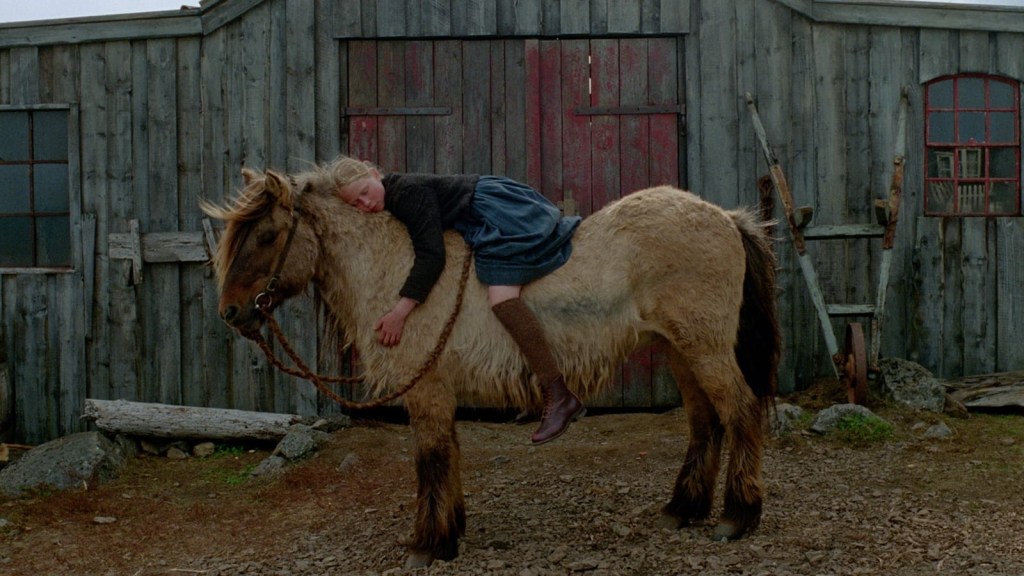
1. Godland
One can be tempted into solely enjoying this film for its cinematography.
Nothing wrong with that. Iceland is titanically beautiful, and these filmmakers, instead of resorting to too much cinematic techniques in the futile attempt to make it justice, just let that immensity express itself, by making it defy the constraints of the anthropocentric photograph.
For all that, Godland can also be appreciated on reflective terms.
As an example, this is a very mature screenplay at analysing the insecurity of human beings. The same that urges for the portioning of reality. A systematic formalization that segments our existence and stories in comprehensive nomenclatures. Like geography inventing country and crutching humans towards defining culture.
Or boxing in language as a form of self-identity, less to communicate and more to cater to our need to possess historical significance.
Or, or course, religion. Starting from a natural so vast to know that it turns supernatural. Then, the metaphysical, also insufficient as it is, needing to be materialized into symbols and lessons. And, its next stage, no longer just about faith, but pervasive across politics, enterprise, and many other aspects of self-actualization, where life is not to be lived but to be righteously accomplished.
The way these cast and crew filmed all this analysis in the powerful embrace of Nature makes it even more inexorable. A movie aware of its own fragility. Of it being itself another portioning of reality: Denmark versus Iceland; Cultured versus Uncivilized; Entrepreneurial versus Animalistic. And, in the end, none of these identities win.
There’s only one victor. Even if humans completely destroy it. Because we needed to destroy it for our existences to leave a mark.
Best of the year
- Godland
- Killers of the Flower Moon
- The Boy and the Heron
- The Zone of Interest
- Oppenheimer
- Showing Up
- Suzume
- The Eight Mountains
- Past Lives
- Leila’s Brothers
- All the Beauty and the Bloodshed
- Return to Seoul
- The Quiet Girl
- R.M.N.
- Poor Things
- No Bears
- Afire
- The Beasts
- How to Blow Up a Pipeline
- Anatomy of a Fall
- In Front of Your Face
- The Eternal Daughter
- Alcarràs
- The Teachers’ Lounge
- Asteroid City
- Mr. Bachmann and His Class
- Corsage
- El Conde
- The Killer
- May December
Happy to describe
- The Promised Land
- Ice Merchants
- Smoking Causes Coughing
- The Creator
- The Five Devils
- John Wick: Chapter 4
- The Royal Hotel
- They Cloned Tyrone
- Sanctuary
- Pacifiction
 Opinion Seed