
There are no excuses anymore.
For years, Martin Scorsese has been blacklisted from the general public’s canon of “The Greatest Directors of All-Time”, because people say he glorifies violence and violent men in his movies.
Well, that goes to the narrative-to-cinematic definition of glorification. And, from that, he doesn’t. The fact that a considerable amount of my male classmates at Economics school idolized Leonardo DiCaprio’s portrayal of Jordan Belfort in The Wolf of Wall Street is precisely the Rorschach test Scorsese was aiming to create.
Now, at 81 years old, he framed the toxic masculinity in Killers of the Flower Moon as not cool or swagger-ish, not because he had anything to prove to those detractors, but because he was more interested in the people that did nothing than the ones that did the crimes.
This becomes even more apparent when you know that the nonfiction book this screenplay is based on was written from a completely different point of view. In the book, we follow Thomas White, the lead Bureau of Investigation agent, who arrives at Oklahoma after the genocide has taken place.
A sort of White-savior whodunnit on the murders, since the book was commercially pitched as the origin story of the FBI.
As such, it is fascinating that Scorsese and, particularly, DiCaprio wanted to tell the facts from a POV before the late FBI arrival. Fascinating because a movie with DiCaprio playing one of the very first FBI agents would sell like gangbusters. And, even more fascinating that they decided to point the camera from inside and not outside the community.
What makes this one of the best films of the year is precisely the way this cinematic ethos of ‘inside the community’ expresses a narrative interest in the people who did or even said nothing during the savagery.
Moreover, just the last two scenes of the movie alone, and knowing Scorsese is a master with nothing to prove, makes Killers of the Flower Moon not only one of his greatest accomplishments (which is, in itself, extraordinary for such a legendary filmography), but also a work of art that will be talked, analysed and taught for decades.
Scorsese going meta-modern, mea culpa, and reflective on where we stand on true crime – a subgenre he himself is the godfather of – is top-tier stuff.
One of the many sentiments Scorsese is engaging us in comes from the pernicious thin line between being hyper-real in true crime to truthfully tell the story of real people that were murdered, and giving a ‘voyeuristic’ vehicle for an audience to entertain themselves while feeling better with their own lives – the ludonarrative dissonance of weaponizing other people’s suffering.
Of course, Scorsese is himself engaged in this dilemma. And, from the point-of-view of a white Portuguese man in his thirties, I find that this film is one of the best deconstructions of such predicament (if not the best) I have ever seen, particularly considering that it comes from the framing of an Italian-American octogenarian.
To do so, this production was non-negotiable on two cornerstones: the first, which I already lightly touched upon, was the reframing of the original text; and the second was the look and sound of the expression.
For the hyper-realistic side of the dichotomy, this filmmaking crew counted with the curricula of two giants of production design: Jack Fisk on the sets and other contraptions; and Jacqueline West on the costumes.
These two crafts’ masters are accustomed to big productions, notably period pieces, and brought their best to this Western.
The exteriors recreated by Jack Fisk set the stage for the scope of it all, but it is the details of the interior designs that spark the movie magic of believability. A barbershop-saloon with pool tables is a particular highlight of a certain masculinity.
Simultaneously, the clothing designed by Jacqueline West exudes quality at the seams. Even though it is of a time, there are some pieces so fit I could see pulling them off today. The only discomfort coming from the ascertainment that such sleekness also served to masquerade evil deeds and evil men under it.
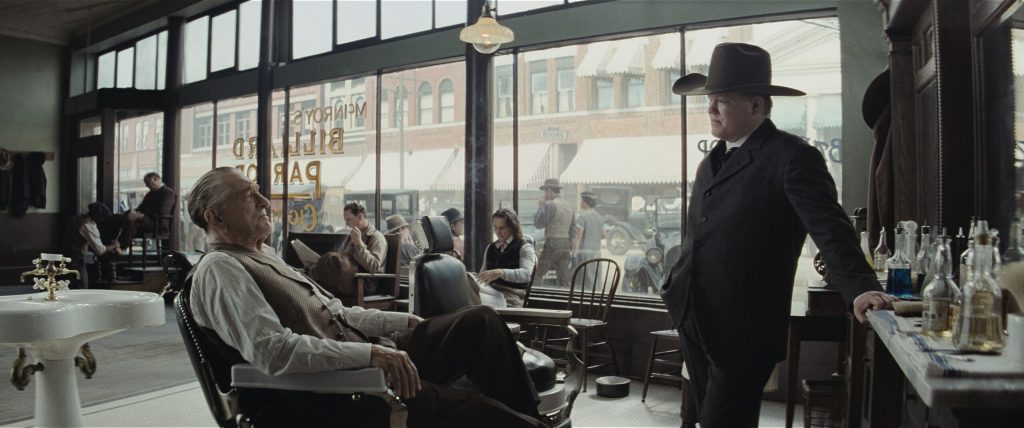
Then, came the moment to figure out how to photograph that reality. For this, the technique chosen by cinematographer Rodrigo Prieto landed on a look and feel that convey that same reflective nature I started to mention above.
I.e., the throughline for the aesthetics is itself one of transitions. Like a thought that ruminates and doesn’t jump to conclusions, the visual language also smoothly drifts between life-affirming and malevolence-encroaching. This is achieved so aptly just through slight changes in a couple of image characteristics: decreasing of light exposure, more elements with saturated colors naturally lit, more or less contrasting figures in a scene, navigating among muted frames, shadows clashing with warm colors, and texture trying to escape the miasma.
And it is precisely in these sets of consecutive frames, two ships passing in the night (colliding or not), that the film reaches its highest highs in terms of visual storytelling. It’s not just the transitions, but the melting pot resulting from a crossing that generates indelible images.
It is in those moments also, without the need for spoken words, that the film says more about its thesis. The savagery of men that describe as “creative” the destruction of something or someone, as a justification for canonizing jungle laws of “preservation of favored things” to the way the world works.
Indelible images of creative destruction, where wealth or worth aren’t drawn from rectilinear intersections but evolve from way more complex and nuanced clouds of brushstrokes. And, in the end, the little men that so desperately want to mathematize life will die like all the rest, and nature will continue to be here with a smirk on her face.
Realism can learn a thing or two from Surrealism.

Before moving on to talk about the performances that bridge this visual metaphysics with the very much real people who were murdered and the ones who did/ordered the killing, there are still two crew members and their artwork I must highlight.
For the self-reflective ethos of this movie to function by and shine through smooth transitioning of images it needed both masterful Editing and immaculate Music to set the pace and other rhythms of worldbuilding and statement delivering.
In Editing, a film can’t get much better than this: legend and life-long collaborator Thelma Schoonmaker. You know how every good first draft is nowadays turned into a 6-to-8 episode miniseries? Even though this is a 3h30 movie, the way Thelma cut it, it could never have been serialized. This is neither a storytelling nor a message that should be delivered through mini-arcs of clocked cliffhangers, twists or dopamine-manipulating rollercoasters.
Because True true crime, (and this is one of the elements Marty is contending with), is a smooth operator. It slowly builds, it normalizes its malevolence-encroaching, and, suddenly (without being sudden), is all around us: justified as law of nature, canonized as the air we breathe, and the atmosphere becomes dominated by a banality of evil.
This is the ambiance Thelma perfectly transmits through her work. I don’t know how she does it. Everything just gradually encroaches, without claustrophobia to warn us. The stakes build, not to entertain us with revelation, but to elicit reflection about the parallelisms with our current world. And even fast cuts or scenes abruptly interrupted never feel fast or show-y, but in the service of the melting pots I described above.
Again, I honestly don’t know how she pulled it off. Not only one of the best editing jobs I’ve seen in my life, but also editing completely in touch with how to retell such a tragic story.
And then, the Music.
Speaking of melting pot. It doesn’t get much more aptly crossroads than the late Robbie Robertson composing original music for this film. Immortalized as the lead guitarist for Bob Dylan and songwriter with The Band, “Robbie” comes at this movie as also the son of a Cayuga-Mohawk mother and a child of the Six Nations of the Grand River Reserve.
The first thing you notice is the percussive heartbeat. You think: oooo, a mystery is coming. But, like a heartbeat, it methodically echoes. Maybe it’s not mystery that it’s conveying. Maybe it’s something different. More considerable, ever present, and slowly encroaching.
But, then, the creative genius and, more importantly, the complex genealogy of Robertson starts to manifest itself in a true melting pot of a score. True because the transitions between genres and sounds don’t feel pandering to the musician’s branching ‘pedigree’, but, (like the cinematography it accompanies), feel like crossing ships in the night.
Conversing with each other. About the different lives they have witnessed: blues, Native American, pop. All trying to come out of the mix as better and more evolved versions of themselves.
In essence, those are the true beating hearts of the soundtrack.
And, what Robbie Robertson left with us.
Rest in peace, maestro.
Like I promised, I will conclude this review by looking at the cast.
And, what a cast.
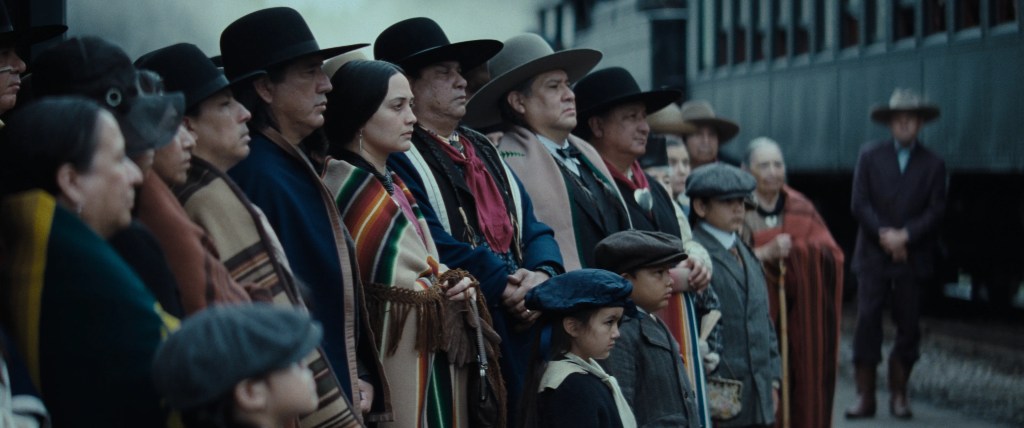
The supporting performances do so much to render nuance to this world. They are the fleshed-out representations of a visual language that drifts between life-affirming and malevolent. So many good characterizations of these energies moving around, colliding and amalgamating. From big names that accepted appearing just a few minutes, to non-professionals completely stealing their scenes.
Even so, these last few lines will have to go to the three main leads. After all, we are talking about some of the best acting I’ve ever seen in my life.
I mean, what Lily Gladstone is delivering here is simultaneously majestic and unthinkable. She commands the screen, even when sharing it with titans of industry, while doing it in a completely understated way. And, what I really equate to great acting, in another layer of her performance, is how she is also giving us the real Lily, with emotion from this subject matter, and not for a single second that deviates from serving the movie.
Sometimes these expressions exist for a reason: She is the soul of the film.
Then, Leonardo DiCaprio.
I already talked about how, even before the film started production, was already fascinating that DiCaprio, pegged to play one of the very first FBI agents in a premise that would sell like gangbusters, refused to do it because he found more truth in pointing the camera from inside and not outside the community. Real people were murdered, and the white savior saved nothing.
But, let’s say something about his acting: one of the best performances of his career. A characterization so refined that he tricks us into thinking that we might rationalize the crimes as we see him as very stupid (while feeling better with our own intelligence – another Rorschach test by Marty and Leo). In fact, DiCaprio isn’t exploring imbecility, but rather extreme individualism. What passes as dullness is just the character’s inebriation to not see the world beyond his own self-interests and self-imposed needs.
It’s one of the best renditions ever in the silver screen of the paradox of extreme individualism: the main cause for self-destruction. And this trick Leo pulls is why he’s the greatest actor of his generation.
Speaking of greats, Robert De Niro.
You know how you know someone is a star? When they spend the last 30 years doing mostly mediocre roles and, at 79 years old, they seem to have an on-off switch and, out of the blue, another legendary performance turns up and sets the house on fire.
Seriously, Bob has his hand on the pulse of white supremacy and capitalistic destruction. The way he makes those two evils banal is so real and so frightening. But, it was the facial expression of his character watching a documentary on the Tulsa massacres, and the rationalization that so slightly transpires from him, that will stay with me forever.
We all know, or heard, someone before mathematizing human lives that way. The slippery slope before descending into hell…
And finally, since we are talking about octogenarians…
There’s not much more I can say about Martin Scorsese than what I’ve been describing and praising about this movie.
Filmmaking is a collaborative art form, and there were still a multitude of artists I could had spotlit in this review. But, auteur theory or not, it is undeniable that we should all wish for our lives to be this engaging at 81:
Interacting with amazing people and thinkers. Being capable of self-critique. And giving back to the world something that is meaningful and will stand the test of time.
A greater masterpiece in a life of masterpieces.
 Opinion Seed