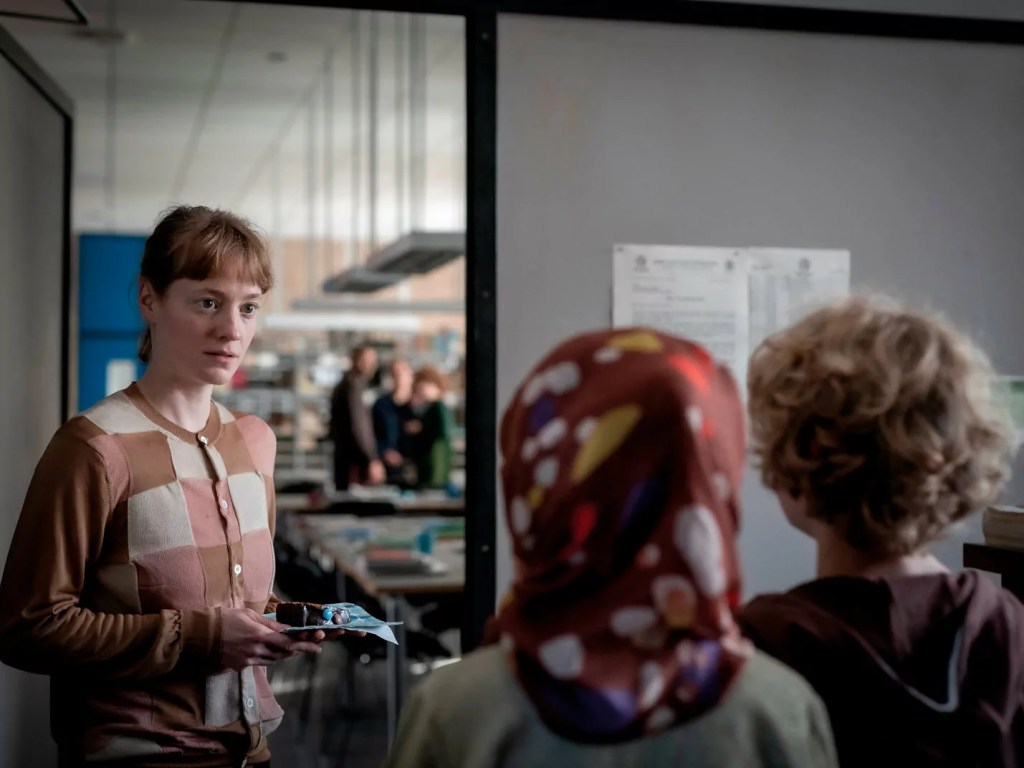
Considering that one of the year’s most critically acclaimed films is a British-Polish co-production about the commandant of Auschwitz, and his wife, striving to build a dream life for their family in a house next to the camp (The Zone of Interest), it is an interesting coincidence that Germany’s submission for the International Feature Oscar is a study on how racism and, above all, the mundanity of jumping to conclusions and not REALLY going through due process can start from an early age at schools (The Teachers’ Lounge).
In just the third scene of the film, Carla, the main character, engages her students with a compelling exercise about the difference between just asserting/claiming something and proving it. The students showcase initial annoyance at the extra work required of gathering evidences, but, step by step, the derivation leading to a better understanding of the problem seems to make those young minds more happy and proud about their new acquired knowledge.
Sooner, rather than later, this echoes as a meaningful introduction to the themes of the movie, because Carla, herself, will also jump to conclusions due to a combination of annoyance and extreme idealism.
And it even gets more mundane when Dr. Böhm, the school’s principal, who equates reputation with a zero-tolerance policy, hypocritically forgoes some of those same steps of derivation and due process, probably because reputation, for her, was never about facts, but about perception.
This film is near-perfect because it excels in three levels every movie should, one way or another, checkmark:
- Immediately piques your curiosity, even if plot is not the point of its artistic statement;
- Coalesces all the elements that make up a film – from sound and cinematography, to actors performing –, and, from that audiovisual coherence, elicits a series of visceral and emotional reactions that connect us below consciousness to what is being expressed; and
- Lands its thesis in a way that expands the duration of the feature – you’ll be thinking about its message long after seeing the movie.
The first point is forthwith. These filmmakers, from writing, directing, to editing, were really apt at setting stages, scenarios and stakes to make us care and engage with the plot: Who stole the money? Who has been stealing recurrently in this school? And, are they the same person?
Then, they use the second checkmark to throw a curveball at us. The thumping sound effects, even if subtle (exquisite sound mixing), never leave. Sometimes, classical music comes out of nowhere (but not the triumphant parts). All together make up an aural musculature that exudes from an already constricted aspect ratio in the photography (4:3). And then, the actors, no matter if adults or kids, start to turn the personalities established in the first scenes into different interpretations of tension.
But, this tension, due to the ethereal enveloping from the crafts and the non-verbiage approach to the storytelling, creeps in a thought that maybe the movie isn’t about money.
Of course, I have to highlight Leonie Benesch, the main actress playing Carla.
Her performance, in a sense (and another reason why this is a great film), is a bridge between those three checkmarks. She is not a simple audience surrogate into that context, even if at first we nod at her initial representation of idealism, or share in the 4:3 anxiety-inducing claustrophobia of being responsible for the rearing and education of so many different kids (with their own energies, problems and personalities).
It is precisely in the way Leonie Benesch transitions from two such distinct states of being, without ever demanding the centre of the frame through overacting, that we start to feel there’s something more lurking below the plot. If she is the bridge connecting the different contributions to this audiovisual story, and her presence is not one of “I had these principles about money and stealing, and now I am having a panic attack because some people around me don’t behave like that”, maybe what’s worrying and transforming her is something more nuanced and probably more insidious.
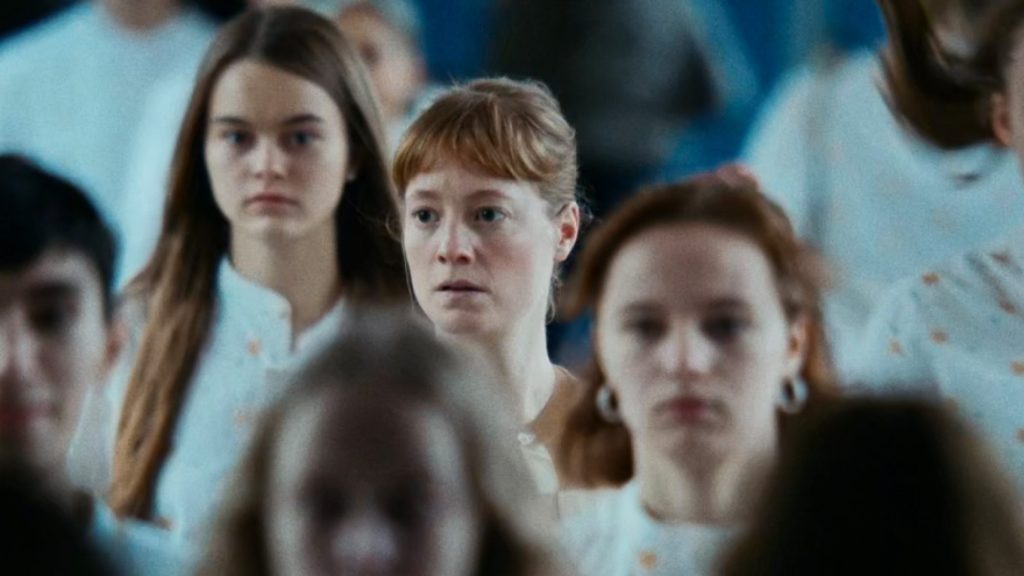
And then, she even journeys to the third checkmark, once again, without an ounce of typical third act overacted revelation.
At this point, because of the way she acts on the scenarios the writers and director throw at her, we know that this movie is not about the money, about who did it, or why they stole it.
Yet, it’s not also obvious. And that’s what makes this film really strong. It’s obvious of what it’s not about. But, it’s not obvious about the solution for the real problematic underneath.
Because, even if we love a solution to a puzzle as much as we love money, more complex and more important aspects of life (than money) require profound thought, even harder work, are not immediately gratifying, and are not solvable through mathematical formulae.
That’s why you’ll be thinking about this message long after seeing the movie. By the end, you’ve been enveloped in an audiovisual thesis that suggests that wasting the formative (and sensible!) years of our children indoctrinating them that money and the stealing of it is one of the worst actions a person can do, at the expense of educating them on other truly more valuable ideals, is indeed one of the worst actions any educator (teacher or not) can do.
It is precisely due to that type of indoctrination, say, to young Germans during the first years of the 20th century that, when money was scarce between 1929 and 1939, those turned adults started to unblinkingly dehumanise other human beings (sometimes neighbours), under the guise of rules and hard work.. just because they wanted “the best for their children”…
 Opinion Seed