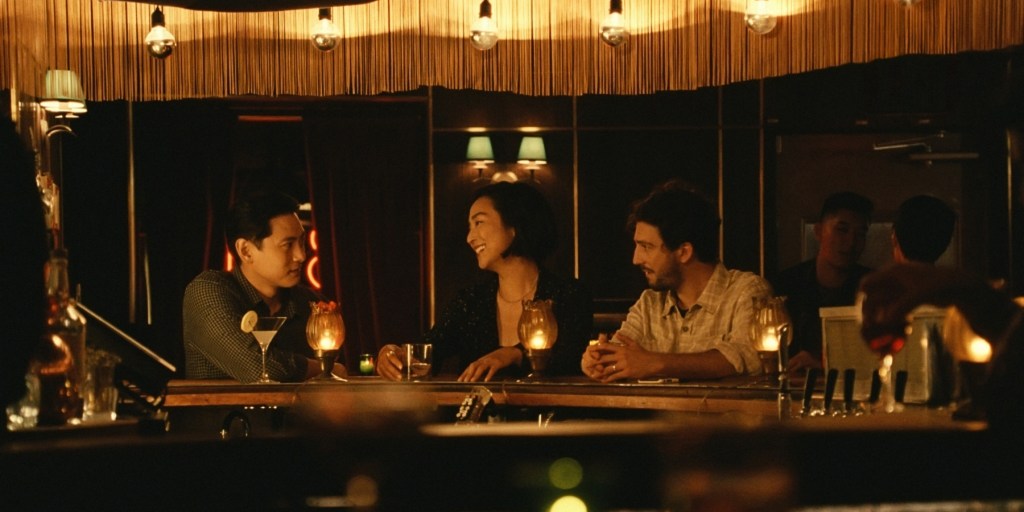
It’s true that the last decade hasn’t been kind to romantic comedies. However, since a resurgence seems to be happening in the subgenre, I’m more worried about this: where did the romantic, not comedic, movies go?
Maybe audiences’ detachment from romance, that has been explained as a financial decision to not watch comedies in theatres, is more symptomatic of a larger problem in our cultures nowadays: we’re so goal-oriented that we forgot the thrills of just feeling for feelings’ sake.
So, it was with optimism that I sat down to see Past Lives. A semi-biographical romantic movie, by first-time filmmaker Celine Song, in which she uses the reconnection of two childhood friends to contemplate how ethereal imprints like love or destiny can affect the roads we choose in life.
And how it’s more nuanced than that, by those imprints staying with us after said choice.
As much as this is a story about Nora and Hae Sung, it is also a tale about New York and Seoul.
The two cities are treated like more than two extra characters. They float through the narrative threads like metamorphic entities who range from mimicking their human counterparts, fusing into one big globalised cosmopolis, to confidently conveying why each is bigger than, mysterious and attractive to, both Nora and Hae Sung.
While never showy, these switches in the visual storytelling do a lot to establish how the different aspects and moods of a complex place can inform the aspirations and decision-making of people. Particularly for Nora, who has images of both cities. But also Hae Sung, who has carried the promise of New York.
It really was one of this film’s elements I enjoyed the most: the way it articulates cinematically that old adage of “right place, right time”. The script is interested in the power of time, as it doesn’t shy away from big jumps or from crosscutting between them to establish shared meaning. Even so, the real movie magic here is how the production and camera crews expressed that engagement (and coping) with time through its relation with the texture of different places.
One minute we are at a generic rock sculpture in a rare metropolis green space, the next we are at a Korean neighbourhood stairway crossroads. Then, we jump to New York, wide flat streets, small apartments and big windows. Back to Seoul again, now at night, rain, steam and neons, while loudly eating out with your friends. New York again, Montauk to be more precise, with an idyllic sun and green for inspiration at a writers’ retreat. Life goes by… Buildings, architecture, and work start to homogenise into a choice of being that it’s neither eastern nor western…
And, suddenly, we are back at a generic rock sculpture in a rare metropolis green space.
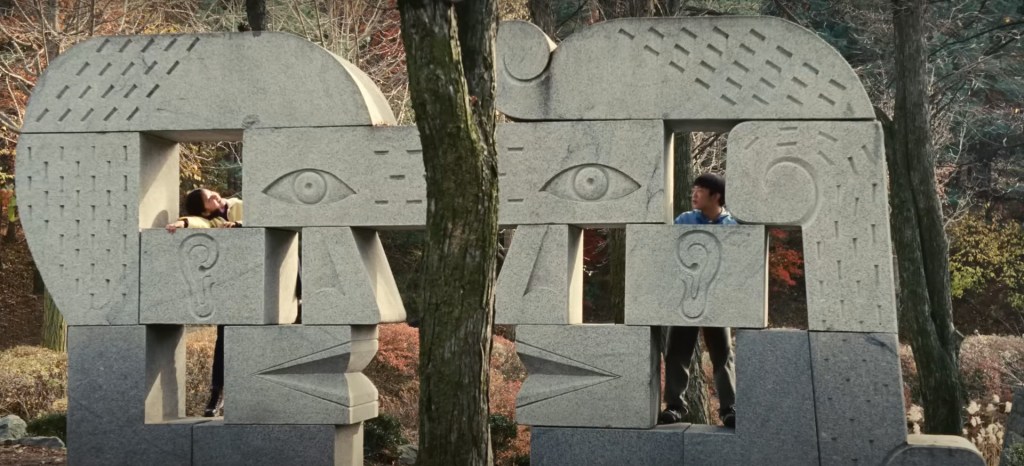
These images are overt choices, yet they work more as clear-eyed reference points than grand metaphors or visual statements. They hit. Even if we are focusing our attention to architecture or iconography, our subconscious is connecting other dots.
I feel like this way of shooting backdrop and still entering into conversation with the audience is praiseworthy. It circumvents the distraction of a larger-than-life connection between the story of a place and the story of a people, and focuses the lenses and our thoughts to the way the vibe of an environment can simultaneously imprint humans and exude from them (to material change).
Past Lives manages to communicate in this way because everybody involved in crafting the visuals of the film followed with sobriety the teachings of the old masters of cinema. It’s a technically immaculate movie, without ever needing to aggrandise the power of art to both explain and elevate life.
The soundscape and the music also follow that same ethos. Classical, skilled and sublime, yet, more interested in deepening a place than ferrying you to it. Aural symbology is ever present, but it’s understated and not a showcase.
More importantly, you notice ambience contributing to a feeling of want. A yearning never uncomfortable nor awkward. It feels like it has been with you for years. And, now (while watching the movie), you want for it (the feeling and the movie) to start talking to you.
The most powerful moment? The film earning the right to not talk to you.
Like the one in the world of the movie, the environment and the audiovisual elements that compose it influence the way people (characters and audiences) think and feel about situations life presents them. Music is never late, nor is it early. It arrives precisely when it was meant to.
Or the space between characters in scenes we thrillingly want for them to talk to each other. Yet, more than the silence, it’s the subtle story and presence of the backdrop in the blocking that turns the physical distance in the framing into metaphysical.
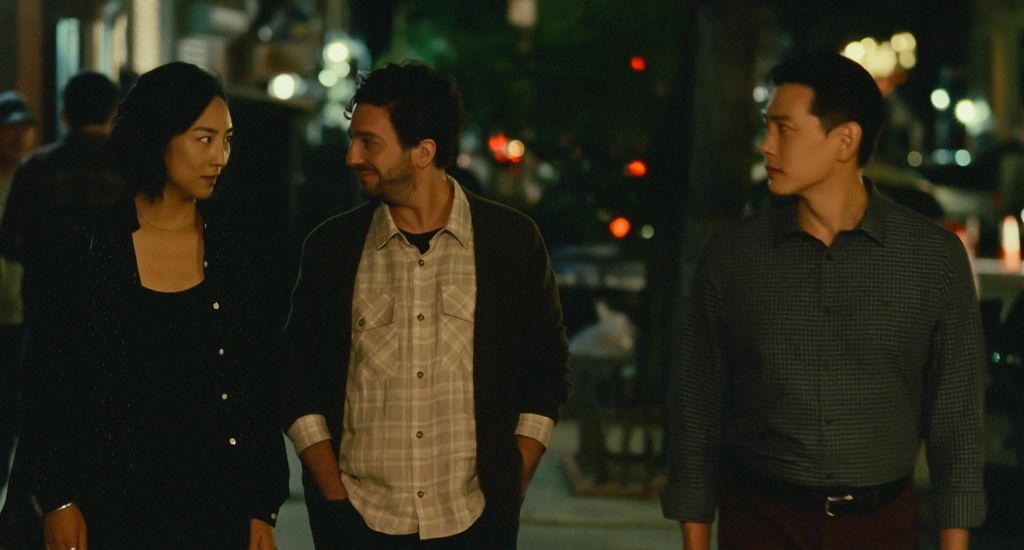
Of course, none of these ways of conveying ethereal imprints through the cinematic lens would land or resonate if the performers weren’t also skilful and believable at transforming abstractions into real states of being, knowing and, more importantly, not knowing.
It’s not an exaggeration to say that this film has some of the best acting you’ll see in 2023 new releases.
Greta Lee (Nora) and Teo Yoo (Hae Sung), both are pinpoint perfect at hitting three states of being that go a long way in relaying the message of the film and making the audiences care for their destinies: they are singular, fleshed-out humans; they are us, through shared occurrences and manifestations; and they are themselves in a stringed connection that is in dialogue with real feelings and compromises, and also with a kind of cosmic harmonization where, whether profound or superficial, consciousnesses find a place to impart essence or empathy.
As a semi-biographical story, Lee takes centre stage. Still, her performance doesn’t conduct the action in the script. Time and space do, and Lee, as an emotional intelligent being, reacts to the opportunities and challenges those two giants put in her path. The most captivating choices of her acting are the ones where she is thinking, while not asking for the camera to close-up. She delivers internal conflict in a way it is rarely done – as something natural in our lives, and not drama for drama’s sake.
It’s rare that I find incoherence as something compelling in a movie. Most of the times, it’s either an unaccounted flaw or a cue for overacting. Here, Nora’s inconsistency is thoughtfully internalised, and the way the screenplay and Lee deconstruct it through rationalisation made her more relatable. Even with the absence of a pay-off or a conclusion, there was always a clarification for her (and us) coming from that process.
Teo Yoo, on the other hand, builds up Hae Sung as a figure of vagrant stoicism. However, there’s a thing, one thing, in his eyes that makes this one of the best performances of the year.
He is a physical presence, and has strong ideas about the world. But, that missing piece inside of him is heartbreaking. More than capable of living without it and achieving success, he needs to know. He needs to, at least, understand it. We always need to understand. How it calibrates our centre of gravity, and, more often than not, if the world around us cares for it.
Lastly, but definitely not least, John Magaro, playing Arthur Zaturansky, is a secondary performance bringing to the forefront the primary theme of this movie. He could’ve easily been a personified punctuation mark in the screenplay. Halt the swooning! No. When I say that this is one of the most adult and emotionally intelligent romantic films of the last decade, one of the main reasons for that is in how Arthur was written and Magaro plays him.
We’ve seen other movies and performers in this subgenre coming to the Arthur part and acculturating the audiences to competition. The thought that if we are rooting for or against something or someone we will be more engaged with the narrative. Nothing against it, but that re-framing tends to overtake the real thematic resonance of stories.
By putting Arthur, a supporting character, on the same playing field as Nora and Hae Sung, but focusing more on his interior conflict than on the conflict between them, gave frame space for him to be a real person (with curiosity, insecurity, bitterness and empathy), and also (because of that) for us to look at him and the narrative confluence as more than archetypes in an arena.
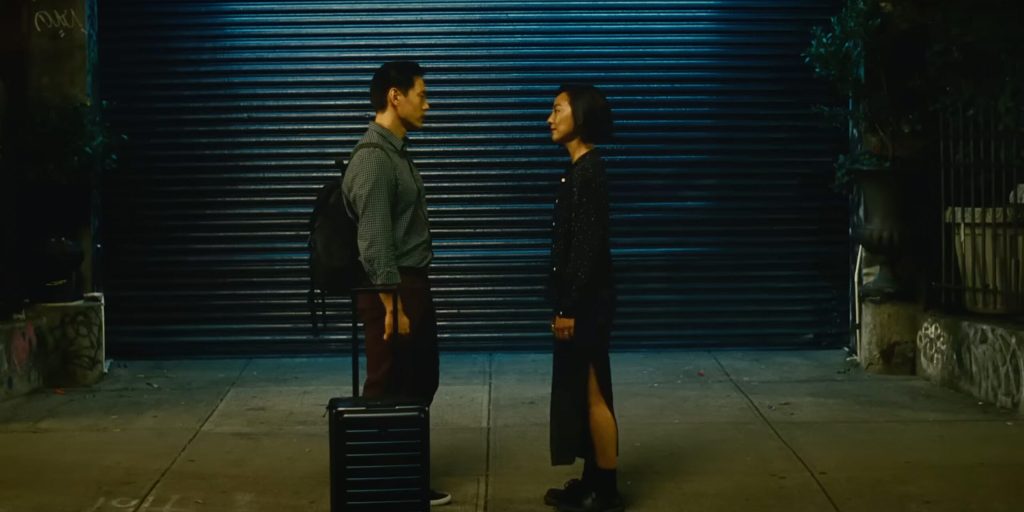
The thrills of this film don’t come from the relationships we win or lose. They come from the challenges of navigating the ones we are currently in. And how they relate to other aspects of our life, at different places and times.
Like I said above, this is a technically immaculate movie. It doesn’t need to express itself too much literally, because its subtle implementation of fundamentals works on audiences’ subconscious. At the same time, this sober respect for the foundations of cinematic storytelling makes the visuals not the most innovative or risqué.
Where the film finds originality is in its writing. Not because of what is it about. But, how is it about it. Original in the sense that only Celine Song could’ve written and directed how these characters live out this story.
We are different people at different points in life, and Celine had first-hand account of how these human beings dealt (and are still dealing) with that incoherence.
Additionally, I found this screenplay even more engaging when I started reading it as Celine Song being intrigued by the possibility of incoherence making us more interesting humans. Not because it makes us enigmatic, but because those inconsistencies are imprints from different people and places in us.
Past Lives frames love as drama, but it doesn’t mean it has to be tragic. Some scars (outer or inner) connect us physically and ethereally to meaningful moments in this journey of cosmic dust. And, like Nora says:
«He’s so Korean. When I’m with him I feel more and simultaneously less Korean myself.»

 Opinion Seed