Back in 2019, when I watched the adaptation of Little Women by Greta Gerwig, I thought: this feels like Spielberg.
Not in the sense that Gerwig is “the next Spielberg”. She is whoever she wants to be. But, in the sense that she can do feel-good, brainy sentimentality at an epic scale.
Like all the best Spielberg’s, there’s nothing missing: technique, artistry, well-paced choreography, complete grasp of the size of the silver screen, intellectual stimulation, and the human element.
There’s something for everyone. Gerwig’s contemporaries like Damien Chazelle or Jordan Peele, even if as forward-looking in form and style, don’t quite hit in the same spielbergian breadth.
So, hearing that Margot Robbie pitched Greta Gerwig as a visionary director to Warner Bros on the Barbie rights, using Steven Spielberg and Jurassic Park as a benchmark, makes total sense.
Apparently, Robbie also pitched $1 billion at the worldwide box office, since the 1993 dino epic had grossed $1.1 billion. And even if she thought she was overselling it at the time, I always had the suspicion that Gerwig has this ‘biggest filmmaker in the world’ potential in her.
Barbie, as a screenplay for a first live-action recreation, is a Rorschach test.
From audiences who wanted a faithful rendition of the doll and its world, with no existential crises or social commentary to contend with, to people like me who wanted Barbie Land to serve as a kind of surrealist backdrop to an analysis on the puppet masters behind the puppets of a patriarchal-capitalist society and the false consciousness that seems to annoy and bother even those most affected by the lack of upward mobility…
This project would’ve never been accepted by either Greta Gerwig or Mattel, if it was designed with one of those extremes in mind.
It’s not possible to review a movie for what it not is.
Barbie is a 2023 American fantasy comedy, directed by Greta Gerwig from a screenplay she wrote with her partner Noah Baumbach, and financed by Mattel and Warner Bros. And, like in her two previous films, Gerwig maximizes the scope and the reach, despite inherent restrictions.
With Lady Bird (2017), she showed the majority of coming-of-age comedies of the late 90’s – early 00’s (the American Pie – > Judd Apatow emporium) that, no matter how personal and financially constrained, a film can be funny, hit deep, and be visually artistic.
And now, with Barbie, she shows parody movies of the same period that it is possible to satirise with appreciation for the object of satire, by resorting to a study on its influence over our own self-consciousness, instead of only and constantly lampooning.
It’s not the deepest feminist study. But, honestly, for what it is (what Mattel would allow) – a broad-spectrum comedy –, it’s better that its analyses and declamations are made through the language of facts, and not of philosophy, sociology or anthropology. This way, at the very least, one of the first barriers of false consciousness is knocked down: young minds, or even old ones, become privy to the realness of something that is different from how they were trained to view it in the first place.
If a billion-dollar movie is doing this with its reach, I’m very happy. In fact, I suspect that it not being didactic is one of the main reasons for its success with audiences. With the exception of a monologue by the end of the second act (could be better, but all facts), the screenplay is not preachy of its ideas, and I have to trust that the smart and engaging humour is (if not my favourite way) an efficient trojan horse for subtextual education.
And, if you want Gerwig’s more in-depth examinations on womanhood and feminism, go see Lady Bird and Little Women. Not only are those richer texts, but I’m also not entirely sure that, this time, she wasn’t as interested in Ken as she was in Barbie (more on that later).
Visually, Barbie is not always on the same level.
By choosing to have its story take place in both a fantasy and a real world, the film embraced contradiction. That’s great and thematically appropriate. The problem is that the design and camera departments never found a way to make the real-world sequences look compelling or at minimum stimulating on their own terms.
For example, the fantasy of Barbie Land was partly generated from alluring shots by Rodrigo Prieto, the director of photography. So, it disappointed me that such renowned cinematographer, particularly from non-fiction works, shot the real-world scenes in such a conservative way.
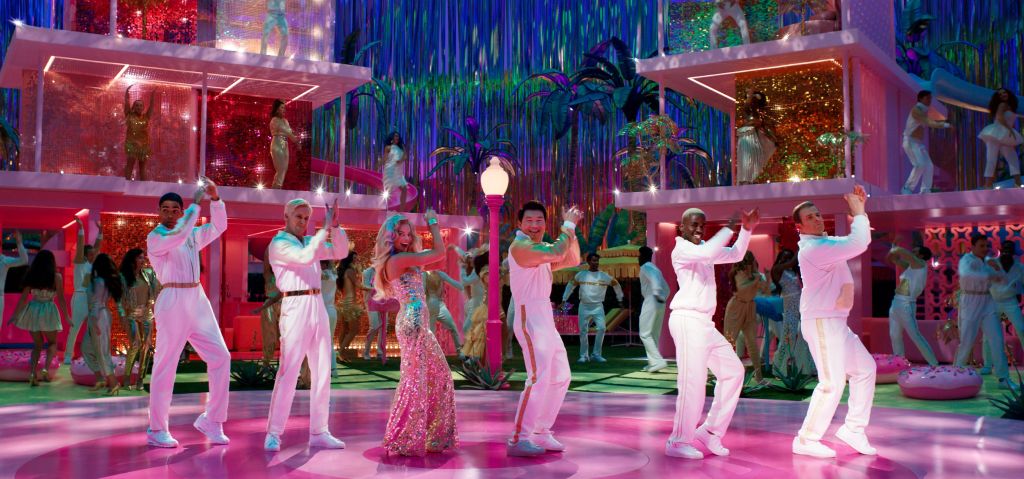
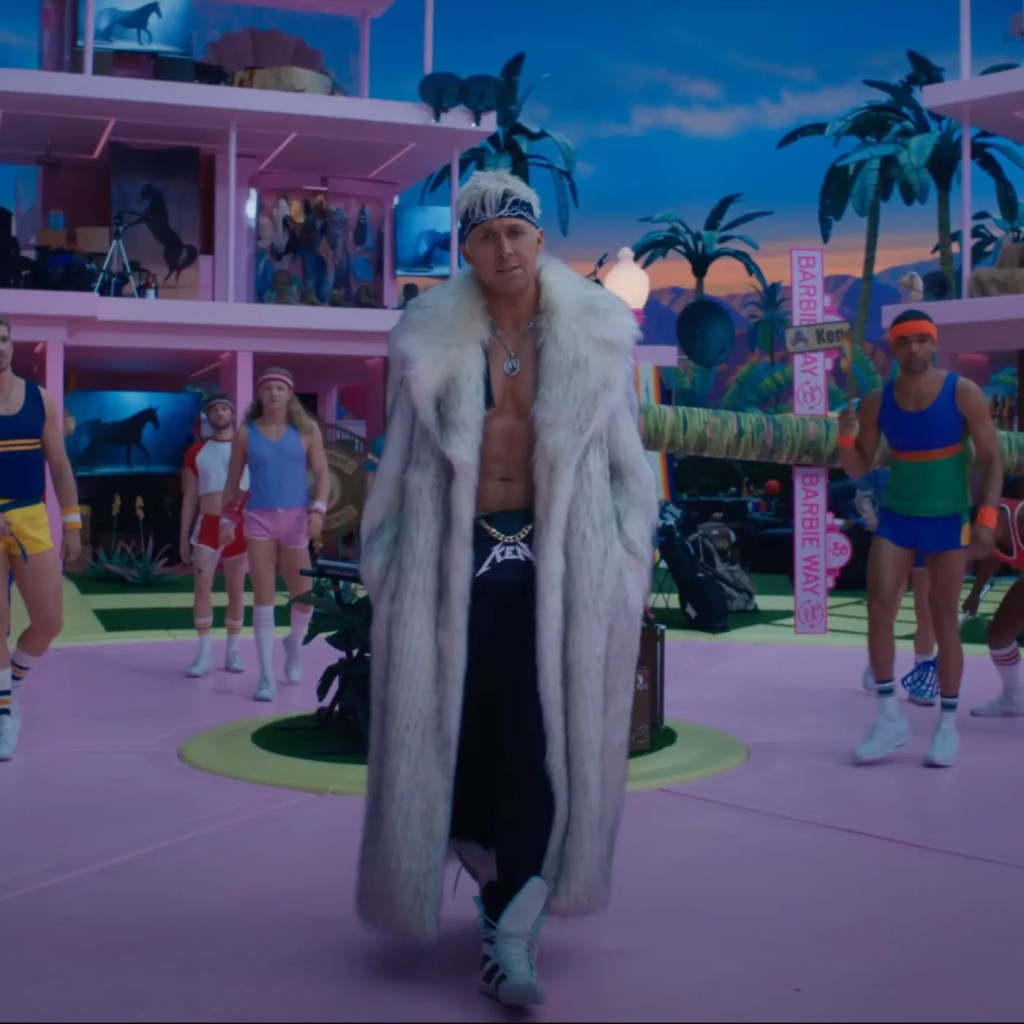
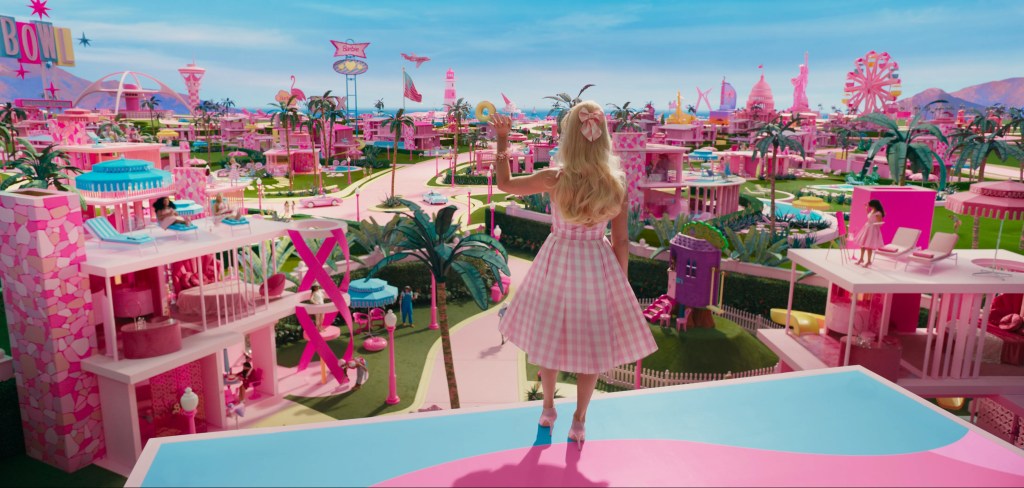
That being said, and besides Margot Robbie and Ryan Gosling, the star of the show is Barbie Land itself. The set design by Sarah Greenwood and its decoration by Katie Spencer is a work of art. They managed to create a Technicolor land, with no green screens, that simultaneously complied and delivered on two essential rules of fictional worldbuilding: a traceable sense of place for the audiences; and an atmosphere that is in dialogue with the themes of the story.
Barbie Land has architecture with function, with its landmarks being memorable and easy to identify in relation to each other, while being able to communicate the absurdity of perfection of the beginning of the movie and the delightfulness of an imperfect place we call home and want to keep improving.
It was filmed in an interior soundstage, but it never felt claustrophobic or too controlled.
In parallel, the costume designs by Jacqueline Durran, if a bit more product placement-y for my taste, also result from the same self-assured artistry that affirms place and function (where she’s going and what she’s doing) as not incompatible with owning your character and personality.
That notion of ownership is integral to the film’s conversation with gender, gender roles, as well as sexuality as a source of power expressed through style, fashion, and clothing. Ken, for instance, is shirtless in more than one scene, with Ken-branded underwear, and with more than one wristwatch to tell the time.
This movie’s whole design ethos could have easily found its expressiveness in the kind of fantastical exuberance of a Met Gala style. But, no. Barbie’s stylistic directive was of everything needing to be of ‘our-world tactile’. Because, even if we are seeing dolls, those are things we touch. And they have a practical connection with our reality: it’s about being dressed for a job or task. This, subconsciously, does a lot to make the themes of the movie hit closer to home.
Still, the Makeup Department did some kind of wizardry to the skin of the actors, because there are scenes when they pass as head-to-toe lifeless dolls.
Another contribution that helped set the mood and convey the message was the Music.
Seriously, there is out there an alternative timeline where Greta Gerwig wants this screenplay to be a wall-to-wall musical, and Margot Robbie manages to convince the execs from Mattel and Warner Bros to do so. And I know Gerwig could have pulled that off, looking at how she captured choreography and action in Little Women.
As a matter of fact, I ended up a tiny bit disappointed with the musical sequences in Barbie. They are very good (particularly their lyrics and cinematography), but I know Gerwig could have done them bigger and more dynamic. Maybe her inexperience working in controlled soundstages shackled her a bit. Albeit, can’t wait for her first musical, if she decides to do one.
I must confess to be one of those old farts that reaches an age and stops keeping up with current pop music. However, it didn’t stop me from appreciating the soundtrack of this movie. If not visually, the film certainly achieves a musical aesthetic of a modern pop opera in its entirety.
Hearing that Alexandre Desplat was penned to score Barbie scares me. Nothing against the two-time Oscar winner, his original compositions for Little Women are some of the best in modern film scoring. But, Barbie definitely needed a less classically-trained conduction.
Mark Ronson instead was an inspired choice. Particularly, knowing his track record with disruptive women musicians.
There is a lot of reclaiming in the lyrics of this soundtrack. In particular, and its greatest triumph, the way it exposes the content of late 90’s – early 00’s megahits coming from proclaimed ‘progressive’ subgenres like nu metal, alternative rock or post-grunge. Those benefited from a general mistaking of rowdiness for radical, at the time, to pass along the same old values of toxic masculinity and woman objectifying.
Ken playing the guitar and singing Push by Matchbox Twenty ‘at’ Barbie had me and many people in the theatre laughing loudly.
In 1997, we thought that kind of music and lyrics were cool. You know what’s cool? The three HAIM sisters are cool.
Margot Robbie and Ryan Gosling are also very cool.
They are so incredible in their acting that they carry the entire movie almost on their own. I also appreciated the realness of America Ferrera and the charisma of Simu Liu. But, that’s pretty much it.
Maybe by design, but many of the other cast members were not given much to do in the screenplay. The supporting performances who were given a little more end up feeling a bit too typecast: Will Ferrell, Kate McKinnon and Michael Cera are good, but more because of quality writing than their inventiveness as performers.
Nothing against focusing on two lead characters. I actually prefer it. It’s just surprising for this kind of ensemble.
The two leads are at the top of their games, though.
Gosling, with this work, cements himself as the current Hollywood star with widest versatility. We had already witnessed 2011, when he gave us his two extremes: the jesting smirk of Crazy, Stupid, Love; and the brooding masculinity of Drive. In 2016, he went even more experimental with his comedic chops by working with Shane Black in The Nice Guys, and also found an underrated balance between the two personas in La La Land.
For a time, I thought we may had lost tongue-in-cheek Gosling, as his latest acclamations, for Blade Runner and First Man, were insisting on channelling the same dark nihilism of Drive.
Nope. He’s back!
I prefer the meekness he explores in The Nice Guys, but, as Ken, he is arguably pulling from a wider and deeper well of human behaviours. He is more than a character-arc personified. He wrestles with the arc comedically, without neglecting the real feeling that comes out of that catharsis.
It’s the most showy performance of the movie, but you never roll your eyes because there’s not a shade of overacting coming from his comedic timing and relatable inner conflict.
The titular character, on the other hand, and counterintuitively, is the most underrated acting in this film. Margot Robbie as Barbie is holding so much in. It’s her poster, yet, in total service of the screenplay, its themes, and of landing an important message she lets the movie happen to her, instead of she happening to the movie.
Of course, there wouldn’t have been a plot or drama if the doll wouldn’t fall and break. And, in those moments, the talent that has gotten her Oscar nominations for I Tonya and Bombshell shines through. Still, what makes Barbie the best performance of her career is the chaos and suffering coming out of her eyes when she doesn’t seem to be broken.
It’s a stoic work of artistry coming from an artist that is on this project for something she believes in, instead of calculating the effects it might have on her career.
With so much name recognition involved, I have even more respect for her choosing to approach it this way. I’m aware that it’s not the most controversial thing to say that the Barbie actress is good in the good Barbie movie… However, I would have never guessed it was for these reasons.
Giant credit to her, in the truest meaning of the word.

Circling back to Greta Gerwig, the other creative partner that deserves a lot of credit for being subversive with a monolithic consumer product, I will end this review by saying this…
Overall, this is a 6/10 movie, elevated to a 7/10 thanks to:
- the ingenuity of who envisioned, designed and built the sets for the sequences in Barbie Land;
- how those sequences were shot by Rodrigo Prieto and his team (particularly the musical numbers);
- the larger-than-life performances by Margot Robbie and Ryan Gosling, with surprisingly minimal overacting to speak of; and
- the writing in the screenplay, that managed to convince Mattel and Warner Bros executives it was a good idea to finance a big summer blockbuster, based on one of the most recognizable symbols of global culture, and use it as a trojan horse for ideas on the perils of toxic masculinity, grandfathering in capitalism and of overall cool-people clubs.
This final point will be the lasting legacy of the film. Not the ideas by themselves – richer texts have been written, even by Gerwig herself. But the fact that those ideas reached a Billion dollars’ worth of all types of audiences.
Whoever sees Barbie comes out knowing that the insecure and ill-intentioned propaganda of the movie having an “anti-men” screenplay is worse than a distracted observation, it is a factual lie.
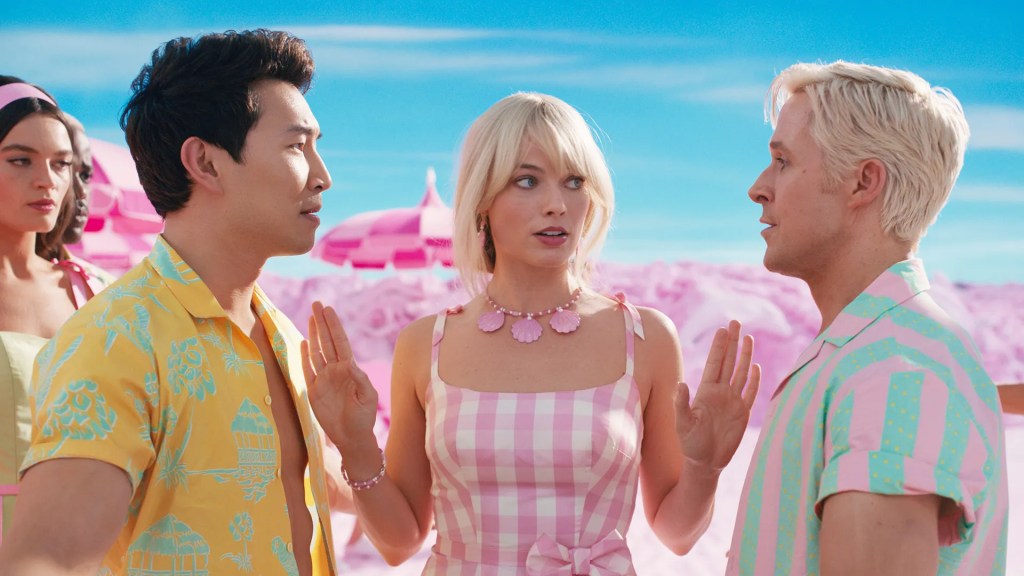
The first thing Gerwig does, which is a crucially intelligent cornerstone for how this fictitious world operates and her message resonates, is role-reversing the genders. The Kens are the ones being left out of the cool-people club.
Notice that it is Ken who says the word “Patriarchy” more times. Gerwig is genuinely interested in seeing if all the gains generated by that type of male strength – money, iconic remembrance, winning – fulfil him as a rational being.
The screenplay, instead of being about One of the sexes falling and rising back up, is about the Kens discovering the power toxic masculinity grants them, the Barbies contending with the power they had before, and ALL arriving at a starting point:
A flawed world not solved, but with a better understanding that power, the power to have job titles or buy things, or the power to be above something or someone in a leaderboard is not a real relationship or a way to be immortalized.
It’s really impressive that Gerwig managed to direct what is a complete wall-to-wall light-hearted comedy, with almost no hiatuses in either physical or spoken jokes, fun for all ages, and do it from the cornerstones of sophisticated subject matters in psychoanalysis, sociology and anthropology.
Comedy is not my favourite vehicle for contending with ideas like these. However, I have to admit that not only does it make them more palatable, thus more engaging to more people, but also that there is brilliance in casting Ryan Gosling, like in Blade Runner 2049, to play a doll who is questioning what it means to be a real man.
 Opinion Seed