
The paradox of fandom.
If I say a Christopher Nolan film is good, is it getting extra points, or is it better than that, but I’m giving it a harder time than other movies because of my expectations towards someone I’ve been considering to be my favourite filmmaker for 20 years?
There was a time when I felt that Nolan was incapable of creating an uninteresting movie. This feeling cemented itself even more after Dunkirk, a construct I had bet to finally disappoint me, because I am a bit tired of historical dramas, and, notwithstanding, ended up manifesting itself as his best work to date.
Simply astonishing how in just 1h45m he reinvented the form of how to tell a war story, without any traces of hubris from the creative genius. It’s simultaneously complex and clean. I thought to myself: this guy can’t miss.
Then, I watched Tenet.
I wouldn’t necessarily call it an uninteresting movie. But, it’s certainly not Chris Nolan ‘good’. Maybe illogical good.
That’s the context Oppenheimer had to face from me: defences way high, because my fandom had taken a punch. If I was unsure about Dunkirk, imagine how I was before a 3h procedural biopic with tinges of courtroom drama…
Oppenheimer is a very good film.
Of all his best movies, this is the one that’s taking me the longest to acknowledge as great. Maybe because it isn’t, or maybe it is, but I just need more time.
What makes Nolan my favourite filmmaker is how he assembles the crafts – production design, cinematography, music, writing, editing, etc. – in service of communicating very complex concepts in a language that is, for all audiences, simultaneously comprehensive and curiosity-inducing.
And, since Oppenheimer is his most colossal undertaking when it comes to coalescing different (sometimes conflicting) ideas and themes – quantum mechanics, progress, political ideology, military-industrial complex, death –, I want to be sure that the crafts, which are immaculate, serve and underscore, instead of superimposing or showcasing, the thematic project.
The fact that I’m needing more time than usual to process the film says three things about it: (1) maybe I don’t possess the intellectual maturity to assimilate so many problematics and connect the dots between them on such short a notice; (2) maybe the movie is tangibly too overwhelming coming out of the theatre (I don’t see it necessarily as a bad thing, but it’s completely justifiable to see it as a knock); and/or (3) maybe the film has the type of importance that needs that kind of time.
So, without removing myself from the responsibility of poking at the questions the film asks – in a non-spoilery way –, the main purpose of this review is to convey, as objectively as I can, the what and the why of sensations coming out of the theatre the first time, and, above all, to ascertain if its crafts and cast, albeit grandiose, had the dimensioning to frame all those audio, visual and even narrative stimuli into a coherent message.
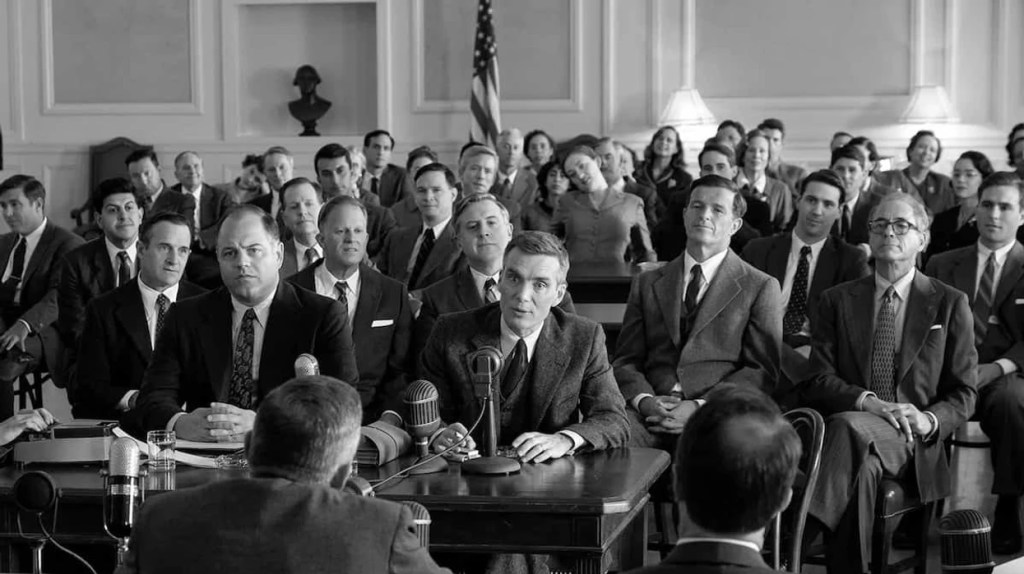
First of all, how can this film only have cost 100 million dollars to produce?!
I bet the actors didn’t demand huge salaries, just for the opportunity to work with Nolan.
And to call this a star-studded cast is the understatement of the year. It’s as if ALL Hollywood decided this was an important story to tell about the perils of (American) exceptionalism.
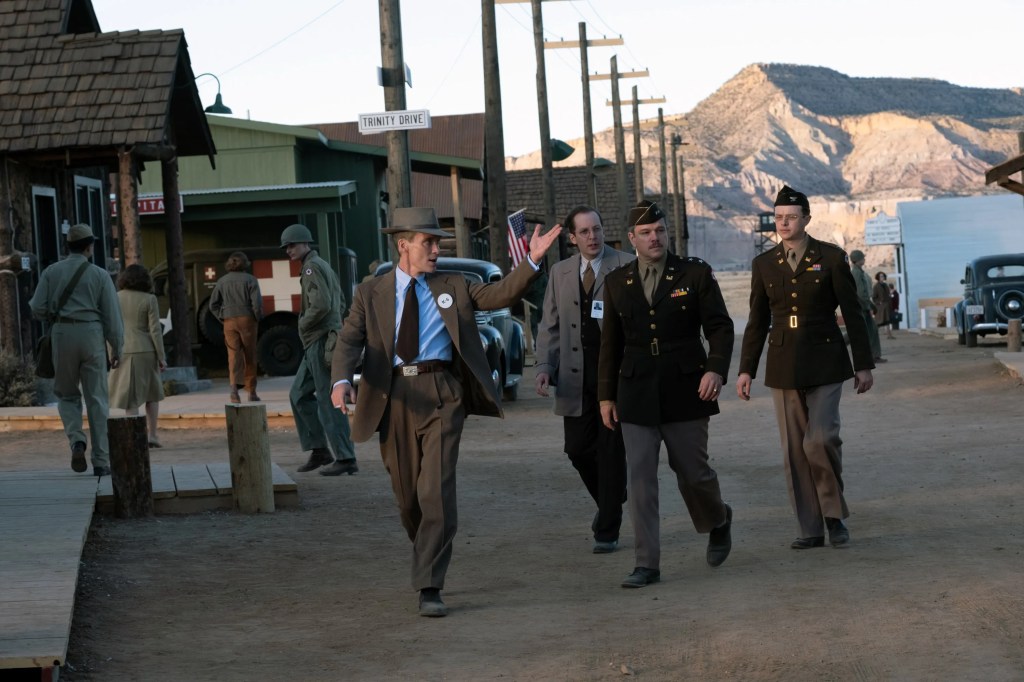
Then, in true Chris Nolan fashion they decided to capture everything on camera. Which means tactilely building everything up: from constructing a version of 1940s-era Los Alamos on top of a similar plateau at Ghost Ranch, New Mexico; to equipping the sets with expensive scientific tools, gadgets and apparatuses; or even finance Research and Development of non-computerized visual effects to safely recreate physicochemical phenomena like, say, an Atomic explosion.
Add to that, also in Nolan fashion, three timelines, with sets of prestigious Universities and Governmental buildings, as well as costumes and makeup appropriate for the time and place. (The makeup and hairstyling of the actors we get to follow through time are particularly trusting of the audience’s intelligence to figure out the chronology – i.e., they don’t overaccentuate getting old or young to an unrealistic degree).
More than expensive, this movie feels Big.
I know there a lot of scenes of just people in rooms talking. But, still… A complex project like this has all the trademarks of something that would have its budget skid.
Emma Thomas, Nolan’s wife, and chief producer of all his movies, should get a lot of credit here for allowing for so much, with relatively so little (if we look at budget references of other current big blockbusters).
I will talk about the amazing cinematography by Hoyte van Hoytema in a second, but first I need to address some of the most underrated visual work done in this film: the one produced by the Special and Visual Effects departments.
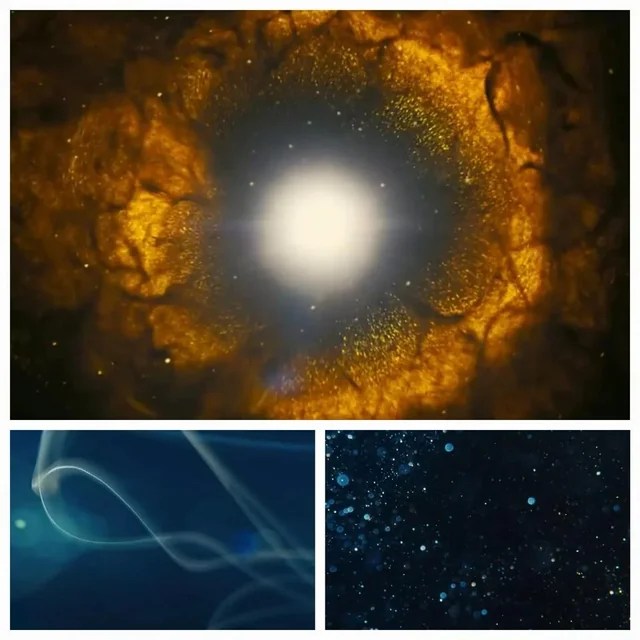
Yes, it’s a talkie chamber piece in form, but it would be off-brand if Nolan wouldn’t want for its content to not reverberate beyond four walls. They might be short clips, but, for me, one of the aspects that added the most gravitas, to both the science and the political of the film, were the visual interjections: electrons orbiting around the atom nucleus at high speed; a black hole absorbing all the light around it; a star exploding like an atomic bomb; the atmosphere catching fire…
This is not a conventional Oscar-bait biopic because the film is not enamoured with its own dialogues. He cuts conversations abruptly with these real effects to show that not only the Universe but also the material world is much bigger than humans, and that we should be very careful of trying to control something we don’t fully understand.
And when I say real, I mean REAL. No computer graphics. Even those visuals of physicochemical phenomena are captured on camera. How?!
Well, another aspect of Nolan’s filmmaking I appreciate is how he knows what he is – a filmmaker. I.e., if he decides to make a movie about science, he doesn’t fancy himself an expert. He seeks scientists to collaborate with. From Interstellar (2014), for example, the Visual Effects team, alongside astrophysicist Kip Thorne, ended up publishing a peer-reviewed scientific paper on black holes.
In Oppenheimer, the Visual and Special Effects teams had a laboratory built on set to come up with tangible physicochemical reactions that could realistically pass as atmospheric or atomic events. I don’t want to spoil how they recreated an atomic explosion safely for everyone on set, but let’s just say the probe lenses of the IMAX camera rendered a frightening vertical image in the theatre.
Speaking of the IMAX camera, I circle back to Hoyte van Hoytema, the Director of Photography.
After seeing Nope last year, and now Oppenheimer, I don’t feel I’m being hyperbolic by saying this: he is my favourite cinematographer doing work right now.
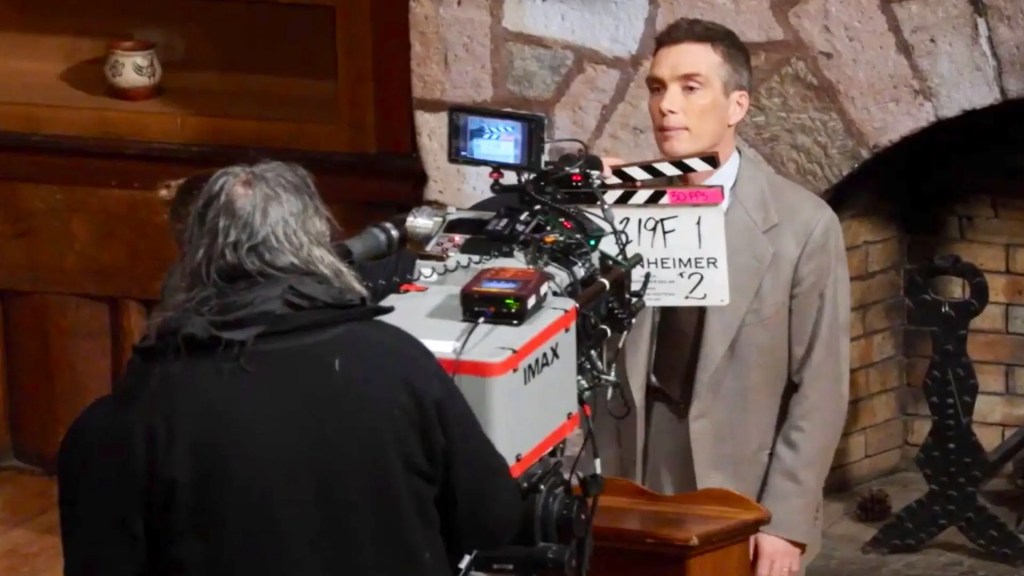
We all know IMAX is top state-of-the-art when it comes to picture quality. Even so, filmmakers (Nolan included) have been, for the most part, resorting to the technology to raise audiences’ immersion in big vistas or big action sequences, thanks to the enveloping nature of the large format rendered by said tech.
Don’t get me wrong, I love an IMAX landscape. That verticality almost rewires your brain on how to study the painterly vision and objective of the director. Yet, it’s precisely that reconfiguration suggesting a potential for other types of images to go through that capturing device.
I would have never guessed that one of the first typologies to test this was a chamber piece biopic with a lot of close-ups on characters’ faces and on their inner and outer dialogues.
And it works majestically.
This way of channelling the power of an IMAX camera to capture and convey the interiority coming out of a person’s eyes will be taught in film schools for years.
In fact, if I had to summarize the main idea of this film, and how it communicates its thesis in a way that only cinema can do, it’s literally the opposing forces of something big and important colliding with something small and flawed like the human face.
We, as a species, are not ‘programmed’ to be in conversation with another human’s face so big and so up close.
It protrudes a weird stickiness from it. Like our skin is fusing with Oppenheimer’s. And we are sharing in his fears and doubts – a shared human guilt and shame for the horrors we are capable of unleashing into the world.
Frightening stuff.
I come bearing other good news!
The sound mixing is good.
Even though Nolan is primarily a visual storyteller, his predilection for architecting tangible narrative structures out of intangible conceptions, sometimes adding non-linearity to plot threads, makes it that, sooner or later in his movies, there comes a character or characters doing a lot of exposition.
This can be pointed out as a flaw in his filmmaking. Nevertheless, he resorts to that “telling instead of showing” crutch to contextualize the peculiarity of this new world he invented, its ruleset, and, above all else, to systematise and to rationalise the language here so that the audience can begin to interpret and externalize meaning out of what he cares the most – the story he wrote.
The thing is… Nolan is not only a visual storyteller. He is an AUDIOvisual storyteller. He loves his foreign sounds, the worldbuilding power of music in film, and how the sonic soundscape of a scene can elicit emotional resonance by touching the body. That physical-to-metaphysical feedback loop that makes him be such an evangelist of the theatrical experience.
So, in an otherwise technically impeccable career, if there’s one blemish in his craft that deserves reprimand, more noticeably since The Dark Knight Rises (and borderline flagrant in Tenet), is his stubbornness to not resort to ADR (Automated Dialogue Replacement) in scenes where that same soundscape is so loud that audiences can’t discern what the actors are saying without subtitles.
Apparently, Nolan decided against ADR again, which, could’ve been cause for even bigger alarm since Oppenheimer, as a biopic in form, is by far his most dialogue-heavy movie.
Like I said, no cause for concern. The sound mixing team did a very good job maintaining the levels of the actors’ voices recorded on the day of shooting, whilst having to contend with one of the highest counts of intercutting foreign sounds in a Nolan edit.
Speaking of idiosyncratic sounds… The sound editing team also deserve their flowers here. I don’t know if there’ll ever be a device that can capture the sounds of electrons spinning, or a star dying, still, I completely believe the ones this film sold me on.
Ludwig Göransson.
What more can I say about this young virtuoso that hasn’t already been said?
Came into the scene with Creed, a spin-off from a film series known for its larger-than-life songs (Rocky). Then, upstaged Alan Silvestri by composing the best soundtrack in the Marvel Cinematic Universe, winning him his first Oscar at the age of 34 with Black Panther. Shortly after, upstaged another legendary maestro by composing, for The Mandalorian (a series I didn’t much care for), some of the best music coming from Star Wars since John Williams gave the world Duel of the Fates (1999).
Despite all that, I would’ve never imagined that even this level of virtuosity could come knocking at the door of one of the most unbeatable sequences between director and composer, and feel right at home.
I mean… Nolan-Zimmer is responsible for some of the most pungent original compositions in the history of cinema. We are talking about Eptesicus, A Dark Knight and Why Do We Fall? from the Batman trilogy. Supermarine and The Mole from Dunkirk. What about Cornfield Chase, Day One, Mountains or S.T.A.Y. from Interstellar? And don’t even get me going on Dream Is Collapsing, Mombasa, Dream Within a Dream and (possibly the best piece of music ever composed for a film) Time from Inception.
Just writing those tracks’ names gives me chills. So many powerful memories that will never leave me. Beautiful music that walked toe-to-toe with equally beautiful images.
A great soundtrack has the magnitude to be worthy of the thousand-words in a picture, as well as elevate them. This effect was anecdotally explained by legendary director of photography Andrew Lesnie: one day, during the filming of The Lord of the Rings trilogy, someone asked him “where does the light come from?” in a scene where Frodo was up against a wall, and contrasting shadows were needed to generate tension; Lesnie answer explains the feeling – “Same place the music does.”.
And, even if Göransson had already achieved this in Tenet with tracks like RAINY NIGHT IN TALLINN, FREEPORT or POSTERITY… Oppenheimer is on a whole ‘nother level.
Can You Hear The Music is a masterclass in one-take tempo increases of the violin. The way the vibrato goes from the beauty and romanticism of science to the (probably 3x faster) neurotic, manic and horrific chaos of not being able to control the consequences of spinning electrons… Monumental and reflexive – like the film itself.
Destroyer Of Worlds is one of the most impactful pieces of music I have ever experienced in a film. It completely channels the labyrinthine and thorny nature of both Oppenheimer the story and the person. To do so, it goes through the spectrum of music: from live instrumentation full of colour, characterizing the aspiration of theory, to three simple modern sounds in the form of pumping bass, metallic tickling and synths, reckoning with the emotional and material fallout of applying progress without checks and balances. And, this impact is felt in the theatre: after filling it with such an operatic beginning, the track takes the air out of the room with the acknowledgment that, like Einstein said, the math preventing nuclear cataclysm is just probabilities.
The original composition has no drums in its rhythm section. However, the punctuation of time and its weight are expressed as both sensory and narrative cues. In the past, Nolan resorted to a ticking clock. Here, feet stomping.
The scene that finally reveals the source of that sound is even more terrifying than the feeling it had been generating throughout the film.
Simultaneously, and despite the movie having music almost from wall-to-wall, there are moments when it was decided to silence dialogue and soundtrack, and that absence is equally as arresting. You couldn’t hear a pin drop in the theatre.
Cillian Murphy, Robert Downey Jr., Emily Blunt, Matt Damon, Florence Pugh, Josh Hartnett, David Krumholtz, Benny Safdie, Jason Clarke, Gustaf Skarsgård, Olivia Thirlby, Alex Wolff, Matthias Schweighöfer, Matthew Modine, Jefferson Hall, Christopher Denham, Dane DeHaan, Alden Ehrenreich, David Dastmalchian, Rami Malek, Kenneth Branagh, Casey Affleck and Gary Oldman.
Yup, Nolan is THE maestro every musician wants to play for.
Actors wouldn’t be my first bet, though. Cinematographers, production designers, effects engineers or audio engineers flocking to be part of his project to capture everything tactilely on set without a lot of computerized post-production, I get it.
But, if there’s one thing that has been hindering his chances of winning the coveted Oscar for Best Picture is the fact that the Actors Branch has the most votes in the Academy. And, since he doesn’t seem interested in movies as spaces for showy performances with a lot of explicit character development, actors appear to not see his project as soulful as others’.
Of course, there are exceptions. Most notably, Heath Ledger in The Dark Knight, or Hugh Jackman in The Prestige. But, for example, DiCaprio, the greatest actor of his generation, in my favourite Nolan movie – Inception –, doesn’t give one of his best performances.
But now, with Oppenheimer, I think it’s time to put to bed the reputation that Nolan is too much of a controlled filmmaker, who doesn’t engender a set with experimental environments for artists and soulful human expression.
Another reason why this film doesn’t feel like a conventional biopic comes precisely from the type of acting Nolan promoted in it. More often than not, this subgenre is defined by an apparent mission to self-aggrandize the individuals at study – they had to do what they had to do, for great things to happen to the world –, resulting in caricatures of human beings that feel like automaton super-heroes. In Oppenheimer, even if we are observing extraordinary people, Nolan seems to have given his cast a production setting to explore the flaws and smallness of great men.
To be fair, it’s legitimate that some people might feel overloaded with so many stars and cameos. However, I never felt that. And I don’t necessarily think it was because of big actors being apropos to Nobel laureates, Pentagon generals or the President of the United States. If self-aggrandizing and unapologetic it would be distracting. No. I think the setting is believable precisely because the egos of these big performers were subtly masquerading insecurity, pettiness, irrationality, and regret. Great teamwork, and great casting direction.
It’s not usual for Nolan to trust the conveying of feeling and high-concept so much to actors. Maybe because, this time, it’s not high-concept. It’s very-real-concept, and you need the most tangible vehicle to deliver this type of message to audiences – other humans.
Not only did he trust them on that conceptual level, he also allowed for their exploration and deconstruction of historical figures. It would be much safer to portray the image audiences have of these giants. Yet, they did the research and, through that, found human elements that allowed them, as performers, and the audience, as recipients, to be closer to the subject matter (not framing it solely as something larger-than-life), thus making the entire endeavour of the Atomic Bomb and its consequences much more visceral and scarier.
In essence, the film is not blinded or does not blind through the grandiosity of the Bomb. It’s a human creation, a human responsibility and a human guilt. And the majority of the cast did an amazing job conveying that.

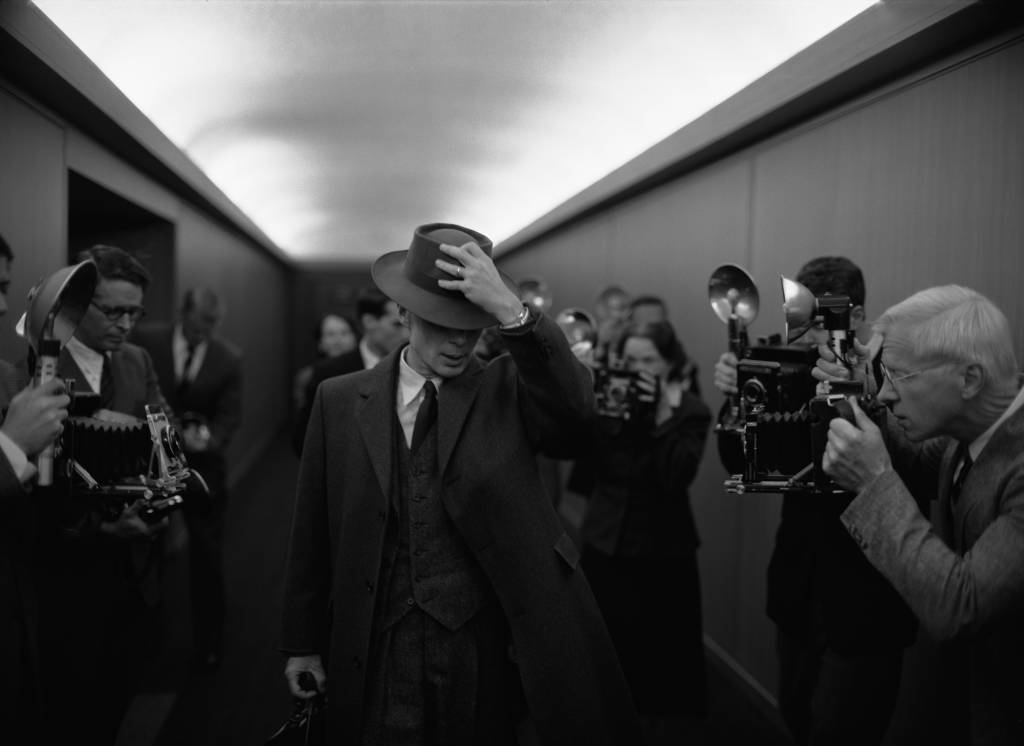
Cillian Murphy is undeniable as J. Robert Oppenheimer.
One of the best single performances I’ve ever seen. An off-kilter rendition for a titular character in a biopic. Usually, we get the boisterous and the externalizations to convince us this was a grand and important man. Not here. Cillian is completely interior. He is not a boxing champion, he is a speed chess player filled with regret about his moves.
His voice is irreproachably intelligent but weighted by the responsibility of what he is talking about. And his eyes… His eyes are another bomb in the film. Bursting with contained inner turmoil, sadness and guilt.
If you know me, you know I prefer internalized acting. So, of course, I was going to love this characterization of Oppenheimer. Still, it’s legitimate that more nitpicky observers might find small moments of overacting in the interiority.
On a second viewing, I read those small contrasts coming from sizzling micro-expressions as intentional by the actor. Oppenheimer is called a sphinx during the movie, but we know he isn’t, precisely because of those micro-seconds. I think our eye, more than the characters in that world, is supposed to subconsciously catch those performance contradictions.
For me, it was consistent with a man who was bursting at the seams (filled with inner disparity in himself), and made that stickiness of skin I talked about early even more palpable. Those micro-bursts protrude and reach you, making us share human skin and human guilt.
It’s much more nuanced and complicated than the typical ‘dual’ acting.
Robert Downey Jr. is finally free of the Iron Man suit. Ironically and coincidentally, he is allowed to fly more here. Without ever overacting, it really feels like he was freed from some kind of acting jail. He runs the complete gamut of human emotions and expressions, despite the director giving us black-and-white photography to show the human failing that it is to be a self-made man who climbed the ladder by being an efficient, yet binary, decision-maker. A reel any student actor should watch.
Emily Blunt and Florence Pugh instantly become two of the best woman characters in Nolan’s filmography. Which, I know, is not the highest of mountains to climb. His track record at writing women is another blemish of his career, but, there are exceptions: Natalie in Memento; Selina in The Dark Knight Rises; or Murph in Interstellar. Be that as it may, Blunt, in the third act, delivers the best acting of her career. And Pugh is crucial at showing (not only telling) Oppenheimer that his lack of commitment to truly understand the plight of the common man would come back to haunt him. His love for theory and ideas is inevitably brought to bear in the real world.
Matt Damon is also undeniable, even if a bit humorous for my own taste.
Alden Ehrenreich is… I didn’t like his performance (or the direction he was given). Too much wink-wink to the audience.
Josh Hartnett, Benny Safdie and Gustaf Skarsgård embody, from different points-of-view, the universal danger of human beings not wanting to have a conversation on morals, when it’s time to get shit done.
David Krumholtz, the unwavering friend, has two easy-to-miss instances showing how individual ambition can wave that aside for a moment.
Jefferson Hall is the friend we don’t want to be seen with, even though we agree with their opinions and, more importantly, were there when we needed them the most. Like Florence Pugh’s character, a crucial person in Oppenheimer’s life to show how unprepared he was for when his ideas had to hit ground. Professional enterprise maintains too many resemblances of children at recess.
Jason Clarke is becoming the go-to actor to portray very angry boys. Here, that negative energy shines a white self-righteous light on how the Law of individual countries or individual institutions, by being closed-off from adjacent and touched on neighbours, is prone to be weaponized for *go figure* individual agendas, without the pluralistic cross-examination we all should demand from it.
Casey Affleck is chilling, and the reason why we should never hand over the bearing of disruptive technology to human beings who see the military industrial complex as the orderly way to make the world a better place.
Sir Kenneth Branagh has replaced Sir Michael Caine in Nolan movies, as the wise man sharing his wise thoughts.
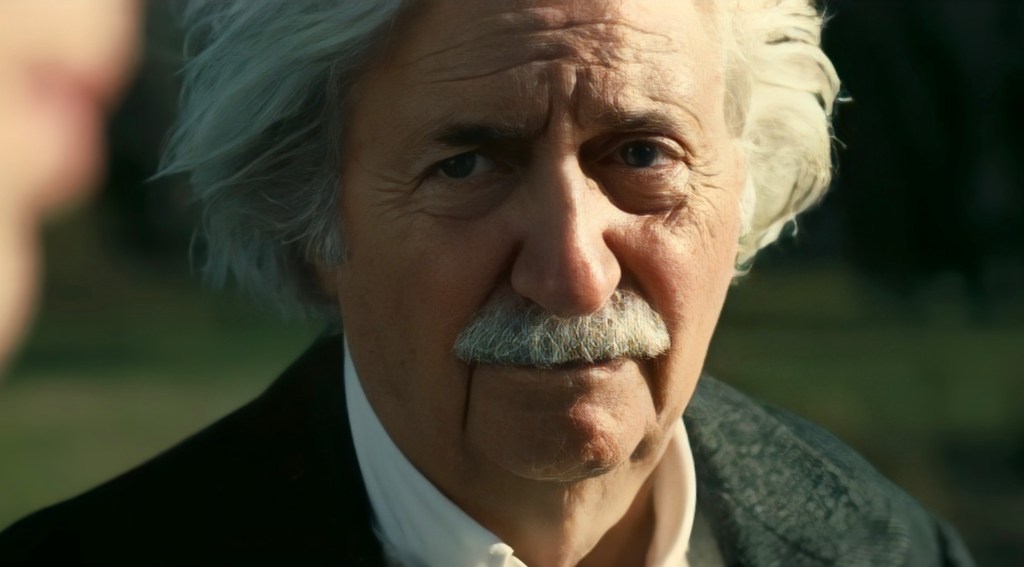
And… I’ve yet to talk about my secretly favourite performance of the entire film: Broadway legend Tom Conti portraying Albert Einstein. Seriously, this is not one of those cases in which the grandeur of the historical figure carries the characterization. Yes, makeup and hair Einstein, but, more importantly, I saw and felt a relatable human in Conti’s eyes, facial expressions, and even walking. More than the face of human exceptionalism and progress, I saw a man with 40 years of perspective on what that progress means. And, despite Einstein’s extraordinary brilliance, Conti carries the interrogation of all ordinary men and women who never get to benefit from exceptionalism.
All in all, an actors’ movie, with a lot of dialogue.
A first for Nolan, but, of course, he wouldn’t be able to let it just be that. Without discrediting how this star-studded cast turned their egos into human-like transformations instead of boisterous caricatures, it is the Nolan-isms of timeline crosscutting and science as visual language that make our relationship with these amazing performances never becoming tired.
No time for overacting, and conversation has to render account for the consequences of its content.
Seriously, as a Nolan fan, I never would’ve imagined that one of his densest, hardest to chew, and best screenplays would be a talkie biopic. A subgenre for which I have become a bit desensitized and disinterested throughout the years.
Leave it to him to make me restless about a biopic in the theatre chair.
Not trying to say that he is reinventing the formula here. Oppenheimer is as procedural as it gets: from the making of the Atomic Bomb to the courtroom drama in the background. You don’t adapt a 700-page Pulitzer Prize winning biography (American Prometheus: The Triumph and Tragedy of J. Robert Oppenheimer) to a 150-page faithful script if you don’t adhere to form.
Yet, the more I think about this screenplay, its macro structuring and micro editing, the more I see its merit. By having a core throughline that is formulaic, this allowed every other discipline contributing to the reproduction of the experience to be disruptive and expressive. This way, no department had to be worried about art or human assimilation blurring the biographical and historical recollection of such a heavy/significant subject matter and period in time.
Art could go directly to what it does best: challenging audiences’ point-of-view. And audiences’ also do it faster themselves for precisely the same reason.
Not my favourite way of challenging people. But, I have to admit that the exercise is there. More often than not, biopics like this are so fascinated with the monolithic majesty of their subject matters that they don’t even notice that the questions they end up raising either act as plot devices in service of only the movie (like twists and thrills, for example), or as rhetoric in service of the subject matters themselves, commodifying their statements instead of deconstructing them.
Nolan does this also here, in a twist during the third act that I didn’t much care for. But, that’s it. For the most part, from minute one to the very last frame, this movie is constantly deconstructing statements. In my opinion, it is its greatest achievement: physicochemical phenomena, getting shit done for progress, or political decisions being dismantled and morally reframed through the cinematic arts.
Visual effects of speed and power. Cinematography of the natural world and of the anguishing eye. Sound and music that is both inspirational and uncomfortably haunting. Set and costume design that has to not comically wink at the fact that some of our props and clothing are social signals for personas to communicate with personas. Actors who decided to go against the biopic trend of elevating the figure being portrayed (thus, elevating their own careers), and instead brought them down to earth, where we can all talk about them.
And a director-editor duo that cut this film with timelines and pace as more than manipulative tools – the way sequences foreshadow or callback, crosscut at fast but pinpoint perfect rhythm, is the type of editing that makes you pay attention (not in an imposing way), and therefore elicit thinking about connective threads (which is rare for a biopic to be less chronologically plot-driven, and more themes-driven).

It is essential to emphasise this: the editing by Jennifer Lame is stunning. Electrons spinning, stars dying, neutrons slamming into atoms, all used as interjections in the visual language. Nolan’s fascination with time even more unravelled – what used to be entangled sequences, now are dissected frames crosscut all over the place, still maintaining narrative sense. And everything, I repeat – everything –, at a breakneck speed that is not common at all for biopics enamoured with character development and verbose dialogue. Aaron Sorkin would be pissed if some editor interrupted his monologues on the greatness of great men this way.
The first hour is fast because Oppenheimer, in his theory years, jumped from topic to topic based on his interests and desires.
The second hour is fast because Oppenheimer is laser-focused on Nuclear Fission to win the race against the Nazis, or maybe the race against the worldwide scientific community, or maybe the race against all wars, or maybe the race against himself.
And the third hour is fast because, once you bring something into the world, such thing is no longer yours, and the many forces that be exponentiate its reach, ramifications, and effects. Like the chain reaction of… Yup… Nuclear Fission…
The film is three hours long, and it’s highly likely you don’t notice the time passing.
However, I can see why some people might feel weird during the third hour. The hormone rush of the bomb exploding, during the second hour, is hard to physically follow from.
But, I am of the opinion that the film is better this way. For this subject matter, it is vital that the climax of the movie is not a Hollywood commodification of the mushroom cloud. The culmination has to be how they (and us now) contend(ed) with the fallout and “Deterrence theory” that resulted from the progress achieved in nuclear physics during those years. When checks and balances were the lowest of priorities.
And, while I might agree that, on a first watch, I’ve experienced cleaner and more elegant Nolan third acts… To also be fair, none of his previous movies had this degree of denseness in their respective first and second acts. Requiring a third act at the same level to tighten all the knots.
And it does. Magnificently.
The amount of payoffs we get to the timeline crosscuts of the first two thirds is technically and emotionally dazing.
AND, whether you vibed with the third act or not, it is undeniable that this director knows how to end a movie. Those last 3 minutes of Destroyer Of Worlds will be seared into my soul forever.
Coming to the end of this review, I should reiterate that I went to this movie on the defensive.
Christopher Nolan, my favourite filmmaker, had recently disappointed me highly with Tenet, a movie in a subgenre that the writer-director is a master of – the sci-fi action thriller. Add to that my general lack of interest in Oppenheimer’s own subgenre – the biography of the great man –, and that particular kind of criticalness/demandingness of a fan was at an all-time high.
So, of course, I’m very happy to report back that Oppenheimer is a very, VERY good film.
Like I said in the beginning of the review, I’m still not sure if I should call it a great movie, precisely because of that third act. It’s certainly its most thought-provoking macro-structure, while also being the less elegant part of the whole (probably due to being so inquisitive of the complex ideas raised in the previous two acts).
I’ve seen Nolan’s third acts make for a better first impression, but, with some distance, Oppenheimer’s might leave the most lasting one. It really is a lot of sensitive information to chew on, and the feeling of dread the film leaves you in definitely does not help with the processing. But that’s why humans make and experience art about these subjects. Otherwise, we would just watch the news or read Wikipedia.
Altogether, this is a Nolan film through-and-through. His persistence on shooting everything practically, without resorting to images generated by a computer, makes the bigness of the facts feel more tactile and, therefore, intimately alarming.
The production team constructed a version of 1940s-era Los Alamos, giving us a sense of place and, more importantly, of perspective on how expeditious mankind really is when we decide to support the scientists of their fields, and not the know-it-alls, to collaborate and be a force for change. One can only imagine if that type of energy was used to solve world hunger, homelessness, concentration of capital and/or climate degradation.
Speaking of scientists, and also in true Nolan fashion, this production collaborated with PhD’s in physics and chemistry to recreate on a micro (and safe) level the phenomena and chain reactions imagined and described by the characters. These were then captured on camera with IMAX probe lenses. You can’t get much more tactile than that.
In addition, and the most Nolan of it all (and the mark of a great director), he put sound engineers, composer, cinematographer and actors all in conversation with each other. I.e., he wrote a screenplay in the first-person of J. Robert Oppenheimer (which is very rare), and to serve that close-up he involved the composer to also write music that expressed singular presence and interior plurality, connected that with the audio department for sounds that most bothered the titular character, and then had his cinematographer and grips channelling the power of the IMAX camera towards the texture of the human face instead of the beauty of the landscape (very innovative for the format).
The end result is a very visceral wake-up call in the form of audiovisual magnification of relatable human feelings and expressions: wonderment, excited drive, ambition, fear, guilt and regret.
Oppenheimer, the film, triumphs because it’s not exploitative of the bomb. Its most scary sound is not the shockwave, but feet stomping in gleeful hysteria. Its biggest fire is not the test detonation, but the soul burning away inside Oppenheimer’s eyes.
In summary, the arts and crafts of this movie alone guarantee a baseline score of 9/10.
However, that third act is a half-star swing. Right now, I have to lower it to an 8/10 thinking of the people who will only watch this movie once and will find it hard to follow from the hormone rush of the explosion in the second act.
All that being said, and irrespective of scores or mansplaining, this is a film I wholeheartedly believe every person should get to see. More than technical aspects, it has an important message we as a species must reckon with.
It is, of course, resonant with our current stockpile of nuclear weapons and nuclear power plants. Resonant with our current Artificial Intelligence race. And resonant with what comes after AI… If we are here to reckon with it then.
 Opinion Seed