20. Neon White
Cards have been cornerstones of gameplay for millennia.
As such, I’ve been being disappointed throughout the years with videogames’ take on them.
I know: “if it ain’t broke, don’t fix it”.
But, surely the most innovative artistic medium of the last 100 years can do better.
And, out of nowhere, from the developer of Donut County (of all people!), a trailer is released for a curiously bizarre game where you play with cards, but it’s not turn-based?! Let me try.
It works. It more than works: it’s gameplay that feels good, makes you be in the moment, and propels replayability.
In essence, you are a character in a 3D space, and your primary means of interaction with the world are cards as consumables. I.e., each card has a dual property: you can either shoot it to kill demons (this is the only way you keep getting cards); or you can discard to trigger an enhanced move (even for jumping you need to discard).
This is ingenious game design, because you are always having to make decisions on the fly (sometimes mid-air), and every decision has a trade-off. The fun of Neon White is that those trade-offs don’t feel punitive.
You know the rules of the cards, and you get to play within those limits to reach your goal. You might be undecided if you should attack or enhance move in a section, but since you can’t hesitate you start to be in the flow of things and notice that sometimes attacking is moving and/or moving is attacking.
After spewing love for Neon White’s novelty, I have to say something about a major design decision that, for me, hurts the game and doesn’t maximize the expressiveness of its core mechanics: the level design. More specifically, the length of its levels.
Don’t get me wrong, I agree that the non-mandatory speedrunning element is smart at nudging the player to better understand the potential of each mechanic. What I don’t agree with is designing for player focus on numbers, by cutting worlds in chunks so short that agency and self-expression are reduced to doing what the developer wants.
I don’t like it when the “strings of the puppeteer” are this visible.
In Neon White is indeed a pity, as I can’t but imagine the joy I would’ve had exploring bigger levels with these cool mechanics, and having to make tough decisions, engaged solely through gameplay, of what paths to take.
Innovative, nonetheless.
19. Azure Striker Gunvolt 3
Look, I know this exudes anime tropes all over the place. The story is so archetypical that I even recommend turning off the dialogue HUD that is plastered all over the screen during the levels.
All that said, I also recommend you play this game for its core mechanic.
You can control the main protagonist of Gunvolt 3 – Kirin – like you would in a standard 2D action platformer: jump around and slash enemies when up-close. However, Kirin has an extra ‘card’ up her sleeve. Well, technically, they call it ‘talismans’. But it feels like Gambit from the X-Men throwing cards that stick to the enemies.
It’s really satisfying. Throw them at a distance, up-close, mid-air, doing a backflip, etc. And, once the enemies are ‘card-tagged’, Kirin can instantly teleport to the chosen enemy and slash them with added bonus damage. You can rack up combos, without ever touching the ground, with some strategizing so that stronger enemies are the last ones in your chain, and you one-shot them as well.
This has already a pretty nice game-feel. And, even if I’m a detractor of design that is too visible (too game-y), I forgive the obviousness of how these levels were constructed, because they not only encourage but also magnify the coolness of pulling those sequences off.
Finally, despite the trope-ish nature of its anime elements, there are two influences that work well with the overall feel of the gameplay.
Those are the hand-drawn animations that both you and the bosses generate when doing a super attack; and resorting to Gunvolt himself.
He is a side-character here, but is so ridiculously overpowered that it becomes somewhat of a welcome respite after the many precision-heavy no-fall sequences I described above.
18. The Stanley Parable: Ultra Deluxe
“Wait… How did you do that?”
I never played the original release back in 2013. But, even knowing it by its fame (of being an ‘out-of-the-box’ game), it becomes evident that The Stanley Parable is commenting on the core tenets of game and gaming: interactivity, choice, control and even replayability and playfulness.
I shouldn’t use the word ‘evident’, because even if The Stanley Parable is very direct with its audio and visual cues, the game (and its narrative structure) is designed in a way that prompts you to think about and explore (literally, through gameplay) its subtextual layers.
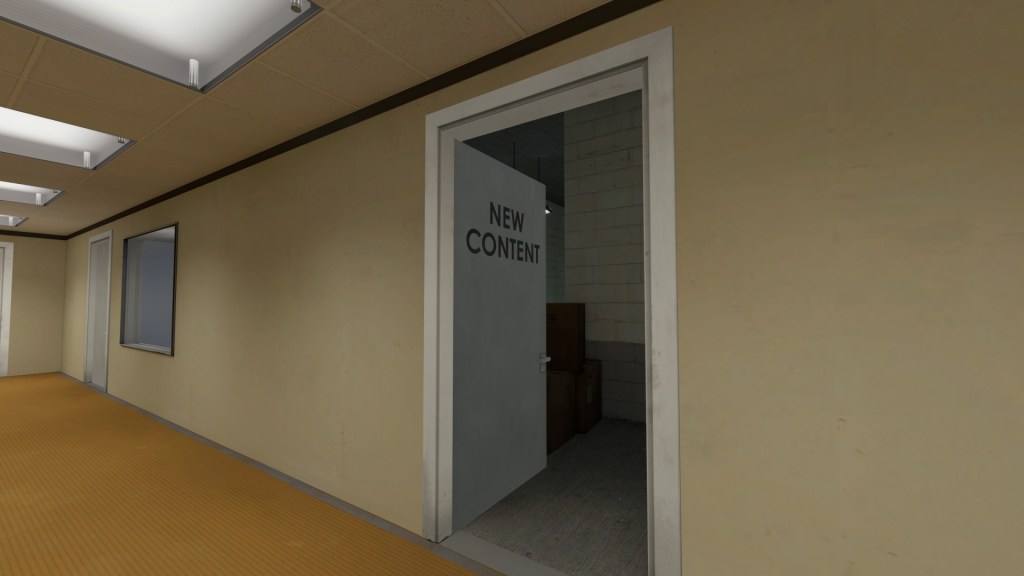
This Ultra Deluxe edition can be divided in two sections: the original game; and the ‘new content’. You would expect that a game like this would subtly gel its expansion throughout the main structure. Nope. Once again, The Stanley Parable finds a way to be both direct and subtextual about its proposition. There’s literally a door saying NEW CONTENT once you ‘finish’ the original story.
The 2013 part is structured around the idea that some games are designed in such a way that they are not that different from the reality we are trying to escape from – jobs. On the surface is a critique on sacred cows like replay-value and fun. More interestingly, I found it to be an original analysis on the illusion of immersion and a more primal need to master and be in control of something – either ludic or professionally.
The NEW CONTENT is first and foremost a commentary on the 2013 Stanley Parable, and how it lives in the canon of the video game artistic field. It addresses concepts like masterpiece, greatness, or revolutionary since the original game was not only very-well received back in the day but also lived on as kind of a cult classic.
Intentionally or unintentionally, it converges again to a conversation about replay-value and fun (now on dialogue with itself).
Both parts are commentaries on the video game industry, messages for both players and developers alike. And, all in all, I think 2013 CONTENT does it better, even if not as mechanically fun as NEW CONTENT.
“It gave me like Death Stranding vibes, y’know? Because it’s like… fucking boring, but that’s the point, y’know?”
17. Rollerdrome
I tend to not be a big of fan of video games whose conceit is to rack up points on an arena.
Nothing against some video games being purely toys. Yet, if only developed for nostalgia’s sake, those tend to not express much more than what was said in an era when that (toys) was the only thing they could be.
That’s why I read reviews for the Tony Hawk’s Pro Skater series in the early 00’s, and those games’ place in history, as not much more than timeless (that is always repeating itself) nostalgic craving for mechanically pure arcade sensations.
Additionally, you won’t hear me clamouring for more guns in video games. They are clearly becoming a design crutch for developers.
So, it’s a bit of a surprise finding myself having enjoyed Rollerdrome.
The 1st-person interregnums between the arenas did a lot of heavy lifting for me. They seem like nothing more than a stylistic flair, but end up doing a lot to elevate the message these developers were trying to convey with their art. The power of negative spaces in video games, and how they let you think about stuff.
Of course, the game looks and sounds really good. But, long gone are the days when that was enough to impress me. That style has to be connected with some narrative purpose. And, by taking you out of the 3rd-person perspective, while remaining in the same aesthetic, all the audio-visual decisions do conflagrate into a cohesive sense of place and mission.
And, I have to admit that the guns do add a more engaging, for me, mechanical layer to the Tony Hawk’s formula. The gameplay becomes less point-driven and more decision-driven (a design principle I much prefer).
16. Call of Duty: Modern Warfare II
I’ve been playing Modern Warfare games since 2007, and while the Multiplayer side of things remains largely formulaic (in essence, and questionably, these shooters have become the new sports and fighting games of the masses)… the side of the Singleplayer story campaign is where some hope and inventiveness still reside.
Honestly, I was not expecting to be surprised by the gameplay scenarios a Call of Duty game would put me through in 2022. But, Infinity Ward did it again. Arguably with more variety and ingenuity than in all of their past games combined.
It’s still behind the state-of-the-art in gameplay diversity and wit of some of its AAA peers. Nonetheless, considering that these devs are working within the narrow (and shallow) vision of a 1st-person perspective of a gun in your hands, I have to give them credit for what they offer here.
From plays on camera perspective; missions without a gun; sequences with a firm slow pace; thrilling use of vehicles (and not for the sake of it); a compelling (if under-implemented) crafting system; to even a fitting boss fight.
If there’s a flaw that I can point out is how suddenly the story comes to an end. Like they are saving some build-up for a sequel or even DLC. I don’t want to be that cynical, but rumours that the next entry in the franchise will be a campaign extension doesn’t sound like an unfortunate coincidence.
Ultimately, Modern Warfare II fills-in the big shoes of its past namesakes, if not in spectacle, certainly through diversification in gameplay action. Infinity War still got it and, more importantly, seem to be going in a more refreshing direction.
15. Midnight Fight Express
This is a try hard.
The visuals are trying too hard to be tongue-in-cheek, without any actual boldness in art direction.
And the music, despite its inherent quality, is so focused in the aforementioned boldness that forgets that video games are a collaborative medium. A score/soundtrack should enhance, not superimpose.
These artistic shortcomings would put me off the game if its gameplay wasn’t so magnetic, and nuanced even. Its combat controls on par with the best this year has to offer.
And, I use the term nuance, because the game even surprised me with two components: progression tree; and scenarios.
The combat would be very good simply with its base level: pleasant animations, strong hit detection, combos, quick flurries, and overall movement. But then, the devs slowly introduce degrees to all those tools through the levelling system. It’s precisely because they gate it this way that you pay attention to the nuance, and feel compelled to see the totality the game has to offer: different approaches for countering after parrying, unconventional use of objects and weapons, a clever implementation of pauses mid-combo to better crowd-control, and, of course, whimsical finishers.
Scenarios, like I said, surprised by offering several moments of gameplay not centred on hand-to-hand action. At the same time, those variations and their transitions needed better editing. Not in the way of more cuts, but precisely the opposite – less cuts.
The game has the right length, but you feel that you are always jumping from scenario to scenario, as the levels are too short. Which is a shame, since a more continuous design to the loop would maximize the good qualities of the combat they developed.
It doesn’t have the intensity of Hotline Miami, but the toolset is way better.
14. Tinykin
Calling Tinykin a Pikmin-clone is rude. At the same time, look-alikes more overt than homages are not always a bad proposition. They can have all the elements that made you curious about the original, except one that was the thing deterring you from trying it.
The clock was that thing for me in Pikmin:

And, when I saw that first still-image of the next Pikmin game, with that damned clock, and read a review stating that Tinykin does not have a time component… I decided: I’m done waiting for that franchise to appeal to me.
It ended up being a good decision, because Tinykin is such a jolly experience.
It’s a 3D platformer, but you don’t even have to jump on enemies. There are no enemies. Only the environment and how you navigate it. That’s not to say that the environment has a dangerous atmosphere. No. The objects and designs are huge, but not menacing. Yet, it is always interesting to look at and interact with these everyday objects when they are scaled to your tiny size.
The challenge/awe comes precisely from scale of it all. And, more importantly, how the developers designed each level with that in mind. They are everyday, inoffensive objects, but when you position and stack them the way these devs did, the sheer verticality and platforming traps that come out of it become really impressive.
Yes, this is a puzzle game, and the way you interact with the objects through the different tinkyin (the little creatures) is undoubtedly engaging. But, for me, the gameplay commitment came from exploring every nook and cranny of this familiar yet alien world.
And, even if I prefer action-based platformers to puzzle-solving ones, because the first tend to feel better on the stick and buttons than the latter, I was pleasantly surprised by how this dev team guaranteed that Milo (the main character) had all the tools to play great.
Using a soap bar for sliding and a soap bubble for gliding is both cute and mechanically inviting.
13. Retro Bowl
Is addicting design good game design?
Without trying to brush off a complex topic, I have to be honest with myself and reward this game for being the most addicting two weeks of gaming of 2022.
It’s hard to pin-point why, particularly if you take it at face value: simple graphics, simple mechanics.
Yet, I have a sneaky suspicion that it’s precisely that simplicity that did the trick. Not simplicity for retro sake, but simplification of rather intricate modes these homages usually don’t delve into. In this case: season management.
The fact that, in two weeks, I had a coaching career of like 3-4 seasons, trimmed of all the fat, while maintaining fun systems like press duties or handling of player egos, AND playing in ALL the games (they shorten their duration by simming your out-of-possession) kept me coming back.
Ultimately, it was not the gameplay that hooked me (though, it helps it being smooth as butter). It was the story I was telling myself while building my own history in that seasons’ campaign.
Now, I have to try their other game – Retro Goal.
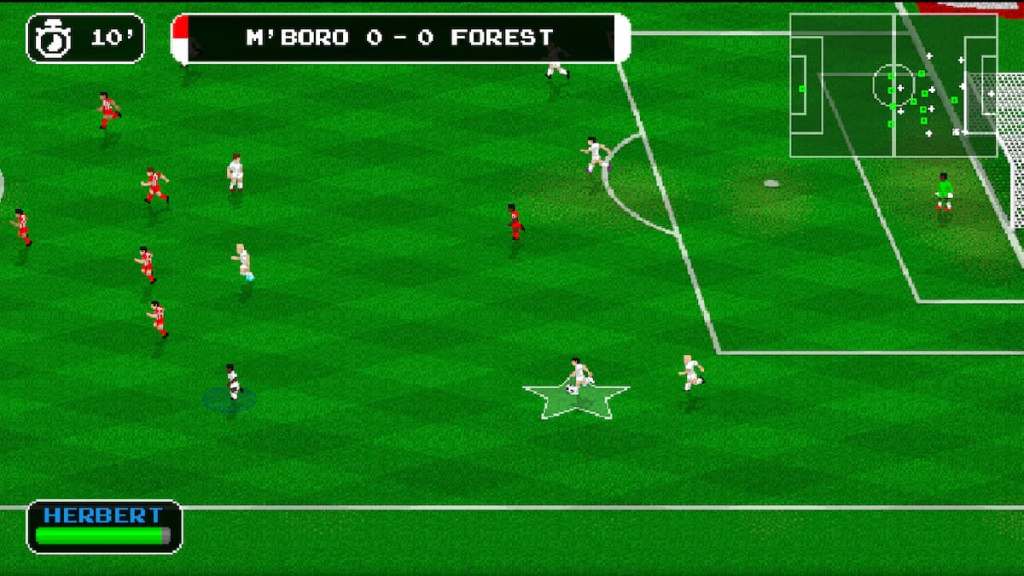
(gulp)
12. Teenage Mutant Ninja Turtles: Shredder’s Revenge
I haven’t had this much fun playing co-op in a long, long while.
Cooperative modes in games that can be played solo, more often than not, tend to feel like an add-on in an attempt to bolster replayability and force emergent storytelling and gameplay.
In Turtles, even though you can play solo, I am certain my experience was augmented thanks to my partner. From simple high-fives between our characters mid-action, to the extension of combos due to intuitive positioning of objects and enemies, this story and characters were a blast to revisit.
I should really emphasize the intuitive vibes pervasive throughout the levels. You can be analytical of them and surgically remove enemies from the screen. But, it’s so much more fun causing ruckus with the playful moves both players (or more) gradually unlock. All that is intuitive because they are sequenced and animated in ways that you find yourself discovering them mid-combo, and, more importantly, they generate spectacle that sounds and looks better when triggered by more than one front.
Speaking of looks and sound, another aspect where this reimagining of the 90’s beat ’em up distinguishes itself from similar endeavours in recent years is on the capturing of the vibes you thought you had with the originals.
Other remakes of arcade brawlers have felt so torn between vibing minimalist and modernized that they converge stylistically to something bordering flash games. And the music in those remakes usually tries so hard to remix the old with the new that the end product tends to sound more like those corny covers in EDM.
Shredder’s Revenge style is on point. Not too crispy, nor too clean. You feel the fabric of the pixel age, while getting the benefits of modern animation an expressiveness (and these characters revel in that). And the soundtrack is not accidental corn, it is purposeful cheese. Like you are always playing in the world of those FMV intros we used to love.
11. Kirby and the Forgotten Land
First 3D Kirby. Huge deal.
Why? Because Nintendo has a pretty good track record when it comes to 3D platforming and adventuring.
How does this one stack up against other giants of the publisher? Pretty well, if you’re asking me.
The 3D levels are not as expansive as other franchises’, but HAL Laboratory (the devs) manage to give each one a captivating wrinkle or mechanic to explore and mess around with.
This design is obviously informed by the trademark copy abilities of Kirby, but the standout in Forgotten Land is clearly ‘Mouthful Mode’. More than an adorable gimmick, this new ability really pushed the dev team to come up with imaginative environments and challenges to apply it on. And they pulled it off: the right balance of weird that brings a smile to your face.
Yes, the ‘Mouthful Mode’ seems like what you will take out of this experience. However, I must emphasize that the strongest element of the game is how the legacy abilities interact with the combat scenarios. The combination of the 3D space, enemies suited for certain abilities, and objects in that space that enhance each ability differently made most encounters more strategic than what is typical of a 3D platformer.
And the boss fights take that loop to an even more thoughtful level. To the point that the last sections are full-on anime action scenes.
10. Horizon Forbidden West
First and foremost, let me be clear: Horizon Forbidden West is an incredible game.
Its flaws are few and far between, but standout enough to not make it one of the greats.
You could think that visuals were an area I wouldn’t attack. Quite the contrary. Since the first game, this has been a point of contention for me. Precisely because it has it all: amazing graphics and inspired art direction. Still, they go too far.
Less is more, and adding this amount of particle effects to the environment (technically impressive) and futuristic clutter to the HUD (narratively logic) only detracts from the beauty you have to show us underneath.
Speaking of state-of-the-art graphic fidelity, Forbidden West establishes a new benchmark when it comes to non-game-y NPCs in errands and side quests. So mush so that you might come out of it liking more the side stuff than the Main story.
The reason I say this is not only predicated on the performance capture they did to seemingly immaterial characters, since the characterization of the main cast is of an even higher detail, but the fact that, pound for pound, you might feel the writing on those side-lines is more human than the plot-driven large-scale of the main line.
And that’s another gripe I have with the game. The main story is not as good as the first game’s. It’s a bit unfair to say this, because the strength of the original’s narrative came from the mystery they slowly (and impeccably) reveal about the past and present of that world.
Now, with thrills unearthed and worldbuilding established, they resorted to something that not always works: going bigger and bonkers. Particularly when you had set up your environmental storytelling to such a quiet and dreamy pace.
The new revelations are cool, but they don’t feel as of their own as Zero Dawn’s felt.
Similar to high standards set by the original, I should talk about the combat. The long-range gameplay and toolkit remains as cream of the crop and lively as it was. With the unfair criticism of not having improved that much.
That being said, the close-range combat, a tool I actively avoided in the first game (so bad it was), is miles better. To a point that I beat the game with the sensation that I had resorted to it 50% of the encounters.
Once again, wonderful game. With some shortcomings, many predicated on the (questionable) fallacy that sequels have to improve on everything from the original.
9. Cult of the Lamb
Action-roguelike farming sim?
That’s a concept.
And, for the most part, it works.
The action in the roguelike could be a little bit better. Only 2 weapons feel good to use, and the spells are largely forgettable. The dodge roll is perfect, though.
Curiously, it was the 2D action that got my attention to this game, and I ended up having a better time with the farming/construction half of it.
A progression tree tied to the management and development of your village is one of the best gameplay systems of the year. The mechanics of chopping down a tree so you can build a farming station to improve your crop growth was satisfying on its own. But, when those crops serve as ingredients to keep your villagers/cultists healthy, who in turn will pray and generate Devotion, which is currency to unlock new abilities and perks for the roguelike sequences… That’s more than satisfying. That’s gratifying.
I could use less variety in the perks offered, and more depth to such curated selection. But, that’s a nitpick, because that spread and connection to elements of farm life made me invest in the most mundane of buildings and decorations.
And, of course, I would be remiss if I didn’t praise the aesthetic and tone of it all. More than the high quality drawing and animation, its biggest artistic merit resides in the way those good looks juxtapose and simultaneously uplift the razor sharp dark humour of it all.
Cult of the Lamb is such a fascinating video game. On one hand, where it lacks in depth to each of its chimeric subgenres, it’s probably that homogeneity that makes them work well in tandem. On the other hand, while the wryness and darkness could limit this to a more niche audience, its sarcasm is painted in such a playful manner that you are bound to find everything very charismatic.
In essence, this could be your first roguelike, or your first farm sim. And, if you’ve already played either or both, here’s an opportunity to try out something smartly original, enveloped in a nice coat of whimsy and bite.
8. Stray
Biggest surprise of the year.
Not because I thought this game was going to be bad. Quite the contrary.
Controlling a realistic cat in a minimalistic indie adventure with AAA visuals… I thought I was being manipulated into finding this beautiful and soothing.
And, well, it is. But, it’s so much more.
For starters, this wouldn’t work if the cat controlled poorly. Another part of the surprise for me: more than the cat feeling great on the stick, the fact that you don’t have 1-to-1 (3D platforming) control on the jumps did not bother me as much as I anticipated.
(Still, I will always wonder what kind of game Stray would be if you had more 3-Dimentional control).
The game also has more variety in gameplay scenarios than what’s typical of mood pieces like this. In terms of pace, the devs always found something appealing to give the player to cat-try-out 😛 . If all, those mechanics felt more under-used than under-cooked, which left me wanting for more time with them.
And then there is the secret sauce of the game. The world. More than a ‘cat simulation’, there is a fully realized artistry in how the studio linked worldbuilding and lore with a fleshed-out and humanistic message.
Like the gameplay mechanics, the level design left me wanting for more like this (I know this is a very small game dev team). The bigger non-linear areas, if few, were astounding. They really let you do three essential things for this experience to land: 1. Feel the cat, and how its mechanics gel with the world; 2. Feel the world, and see how its structures, inhabitants, and their relative positioning tell a story; and 3. Feel the message, by having a fully interactive space not mandated by action so that you can reflect and better understand the history of both the specifics and the universal.
I really would like to emphasize that being a cat and talking to robots doesn’t make this game any less human. If else, it makes it more in a different way. You are looking back at us through a different presence, and a different future.
7. Little Noah: Scion of Paradise
I’m a little bit tired of the rogue-like design ethos. So, what made me try this one out?
Two elements that ended up completely meeting my good expectations.
The first is the relationship between recruitable allies you find while exploring the rogue-like dungeon system and how your attacks are completely linked to those creatures. You see, Noah (besides super moves) doesn’t attack. Each button press is a summon attack, and a combo is in essence a sequence of different allies attacking.
This is very creative and engaging, because it entices both experimentation and exploration. There are so many permutations to this mechanic. You can put a Lilliput that shoots a slow horizontal tornado between one that launches enemies into the air and another one that chases them and pushes them forward so that they’ll be hit by the middle tornado on their way down. You can build sequences that maximize slow, but powerful, earth attacks, by putting ice lilliputs before the earth ones so that the enemies are frozen in place while a ground attack is charging. Or you can even specialize by only going all wind, or all ice, by only collecting accessories that min-max those elements.
The other characteristic that caught my attention was the presence of features that help to mitigate the bad by-products of rogue-like design (inflated repetition, redundant experientialization, and other derivatives). You can fast-travel to any room already explored in that run. And you don’t have to beat the entire game in one sitting. Each run you HAVE to select between two different dungeons in each level. And since they aren’t completely randomized, you know what trade-offs you are incurring in each bifurcation.
All these design crumbs go a long way to give you ownership of a loop that usually feels superimposed of interactivity.
Try this one, if you are curious or tired of rogue-likes. The Lilliputs are full of personality, and you get to express each one of them.
6. Sifu
When in combat, this game is great.
Two things I love about the combat. First, I enjoyed that the style of Kung Fu recreated is not generalist. The animators and combat team worked with nuance to put you in the place of a Bak Mei kung fu specialist. This makes you pay more attention to every micro-movement, which is important in this game, and also lends a soulful connection between your character (and you, to some extent) and the legacy of those moves.
Speaking of soulfulness, the second element I appreciated about the combat gameplay was how serene everything felt. Of course the encounters are energetic and you have problems to solve from every type and every different direction. However, when going through the motions, thanks to that nudged attentiveness I mentioned, animations and technique representations seem to slow down and allow for more than rock-paper-scissors management. It allows for some pondered expressiveness.
Usually, games of this sub-genre are so interested in throwing the kitchen sink at you that they forget to try to make you understand why your moveset and mechanics have dedication in them.
With all that said, an area of this game that needed more work is outside-combat movement. It never felt great to control the character to explore the levels. Which is a shame since most of the story is told through objects found in the environment, and the art direction in each room is a joy to contemplate.
It really is fun to piece the environmental storytelling together to know more about the history of these characters and solve the mystery that put them in conflict. But, it is such a blunt difference between combat animations and outside-combat movement that always messed with immersion.
Let me also reiterate: some of the best art direction of the year.
Finally, a rather unfair note: I would have loved if this game was a bit more cinematic, with possibly QTE’s in big moments during boss fights. Unfair, since I know we are talking about a very small studio.
But, I enjoyed so much the references to Oldboy, John Wick, Kill Bill, Captain America Winter Soldier, and others that it would’ve felt appropriate to be more playful with the camera and editing.
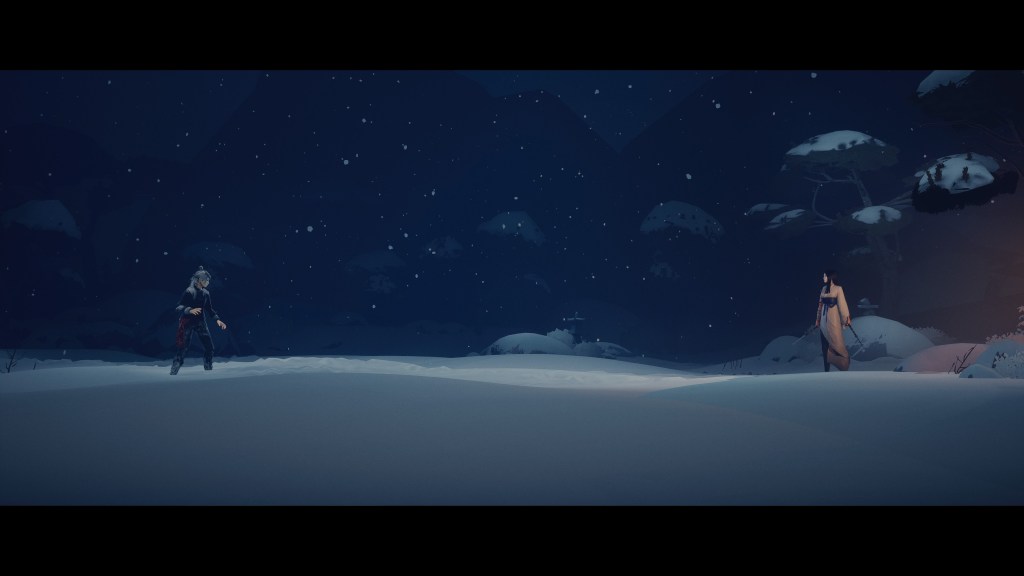
All in all, it’s probably alongside Sekiro the second game I played in my life that transmits the sense of legacy and soul of a martial art better.
5. Uncharted: Legacy of Thieves
I was wrong.
When I first played Uncharted 4, back in 2016, I was impressed, but it did not meet my expectations.
Those expectations had been set by The Last of Us, a game that changed Naughty Dog and cinematic action-adventuring in games forever. In retrospect, it probably was unreasonable to compare them at that time. TLoU had the canvas of a fresh idea to explore. While, Uncharted 4 had to juggle several things at once: finish Nathan Drake’s story (a beloved character); respect the legacy of the previous 3 games (old Naughty Dog); embrace the inevitability of new Naughty Dog; and probably much, much more behind the scenes.
All those challenges contributed to what was known immediately: Uncharted 4 was going through development hell, with continuous delays, story re-writes, characters scrapped, and, more notably, the game director and series creator – Amy Hennig – no longer working at Naughty Dog mid-project.
Looking back at all this mental and operational tumult, and playing these remasters now for what they are… I’m sorry Uncharted 4. I was very harsh on you.
Besides the imperfection that remains of it trying to do and say too many things, perhaps as a result of the ‘two games’ turmoil during development, Uncharted 4 is a revolutionary masterpiece.
It is, more than The Last of Us, the true inflection point in character animation. All these years later it’s still the benchmark. The remarkable sense does not come from how realistic Nathan animates when energetic vs tired, but how that realism never compromises control fluidity.
Uncharted 4 is a trailblazer in another aspect of game design: the wide-linear approach. Despite not being a sprawling RPG, this game remains the best recreation of the archaeologist power(?) fantasy. By designing, not an open world, but linear levels that are open enough you don’t feel pushed, Naughty Dog managed to allow for player agency in exploration, while retaining the propelling nature of its page-turning storytelling.
This wide-linear ethos really works wonders to elevate the main narrative beat of the experience: pirate treasure hunting. I loved how the writers juxtaposed the wonders and tragedies of the Golden Age of Piracy with current-day Nathan Drake’s adventuring, danger-seeking and wish to have a family. Like I said back in 2016, Henry Avery (the pirate) is one of the best characters in all of video games, and you never get to see his face. Yet, this conflict resonates deeper precisely because this is a video game.
You are mesmerized by the landscapes and ancient ruins. You want to probe every side path. You feel thrilled when sneaking up on enemies. You are ecstatic when things start to escalate and you are executing to perfection a choreography with gunfire, car chases, and giant clock towers collapsing.
And then you see how the people who care most about you react to all that…
We can never be Nathan, yet that feeling of shame of your actions is universal.
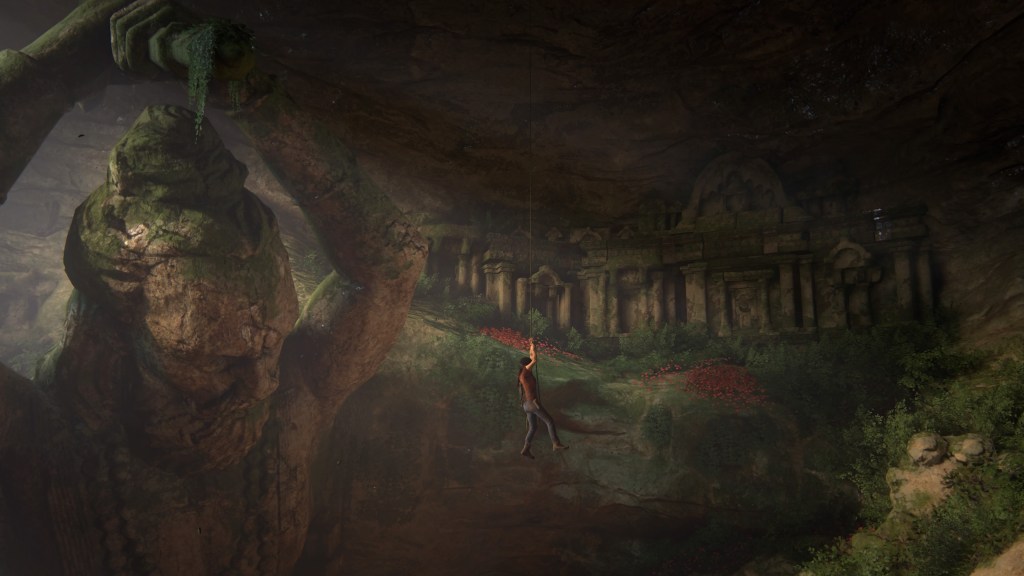
Now I notice that I have yet to talk about Uncharted Lost Legacy, the other game that comes in the Legacy of Thieves collection. So, let me be straight to the point about it.
Back in 2017, I felt that Lost Legacy was a better game than Uncharted 4. I was also wrong, but for different reasons.
Once again, context and expectations influenced that view. Lost Legacy was supposed to be a DLC to Uncharted 4, but it grew so much in scope that ended up developing into its own game, with its own identity. Only Naughty Dog to make a completely polished, high production level and value, fully-fledged game one year after a colossus like Uncharted 4. No wonder I was staggered by all of it.
But, what really put it above UC4 for me was, ironically, the fact that it was smaller. By beginning as a DLC, there were no ‘two games’ conundrum of too many things left to say and do. It was focused, while taking advantage of the wide-linear advances they had done one year prior.
Now, years later, I know for a fact that Lost Legacy is not a better game than Uncharted 4. Although, IT IS the groundbreaker of a production level I wish more and more of the AAA side of the industry adopted: 7-to-8 hours experiences.
Don’t get me wrong: I love big adventures, and I will always advocate for a market space to every approach in scope.
Notwithstanding, imagine some of the more bloated AAA offerings out there (that are only this way because those same studios ‘conditioned’ consumers to equate dollars spent with hours of content), and all those talented developers in state-of-the-art animation, environment design, graphical fidelity, musical composition, performance capturing, etc, and you let them design and direct those elements in service of a narrative completely in line with gameplay like Uncharted Lost Legacy.
I bet we would get some of the best artistic products gaming as ever seen.
Uncharted: Legacy of Thieves, by being a collection of UC4 and Lost Legacy remastered, instantly becomes an unmissable anthology on wide-linear design that everybody should play.
4. Infernax
The styliest game of the year.
With substance.
Besides the fantastical pixel-art and pixel-perfect controls, the game makes its metroidvania design worth your time through a creative take on the formula. Instead of baiting you to backtrack to get power-ups, the devs tangle it with the decision system and side-questing.
And this decision system… Damn. They get you not through the number of ramifications in the tree, but through the aggressive pruning of those branches. When you make a choice, you FEEL it. It’s not one of those RPG’s where every choice is cool, and you are not really deprived of the full experience. Nope. Here you KNOW that you have just made a poor choice.
And that feels great. And looks great in the game world. It significantly changes things, and you want to backtrack to see in ‘that’ village the consequences of your actions. This made side quests matter, and more surprising than most power-ups metroidvanias keep gatekeeping and telegraphing throughout their level design.
That being said, power-ups are neat. And since the gatekeeping here is done through story, the designers don’t have to spoil them with cues, and you get to enjoy them more for the difference they make against tougher and tougher enemies.
3. Bayonetta 3
PlatinumGames learned a thing or two from their time with Yoko Taro, while co-developing NieR:Automata.
And that’s saying something, because the Bayonetta franchise is not known for conventionality.
In my opinion, this is a bigger and bolder leap than what Bayonetta 2 was to 1. There’s more variety in everything – and variety that makes sense (well, sense for a Bayonetta game xD ).
Even if I prefer religious iconography informing level design like in the previous games, and find the jumping around between real-life cities and historical moments a bit uninspired, Bayonetta 3 is, at the same time, undeniable at engaging you through costumes, weapons and summons that are related to those levels and have a story with those places.
I see what they are trying to message with this new entry, by saying that religion has been supplanted by technology, and our incessant craving for its advances, as the new opioid. And how that numbing is making us forget our history and present diversity. That’s a smart way to apply the multiverse formula to Bayonetta. I just wish that the enemy and level designs were a bit more imaginative.
But, maybe that’s a meta-commentary in itself: of technology being more standardized than religion, and that multiversal storytelling, despite the infinite possibilities, tends to be anthropocentric and triangulate to too much familiar places. I wouldn’t put past Hideki Kamiya to be this meta, however, if true, it should’ve been better communicated. Maybe it was, since I’m thinking of the possibility… I don’t know xD
Irrespective of that, the new weapons ARE inventive. Detailing more would be a spoiler. Trust me, go play Bayo 3.
I also loved how they evolved one of the distinctive features of these games and Cereza herself: summoning of demonic and mythical creatures.
Once again, describing them too much would be a shame. Let’s just say that I was initially impressed by how they implemented such hefty elements and movements in the moment-to-moment gameplay. And then I was MESMERIZED with their EXPANSION to climatic boss fights.
This is the Dragon Ball Naruto game that will never be made, but better. And, like I said above, Bayonetta is no stranger to scale and excess.
That being said, I also appreciated how this is a softer and tender Bayonetta game. From the colour palette to the way characters are developed and interact with each other, there’s a contagious confidence in Cereza’s strength as a mentor, sister and partner.
The new character Viola is a welcoming addition, not only because her combat style diverges a bit from Cereza’s – with gains coming from parrying, rather than dodge offsetting – but also because her youth clearly motivated the developers to design a more colourful and warm-hearted game.
Jeanne, as the coolest person in the franchise, gets to be even cooler here by putting her in 2D side-scrolling missions, where she is a spy and primarily resorts to stealth. Taking a page out of Taro’s (gameplay twist), Kojima’s (homage) and Cowboy Bebop’s playbook. And even that gameplay twist gets a twist! Not to mention the role the character you are trying to save in those missions ends up having in the game as a whole.
Even the character of L.U.K.A., somewhat relegated to anime trope in the previous games, is more fleshed-out here, to the point that you begin to care for his actions and place in this franchise’s story.
I should also say something about the music. Always a passer-by in the previous games to me. This time, I noticed. And, more than noticeable, I found it to be expressive. The environmental tracks were thoughtful mixes of known sounds from those cities/ places in time. And the character and story tracks, despite ranging from punk or pop melodic to big classic orchestrations, always landed their intent.
Apparently, I’m turning into one of those old and jaded film critics: like Devil May Cry, after all these years, I still prefer Bayonetta 1 to the sequels. The constant breaks to combat arenas with invisible walls is starting to feel dated design. Be that as it may, Bayonetta 3 continues to astonish in terms of gameplay scenarios. And, this one, despite a bit Marvel-y (but better, because you get to play it), recontextualizes the previous two entries through an intriguing prism, that even makes you question who you were playing in them…
Take the plunge. You’ll be in for a ride.
2. God of War Ragnarök
I’m known to cry when art moves me physically and/or touches me metaphysically. This happens yearly with cinema.
Before playing God of War Ragnarök, I remember only 3 games that had had that effect in all of my life up to that point.
And, without trying to link artistic merit to tear-inducing quality, since that’s the most personal of connections, the construction behind what made me cry IS artistically magnificent.
The ending to God of War Ragnarök is one of the best culminations I’ve experienced in any media. It works on many levels:
- It gives you the action you wanted since the Norse Saga of this large-scale series began;
- Those same actions are no longer just spectacle and self-aggrandizing, they have more punch for the right reason of character growth;
- The relationship between Kratos and Atreus gets a very REAL arc, empowered by the gameplay perspectives the team at Santa Monica gives the player;
- The relationship between You (we, the gamers and the games’ industry) and Kratos enters a new level of meta-textualization, while making perfect sense within the text of this game (this was what broke me);
- It has the courage to end the Norse Saga in sadness and loss, showing you that that hole is big because the journey we did together was also big.
God of War Ragnarök also helped me look at God of War (2018) with an even greater appreciation. I now think that that first game of the Norse Saga is one of the best designed experiences in all of gaming.
Ragnarök is a better game in every aspect:
- Music – it’s even better than Bear McCreary’s compositions to Lord of the Rings;
- Controls and exploration – the new grappling mechanic is not a fad, it changes the way you consider the environment in combat and free-roaming, specially for such an on-the-ground character like Kratos;
- Combat – the additions to weapons, shields and other accessories are not for the sake of variety, and all exude a care to give them meaningful identity, not only related to player self-expression but also to a narrative sense of existence;
- Enemy variety and boss fights – it’s basically all of Norse mythology;
- Level design – what these developers do with the wide-linear formula and completely change whole areas as the true reward to player exploration and interaction with the world is more than great engineering, it’s breathtaking;
- Progression – playing around with stats, trade-offs, buffs and de-buffs through choices in equipment and special attacks was way more justified and fun than in the first game;
- Acting – Christopher Judge (Kratos) and Danielle Bisutti (Freya) are even more nuanced than in their debut. There are a pair of quests involving the two that is some of the best acting I’ve seen in a video game. Robert Craighead (Brok) and Adam J. Harrington (Sindri) now contain multitudes and are no longer the archetypical fantasy dwarves. Scott Porter as Heimdall is deliciously detestable. And Ryan Hurst is giving us a Thor take even more subversive than the Marvel one; and
- Themes – here is difficult to say ‘better’, because I loved how the ‘2nd chance in life’ theme permeated all of Kratos’ journey in the first game, propelling himself to take a non-violent mission to its end for the first time in his life. In this second game, I think the writers were dexterous in how they crossed myths and put Kratos’ violent nature into question by cause-and-effecting the self-fulfilling prophecy of Ragnarök itself and its violent form with the Greek god’s presence in this world.
Yet, this recalls my assertion that Ragnarök made me look at God of War (2018) as a personal definition of what a perfectly designed game is.
Ragnarök’s highs are higher, but while it chose to deliver those through the vehicle of epic tale and grandiosity, I prefer the self-restraint and minimalism of the first game.
The fact that they never let you see Thor or Odin in that first game, but their presence echoes very clearly in your mind, will always be a reference to me when talking about the potential (and power) of INTERACTIVE storytelling.
In God of War Ragnarök you see Thor and Odin. And it’s amazing on its own terms.
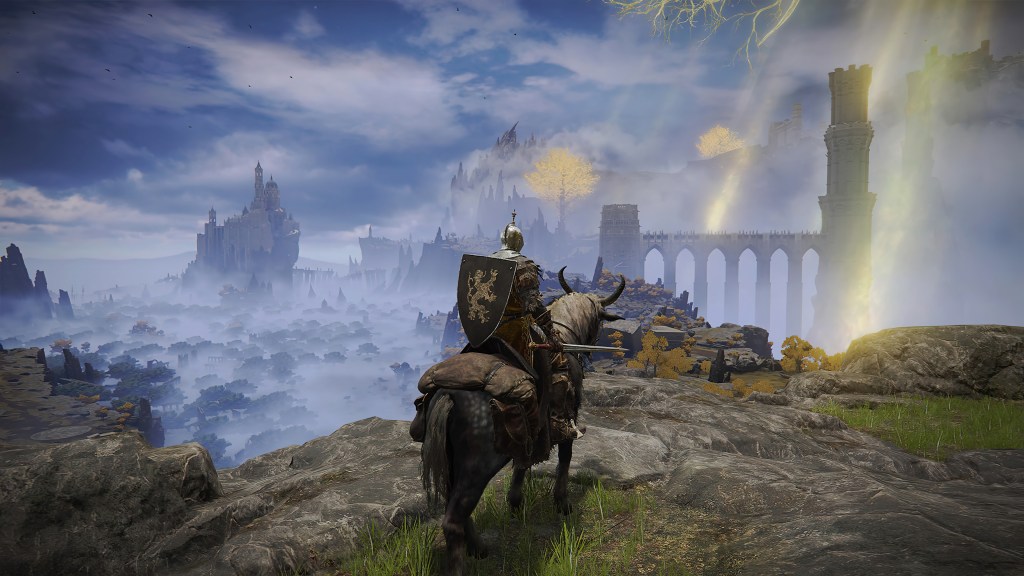
1. Elden Ring
There isn’t much more I can say than what I wrote here:
If not my new favourite game of all-time, probably the one I think is the best of all-time.
And for people who are wary of FromSoftware games because they have either too difficult combat and/or too obtuse storytelling…
Let me guarantee you that this is both the easiest of their recent games, and the one with most comprehensible story.
The open world approach to Elden Ring does make a HUGE difference when it comes to difficulty. If you are having a tough time, just run away and go explore the million other curiosities the Lands Between have to offer. When you come back to that tough boss you’ll have reached that Hero’s journey stage in which the character is now overpowered. With the HUGE difference that it was YOU who actively accepted the call to adventure, and not Joseph Campbell writing it instead.
Speaking of writers and that concern of too much esoterism… Elden Ring’s main story and side-missions now germinate from much more structured cornerstones than FromSoftware recent works. George R. R. Martin wrote and arranged the creation of this Universe, its conflicting energies and forces, lore and its people’s beliefs and motivations. And the connection of that past with your presence now in the world is much more clear and resonant.
Like a video game novel, this is one incredible world to explore and learn more about. Trust me. This is the highest of recommendations. You and the video games’ industry never played one like this, and you and the industry will never look at this art form the same way after playing it.

- Elden Ring
- God of War Ragnarök
- Bayonetta 3
- Infernax
- Uncharted: Legacy of Thieves
- Sifu
- Little Noah: Scion of Paradise
- Stray
- Cult of the Lamb
- Horizon Forbidden West
- Kirby and the Forgotten Land
- Teenage Mutant Ninja Turtles: Shredder’s Revenge
- Retro Bowl
- Tinykin
- Midnight Fight Express
- Call of Duty: Modern Warfare II
- Rollerdrome
- The Stanley Parable: Ultra Deluxe
- Azure Striker Gunvolt 3
- Neon White
 Opinion Seed