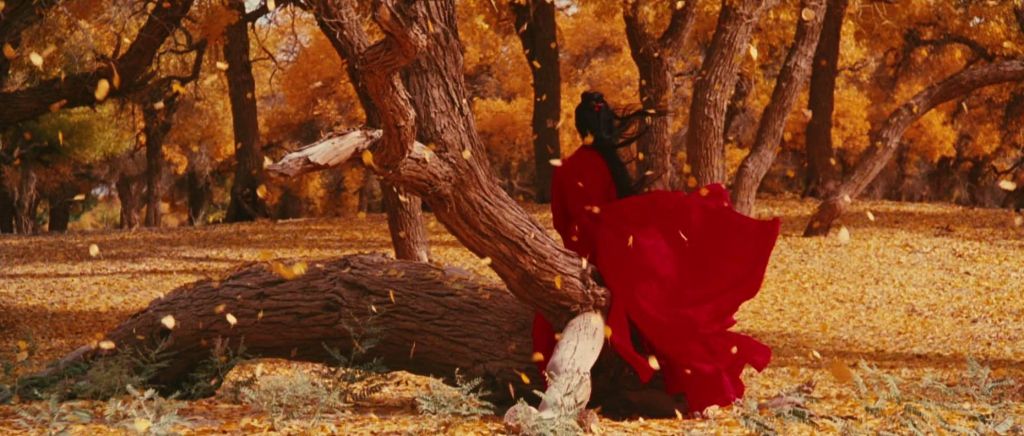
I didn’t know it at the time, like it always is, but in the years 2002 and 2004 I watched two movies that would end up defining a lot of what I am as a cinephile.
Hero and House of Flying Daggers, both directed by Zhāng Yìmóu.
The reason why my 15yo self came across wuxia dramas is now difficult to pinpoint, but I bet it had something to do with their fame for ornately choreographed action scenes.
Maybe not the ‘single’ reason. Maybe curiosity for something different than Hollywood.
A different kind of spectacle, nonetheless.
It didn’t take long, however, to start noticing (and feeling) a subtle presence entangled in the fighting.
Substance amidst the style.
Even calling it fighting, now I know, is a poor understanding of the purpose of martial arts in these films and in these filmmakers’ culture.
At the time, I didn’t know what cinematography was. But, if I was noticing something more than the battles, in a film with parsimonious dialogue, it meant the story was being told through other means.
For the first time in my life, I started (or these films were teaching me) to pay attention to meaning in composition and framing.
I didn’t know a thing about those technicalities, but those images remain some of the most important in my film taste and education. Their beauty was not an end in itself – it prompted analysing and reflecting, like all good paintings, like all good art.
What started as a ‘wow’ for the visual effects, the costumes, or even the editing (another element I was far from grasping) began morphing into ‘why’.
Why are they fighting the way they are? Why are they dressed in this colour? Why is the backdrop of this scene such a naturalistic part of China?
It really is important to underline that I didn’t go to movies to ask questions. The way these were crafted and expressed made me pay that type of attention. Their moving images pumped me with feelings beyond entertainment or melodrama.
I did not have the answers. Yet, that wasn’t the point. I felt something deeper than disposable adrenaline or tears. They taught me how to give myself to them, and, in that journey, I more than learned – I was no longer the centre of the world.
I felt another place, another time, and other people. Movies as “empathy machines”, like Roger Ebert used to say.
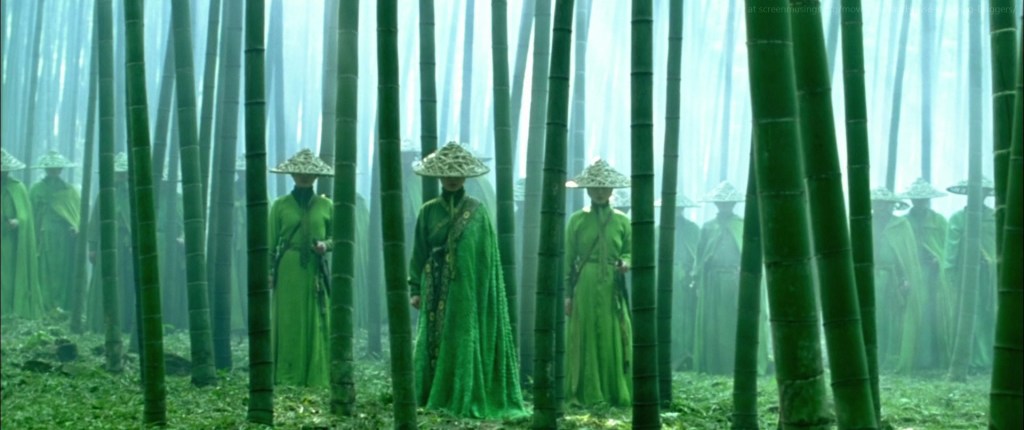
That is why, since then, I actively open myself to different origins of moviemaking. Hero and House of Flying Daggers revealed to me that action can be more poetry than spectacle – that movies can say much without words.
Going in for martial arts, but coming out with a better understanding on the importance of the feminine in our societies, or the amount individuals have to give up as the reason why autocracy is never heroic.
That is the power of a great movie. Memorable (more than beautiful) images, composed, framed and edited together with the intent to let you understand a little bit more about the people who are sharing this journey with us.
If the purpose of civilization and growth is to be able to reach out and empathize a little bit with other people, I encourage myself, family and friends to try out movies from varied countries, varied forms of storytelling or varied ways of stimulating.
Once you open yourself to films like these – the ones that are exceptional at educating movie-watching –, you start noticing more elements and, in that, elevating the overall pleasure.
Deriving interest from the writing, for example, starts to become more of a focus on how the scene was idealized, rather than the verbiage itself. Another example: you start to notice that best acting is different than most acting.
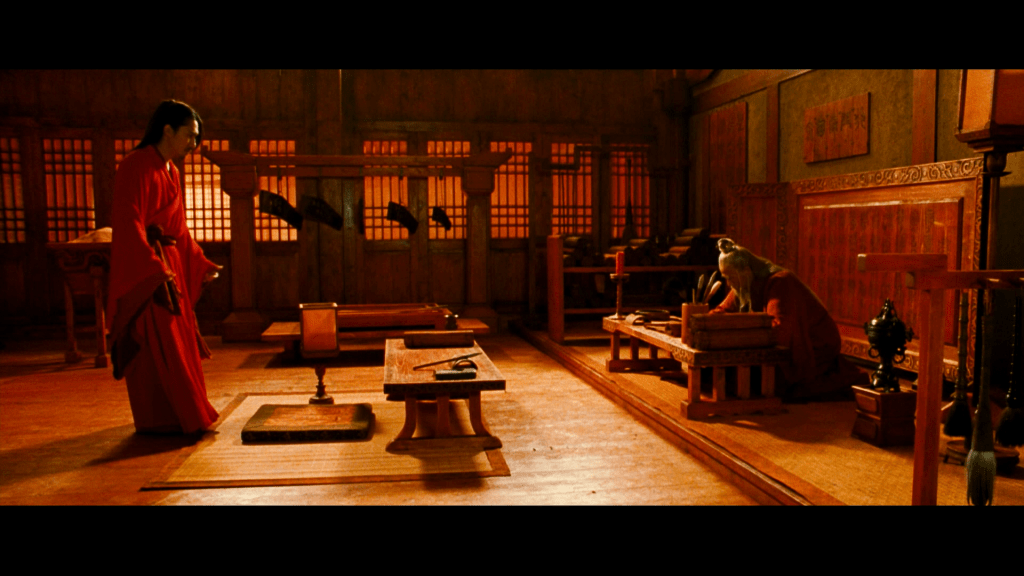
The entire story of Hero can be surmised from two dialogues and three or four images.
It is in the exercise of piecing together these moments by yourself, and how they coalesce with the overall aesthetic design of a film’s scenarios and its actors’ body language, that a bigger satisfaction comes from watching a movie.
- “You intend to go beyond the 6 Kingdoms?” – for the first time, Nameless changes his facial expression.
- The King, furiously and frustratingly, cuts down the green silk decorations of his Great Hall, trying to reach the pensive Broken Sword, also dressed in green.
- The King, now present, accepts death, while contemplating the word “Sword”, painted in red by Broken Sword, and ruminating on the ultimate goal of swordsmanship: “to have no weapon in either one’s hand or heart and to be at peace”. To understand and be understood by thy enemy.
- The cost: two people, dressed in white, embraced in death, with the backdrop of a desert, as far as the eye can see.
- The result: a non-heroic ruler that stopped at the 6 Kingdoms and ordered the Great Wall built to protect his subjects.
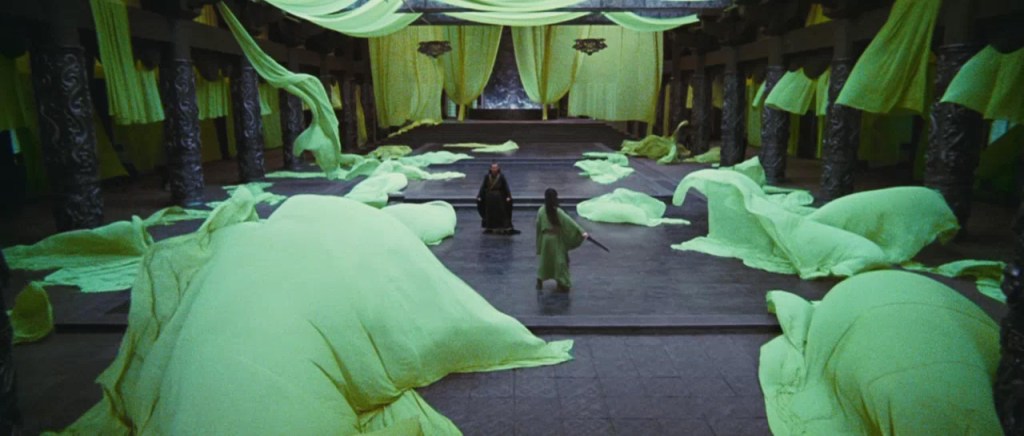
Like I said above: non-disposable. A journey of unentangling visual and narrative ambiguity that stays with you forever, and makes empathy beat hormones.
The last 30 minutes of House of Flying Daggers, another example, are a masterpiece of entanglement.
The plot proposes that two armies are about to clash. Two social structures. Two ways of seeing the world.
The story, the visual storytelling, is suggesting something different.
That something is bigger and more important that those immovable structures. That you are not entitled to nothing. That life contains multitudes, evolves. And that our biggest focus and drama – the grandest edifices of our society – emerge from human-to-human relations and being attentive of the other.
Those last 5 minutes, in particular, are some of the best screenwriting I’ve ever experienced.
With few words all the stakes become clear.
And, from the combination of physical acting and visual composition, said complexity emerges.
It puts the viewer in a zero-sum game. But, there is challenge.
Unentangling feelings you didn’t know (or notice) you had for those characters. Whilst preparing for the decisions they are about to make.
Yet, when those decisions happen, you are surprised once again. Not because of a screenwriting trick, but because life, like those characters, does indeed contain multitudes. And everything makes sense, and it doesn’t.
“If only they had…”
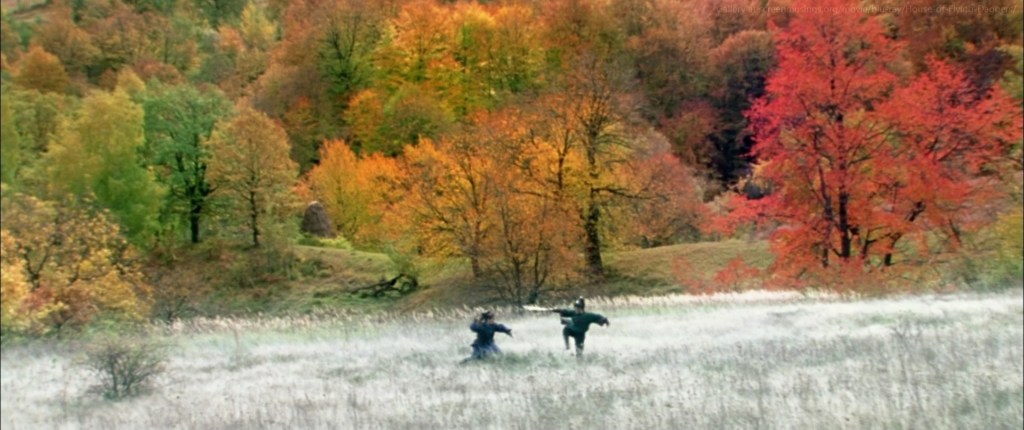
It’s in that moment, when you realize that the filmmakers created such a vivid and open world that you are thinking about it after the credits, after years of watching it for the first time, that you know you just experienced something special.
More importantly: a creation so aesthetically vast and narratively sound that you start thinking about it on your own terms, and letting its influences shape how you experience other works of art.
So, when I say that I have a predilection for Asian cinema, or that I have a big respect for visual storytelling that tells a lot without characters always talking to each other, you know that that taste is not entirely subjective.
I was taught by two masterpieces to understand it and to love it.
 Opinion Seed