Granted some of these movies were delays from the year prior, 2021 steadily built up one of strongest catalogues of the last decade.
It might not have the highest count of instant classics/masterpieces (I’d still argue for three, or even four, of my Best 10), yet it’s remarkable the number of films you have to see for your list to transition from very goods to goods.
Only 65-61 I consider so-so movies, with as much good as meh in them. But, going from 60 to 41, I find them all good films with something important/interesting to say. From 40 to 21, all very good. And 20 to 11 are works of excellent quality that comprehensively embody the virtues of the artistic field.
65. Don’t Look Up
Biggest disappointment of the year.
Let’s try and do a synopsis: Adam McKay, who reinvigorated the studio comedy with hits like Anchorman, Step Brothers and The Other Guys, and then successfully jumped to drama with seething eviscerations of Wall Street and the Bush administration in The Big Short and Vice, respectively, decides to take on the templates of Roland Emmerich’s disaster movies and Michael Bay’s “amurica” to make a satire of how people think scientific facts like climate change and pandemics are open to be discussed in the same wavelength of ideology.
How could I not have high expectations for that?
Add to it a cast of Leonardo DiCaprio, Jennifer Lawrence, Meryl Streep, Cate Blanchett, Jonah Hill and even Mark Rylance. And a crew with Linus Sandgren (cinematography of American Hustle, La La Land, First Man and No Time to Die), Hank Corwin (editor of Terrence Malick films), and Nicholas Britell (music composer for Moonlight, The Underground Railroad, The King and Succession).
My hype was through the roof.
The movie is not bad. It’s just uninspired. With the satirical envelopment, it could have risked a lot more. And it’s weird to be saying this of a McKay movie, since he’s usually very creative with his scenes.
There’s still a powerful message here about not listening to scientists in our day and age. But, Leonardo DiCaprio’s talents could’ve been used much better than just for audiences being giddy at his extraordinary ability of transforming into any kind of person.
64. No Sudden Move
Steven, please slow down.
I think the playful teasing of his friends (Nolan, Tarantino or PTA), about him preferring to shoot digital instead of on film, has gotten to his head.
Steven Soderbergh is trying so much to add flavour to his digital cinematography, that many effects are starting to taste more like gimmicks than condiments.
It’s a shame, because he continues to be a master at lighting and blocking a scene. Below all the unnecessary garnish, there’s a beautiful movie in No Sudden Move. I just couldn’t get past all the visual noise.
On the other hand, the rapport between Don Cheadle and Benicio del Toro is completely enthralling and believable. I could entertain the thought of franchise storytelling with those two.
And, even if not reaching the highs of his best works, Soderbergh does know how to end a movie.
63. Nobody
If there are people who would know how to parody John Wick, the ones who created it in the first place (written by Derek Kolstad and produced by David Leitch) seem like a logical choice.
And it works for 2/3rds of the movie. But, the last half hour forgets Wick completely and becomes a generic action-comedy. It also doesn’t help that the movie – an action movie – peaks during the first act.
Still, Bob Odenkirk is really good and the “Bus Fight” scene is some of the biggest laughs I gave in 2021.
62. Holler
Like its subject matter, this is a rough and tough watch.
If you’re up to it, get ready for crude cinematography and intentionally unpolished editing to not have the traditional ups-and-downs of storytelling that captivate. Nope, it’s all downs.
Maybe that’s what makes this film interesting. I was clearly not in the mood, but respect it a lot for being this way. In a movie about scraping metal, I left feeling like I had small cuts in my hands and a metallic flavour in my tongue.
And the actors are also on point at conveying this atmosphere.
61. The Courier
Yes, it’s another one of “those”: Cold War thriller, based on a true story.
The saving grace to some originality resides in the fact that its protagonist is completely inexperienced and unprepared for the mission at hand.
And it becomes a bit more refreshing when it’s Benedict Cumberbatch playing that role. His calling card is always one of self-serious proficiency. So, it’s cool seeing him out of his element, and using humour (!) to divert all the nervousness of the person he’s playing.
Knowing this now, I probably could’ve gone for more of a straight line between pathos and comedy. Not Johnny English, of course. But neither this slightly boring homage to boring current-day Steven Spielberg.
60. Worth
The moment Economics turned to Mathematics in a desperation move to garner credibility from the scientific community, that’s precisely when it became more pseudo-science than science.
Making claims about human behaviour through formulae and axioms is more than pseudo-intellectuality: it’s dangerous. You can’t mathematize the feelings that govern actions. You can’t predict reactions like we’re some kind of automatons.
And, more importantly for any social science, you can’t intentionally ignore justice and righteousness just because real-world evidence isn’t comported in your algorithms and models.
Saying “ceteris paribus” is NOT remotely close to seeking for falsification by replicating peer-reviewed laboratory experiments in different places and times (hundreds, if not thousands, of times).
59. Stray
First and foremost, it’s morally bankrupt to not have measures in place to grant lives raised from artificial selection a worthwhile existence: you can’t render beings to this world, and not give them rights.
Secondly, seeing such world from the eyes of the dogs should also alert us for something our human eyes are clearly looking away from: homeless children.
People, it’s 2022. Let’s not spend billions to make flying cars or go to space. Let’s take better care of what we know for sure.
We can dedicate our minds in a relentless search for a Planet B, and come to the conclusion that what we are and have is not enough to reach it. While, here on Earth, we created even more chaos as a result of shorting our resources to finance delusions of grandeur.
58. Slalom
The more civilization evolves, the harder we punish crimes and deviant actions.
At the same time, the model we adopt for this development can be detrimental to that vital definition of humanity.
Growth for growth’s sake unquestionably leads and (worth) encourages power dynamics that are not only unsustainable to our evolution, but also pernicious to our raison d’être.
Amidst this model, a one-dimensional imposition of success funnels very different people into a formulaic producer of livelihood and benefits. And it’s here, in this tunnel towards accomplishment, that corrupt and malevolent individuals try to monetize (emotionally, physically, or otherwise) the way to the exit.
This is a film that tells one of (unfortunately) many of these stories. A heinous crime in the name of success.
57. Fathom
Remember Arrival? The 2016 science fiction film, where Louise Banks, a linguist, is enlisted by the United States Army to discover how to communicate with extra-terrestrial aliens.
What if I told you that we don’t have to leave Earth, and work on the realm of fiction, to witness something similar?
Dr. Michelle Fournet and Dr. Ellen Garland, two biologists, are trying to talk to humpback whales, an animal culture evolving for more than 40 Million years. That has the same scale of Sci-Fi, and yet so close to us.
And like in good Sci-Fi, the knowledge we accrue through the experience is not as much on pioneering, as it is about having a deeper conversation with our inner selves.
56. Little Fish
Wait, wait… This is not a pandemic movie.
It was conceived in March 2019, and is based on a 2011 short story of the same name.
As a matter of fact, the movie isn’t much interested in the apparatus of that backdrop. This is a story about the love between a couple, and an interrogation on what makes a relationship: memories of past courtship or personality bases to build a future on, or both. The pandemic premise just makes everything more incisive and timelier.
On the other hand, the almost complete disengagement with the machinery of the pandemic happening around its characters makes the movie a bit slow and melodramatic for my taste. The good thing is that such roles were given to Olivia Cooke and Jack O’Connell – two of the most promising young actors out there. The humanism and nuance they inject into the plot keeps making you care for the couple, and their outcome.
It was also shrewd of the filmmakers to toy around with the Kuleshov effect in a film with a memory loss virus.
55. The Mitchells vs. The Machines
I fully recognize that animation, to be distinctive, must take advantage of one of its perks: freakish mechanics of movement and action to use in exotic scenarios. A never-before-seen experience.
On the other hand, I prefer animated movies to not take that endorsement literally and channel that power in a more unravelling way. I.e., be restrained and freak us out when the narrative is longing for it. You know, the Hayao Miyazaki school of animation.
That being said, it’s disingenuous of me to expect such sobriety from a Lord & Miller production. After The Lego Movies and Spider-Man Into the Spider-Verse, I should know better. And, to be fair, they are not only the best at doing over-the-top but are also pushing the boundaries of what animation can be, from a technological point-of-view.
The mechanics are indeed cutting-edge and alluring, and not too much distracting that the emotional core of the movie is lost in them. I was just a bit dissatisfied with the overall feel, precisely because the subtext in the story is sharp, deserving thus a less rowdy canvas.
But, hey. It’s not often we are presented with Olivia Colman playing an evil A.I..
54. The Suicide Squad
Just because James Gunn is once again pulled from persona non grata to direct a band of misfits and galvanize a comic-book cinematic universe, it doesn’t mean we’re in the presence of another Guardians of the Galaxy.
Even if I’m not nuts for Guardians, I still acknowledge its momentous influence on the MCU and movie culture at large: it brought Marvel to space, and effectively rendered other movie genres unappealing to casual audiences (colourful special effects, catchy pop songs, space action-adventure, drama comprehensible for both children and adults, and well-written comedy, all in one neatly paced package).
The Suicide Squad is not THAT. However, the MCU was not in the same state, at the time of Guardians 1, as the DCEU is now. So, in that sense, there’s a chance that James Gunn ends up having the same kind of impact on this cinematic universe, proportionally speaking.
The movie is, like I said, another neatly paced package. It’s not afraid to use colour, even knowing its biggest audience are teenagers renegading their younger years, the action and set-pieces are creative, and Gunn’s jokes continue to land.
And, without trying to read like a “homer”, I find Daniela Melchior’s performance to be the most compelling of this star-studded cast, as she carries with her a brand of subdued drama a movie like this always needs.
53. Woodstock 99: Peace Love and Rage
Man, I see here the strongest and smartest who’ve ever lived. I see all this potential, and I see squandering. God damn it, an entire generation pumping gas, waiting tables; slaves with white collars. Advertising has us chasing cars and clothes, working jobs we hate so we can buy shit we don’t need. We’re the middle children of history, man. No purpose or place. We have no Great War. No Great Depression. Our Great War’s a spiritual war… our Great Depression is our lives. We’ve all been raised on television to believe that one day we’d all be millionaires, and movie gods, and rock stars. But we won’t. And we’re slowly learning that fact. And we’re very, very pissed off.
1999 is the year of Fight Club.
Like The Social Network (2010), David Fincher seems to have a knack to pinpoint bubbling evil in novelties of our society long before we deem it as an issue worth caring for.
It’s striking if we trace a line between the concerns raised in the 1996 novel “Fight Club”, the dark energy exposed in Woodstock 99, the sexual culture that motivated Mark Zuckerberg to create one of the most influential companies of our times, and the same nihilism that wound up in our current-day social networks.
A morally corrupt connection between corporations growing of the animalistic urges of mankind, and that mankind becoming increasingly angry because those corporations then say our lives amount to nothing in comparison to their too-big-to-fail “grandiosity”.
52. Roadrunner: A Film About Anthony Bourdain
We can learn a lot from insatiable people.
We become more aware that the world, and the life in it, is a cosmic improbability worth keep discovering. On the other hand, constantly discontent individuals also teach us that the “disease of more” ironically blinds to what is close: a universe of human complexity and connection also worth zesting in.
Bourdain showed us that if in even in the most primal of needs – eating – we still find expansiveness to our worldview and empathy, we are a long way from stabilizing as an evolved species and reaching the top of Maslow’s pyramid – true self-actualization.
51. Derek DelGaudio’s In & Of Itself
Yup, a bit self-aggrandizing.
However, its heart is in the right place, and there’s a powerful feedback-loop working here: you can’t help but empathize with the people in the audience, and, by doing so, you get to experience some of the “magic” inside of you too.
What also contributes to that connection is the cinematic feel they managed to imbue in a simple recording of a live stage performance. That’s very difficult to do, because you don’t have a lot to work with.
50. CODA
Don’t be a cynic, and think you’ve already seen this movie a dozen times. Yes, the structure is familiar (even if rarer, nowadays), except that the hardships of families like this are so infrequently given visibility.
That alone makes the premise rather unique. And the filmmakers were legitimately astute in how they took a tired trope of “these” movies – musical elements –, and refresh it with real stakes. Not narrative stakes, but humanistic ones: how something good we take for granted, like music, can become another wall in our relationship with already segregated people.
It’s a feel-good movie, and we should also not take them for granted, particularly the well-made ones 🙂
49. Zola
Yes, we’ve come to a point in our culture where Twitter threads can be nominated for the Oscar of Best Adapted Screenplay.
In 2015, I was on Twitter, but I didn’t catch the virality of the 148-tweet thread about prostitution, murder and suicide that Detroit waitress Aziah “Zola” King posted, containing details of a trip she took to Florida with a stripper named Jessica.
As such, I can only assume that this filmic adaptation resonates more with the people that followed the thread during those days. Even so, it wouldn’t be excessive if the movie ended up getting that nomination, as it balances really well both the tightness and the tilt that is social media surfing and discourse.
48. Rocks
In 2022, it is inconceivable how, in even the wealthiest countries in the world, the abundance doesn’t even nudge so many families. And their children don’t have the minimum conditions to just be children. While many, many individuals have unproductive capital like 3-4 houses, 3-4 cars, etc etc.
The strength of this movie resides precisely in how it shows two distinct sides of frenetic: a teenager enjoying the rate at which she discovers the world and herself; and a teenager, all of a sudden, having to juke and hide from capitalism just to survive.
Bukky Bakray, the lead actress, is amazing at juggling both states of frenzy, without ever losing an inner sadness that is essential for the overall message the movie is trying to convey.
47. Sweat
Modern celebrity lives and dies by the expectation of authenticity.
That’s the currency that transferred fame and fortune from rock stars, super models, Hollywood actors, or athletes to everyday people – the so-called influencers. Even the sex industry is amidst a revolution with the rise of amateur pornography.
But, is that authenticity authentic?
Like other types of currency that the internet conjured out of thin air, is the demand for authenticity just a gateway to a Ponzi scheme? In this case, an emotional one.
These are the questions the Polish-Swedish movie asks. An interrogation on the importance of substance to any human exchange. A material connection to the core in us that has and generates value.
46. The Disciple
The relative positioning of this film on the list reflects how prosperous the year was for cinema.
I loved the film. Even the moments when the pace made it a more difficult watch. They are completely in line with the non-progressing monotony of this devoted artist’s life.
For example, every time he has to ride his motorcycle, he uses it to listen to lessons on the art he’s striving to master. We get to experience the narration of the lessons in real-time, but the ride is in slow-motion, which makes it even more demanding. It’s a call for attention. To actually listen to the content of the lesson, and juxtapose its meaning with the visuals of modern-day Mumbai.
Those are striking moments. And yet, what categorically makes this a special movie is how it is a story about not being good enough.
It’s very bold to build your commercial film (it’s on Netflix) based on the premise that your protagonist is never going to overcome the odds. This isn’t a spoiler, because the true ending is figuring out, alongside him, if dedicating most of your time to get better at a craft, and not be successful, is a failure.
45. 007: No Time to Die
James Bond has been charming us for decades with one of the oldest tricks in the book. A trick that franchise filmmaking and even serialized TV don’t seem to understand.
Since 1962, almost all 007 movies are standalone. I.e.: despite main characters and thematic lines travelling across entries, each story is relatively self-contained. I never found these movies particularly appealing, but it’s undeniable that this artifice works very well in combating both franchise fatigue and audience entitlement.
So, in the final movie of an actor that truly reenergised the brand, the producers fall for the trap of the direct sequel. Worse, a sequel to one of the worst stories this actor had to work with during his tenure as James Bond.
No surprise that everything bad about No Time to Die comes from Spectre (Léa Seydoux, Christoph Waltz and even Ralph Fiennes all continue to have very poor storylines), and everything good comes from Daniel Craig being an unrelenting force without the need for constant drinking and objectification of women.
Oh, and Ana de Armas is fire. It’s just a shame she’s only in the movie for 10 electrifying minutes. I would have much preferred for No Time to Die to be a standalone adventure of Bond and Paloma globetrotting and kicking ass. Those two were having so much fun in the “Cuba Chase” part of this film.
In the end, No Time to Die works better if, like me, you’ve grown to like Craig as Bond in Casino Royale (2006) and Skyfall (2012).
44. A Quiet Place Part II
This is the typical case where the original movie was trailblazing in a stagnant field, and, suddenly, people (me included) expect the same trend for the sequel.
A very well-made film, that moves very little from where it landed 3 years ago.
43. The Last Duel
The whole is less than the sum of its parts.
Ridley Scott, at 84 years of age, continues to shoot action like a young vibrant director. The performances are all great, particularly Jodie Comer and Adam Driver.
And even the ideas serving as cornerstones of the screenplay are very interesting. It’s the execution of those that fails. Mainly in the uninspired employment of the Rashomon framework. What could have been a very original use of that effect to tell on the inherent significance of #MeToo in the Medieval times, ends up disserving the individual issues and the movie as a whole.
The audience is treated like we wouldn’t have been able to grasp the timeless nature of the crime, if the film had a less spoon-fed editing structure. Maybe we wouldn’t. But that never stopped Christopher Nolan from complexifying time signatures in complex subject matters, and his movies remaining very successful commercially.
42. Spider-Man: No Way Home
This movie totally works as commercial art.
One just had to be in a live-screening and hear the audience laughing, cheering and crying to understand what a cultural phenomenon this is. And that’s tremendously difficult to achieve. Believe me, I’ve been witnessing movie theatres becoming emptier and emptier as the years go by.
It’s movies like this that reconvert people to the uniqueness of the cinematic experience. It’s very rare that so many different people get to feel so many different emotions in just 2h 30m. And, if just 1% of those rooms end up becoming cinephiles because of that good time, it’s probably just as important as the money a movie like this brings to the industry.
That being said, there’s very little identity in this movie. It feels worse than storytelling by committee. It feels like it was a story made by us, the fans.
Nothing against fan-service, but it should be coherent with the flow of what you’re building.
Let me give you an example of why a movie shouldn’t be made like it was made by the fans for the fans. I’ve been saying that I prefer Tom Holland’s Spider-Man to the Maguire and Garfield ones, because he is more “neighbourly” and upbeat, and that becomes even more meaningful when he is among the Avengers and all the planetary stakes they have to deal with.
On the other hand, I’ve also been wanting a gradual rise in darkness and expansiveness of the Tom Holland’s standalone movies. I like levity, but they were becoming a bit one-note-ish. And there are different emotional places yet to explore in the future of this character.
Spider-Man: No Way Home is, without a question, darker and more expansive. But, since it was fan-service that informed those decisions, the emotional places come from the past and have already been explored.
41. The Matrix Resurrections
This movie doesn’t fully work as commercial art.
This isn’t a Matrix movie that you can just come for the action sequences. Keanu Reeves never touches a gun, for example.
In that sense, you need to have more than superficial knowledge of the franchise to fully enjoy this one: you should be aware of thematic lines, philosophy and mythology. And, even then, the movie is a bit careless in its execution.
Yet, I loved that recklessness. It felt like an auteur completely reclaiming her art and dissecting it, 20 years later, in her own terms.
Art is intellectual connection, as each of us tries to decode the message in it. Art is also emotional connection, as we realise we share the same feelings of its creator.
Matrix Resurrections is the true sequel to the first film of the franchise. The other side of the coin, if you prefer. What The Matrix (1999) had in droves – use of Sci-Fi to equate the heavily commercialized, media-driven society with Plato’s Allegory of the Cave and Kant’s Critique of Pure Reason, where people come to know and explore the world through synthetic means (language, etc.), thus making it difficult to discern truth from falsely perceived views – it lacked in heart, since all the trans politics were unhappily closeted.
That’s why people tend to not like Reloaded and Revolutions. Because they internalized even more, and leaned too much on the sci-fi and on the action set-pieces.
Resurrections is not only the heart that was lost, but also the externalization of the heart that was cloistered in the first film. A confident filmmaker, in a better place in her life, saying that the best way to pay tribute through a sequel is to take those thematic lines, philosophy and mythology and be honest about her current feelings about them.
40. Final Account
B: Targeting me won’t get their money back. They crossed the line.
A: You crossed the line first. You squeezed them, you hammered them to the point of desperation. And in their desperation, they turned to a man they didn’t fully understand.
B: Criminals aren’t complicated. Just have to figure out what he’s after.
A: With respect, perhaps this is a man that *you* don’t fully understand, either. A long time ago, I was in Burma. My friends and I were working for the local government. Their caravans were being raided in a forest north of Rangoon by a bandit. So, we went looking. In six months, we never met anybody who traded with him. But, one day, I saw a child playing with a ruby the size of a tangerine. The bandit had been throwing them away.
B: So why steal them?
A: Well, because he thought it was good sport. Because some men aren’t looking for anything logical, like money. They can’t be bought, bullied, reasoned, or negotiated with. Some men just want to watch the world burn.
Some people see similarities between this description of the Joker character in Batman, and the rise of fascist leaders.
The frightening realization this documentary demystifies is precisely the notion that “You crossed the line first. You squeezed them, you hammered them to the point of desperation. And in their desperation, they turned to a man they didn’t fully understand”.
Either in the 20th century, or now, the people that are most responsible for acclimatizing and opening doors to this type of evil were/are not desperate.
More often than not, they are middle to upper-class individuals who benefit substantially from the socioeconomic experiments those idealogues want to implement, paid by selling the bedrock of modern civilization we’ve been gradually and tirelessly accruing.
39. About Endlessness
Can a movie go over your head in most of its textual elements, and still live in your memory as one the most enjoyable cinematic experiences of that year?
Apparently, yes.
The film consists of a series of vignettes, and even if I didn’t understand the second layer of meaning of many of them, the first layer of staging was hypnotic every time, and the third layer of existentialism stringing them all together was engaging and memorable in its totality.
In just 1h 18m, Roy Andersson shows us so much of what we deem fatiguing idiosyncrasies as fleeting receptacles for the essential distillation of what it means to be alive.
The anti-thesis to the thesis that life is dominated by bad moments, and that we should do everything in our power to aggrandize those few good ones.
38. Atlantis
I admit that I’m probably the worst person to tell you this is the best horror movie that isn’t a horror movie I’ve seen all year, since I don’t much care for horror movies.
Be that as it may, I haven’t seen more haunting and tense images, this year, than the ones of 2025 Eastern Ukraine, and the horrors (internal and external) still living there after winning a war against Russia. Yes, winning.
It even employs the horror trope of new-found love. The flickering light source we’re not entirely sure will last the long dark night ahead.
37. Night of the Kings
Since Peter Dinklage verbosely declared Bran Stark winner of the Game of Thrones, we’ve been disenchanted with the alleged power of stories and storytelling.
Unfortunate snobbery aside, what Tyrion Lannister tried to convince us of is expressed in a much more palatable, legitimate and heartfelt way in Night of the Kings.
Here, it is explained why “there’s nothing in the world more powerful than a good story”, why “nothing can stop it”, why “no enemy can defeat it”. The strength of stories to hold a people’s legacy. The influence of stories to set in motion conflict and destructiveness that gradually modify culture.
That’s what the character Silence means by “if you want a chance at survival, don’t finish your story”. Our never-ceasing call for a never-ending story, in which we strive to correct all our past mistakes, and establish connections with more and more fellow humans.
What unites people? Armies? Gold? Flags?
The wars, weddings, births, massacres, famines. Our triumphs, mm, our defeats, our past. Who better to lead us into the future?
Stories.
36. Identifying Features
A non-paternalistic way of depicting the real drama that is drug trafficking in Mexico.
Fernanda Valadez, the director, doesn’t shoot cartels like toy soldiers. As a matter of fact, she doesn’t shoot them at all.
In Identifying Features, traffic is bigger than a numbers game of kilos or bullets. The cartels are represented by more than the power the oligopoly exerts. It’s a later stage where economic and political influence have seeped into the social fabric, morphing figureheads into demonic folklore.
But, like all folklore, the roots of it are very real. Tragedy, struggle and fear: all very real.
And the film doesn’t shy away from taking you to places where that heat is palpable. So we can better understand what pushes people into life-changing/ending decisions.
35. The Card Counter
It’s curious that Paul Schrader decided to set the plot of his new film around casinos and poker tables, with a protagonist who isn’t interested in the capitalistic notion of winning.
Hm… Maybe that’s precisely the point of choosing that setting.
It’s not rare we start our movies with a self-deprecating protagonist, commiserating their past actions. However, that’s usually a bit disingenuous and shady, as that trope serves as an easy to beat benchmark for the irresistible need to give us the growth of the hero’s journey.
Oscar Isaac’s character, William Tell, is a different kind of self-deprecating. He doesn’t commiserate. He actively and methodically avoids gaining things. He aptly fends off any semblance of growth.
Like a larva that not only rationalized the animalistic mechanics of metamorphosis, but is also apprehensive about the promise of the next stage.
Mr. USA is the late stage – a plastic butterfly.
34. Riders of Justice
There was a time when dark comedies that use violence as a deconstruction mechanism was one of my favourite subgenres in film.
They became so prevalent that I started to question if they are still on the joke, or the joke itself. I.e.: what does it say about us that, suddenly, violence, particularly gun violence, has become more ubiquitous in our comedies than even in our dramas?
Riders of Justice is a contribution done right, where gun shots aren’t the new fart noises. The violence is not just there to justify action scenes and agreeable pace. There’s an emotional earnestness at the core of these characters decisions.
Still, we should remain analytical of our comedies. Through the guise of comedic “free speech”, there are a lot of cheap instruments being used to elicit easy laughs and entertainment. Those, more than in dramas, tend to soften the convergence to an unhealthy relativism of values we would consider medieval in any other context.
33. Titane
Look, I know you’re probably pretty confident what type of film watcher you are, and think you already know if this movie is for you or not.
It probably isn’t. But, let me just say this: preconceived ideas is a bad starting point for any movie, particularly this one.
This is precisely about identity, giving a chance, and a second life.
32. Parallel Mothers
Penélope Cruz as the protagonist in an Almodóvar film. Almodóvar’s interiors. And him talking about mothers and how they shaped the history of his country.
Sincerely, what more do we need?
31. Benedetta
Don’t be deceived by the sensuous imagery of lesbian nuns.
Like in much of Verhoeven’s filmography, what he’s in fact interested is power, and power dynamics.
And many few things have held a more powerful grip in our history than the exploitation of fear/faith and the capitalization of the supernatural as an answers’ machine by organized religion.
The way Verhoeven shot and coloured this film tells you a lot of how he sees the effects of such Olympic forces on the people of the time (and today). More often than not, movies taking place during the 17th century have intentionally muddy production design, and gloomy cinematography to pair with it.
Benedetta is sharp, brightly lit, and full of colour.
30. Bo Burnham: Inside
Trying to be funny and stuck in a room
There isn’t much more to say about it
Can one be funny when stuck in a room?
Being in, trying to get something out of it
Try making faces
Try telling jokes, making little sounds, uh
I was a kid who was stuck in his room
There isn’t much more to say about it
When you’re a kid and you’re stuck in your room
You’ll do any old shit to get out of it
Try making faces
Try telling jokes, making little sounds
Well, well
Look who’s inside again
Went out to look for a reason to hide again
Well, well
Buddy, you found it
Now, come out with your hands up
We’ve got you surrounded
29. The Dry
It’s true that limited-run series have taken up the mantle on this traditionally lucrative subgenre of the theatrical experience.
However, even if the most successful TV detective dramas tell a complete, non-recurring story, without procedural design thought to rake in seasonality, there’s something to be said about a crime mystery taking you on a one-sitting journey of mood swings, in the darkness of a movie theatre, without the dependency of tension crutches like serialized cliff-hangers.
Movies like this one are a dying breed. And it’s a shame, because they are so much fun.
Eric Bana is so much fun. The small town that becomes a megalopolis of lies, traditions and relationships is so much fun.
We don’t need several episodes to “flesh out” characters. Be empathic and assume that all are humans with inherent value, let the story (not the plot) drive the motion of the pictures, and enjoy the rollercoaster.
28. Cliff Walkers
Zhang Yimou is one of my favourite directors. I can trace back my love of cinema to Hero and House of Flying Daggers, and to what they taught me about the power of composition and staging in narrative delivery through sensations and no words.
Cliff Walkers is not wuxia, and Yimou is not as colourful nowadays as he was 20 years ago. Nevertheless, the clinical eye is there and he still sees human relations as a dance where our most flamboyant is revealed.
His films have also never shied away from owning their inherent political backdrop. Yet, he is much more interested in how politics don’t have a life of their own, and how they are made of actions on a place and time, affecting people’s lives and their relations.
Besides, we don’t get many spy thrillers of this quality nowadays.
27. The Dig
British high society movies define probably the most successful film genre that isn’t a film genre.
I understand but can’t relate to the appeal. They are usually too aseptic for my taste.
Not this one. High society getting their hands dirty for something bigger than their egos.
As World War II approached, Churchill (another highborn) was asked to cut science and arts funding in favour of the military effort. He replied: “Then, what are we fighting for?”.
Winston Churchill is not depicted here, but that’s essentially what the movie is asking.
Also, Carey Mulligan and Ralph Fiennes never disappoint.
26. Dead Pigs
Cathy Yan is starting to make a name for herself with her work in Birds of Prey and Succession.
Notwithstanding, in her debut Dead Pigs, it’s immediately evident that she is a tour de force director who, when working unconfined, will be here to give us stylishly daring cinema.
She is frisky with her characters and holds no punches in testing their credibility with fast-paced editing and disparate scenarios. At same time, this brazenness is entirely respectful of the subtext.
It’s the mark of a great director: the style doesn’t upstage the substance.
25. King Richard
This is not a sports movie.
This is a drama expanded beyond the biographical turmoil of one individual, that manages to have a very compelling sports movie inside.
I confess I never understood why Will Smith is considered one of the biggest stars of modern Hollywood. Rare are the performances where he shows me more than Will Smith with costume and makeup.
Not this time. I completely forgot Will Smith and saw Richard Williams.
24. Mass
This is not one of those cases where a movie is in effect two movies.
The thing is: it’s 10%, that coincides with the beginning of the film, that is doing something intriguing with its pace and framing.
That’s not to say that 90% of the movie isn’t hair-raising. Quite the contrary. The content of the rest of the movie is profoundly gripping. It’s just the format that is more old-fashioned: like theatre, we’re in the same room with the same 4 people dialoguing.
Well, maybe “old-fashioned” is not the best descriptive. A movie where 90% takes place in the same place with just 4 characters is quite refreshing in its own way.
Be that as it may, your senses for that 1h 35m are definitely heightened after the introductory 15 minutes. The aforementioned room is set up with the blankness of a horror staging, and deliberately not giving screen time to the other half of the couples before the meeting is the suspenseful strain the upcoming dynamic needs.
And despite the negligible theatrically in some of the line readings, it’s impossible not to see in these 4 performers some of the best acting of the year.
23. The Power of the Dog
With the exception of Disney animation when I was kid, the film I watched more times in my life is The Fellowship of the Ring.
Consequently, by knowing that Jane Campion is New Zealander, the cinematography and production design of The Power of the Dog could never convince me that I was in 1925 Montana and not on Middle-earth.
That nitpick aside, this is an instant classic of a probe into toxic masculinity, and an earnest inquiry of what defines a manly man.
Benedict Cumberbatch gives the best performance of his career.
22. Acasă, My Home
There’s a lot of reflecting to do after watching this documentary.
Even so, it immediately becomes clear (if it wasn’t before) that what we call the “civilized” way of living of the “developed” countries is not only failing a lot of people, but is also unsustainable.
This is some of best cinematography of the year, tearing open the “industrialized” and “high-income” country, and how those dogmas have distorted how we look at natural and humanistic beauty.
The addiction to “more” is slowly dehumanizing us, breaking our connections with life, and leaving the other who can’t run at the same speed behind.
21. Summer of Soul (…Or, When the Revolution Could Not Be Televised)
The power of music.
Sounds like an empty catchphrase. Yet, the fact that this music festival, that managed to bring together some of the most respected and influential artists of the 20th century, was intentionally censored by the biggest media conglomerates of the time is the quintessential proof that music unites and is more than rhythm and lyrics.
More than 50 years later, those lyrics are still unfortunately timely, and that rhythm has been reverberating since then for evolution and change.
One just has to slightly squint to see the similarities between the Moon landing of 1969 (juxtaposed by this documentary with true hunger and poverty), with some of the richest men in 2021 spending millions to scratch the stratosphere and their ego, while in the middle of a devastating pandemic.
The power of music to unite us, and to teach us that the grandeur lives right here on this earth, right next to you, inside your fellow human, with their heart pounding at the same rhythm of yours.
20. Belfast
Before anything else, this movie should be prefaced with two caveats that can legitimately alienate some members of its audience:
- The film chronicles the life of a working class Protestant family from ONLY the perspective of their 9-year-old son, during The Troubles – the ethno-nationalist conflict in Northern Ireland that lasted 30 years;
- You really have to frame everything (from good to bad) the movie is showing and telling in a child-like canvas.
I concede that’s a lot of heavy lifting and suspension of disbelief for such a serious conflict.
That being said, and to be fair, a weighty cross-examination of The Troubles was not what native Kenneth Branagh purposed to do with this autobiographical project. The specialty and honesty of the film comes precisely from the youthfulness and innocence shattering of Buddy’s world and point-of-view.
There’s an undeniable charm and wonderment in every shot. Jamie Dornan and Caitríona Balfe, for example, must be the most good-looking parents a kid as ever had. But, it works. Branagh sneakily brings the pantheon of people down to earth, with glimpses of how profoundly sad they are about what’s happening in their community.
And the black and white is also not a gimmick to convey nostalgia. It’s used to contrast the light and dark of what Buddy sees and doesn’t see, respectively. And, when Branagh risks colour, you are immediately transported to how it felt to have magical moments as a kid.
19. Who You Think I Am
Besides the stinging exploration of social media identity (that has been done before, and better), the first 2/3rds of this movie are not “Top 20 of the year” worthy. Ok, Juliette Binoche is amazing as ever.
However, once the final third kicks into gear, the film inner rhythms decide to be bolder, and its message, instead of just backpacking, decides to probe and poke at what second life are we actually aiming in virtual worlds. And, more poignantly, why are we not striving for that in the real world.
18. Shang-Chi and The Legend of the Ten Rings
After the epic culmination that was Avengers Endgame, it’s an equally big ask of audiences to say: the characters you grew fond of for 10 years will not be part of the next massive saga we’re building up to, either because it doesn’t make sense from a storytelling perspective, or due to the actors’ exhaustion of working in franchise filmmaking for more than a decade.
As such, I’ve been very reluctant to invest more time and headspace in new movies and TV shows coming out of Marvel Studios.
Just when I thought I was out, Marvel money pulls Tony Leung (one of my favourite actors) in to play a villain. ¯\_(ツ)_/¯
First of all, my benchmark to these new origin stories cannot be Endgame. That’s the top of the mountain not only because of the expansiveness it lets you see, but also due to the climb you had to make to understand the achievement that reaching the pinnacle means.
At the same time, I cannot disassociate that these new stories and Endgame are of the same cinematic universe. Therefore, I can use Endgame as some kind of metric: can I imagine these new characters in that last battle against Thanos, and care for their survival?
Shang-Chi and the Ten Rings pass that scrutiny with resounding Yeses.
Simu Liu’s performance has everything we’ve come to expect out of a Marvel hero: dark past, sweetness and martial arts acumen that make action sequences have roots in some verisimilitude. His supernatural powers and how are passed onto him is also cool as hell.
Awkwafina in a Marvel movie is another reason why the MCU killed the comedy blockbuster.
Michelle Yeoh is VERY welcome into these movies.
And Tony Leung instantly becomes one of the best villains in a legendarium that already accounts for 27 films.
17. Spencer
I have almost zero fascination for the social construct of royalty. And that’s probably why I liked this film so much.
Pablo Larraín, akin to Guillermo del Toro, is one of our best filmmakers at building alluring fairytales that collapse into horror stories.
The visuals by Claire Mathon show us the charming fable, while the music by Jonny Greenwood tell us something is not quite alright.
And even with all those technical merits, it’s Kristen Stewart’s performance that elevates all the aura. Her physicality has the range this story needs: anchor and bursts. Yet, it’s the way she delivers dialogues like this that tells you everything you need to know.
William: Mummy, why do we have to open our presents on Christmas Eve? Why not Christmas Day like everybody else?
Diana: You know at school, you do tenses?
William: Yeah.
Diana: There’s the past, the present, future.
William: Right.
Diana: Well here, there is only one tense. There is no future. The past and the present are the same thing.
16. The Lost Daughter
Maggie Gyllenhaal, with her feature-length directorial debut, instantly becomes a must-follow.
It’s genuinely impressive that, in a film based on a novel by Elena Ferrante, with on-location (beautiful Greece) beautiful cinematography, tense editing, and Olivia Colman, it’s the first-time directing that steals the show.
She’s comfortably playful with scenarios, timeline and characters, while having a clear-cut eye on how and when to employ the powers of mystery, sexuality, or intellectuality. Just from 1 movie, we can already tell that Maggie Gyllenhaal knows how to channel her characters’ anxieties into audiences’ expectations, thus putting psychological pressure on the suspense of the experience.
Point-of-view is a tool here, but not just as a mechanism to generate tension and drama. There’s an earnest desire to confront herself and the audience with women’s roles that don’t fit the proverbial mould. Film directors have/had their own mothers, and it’s hard coming to grips with moments when they were not loved.
Like I said, Maggie’s directing is certainly the highlight. Yet, I should not take Olivia Colman for granted. I know we’re coming to a “Meryl” state with her, where she gets the best feminine roles of the season. Still, like with Meryl Streep, all the director’s vision I’ve described only works because these women are great at their art.
I should also leave a note to Jessie Buckley. She plays a younger version of Colman’s character, and, even with the greatness of the latter, you buy them as the same person because Jessie is undeniably outstanding in her own right. I would even venture saying she is the best performance of the movie.
15. Dear Comrades!
A razor-sharp examination of how there’s a fundamental distinction between ideas and ideology.
Even if it’s a bit primitive referring to “left” and “right” when talking about political ideas, it’s undeniable that, when it comes to beliefs and its results, “far-right” and “far-left” are just empty labels for the last stage of ideology: entrenched clubmanship (the authoritarian and militarized version of organized religion or football clubs) characterized by hate for opposition (different club, different ideology) and strong regimentation of society and its economy.
This film keenly breaks down how people in the USSR could be completed divided in defending the ideas of Marxism or even Communism, while damning the political party purporting to uphold those ideas.
A people who sees their ideas being appropriated as marketing to the more comfortable place of ideology, where clubmanship (on the left and on the right) allows for the individual interests of club leaders to superimpose the collective good.
The last sequence of this movie is one of the most powerful of the year. A crisp frame of reference to the illusion of free will in adopting an ideology. There’s a fallacy in saying that you are thinking in your own terms by doing so. It’s just a convenient package of skins of ideas, stitched together into a frictionless mantle of pseudo-catharsis.
14. The Harder They Fall
The coolest movie of the year.
After films like The Revenant or The Assassination of Jesse James by the Coward Robert Ford, “spaghetti” has become a take on westerns that feels a bit too much démodé.
But, if you must do spaghetti, this is how you loosen it up with originality sauce.
Everything is stylish. With substance. All characters are memorable (and they are MANY). The use of colour is gutsy and there are several shot transitions that will also stay with me for their legitimate creativity.
And the soundtrack… Aah… the soundtrack.
13. Playing with Sharks
Jaws (1975), by Steven Spielberg, is considered one of the most important films of this artistic field. Deservedly so.
It is also responsible for heightening negative stereotypes about sharks and their behaviour, producing the so-called “Jaws effect”, which inspired “legions of fishermen to pile into boats and go kill thousands in shark-fishing tournaments”.
In that sense, it’s inspiring to see some of the people responsible for the “realism” of that movie both sad and happy to recontextualize it and their fame.
Valerie May Taylor and her husband Ron Taylor were very respected in their community, but became famous for shooting the real great white shark sequences of Jaws.
In this documentary, Valerie shares how much the ramifications of that watershed moment in their lives and motion picture history (pivotal in establishing the modern Hollywood business model) changed their perspective on filming sharks.
There’s a big disparity (and consequences) between shooting adventure films for high box-office with simple high-concept plots, released during the summer in thousands of theatres and advertised heavily, or making documentaries that tell the complete story of sharks, helping people understand and admire both the animal and its role in the ecosystem we are also part of.
Valerie was a trailblazer. Did so much with very little. Her budgets were miniscule compared to Jacques Cousteau’s for instance. This is a great documentary at showcasing that. The old footage retains beautiful and soulful cinematography, and the current day images are on par with the best we have of wildlife filmmaking.
12. The Hand of God
Oh boy, does this movie go places…
At the expense of a semi-chaotic editing style. But, I don’t care. It feels fully personal and humanistic, and very few things are left unsaid.
It doesn’t have cocktail elegance, yet, it exudes natural beauty. It doesn’t follow film protocol that helps make products agreeable, but that never stops it from being an easily enjoyable ride.
Let the movie take you where it wants to go, and turn the colour, the movement, the laughs and the cries into feelings that makes you connect deeper with yourself and others.
11. Preparations to Be Together for an Unknown Period of Time
Don’t be disappointed if this film ends in a completely different mood than the atmosphere it creates throughout. Think about what you’ve felt during it, and how successful it must have been for generating such expectations.
I think some people in the film industry are so afraid of communicating pretentiousness by saying their endeavour is Hitchcockian, that we are seeing less and less works inspired by one of the greats.
This Hungarian cast and crew were confident they could stand on the shoulders of that giant. Rightly so. The film has its own authentic take on the formula, taking advantage of the medical context of the plot and the propensity for over-rationalization of its characters to sell you on a premise that grows like weeds as the cinematics, music and narrative proceed.
10. Test Pattern
Probably the most attentive portrayal of how rape crosses with bureaucracy and interpersonal relationships. And, more importantly, how that red tape affects partnership, and vice-versa, from the point-of-view of the assaulted.
The ending scene is one of the most powerful of the year, because it shows, without showing, how the healing only begins after all the public confrontation, in the privacy of what we had built together.
9. Limbo
I usually don’t care about slotting a movie into a genre. You shouldn’t make art for a target audience, but for expressing yourself.
That being said, and even though Limbo is being marketed as a “Comedy”, don’t go expecting “that”. Yes, it has comedic moments, but they act more as small safe havens in the sea of drama that is migrant and refugee life.
And even if I was misled, this movie is so good that it was impossible to disappoint such duped expectations. Comedy is respite here. At the same time, it’s in the thin/possible threads connecting solitude with sharedness that these people establish the strongest cathartic connections.
The substance of the film resides in showing how socioeconomic rights and human bonds are intertwined. And depriving people of them is a vicious cycle that beats out all the energy they have left.
This concept of “energy” is so intelligently captured in the construction of the movie: from set design, cinematography to even the posture and facial expressions of the actors.
8. Pig
I know it’s a bit risky to proclaim it, since his filmography is as predictable as the stock exchange, but Nicolas Cage is sneakily and reliably putting forward thespian-like performances year after year.
This movie is a must-watch not just for Cage.
It’s beautifully shot, with smart transitions and capturing of set design. The music is alluring without being intrusive. Alex Wolff is starting to affirm himself as one of the best young actors out there. And the screenplay, despite aiming to deconstruct everything you expect of a film like this starting Nicolas Cage, never loses its heart.
7. Shiva Baby
The most claustrophobic movie of the year.
A sharp examination on how family and expected social bonds can be dehumanizing. How humouring and jokes are more animalistic signalling than inviting connection.
Everything and everyone are contributing to this feeling. The close-ups, the play with focus and with unsteadiness create both numbness and hotness in the picture. The musical score is a deft imitation of the goal-driven cacophony going on in these events. And Rachel Sennott is a star in the making.
6. Quo Vadis, Aida?
Jasna Đuričić carries this film almost singlehandedly on her shoulders.
And all benefit from it. Every time the filmmakers go away from her and broaden the scope, the movie finds it strenuous to match its small budget with the enormity of the tragedy it’s depicting.
Honestly, the camera doesn’t need to go grand. A retelling like this is much more effective when we are allowed into real people’s lives. That human connection that makes even the most idiosyncratic matter in time of war.
Following the character of Aida Selmanagić is intensely effective. And it’s not her particular point-of-view that does the trick (translator for the UN coalition in Srebrenica). It’s when her footsteps start to hasten. Her pace not only gets faster, but also transitions from diligence to despair.
You feel the darkness surrounding these people as the space she is running in shrinks.
5. The Truffle Hunters
The best film about value you’ll see all year.
It is a fascinating study on faux economics, as it becomes immediately apparent how medieval our transaction politics still are. The gap between what these hunters receive for their labour and the price the truffles go for in those pretentious auctions would never equate to what we self-define as “intelligent life”.
One just has to observe the untamed nature of those north Italian woods and mountains to ascertain where added value is generated in the white truffle economic activity.
Even so, the biggest triumph of this movie is how it ridicules the pompous with beauty and love. People who define value and success by the metrics of late-stage capitalism got nothing on these old men and their connection with their land and their dogs. No matter on how many villas you buy in Liguria.
4. The Woman Who Ran
It’s so rare that we get to see movies through the lens of feminine bonds.
The plot here is deceptively simple: conversations inside rooms, and walking from a friend’s house to the next. Still, the film tells so much story.
Starting with the interior design of these women’s homes, to what topics they decide to be up front about, or even the different uses of silence: respect, taboo, distraction. All these actresses are amazing at giving life to their characters.
In the addition, I would highlight Kim Min-hee (celebrated by her performance in The Handmaiden). The biggest incantation of this film is when her character is walking alone down a street.
She’s not afraid, nor insecure about herself. A different embodiment of self-confidence from the one we are used to in more masculine cinema: curiosity about life, and choices made to establish that type of connection.
3. Dune: Part One
We all know The Lord of the Rings (1954) and Dune (1965) are two of the most influential works of modern storytelling.
However, just because the most recent film adaptation (2001) of Tolkien’s magnum opus has also become a landmark on its own artistic field, there was no guarantee that adapting Herbert’s with 20 extra years of technological advancements would result in just as successful worldbuilding.
The process of constructing a fictional universe is not just geography, climate, flora, fauna or technology. It is also history, story, culture, politics and even language.
And that’s why Denis Villeneuve’s Dune is a tremendous achievement. The way this team combined state-of-the-art digital effects with practical filmmaking generates two hyperboles: “this is the best movie I’ve ever seen”; and “this imaginary world really exists”.
I’m not going to analyse here the socio-political trappings of Dune, and how it interrogates colonialism and the white saviour trope of western storytelling. Let’s wait for Dune Part Two.
This movie, without question, deserves your time. It’s the new benchmark, like Peter Jackson’s Middle-earth became 20 years ago. Its cinematics run the complete gamut: from epic to naturalistic. Costume design is otherworldly without losing physicism. And Hans Zimmer’s score is not only one of his most grandiose, but also with space for soulfulness, lending the extra life this universe needs to feel believable.
2. Nine Days
Despite the beauty in its visuals and music, and other technical merits, I am the first to admit that this movie is so high on this list greatly in part to how it connected with me on an emotional level.
Of course, you begin the story with the hunch that something is going to happen by the end of the nine days. Yet, this cunning of a movie knows how to lower those defensive senses. And, when the crescendo starts to happen you are caught in it vulnerable.
The way this film crew set the stage for the explosion in contrast of the final scenes is magical. From colour palette to acting. Bill Skarsgård and artificial light set you in a mood, Zazie Beetz and natural light tear that up, and Winston Duke, who had been admirably holding his cards, bursts into the scene and only needs 5 minutes to transmit some of the most powerful sensations a movie has ever graced me with.
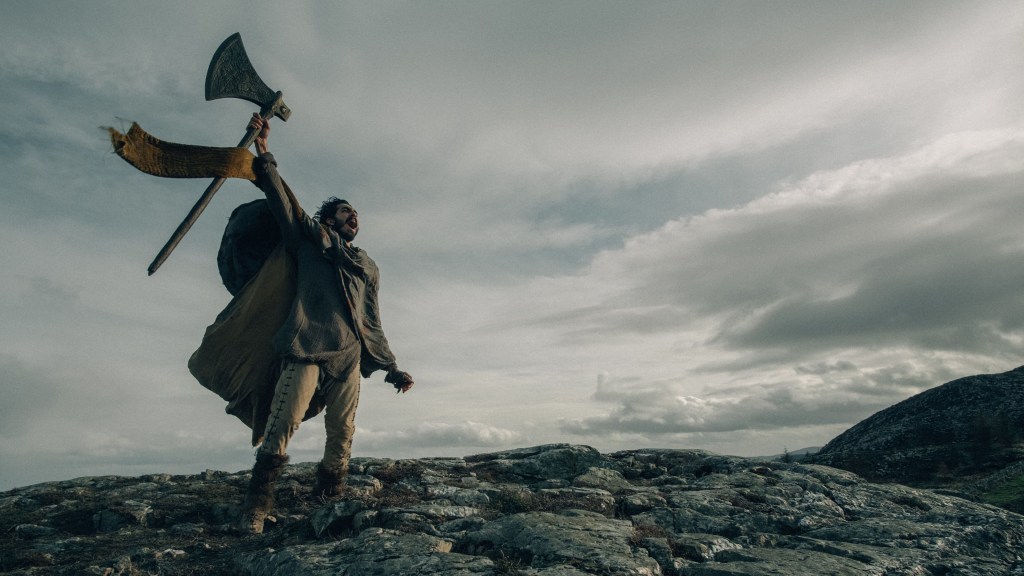
1. The Green Knight
This film is one of those rare occasions where every scene is memorable.
Every moment stays with you for different reasons.
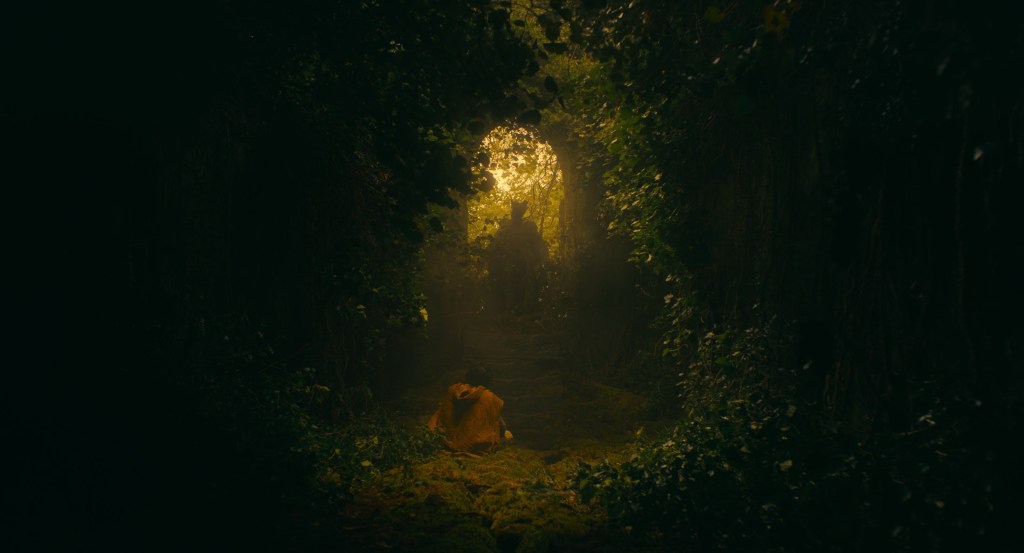
A diverse but congruent cinematography, where the filmmakers are bold in their transitions from darkness to colour, completely serving the narrative phases of a person’s journey.
A production design that thoroughly understands the importance of a safe space versus the impending doom of a foggy and mossy nature taking our life.
And the acting. Sean Harris and Kate Dickie give original portrayals of Arthur and Guinevere, retaining all their majesty, but withered from all the heroism. Alicia Vikander and Joel Edgerton give some of the best monologues on ageing and decadence I have ever seen on film.
And Dev Patel. The performance of the year.
His acting in the last half hour, almost without words, coupled with masterful editing, will stay with me forever, not only as proof of his greatness, but also as one of the most meaningful messages of any story in my life.
- The Green Knight
- Nine Days
- Dune: Part One
- The Woman Who Ran
- The Truffle Hunters
- Quo Vadis, Aida?
- Shiva Baby
- Pig
- Limbo
- Test Pattern
- Preparations to Be Together for an Unknown Period of Time
- The Hand of God
- Playing with Sharks
- The Harder They Fall
- Dear Comrades!
- The Lost Daughter
- Spencer
- Shang-Chi and The Legend of the Ten Rings
- Who You Think I Am
- Belfast
- Summer of Soul (…Or, When the Revolution Could Not Be Televised)
- Acasă, My Home
- The Power of the Dog
- Mass
- King Richard
- Dead Pigs
- The Dig
- Cliff Walkers
- The Dry
- Bo Burnham: Inside
- Benedetta
- Parallel Mothers
- Titane
- Riders of Justice
- The Card Counter
- Identifying Features
- Night of the Kings
- Atlantis
- About Endlessness
- Final Account
- The Matrix Resurrections
- Spider-Man: No Way Home
- The Last Duel
- A Quiet Place Part II
- 007: No Time to Die
- The Disciple
- Sweat
- Rocks
- Zola
- CODA
- Derek DelGaudio’s In & Of Itself
- Roadrunner: A Film About Anthony Bourdain
- Woodstock 99: Peace Love and Rage
- The Suicide Squad
- The Mitchells vs. The Machines
- Little Fish
- Fathom
- Slalom
- Stray
- Worth
- The Courier
- Holler
- Nobody
- No Sudden Move
- Don’t Look Up
 Opinion Seed