20. Ratchet & Clank: Rift Apart
Let’s make one thing clear: I find Rift Apart to be a very well-made game, that feels enjoyable to play and delightful to look at.
I was just dissatisfied with it.
A cartoonish structuring has its perks, namely when it comes to presenting the player with freakish mechanics to use in over-the-top scenarios. A never-before-seen experience, so to speak.
Rift Apart, a science fiction 3D platformer at its core, despite all its technological allures and exotic backdrops, doesn’t have much more to offer than a shooter game-feel.
And that’s even insulting to some shooters. Titanfall 2, a first-person shooter in its essence, is a much more inventive game at delivering fun platforming sections as well as, curiously (given that it is Rift Apart’s premise), coming up with inter-dimensional high jinks.
Again, Rift Apart is positively entertaining and aesthetically charming. I just wish that you didn’t have to shoot almost everything in this game to progress.
19. Olympic Games Tokyo 2020 – The Official Video Game
Licensed games, thanks to many disappointments throughout the years, have racked up somewhat of a bad reputation.
All artistic fields are unique in their trade. Videogames, by virtue of their explicit interactivity, make adapting and meeting the expectations of what/how audiences want to interact with from the original intellectual property extremely demanding. We also see it the other way around: adapting videogames to other media has also been tough.
This stereotype is even more intense when games are produced specifically as a tie-in with a new or upcoming event.
It is, therefore, surprising to be here recommending “The Official Video Game” of the Tokyo Olympic Games. Even more if you know that I particularly enjoy sports simulations like NBA 2K or FIFA/PES.
For the reasons I’ve described, my expectations were low. Even so, it did more than exceed them. It’s not unforeseen that it would have many sports, but 90% of them controlling legitimately well was unanticipated. I was also predicting that only a handful would not wear out their welcome in replay sessions – the total opposite.
Essentially all sports have two layers: playable/enjoyable with minimalist inputs, or gradually exploring the expressiveness afforded by extra buttons on the controller. All balanced in a way that beginners don’t feel exploited by people with more experience with the game, and the latter don’t feel their skill isn’t valued.
I, nowadays, play almost no games online. To my own stupefaction, I found myself facing gamers around the world, way better than me, and having a blast. I wouldn’t do it if this wasn’t a game with no nuance and margin to get better at.
18. Virtua Fighter 5 Ultimate Showdown
Nothing new with this enhanced remaster of the fifth instalment in Sega’s series of arcade fighting games.
That’s counterintuitively why it has a place in my 2021 list.
The first location tests of Virtua Fighter 5 took place on November 26, 2005. More than 15 years later continues to be the fighting game with the best trade-off between fun and realism.
It has a high ceiling of mastery, but its floor is low enough that a newcomer can start having fun almost immediately. Add to that some of the most realistic animations in the genre, and curious players are gradually emboldened to learn more about these recreations of martial arts.
Speaking of bold: they might be long-established, but landing an attack in this franchise continues to have some of the best sound effects.
17. Kaze and the Wild Masks
It looks like Sonic, but it plays like Donkey Kong. I.e., finally a sonic game that feels tight to control, and a DK game that has a rad aesthetic.
The only quibble I have with this one are the “Wild Masks” themselves. Instead of serving as triggerable abilities to progressively enhance the interaction with each level, they are just an excuse for some levels mandating different mechanics than the rest of the game.
Nothing against mixing things up. It’s just a little bit pompous 😛
16. NieR Replicant √1.5
NieR:Automata was my game of the year 2017.
And I know that Replicant is a remaster of the 2010 prequel.
That being said, this experience with √1.5, despite exhibiting the roots of what made me love Automata, was lukewarm. And that is the complete opposite sensation produced by Automata: several categorial wows.
Again, Replicant √1.5, by its very precedence, has all the ingredients. Understated but thoughtful art direction and combat. Beautiful music. Respect for logical character development and for the enormity of small humanism. And taking risks with intentionally dissonant gameplay scenarios.
Maybe I’m not being impartial, by not disassociating experience and artwork. What I felt during Automata should not cloud this much my evaluation of Replicant, even more if I take into consideration that its core was developed 7 years prior.
Maybe NieR Replicant √1.5 is better (and more interesting) than some games above it in this list. Nevertheless, this has to reflect my feelings, or else you can just go to metacritic/opencritic.
15. Monster Hunter Rise
It’s tough for me coming to grips with the realization that the game with the best visual art direction and musical score of the year is this low on the list.
Even more, Monster Hunter continues to be the best virtual recreation of an ecosystem and the animal macro and micro behaviours in it.
Regardless of all that, this franchise can’t seem to escape its own narrow positioning as a glorified AAA boss rush. Precisely because the world in front of our eyes is so rich and dynamic, it’s just a shame that mission structure and creativity are so poor.
Rise even adds some mobility options that make interacting with the geography more pleasant. At the same time, they might exacerbate the “boss rush” feeling. Now, you can get quicker to your target, making the qualities of the ecosystem look like a blur.
14. Flynn: Son of Crimson
Looks can be deceiving.
Not that this game looks “a certain way”. It has a genuinely pristine pixel art, and the worlds it takes you are unquestionably enchanting and diverse.
It’s just that its combat is more thoughtful and deep than the games of the past it is trying to recapture. You absolutely need to be on your toes about how many swings you get to land and when to dodge roll.
Add to that a precise launcher, air combos and variations on “dive kicks”, and you get to be legitimately expressive with this chibi-looking protagonist.
13. Scarlet Nexus
No way to sugar coat it: this is anime silliness. From the narrative threads to what you are actually doing while playing it.
There are just too many ideas raised without consequence, or too many mechanics and abilities happening on screen.
It still works. The game is really cool to look at, you are connected to the combos you are pulling, and you end up curious and caring for some of these characters’ fates.
Fun game.
12. The Legend of Tian-ding
Given the contributions of Japan to the art, industry and history of videogames, it’s very rare that we see the country portrayed as the bad guy.
In this context comes indie studio “Creative Games & Computer Graphics Corporation”. Their endeavour is to tell Taiwanese stories through game development.
And, let me tell you, they managed to create a very enjoyable game, while grabbing my complete attention regarding their country’s history and legacy.
The mechanics part of the game are continuously engaging. Your character’s (Liao Tian-ding, the Taiwanese Robin Hood) signature move is how he deploys his scarf to steal the enemy’s weapon and use it against them. Simultaneously, he keeps learning new martial arts that unlock options in both combat and exploration.
The story part is also very well implemented. Not only are you graced with beautifully hand-drawn skits, alongside marked moments of respite to interact with the people of this period, but also the way the game treats player levelling. You don’t have the traditional skill tree. You get stronger by collecting memorabilia from Taiwanese culture.
It’s a sign that these developers succeeded in what they set out to do, when I cared more about the art of each object and the story it told, than the percentage it increased in my skillset.
11. The Forgotten City
I know time-loop and rogue-like games are in vogue. Well, that’s not the reason this one is here, since I don’t much care for their proposition. I tend to find them a by-product of an over-obsession with replayability, as well as a poor understanding of what really makes a game memorable.
Loops do raise the number of times you play. But, does quantity always equate to memorization?
If one these becomes too much enslaved with death/fail states to face a proxy battle with “content”, the experience starts to gravitate around a sterile process of stats’ optimization, instead of an artistic engulfing in gameplaying.
Although, it can be done right. Like The Forgotten City.
Here, the time-loop structure serves the quality of the message, and not the quantity of the content. As a matter of fact, the development team was so uninterested in procedural progression that they worked out a pair of ingenious mechanics for the player to bypass as much repetition as possible.
In essence, the pitch for this game is: what if gameplay was debating like the ancient philosophers?
And that’s 90% of the experience. You have small portions of action and platforming, but they are not that great. Dialoguing and puzzle solving through inquiry is amazing, though.
If you manage to unearth the true causes of these people’s predicaments, you’ll understand why this game was awarded by the Writers’ Guild.
10. Resident Evil Village
I’m not a fan of the Resident Evil franchise. In that regard, I’m not in a position to say Village is like a greatest hits album. On the other hand, if it is, maybe I am a fan of RE?
Diverging from Resident Evil VII, the scope of VIII is much less minimalist and more open to action. “Village” is a deceptive subtitle, as you are presented with diverse settings and gameplay scenarios to maximize the assorted arsenal at your disposal.
There’s a sense that threads are always on the verge of being too much unconnected. However, no matter how bizarre things get, the developers manage to stay articulated with the rules they created for this world. Pulp rules, but rules, nonetheless.
The result is a game that offers both jumps scares and power fantasy. Yup, a horror game that is also fun.
9. Omno
More often than not, games that put themselves forward as meditative experiences invite the sweeping atmosphere to mask a possible lack of compelling mechanics to interact with said contemplative world.
Omno is the complete opposite. Developed by Jonas Manke, it was unequivocally thought as a virtual place and journey to, yes, in brown study absorb the interplay of game mechanics.
Both dimensions never feel at odds with each other. Quite the contrary. The mechanics elevate where you can go mentally. And the atmosphere of the negative spaces and their lack of action only makes your engagement with physics and animations more psychologically meaningful.
Introspection and Intentionality linked for a healthy balance.
8. Lost Judgment
If there are still sceptics about the notion of videogames as art, this entry from Ryu Ga Gotoku Studio is another proof that long are the days when this industry was only concerned with measuring contributions on the toyish scale of “if it’s not fun, why bother”.
One of many manners of ascertaining the artistic merit of a work comes from interrogating it with the following: Are you trying to say something? If yes, are you apt at doing so?
Lost Judgment is a work of art because it took a risk in its craft to face the above deceptively simple scrutiny. And failed.
Moment-to-moment, this is the best videogame the studio has ever developed. The combat is finally on par with the benchmarks of the industry. You no longer solve everything by punching dudes (it still needs more scenarios to take advantage of the “peaceful” mechanics). The open world is starting to feel more like a city, and less like a one-note red-light district. The alternative way of locomotion (skating) is very welcome. And it looks and sounds better than ever, not just technologically, but stylistically (they went for it!).
All that being said, the risks it took with its storytelling and messages hurt the overall work. I applaud it for taking the chances. But, when you come play at the art table, you face more rigorous examination. There are a lot of complex ideas raised. It’s their weaving into a trustful flying carpet that prevents this game from being one of the greats and, thus, higher on this list.
7. Kena: Bridge of Spirits
It is extraordinary how a game like this was made by so few people AND a first foray into the industry for the studio.
Their previous experience in animation positively helps with the fidelity exuding from the art. At the same time, what’s really remarkable is how game-complete everything feels.
The combat is the right kind of challenging, with movement and swings having legitimate weight and thought to them. Kena might not have a huge arsenal of weapons at her disposal, but I love that the devs focused on giving more to the less: every sub-ability has a purpose and, in their nuance, they all feel good to use.
And the puzzles are phenomenally well curated. Akin to the combat, the team at Ember Lab keeps introducing varied challenges that respect your time and intelligence, without frustrating. The way puzzles are part of the main path and also side ventures helps in homogenising both the world and the adventure. They serve as a reward for curiosity and exploration, because you keep getting delighted at how much the dev team and you can do with a small toolset.
I only have two nit-picks with this game. And both are obviously a result of first-timer small budget. The puzzle solving really has to be the reward in itself, because the prizes become corny after a while. And, considering the beauty of the world they created, I would’ve loved to see more diverse biomes.
In the end, this is one of those experiences that gives you total confidence that this team’s next project will be something really special. It makes you wonder what they could do with the size and budget of a Zelda game.
6. Super Mario 3D World + Bowser’s Fury
3D World remastered would be more than enough to guarantee a slot in my top 10 of the year.
Its levels don’t bring about the spacious ambience of Mario Odyssey. But, it wasn’t its intention. By assuming a more segregated approach to the “mission” progression, it allowed the designers to create unique experiences for almost every level. They really are ingenious.
I’ve probably never witnessed so much creativity per hour played. All with guaranteed quality in the controls and game feel. Wow moments that are also great fun to interact with.
And then this package comes with Bowser’s Fury. A complete 180 in level design philosophy, without losing too much on the inventiveness. Think 1 level of Mario Odyssey but way more ample and dynamic.
I guess this is just a peek behind the curtain of the scope for the next mainline entry. Still, for a quick look, it is a very replete open world and a complete breath of fresh air for the Mario formula.
5. Death’s Door
People, like me, who have been experiencing videogames for many years, certainly already had that feeling of: this game has everything, and everything is in the right amount and place.
That’s Death’s Door.
The visual art, despite understated, has memorable colour and designs. The music has a bigger reach than its starting point. The controls are pin-point perfect. The level design is inventive without being confusing. And it’s as fun to battle as it is to solve puzzles because you not only use the same mechanics for both, but also unlock them gradually by, precisely, battling and solving puzzles.
Like I said, it has the right amount of Zelda, Metroid and Souls at the precise moments those inspirations strengthen the overall game and not distract. It’s not a mishmash of influences, but an artistic end-product whose identity is greater than the sum of its parts.
4. Nioh 2 Remastered
For more than 6 months, this was my game of the year.
Nioh, the franchise, is more than homage. It is an unabashed imitation of Dark Souls, the franchise.
And, even though I much prefer the approach to “place” of FromSoftware, where area interconnectedness creates the semblance of a faux open world, I don’t think less of Team Ninja endeavours, since they managed to develop a clone that is better than the original at one of its core elements: combat.
Everything else is better in a Souls game (there’s an argument to be had about how separated levels are way less disorienting for newcomers to this subgenre), but the combat in Nioh is king. I don’t even get proficient with all the weapons and find it extremely deep and extensive. And not to mention the equally engaging onmyōdō magic and ninjutsu.
It should be noted that, despite such complexity, Nioh’s options and mechanics all have low barriers to entry. Which, in turn, promote experimentation in easier enemies, leading to a player knowing about almost every tool the game provides to face its challenges.
You don’t have to get good in any particular skill/technique to beat any boss. Studying its movements and having your own spatial and timing awareness is always the key. Even so, the knowledge you acquire by being nudged to experiment (constantly different loot drops and everything feels great to wield) will give you ideas how to turn the difficulty tide in your favour.
Nioh 2, by saying that you are half-yōkai, allows itself to introduce three new mechanics that elevate the spectacle of the combat. I preferred the franchise when this extravaganza wasn’t available, but I can’t deny the charm of using their own attacks against the monsters, or the umpf that a burst counter makes you feel when you decide to be monstrous against a terrifying red-glowing clobber in your direction.
Either through the cerebral combination of samurai/ninja techniques/tools with space-time awareness, or being heavy metal proficient with your movements and supernatural powers, you will have a very good time in this game.
3. Far Cry 6
After a disappointing experience with Deathloop, I needed a palate cleanser.
My time in Yara ended up serving much more than that.
It’s true that the last and only Far Cry I’ve ever finished was 4, back in 2014. And the last Grand Theft Auto was Vice City, almost 20 years ago. Still, videogames surely have come a long way when it’s time for seamlessly going in and out of vehicles, while having fun improvising on your way to the next destination.
Yes, I really appreciated how the developers made topographical variety mesh with anthropological constructs. The militarized capital has the best accessibilities, while being the quietest. Gradually, roads and housing become less amenable (with the exception of ways to strategic feedstock) as agriculture becomes the modus vivendi in the more vocal peripheric lowlands. Thus, generating the drive and opportunity for the more revolted to form guerrillas in mountainous areas.
That being said, planning an insurgency on a forced-labour camp from the top of a mountain, starting that mission in a helicopter I’d previously stolen from the army, jumping off it with a combination of wingsuit and parachute, grabbing a car for the rest of the way, scouting the camp from afar, igniting chaos, and escaping in a completely different means of transport without they ever knowing was also pretty great. Especially when all those mechanics feel good to control.
And that’s Far Cry 6 in a nutshell. Many disciplines of game design converging to give you engaging scenarios, while knowing how to extract the virtues of both realism and unrealism. Hijacking a tank or treasure hunting in turquoise waters never felt part of two different games, because both activities had the proper ratio of power fantasy to physical limitations of the world.
Like the characters you interact with through the story. They are “C”haracters, but their strife comes from real human drama.
Or your own character, singing along to some songs while driving, if you listen to them more than average. I suggest you choose Latin American Spanish as the spoken language. It adds up to the cultural groundwork the game is expressing.
2. Mass Effect Legendary Edition
It’s this high, and I didn’t even revisit Mass Effect 3.
The last mission in Mass Effect 2 continues to be the peak of the trilogy, and one of the best moments in videogame history.
Notwithstanding, the expansiveness of such stakes and place would’ve never worked without the foundation laid bare in Mass Effect 1 – the game that most benefits from this remaster.
ME2 is a better game, moment-to-moment. But, what it trims from ME1, in favour of focus and solidity, was essential in sparking our imagination of where we are, and where we could go in this universe.
Almost 15 years later, having the possibility to land on any planet of the galaxy map and free roam in it, no matter how barren or deprived of points-of-interest it is, still does a lot to capture your imagination and sell you on the premise of space opera and exploration.
It’s a magic trick. They removed it from ME2, and you know you are playing in linear levels. Doesn’t matter. Your flight of fancy was already there, and the impeccable writing in every corner of these scenarios keeps rekindling it.
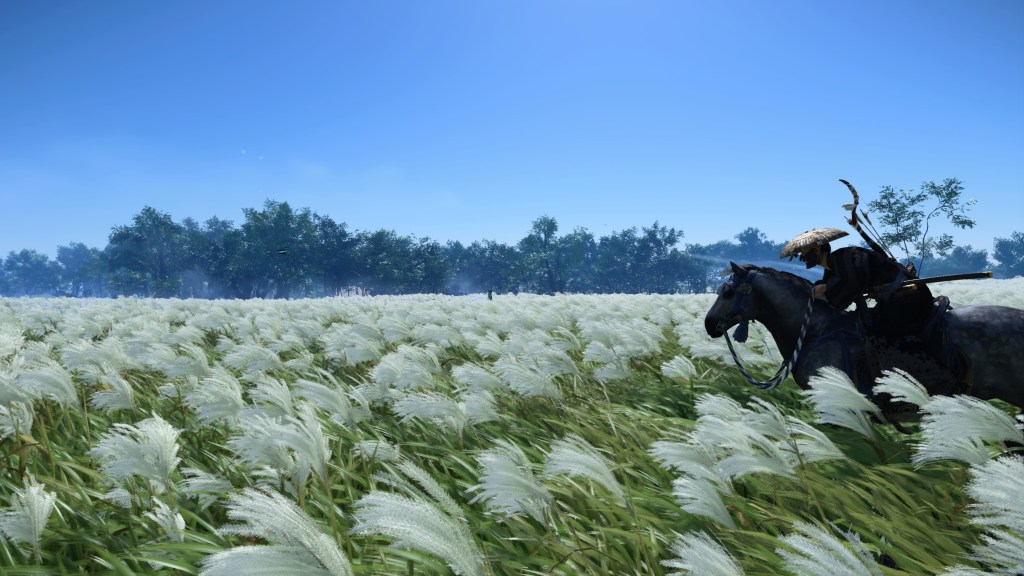
1. Ghost of Tsushima: Director’s Cut
I know Tsushima was #2 in my 2020 list; yet, that’s precisely a reason for feeling comfortable at repeating and elevating it one year later.
Let me explain: I almost never go back to videogames I already finished. Even less games I completed 100%.
Of course, I was going to play the Iki Island expansion. I really enjoyed my time with the game the year prior, and I was a bit curious if what prevented me from considering it #1 back then was more on the game itself or more related to experiencing it right after The Last of Us Part II.
What I was not expecting was finding myself not only in the flow to 100% it again, but also, and more important, loving it even more than the first time.
Iki Island only triggers after you complete 1/3 of the story. However, if, like me, you have a save file from your previous foray in Tsushima, you can go straight to the expansion. As soon as I set foot in that world, and my brain started to recall why I previously enjoyed it so much, I had to do it: create a new save from the beginning of the story.
Like I said, I hardly ever do something like this. And naturally feel it, just 1 year later, honestly impressed me.
This is the emotional reason why Tsushima is #1 in 2021.
Even so, there are also rational elements to it. Certainly, from a technological standpoint, the Director’s Cut improves the game in every way. That’s not why I’m into videogames.
Pound for pound, Iki Island is even better than the main game. It introduces new enemies and combat mechanics that make you think even more mid-battle. Journeying with your horse now has an extra layer of mounted combat. Mysteries and treasure hunts in the open world are more experimental and playful. And, the story that backdrops your stay in the island tackles all the criticisms I had with the main one.
Last year, my main objection to the game was how, besides some occasional moments, its narrative weavings found it hard to coalesce the theme of loneliness with the respite found in friendship bonds.
The Iki Island storyline, curiously, by risking going even more personal and lonely, makes self-discovery through others much more dramatic and memorable.
To sum up, once again, Ghost of Tsushima is an incredible proposition: a fluid gameplaying state where the agency in the gradient between stoic samurai and illusive ninja is logical; a world where towns and untouched nature are positioned as equally interesting to explore; and an all-encompassing audio-visual artistry that will make you feel that someone really created your dream feudal Japan game.
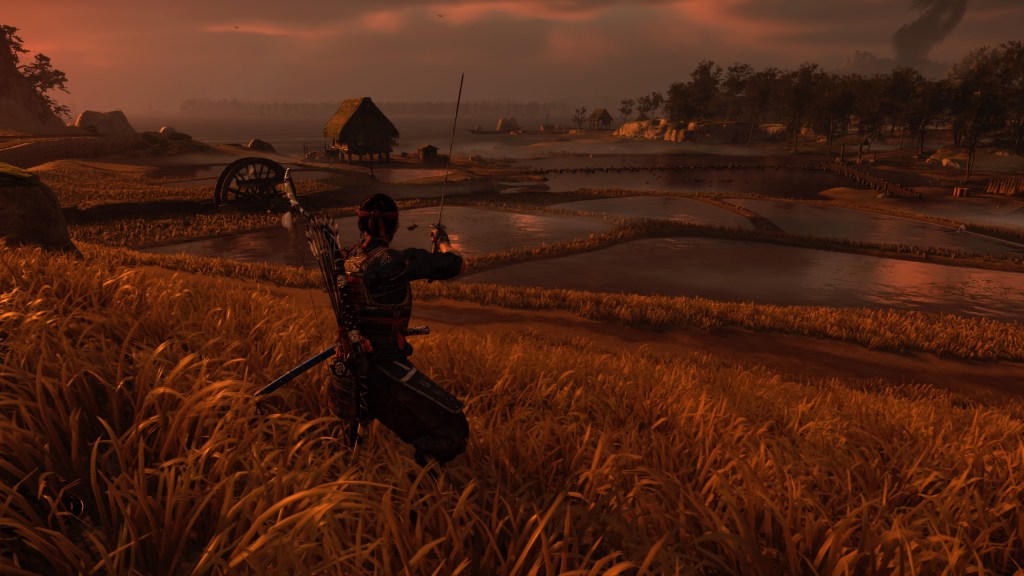
- Ghost of Tsushima: Director’s Cut;
- Mass Effect Legendary Edition;
- Far Cry 6;
- Nioh 2 Remastered;
- Death’s Door;
- Super Mario 3D World + Bowser’s Fury;
- Kena: Bridge of Spirits;
- Lost Judgment;
- Omno;
- Resident Evil Village;
- The Forgotten City;
- The Legend of Tian-ding;
- Scarlet Nexus;
- Flynn: Son of Crimson;
- Monster Hunter Rise;
- NieR Replicant √1.5;
- Kaze and the Wild Masks;
- Virtua Fighter 5 Ultimate Showdown;
- Olympic Games Tokyo 2020 – The Official Video Game;
- Ratchet & Clank: Rift Apart.
 Opinion Seed