DOOM Eternal is not only the best First-person shooter but also the best designed game I have ever played.
Or, am I mistaking most designed for best designed?
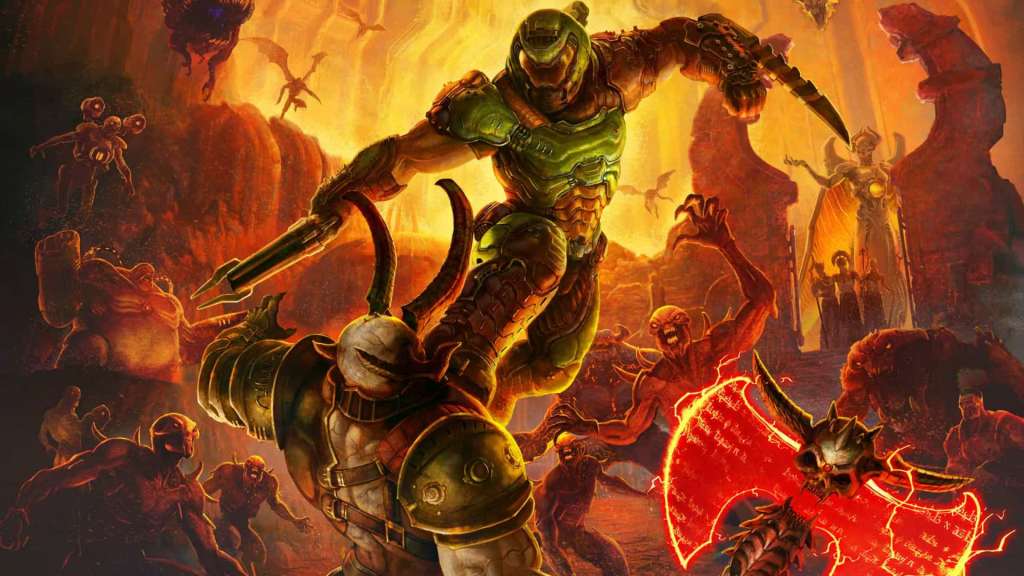
In DOOM, you do a lot of violent stuff. However, the developers get away with the graphic content, because, in one of many smart design decisions, they chose to give the game a semi-toyish look and feel that is reminiscent of the violence happening in cartoons like Tom & Jerry or Coyote and the Road Runner.
Despite “Hell and darkness” being the lexicon, the game is actually very bright and filled with saturated colors. The environments and the enemies. Each time you kill a demon, the presentation is so extravagant and stylized that they look more like platforms than beings.
Altogether, this visual style already did the trick in DOOM 2016; even so, this time around, the art and modelling teams produced more varied environments, with forests, ice, castles and colosseums giving a bigger range to your mission.
Returning is also Mick Gordon. The composer from the last game is more metal than ever. And, while the music of DOOM Eternal perfectly aligns with the barrage of things you are doing at the same time, Gordon also added some exotic and mysterious moments, where your heart races not because of the present, but due to the impending.
More than once, I found myself alone in a calm corridor after a break-neck pace of a fight, my senses stabilized, started noticing the softened music loaded with mystery and tension, and I smiled. The alternative was to fear the challenge ahead.
This rhythm is the design tenet of DOOM. You never stop because the game never stops. It’s like pinball with a shotgun.
First of all, for this to work, the character has to control with precision and pleasure. And it does. Everything you need and aim to accomplish the controls let you. I need a headshot in this shielded enemy? Don’t have to hold my breath. I need to stick a grenade on this spider’s tail? It sticks in the generous vicinity. I need to reach this enemy in the next 2 seconds before he loses his staggered state? The animation gods let me.
And this same principle applies to the exploration. Does that seem like a giant chasm between point A and point B? Just jump and dash in the air. You might feel agitated by the challenges the game presents you, but rarely will you feel afraid. The developers made sure of that.
With these tools in hand, comes the next level of engagement: the gameplay loop. And this is where my initial question comes to bear: am I mistaking most designed for best designed?
The gameplay loop in DOOM Eternal is, undeniably, very special. In defiance to most action games, where number of mechanics is touted as a measure of depth and player-serving, DOOM actually makes you use all the toys in the sandbox.
The way everything is connected and, more importantly, necessary is a breath of fresh air that takes you out of your gaming comfort zone. Are you low on health and the arena has no more medkits? Don’t kill your enemies; instead, do a special finisher on them. Are you low on ammo? Use your chainsaw on them. Do you need extra protection because this group of demons is really tough? Put them on fire with your flame belch. Is that enemy protected against your grenades or machine gun? Overheat his shield with a laser weapon…
All this at a 1.5x speed than other shooters, while heavy metal echoes in the ramparts.
You rarely stop attacking to search for consumables, because a good offense is not only the best, but also the most efficient defense in DOOM Eternal. This is masterful design and perfectionism that directs the player into feeling shaken and fulfilled at the same time.
However, at what point does perfectionism turn into auteurial orthodoxy?
By making the player play the way it should be played, the game did start to feel like a pinball table with too many bumpers.
Two examples of that are precisely related with two of the most ingenious systems they have in the game: player progression and boss encounters.
Regarding player progression, the designers were, once again, really smart in linking skill points for your armor and weapons with challenges in how to kill the demons. These challenges are done through natural playing, but do teach you the most efficient ways to deal with the different enemies. Don’t get me wrong, this is really empowering: teaching through play and challenge and not via no-stakes tutorials. However, two things also resulted from that: enemies became equations always solved the same way, and my progression turned into the game developer’s progression.
Boss encounters had the same strengths and weaknesses. At first, you feel really bad-ass learning on the fly in an epic duel. But, then the puppeteer shows you his strings, because he wants you to ballet that boss the way he envisioned. You see the matrix. You crack the code. And, every time that enemy is reused, the fall in epicness is pronounced, because, since he is so tough, plus all the other demons now surrounding him, you have to employ the most efficient tactic.
Even the most interesting of the bosses, an enemy that tosses all the other mechanics I’ve described out of the window, is too quickly given a solution that breaks the spell, and you just rinse and repeat.
Instead of a sandbox with toys for you to imagine in, you are presented with immaculate sand castles and roads, with the toys already perfectly balanced and positioned to carry you through the motions.
Those are some cool and powerful motions, but are also so tight that you sometimes have trouble finding the line that separates player input from designer input.
I really enjoyed DOOM Eternal. Like I said in the beginning, this is probably the best FPS of all-time.
All its elements are in perfect tune for the experience it wants to offer. The visuals are imaginative and functional. The music conducts your heart beat. The movement and shooting are almost one and the same. And the gameplay loop and progression are refreshingly interconnected and interdependent on player agency and player awesomeness.
And, I’ve yet to say how much I liked this story. The way all this demonic, industrial and religious iconography meld into an allegory for capitalism and labor exploitation is my kind of subtlety. I particularly enjoyed how the writers used the moments for expanding the lore from DOOM 2016 to adorn them with metaphors on corporate cult, boardroom domestication, or the promise of growth and distribution of riches through dividends.
Still, I arrive at this moment a little bit saddened, because I wanted to give it a 5/5. I can’t 😦
A game with so many mechanics, tools, freedom of movement and power fantasy should not hinder player originality in service of the most beautiful choreography.

 Opinion Seed