
I’ll start by endorsing some games I played during last year, but that were not released in 2019 or are remasters of old products.
Then, I’ll list my personal games of the year, and give out the following awards in excellence of artistry:
- Audio;
- Music;
- Visual Art;
- Technology;
- Controls;
- Gameplay;
- Progression;
- Acting;
- Story;
- Direction.
Remasters / remakes, or not released in 2019
Crash Team Racing Nitro-Fueled
Fun, creative and challenging like 20 years ago.
Wolfenstein II: The New Colossus
A mixed bag.
The gameplay is at odds with itself. You are in a situation where you want to run and gun nazis down, but the level design and difficulty bumpers do not allow for a full commitment. Rather, you find yourself employing stealth tactics that, not only slow the game to an undesirable pace, but also aren’t that satisfying to begin with.
On the opposite side of the spectrum, the story of this game is bonkers. With scene after scene upping the ante, with hysterically bold choices. The cinematography to convey those fevered dreams, in particular, is some of the best I’ve seen in any game.
Ratchet & Clank
It seems I have been missing out on a genuinely engaging franchise.
Variety is the word: an array of tools and gameplay mechanics, a diversity of captivating characters, and game worlds filled with imaginative level design.
More importantly, this is not bloated diversity. The game was devised to encourage (sometimes, demand) the use of the different tools, and the exploration of the planets. And, every time you are introduced to a new puzzle and solution, it feels great to solve them. This is the biggest strength of the game – almost all tools feel fun and useful.
To enhance this pleasantness, it helps that the game looks beautiful; with art and coloring that have the same charm of animated movies.
Assassin’s Creed Origins
I was not clamoring for big changes in the Assassin’s Creed formula.
It was like comfort food. Whenever a setting interested me, I knew what to expect from the other aspects of the game.
In Origins, the setting was right up my alley. But, could I trust in the promoted new direction of the franchise?
I’m glad I did.
The changes were smart, without distorting the loop we liked. As a matter of fact, the Egyptian backdrop is, not coincidently, ideal to showcase the new gameplay priorities they wanted for the franchise.
Now, they are using the solidified movement mechanics to encourage you to explore and discover more places, instead of more objects.
The Souls-like combat, on the other hand, is competent. And the looting system was unnecessary.
But, the design focus on free roaming did really expand the potential of the aspects Assassin’s Creed was already good at doing.
Additionally, the story here is very strong, with fleshed-out characters and revelations that will satisfy the fans.
Yakuza Kiwami (and) Yakuza Kiwami 2
After Yakuza 0, I just had to know where these characters were headed.
As you can see, I liked enough of the unifying threads between 0 and Kiwami 1, that I also played Kiwami 2 in the same year.
And, what a game Kiwami 2 is. Not only it continues to have narrative strength, in regards to Zero, but the new Dragon engine makes the non-story aspects of the franchise also more immersive.
The combat finally has animation variety to cohere with the sensational cutscenes, and the calm moments of roaming the city are way more inviting because every transition is smoother, lending a sense of continuum in place, in story, and in character development.
Even eating, what and where to eat, and how much to eat become decisions and actions that help bringing together all those described elements, thus adding important rules and logic to the world building.
Mark of the Ninja: Remastered
Still, the king of stealth games.
Playing through this again, I was reminded how every layer here was designed to funnel you into, enjoyingly, use stealth, without ever robbing the player of mechanics and tools to be stealthy in their own way.
Every level feels like a math problem that can be beat without scribbling the paper. Yet, like math, it is able to trigger excitement when you improvise and find an alternative path.
Onimusha: Warlords
It’s a bit frightening to, almost 20 years later, play a game that was nostalgically comfortable in your Top 10 of all-time.
I’m so happy that it still holds up.
The pre-rendered backgrounds are as inducing of placement and imagination as they were. The tank controls for sword fighting, unlike the shooting in Resident Evil, maintain their original responsiveness. The magical unlocks still resonate as properly sedate. The boss fights retain their tension. And the music continues to be one of the most underrated ever.
Games of the year 2019
8. Metro Exodus
This is probably the best rendition of post-apocalyptic fiction I’ve seen in a game form.
The attention to detail makes every object or empty room have more significance. Which, in turn, enhances the interactive engagement with the world, as resources’ management and their use is more palpable.
However, the gameplay and controls didn’t receive as much care. There are not seldom moments when the actions get in the way of the involvement with the stakes.
With a bit more polish, this could have been a classic. The locations they created are enthralling and worthy of exploring, but it’s hard to be fully committed when the feedback loop on the stick is not 1:1 with the world building.
7. The Fighting Games: Mortal Kombat 11 and Samurai Shodown
It’s tough to say which one is better.
Mortal Kombat has the best story of any fighting game, coupled with great production values in graphics and sound.
Samurai Shodown has the best gameplay of any fighting game since Bushido Blade.
But neither of them is quite perfect at what they do best. MK has some distracting user interface, and SamSho should make the fights even more realistic, with limb injury and more 1-hit KO’s.
6. Devil May Cry 5

Sometimes, better graphics don’t equate to more immersion.
This new Devil May Cry is proof of that. It could be higher on this list if it had used a different asset’s engine.
Don’t get me wrong, the RE engine is impressive, particularly when it comes to somber environments. But, unlike Resident Evil, Devil May Cry is all about the live-concert aesthetic.
Look at DOOM (2016) or even Devil May Cry 4 (which I didn’t much care for). Those games are less photorealistic, yet more visually stimulating and coherent.
As a price for really good looking faces, the scenarios here were bland and smeary, making the spectacular things you’re doing, sometimes, feel estranged.
But, boy, spectacular things, indeed.
The progression in this game is so well thought out, gradually feeding you with new maneuvers and abilities. To a point, a perfectly paced point, when you truly feel like a badass.
Even if the developers insisted again on the same plotting choice of Devil May Cry 4, where you had to go through the same scenarios in different points of the story; this time it worked. Why? Because they doubled-down. The repetition was even narrower, successfully conveying the sensation of beating your head against a wall, and finally conquering it.
Another way it improves on DMC4’s axioms, is in how the different characters you have to play feel different. Their gameplay had enough, again, constrictions that directed you into controlling each one the “right way”. Additionally, the enemies spawned against the different protagonists were also smartly different, to maximize fun.
Still, it was even more gratifying, after being comfortable with the different characters, noticing how a same enemy could be approached through their different styles.
5. Call of Duty: Modern Warfare


The thing that has always put Call of Duty above all the other online shooters with great controls was the fact that it had a globetrotting offline campaign. The developers put you into diverse scenarios around the world, where you take action as part of bombastic sequences.
But, what made some COD entries more memorable than others were the ones that had silent moments of inward conflict. Commercial art has a way of romanticizing war, yet, these junctures with humans coming to grips with their actions and predicaments is what snaps us out of the voyeurism.
This new entry, Modern Warfare, is the least loud the series has probably ever been.
The globetrotting, this time, is done for character studies in context, their development, and to increase the impact of their convergence. And even the more dramatic missions are the ones that are based on stealth engagement, with silencers and night-vision goggles.
Tense missions that, despite their calmness, instill an urgency to keep moving, while each shot has to count, for enemy alertness, and counts, on the individuality of each death.
That’s why the audio in this game is consequential. You are with silencers, yet the muffled sounds of a single bullet and a single corpse hitting the wooden floor are weightier than any burst or barrage.
I’m a proponent of contrasts within a product. However, these hushed scenarios were so well designed that made other missions feel more pulp than exhales. I wish the whole game had the constriction of the stealth sections.
Regardless, the production values are very high, with face technology serving more personality than uncanny valley, and the music with depth and range to glue all the contrasts.
4. Star Wars Jedi: Fallen Order

Should an artistic endeavor be penalized for not being totally original, and for being a sum of others’ ideas?
This is the fine line that differentiates between plagiarism and referential, and we should let creative people walk it, in order to eventually get something revolutionary.
Star Wars, once a fertile ground for imaginative creations, has been boring in recent years, to say the least. Is a videogame going to do any better?
I’m here to say that Fallen Order is a step in the right direction. There are a lot of things in it that are very predictable, but through a solid replication of others’ ideas, it ventured into a territory we’ve yet to see in this franchise since the 80’s: expansive mythology and exoticism.
The first moment I noticed this was in a scenario of bounty hunters and other marauders, where the music deviated from the typical John Williams’ style and became way more folkloric and rebel. I later found out that such song was composed by a folk heavy metal band from Mongolia called The Hu.
Still, the majority of the sounds and music of the game are what we come to expect of Star Wars, with some tracks feeling like a cheap knock-off, while others have strength and emotion to go alongside the classics.
Visually, the game has its moments. The art and technology showcased are, sometimes, so expressive, detailed and imaginative that it becomes even more noticeable when they aren’t. The journey takes you to know different planets and characters, and some look like they are part of a universe open to possibility and personality. On the other hand, a couple scenarios and faces clearly didn’t get as much attention, a contrast that can break the illusion.
At the same time, the controls and the gameplay loops are so engaging that you never fully give up on going forward. The first hours are a bit tough. Some environmental puzzles that require mobility demand more precision than what should be expected of the context they’re in. And the fact that you are still waking up your Force mechanics conveys a sensation of powerlessness, which helps the narrative but hurts the fun.
Yet, the gameplay is really good. The combat has the same framework as Dark Souls games, making the lightsaber feel meaningful. The exploration is like Uncharted and Tomb Raider, which is good for a tactile experience with the planets, and a cultural discovering of their history (still, I think that they abused on the tombs and collectibles). And the loop is informed by a metroidvania game design. This approach was a very smart decision, since it heightens not only the feeling of character development, but also of planet complexity.
You play as Cal Kestis, a young Jedi that never finished his training due to Order 66 (the Darth Sidious directive that triggered the clones to betray and assassinate their Jedi commanders). In this context, some areas and mysteries are inaccessible to you in the beginning of the game. So, the unlocking of new abilities and mechanics makes you calmer and collected in face of the Dark Souls combat (gradually becoming a true Jedi); it also makes the traversal and exploration more athletic and fun; and the metroidvania design way more engaging, because you get to know more settings and stories in each planet, only accessible because you are growing.
And let me reiterate: the tools and abilities are really varied and enjoyable to use and combine.
The other cast of characters are hit and miss, partly because, like I said before, some were treated with more visual care than others. But, the ones you spend more time with, even from the dark side, are fleshed-out enough to not land as archetypical. BD-1, in particular, seizes its place as one of the best droids in the Star Wars canon.
Lastly, the story, despite not properly exploring some plot points (which makes them extraneous), it still has one of the best narratives of the franchise, with an angle on the conflict between the mythos and the nature of the Force, and on what makes you a Jedi that, not only envelops all the gameplay and game progression with purpose, but also takes advantage of the immense potential of Star Wars.
All in all, Fallen Order has some flaws in the art, gameplay and story. Notwithstanding, its cornerstones, on the shoulder of giants of game design, are so strong that you always feel right at home and with something enjoyable to do.
Moreover, knowing that this was a first foray into third-person action adventure by a studio known for their acumen in first-person shooters, it carries a lot of promise for what a sequel could be with more experience and refinement.
3. A Plague Tale: Innocence


What a delight of a game.
Without much experience on creating original IP, Asobo Studio, from Bordeaux, just delivered one of the most enchanting stories of the medium’s recent years.
At a time when videogames are getting really good at telling cinematic stories, this relatively small team of developers managed to not only build something new with competitive production values, but also permeate it with character and fable to make you care about what’s happening there.
The game world is really beguiling without being exultant. Every nook and cranny got the attention it deserved, not more, not less. And, the final paint-over gave the visuals an aura that triggered the expectations you didn’t know you had about 14th century France.
To add to that believability, the writing and acting on the characters is some of the best in the industry. Specially, if you consider that most of them are children. They are the right measure of fragile and strong, they make mistakes, they grow through interacting with each other, and, more importantly, they preserve the child-like view of the world that points us to a bigger appreciation of what the developers created.
The only shortcoming I would point out is related to the gameplay mechanic involving the rats. In theory, the parallelism between the children’s fragility and the insurmountable terror that must had been swarms of rats during the Plague is an interesting premise to design game challenge around.
The execution, though, was a bit too on the nose. I didn’t mind the liberties they took with the stealth moments, because the suspension of disbelief they required were in service of less frustration. But, the use of environmental tools to get past the rats, despite its creativity, got too zany for the sake of diversity, leading to some immersion breaking.
Even so, the character and environmental storytelling is so natural that you never fully leave this world and the story.
2. Ace Combat 7: Skies Unknown

I have a bias against games that only let you play with the vehicle and not the person inside it.
So, it is with surprise that I find the new Ace Combat this high on the list.
Looking back on my experience with it, the first thing that comes to mind is the humanism of the game.
Despite the potential sterility of just controlling an airplane, the missions are so smartly sprinkled with intercom dialogue between pilots and between pilots and the people on land that you become aware of the lives that are at stake.
The cutscenes and briefings before the action also have life-like writing, with a tone that paints a picture of geopolitical drama and individual conundrums, thus showing you how the views and decisions of the characters you get to know scale in comparison to the world. After all, wars and history are borne by people.
Multiplying this effect is the malleable scenario design in each mission. Not only you get to do different tasks, demonstrating the importance of the air force in times of war, but there are also a lot of missions in which things don’t go according to plan, leading to human responses from everybody involved that end up having consequences to the flow of the narrative and the fate of the countries in conflict.
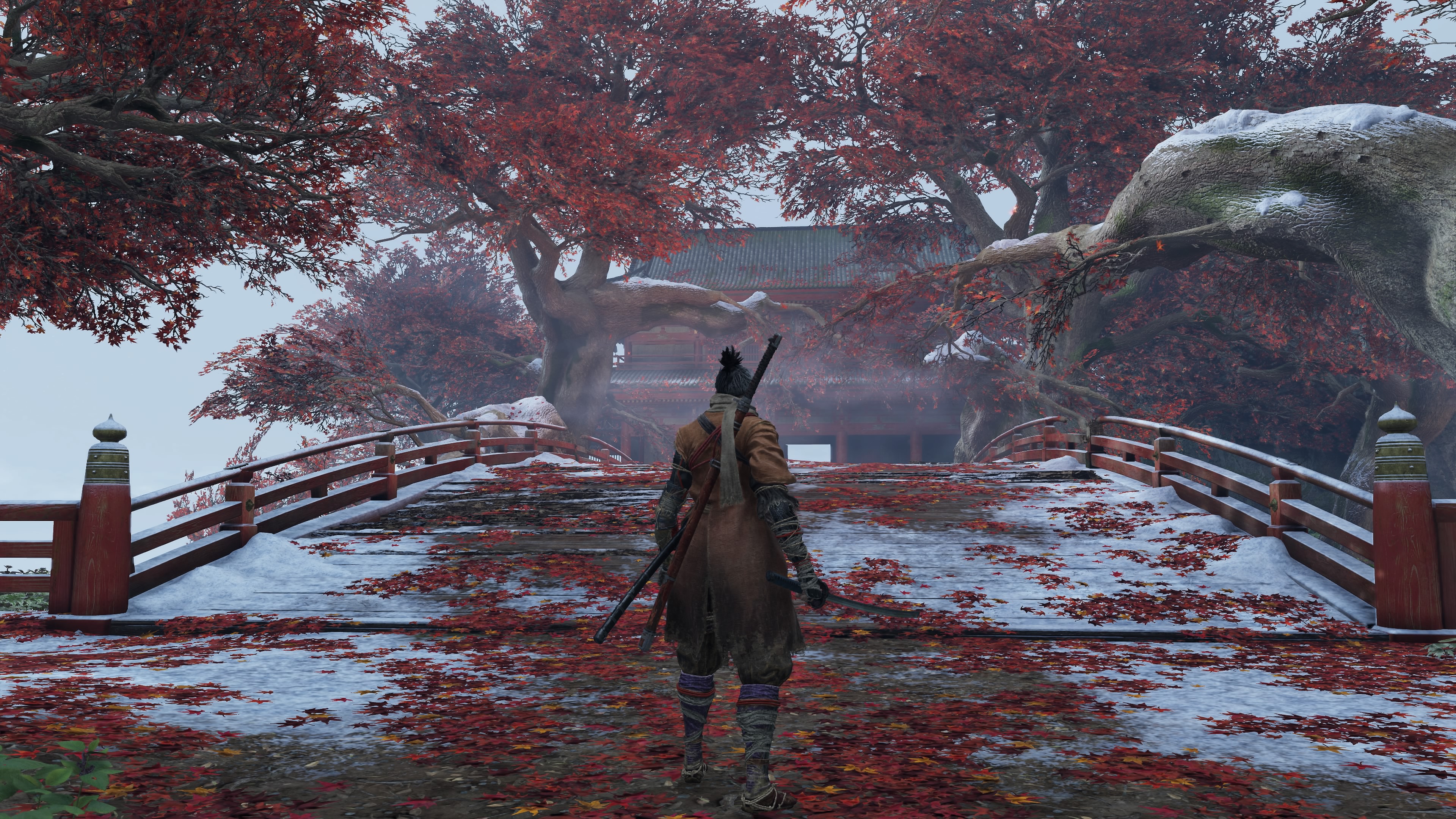
1. Sekiro: Shadows Die Twice



There are two subtle moments in Sekiro that symbolize everything the game is about. They happen in the cutscenes before the first and the last bosses and are easy to miss, since, like the whole design of this game, they’re subtextual and not boastful.
In the first boss, the cinematic shows Sekiro, for a very brief moment, searching for the handle of his sword. While before the last boss, Sekiro unsheathes his weapon way faster and more confidently.
These little details are much more than homages to the rituals of samurai fighting. They illustrate the evolution you’ve been through in the game, to a point, like Sekiro and his sword, you and him are one and the same.
From Demon’s Souls to Bloodborne, FromSoftware has always understood that, despite those games having character stats in which you allocate points, the way to reach a true role-playing engagement is through improvement of the player.
And Sekiro nails this again. Probably even better than those previous games. By having a more limited amount of combat builds for players to experiment with, the developers had more concrete information on how enemies could be tackled, thus allowing for a more optimized design on how to challenge.
This is a really brilliant decision, because the teaching and player progress that are staples of these games benefited from a “less is more” approach. Your learning got more appreciable, while you knew you were mastering a less exploitable gameplay loop.
There are other pristine aspects to this game, like the tight, while intricate level design; the art in the environments that exudes so much history and mistery; or the underrated story about the thin line between serving and abusing power.
Still, it’s the feeling I got right before the final battle, when “I” unsheathed the sword, calm and confident on my learnings, that will stay with me forever.
Remasters or not released in 2019
- Onimusha: Warlords
- Mark of the Ninja
- Yakuza Kiwami (and) Yakuza Kiwami 2
- Assassin’s Creed Origins
- Ratchet & Clank
- Wolfenstein II: The New Colossus
- Crash Team Racing Nitro-Fueled
Awards
- Audio – Call of Duty
- Music – Ace Combat
- Visual Art – Sekiro
- Technology – Call of Duty
- Controls – Sekiro
- Gameplay – Star Wars
- Progression – Devil May Cry
- Acting – A Plague Tale
- Story – A Plague Tale
- Direction – Sekiro
Games of the year
- Sekiro: Shadows Die Twice
- Ace Combat 7: Skies Unknown
- A Plague Tale: Innocence
- Star Wars Jedi: Fallen Order
- Call of Duty: Modern Warfare
- Devil May Cry 5
- The Fighting Games: Mortal Kombat 11 and Samurai Shodown
- Metro Exodus
 Opinion Seed