
This is a ranked list of all the 2018 movies I’ve seen until the date of this publication. There are a few cases of 2017 regional-limited releases, but since I only got to see them, here in Portugal, in 2018 they go on the list. Also, 2018 awards’ season films that I only saw in 2019 go on the list as well. I know this is a bit incoherent, but the main purpose of this ranking is to do an analysis of what was cinema like at this point in time for me, using the most recent releases as conversation starters.
Additionally, I will give out awards for achievement in the 10 categories I consider the cornerstones of modern cinema: (i) Costume/Makeup; (ii) Stunt/VisualFX; (iii) Production; (iv) Sound; (v) Music; (vi) Acting; (vii) Screenplay; (viii) Editing; (ix) Cinematography; and (x) Direction.
I sincerely hope this is as enjoyable to read and intellectually stimulating as it was for me to write it. Thank you for your time, in advance 🙂
87. The Cloverfield Paradox
This is the first entry not because it was the first movie I saw of the list (it was), but because it is the most cynical release of all.
They had to know the movie was not good. They had to.
And instead of casually releasing it to avoid the attention and backlash about this relapse on one of the most refreshing franchises in modern sci-fi. No. They decide to market it during the Super Bowl and promote its viral consumption by making it available right after the game.
That’s how you turn negativity into money.
86. Sicario: Day of the Soldado
Another movie which had the challenge and responsibility of following-up a strong predecessor, and that also missed to meet that standard by a wide margin.
The first Sicario (2015) was brutal but made you question the true origin of evil in the drug trade. Day of the Soldado is just a glorified killing fest that is trying to justify itself by saying to us that someone or something is bad, without even trying to show why.
And this type of lazy writing is particularly disappointing, because the screenwriter, Taylor Sheridan, has been doing great work, with films like the first Sicario, Hell or High Water and Wind River.
85. Jurassic World: Fallen Kingdom
Contrary to the previous two entries, I did not have many positive expectations towards this sequel. After all, the first Jurassic World is as bland as it can get in a movie with dinosaurs.
This time around, the issues I have with Fallen Kingdom do not reside in the same place, but in the narrative instruments the filmmakers chose to combat that staleness. The movie is all over the place in trying to give stakes to the action, never converging into a fully formed crux. And when the time comes for resolution, this world is given pre-built structures from other franchises that not only don’t feel earned but are also strange in a story with so much past mythology.
Well, at least they are trying. Maybe the next is finally able to capitalize what seems like a stable platform for world building: freakin’ dinosaurs!
84. Tomb Raider
Like in the videogames, this rebooted version of Lara Croft has much more potential for character development and meaningful back and forth between the explorer and the explored. And Alicia Vikander has shown in previous works that she is very good at portraying introspection and conflict arisen from new findings.
However, not like the new games, this movie doesn’t know how to balance action with quietness. It is possible to have conflict in both moments but these filmmakers focused too much on the former. Which could end up working fine, but even the set pieces were not that impressive, with the visual tricks being too much noticeable for their own good.
83. The Young Karl Marx
One of the most influential economists and forward-thinking sociologists of the last two centuries, and a movie is made about some of his most fiery years without any stylistic boldness?
Marx deserved better. He wasn’t OK with the status quo. But this movie is.
82. Dragon Ball Super: Broly
The first twenty minutes of this movie show some promise, developing the mythology we rarely see explored in Dragon Ball.
Then it becomes an audiovisual mess with over-stylized animation and palette, just for the sake of it and with very little vision.
Close to the end, it is hinted at another take on Broly that could actually be interesting, but they rapidly shrug it off with a very by-the-book arc.
81. Black Mirror: Bandersnatch
As an avid gamer, I can safely say that Bandersnatch, despite its roots in choose-your-own-adventure design, would be greatly improved if it wasn’t interactive.
Or, if it had to be, it should be much more dynamic with, for example, real-time stakes.
The way it was implemented, as a leisurely sequenced line of dichotomies, lacks all kinds of immersive scenarios that feel organic and, as such, meaningful and engaging.
I’m happy that filmmakers are playing around with these tools. Game design has a lot to offer to other mediums. But the latter have a long road ahead, evidently.
80. Fantastic Beasts: The Crimes of Grindelwald
Don’t get me wrong, I love me some Harry Potter. Even the movies.
As a matter of fact, what captivates me more about J. K. Rowling’s phenomenon is the lore she permeated those books with.
So, this Fantastic Beasts franchise should be right up my alley. Boy, they have been disappointment after disappointment.
Yeah, yeah, I know. They announced like 30 movies for this series, and there is still time to explore the world outside Hogwarts with breadth in mysticism. But these two movies have been TOO much filler.
The magic looks good, though. ¯\_(ツ)_/¯
79. Beirut
I have the feeling I liked this movie more than the ranking suggests.
But, I can’t put it higher because I honestly don’t remember a thing that happens in it.
And I swear I watched it from begging to end without falling asleep xD
78. Ready Player One
This movie represents every wrong preconceived idea that people have about videogames.
That industry has grown so much as a storytelling medium and as an artistic field, that makes this movie look like a cartoon from the 30’s.
Notwithstanding, A+ in the Visual Effects’ department.
77. Bumblebee
More than just the best Transformers movie.
This is genuinely an enjoyable flick on its own terms 🙂
Hailee Steinfeld needs more opportunities like True Grit.
76. Outlaw King
The only reason for an historic piece coming out of another collaboration between the director-actor duo of Hell or High Water (David Mackenzie and Chris Pine, respectively), and the starring of one of the most promising british actresses out there (Florence Pugh), being so low in this list is due to it being more disappointing than bad.
It’s an ok movie. Yet, it should be much more than that.
75. All the Money in the World
I recommend this movie.
It’s at #75 because, by the end, I was left with a thought: I would cast a different actor to play J. Paul Getty (not Spacey, of course), write the film to make him the lead character, and just go deeper on the study of his skeletons and psyche.
Oh, and I also would do my damnedest to not waste the talent of Michelle Williams like this screenplay did.
74. Bohemian Rhapsody
Like I said above for the movie The Young Karl Marx: how do you decide to make a biopic about one of the most interesting and important persons in his field, and never try to go inside the eyes of the actor and complement such soul-searching with a striking aesthetic?!
It’s Queen and Freddie!! This movie should be narratively and visually LOUD and with REACH.
Instead, we got a high-budget MTV video clip of their highlights.
Rami Malek did his best. It’s not his fault that the script was insipid.
73. First Reformed
There is a lot to like about the latest movie from the writer of Taxi Driver and Raging Bull (Paul Schrader). And Ethan Hawke is also impeccably sober and layered.
Still, as a former researcher on evolutionary biology, ecology and genetics, I am fundamentally against the premise of this movie, and as an epistemological thinker, I find the issues raised by Schrader quite empty of any rational or even spiritual content.
It’s just an out-of-touch cocktail of nihilism, demagogy and pessimism that is trying to give a signature to the discourse, but to which, I’m sorry, I call bullshit.
72. Dark River
Like First Reformed, it also has great artistic sensibilities and vision from writer/director Clio Barnard, and a spotless performance from Ruth Wilson.
But contrary to Schrader’s work, this movie almost had me in for its entirety. Then, the last 15 minutes happened. Ugh… Not great.
It’s a shame. The cinematography is so appropriately misty that I could almost rank it higher on that account. Still, I can’t close my eyes to that failed landing.
71. Animal Behaviour
This is a short, so the video^^ is the complete run of the film.
I found it to be a very smart and modern take on the use of animals as metaphorical vehicles to remember us about certain human behaviors that should be addressed.
The usual formula for this type of fable is a quasi-total anthropomorfization of the animals, in the hope of reaching the human audience. But, this time, the interesting take was to use the idiosyncratic specificities of certain species, which trigger the immediate “so true”, and then show how human behavior is not that different from “animal” behavior.
70. The Death of Stalin
I still can’t quite grasp why this movie isn’t higher on the list.
Dark humor is what tickles me the most, and, in particular, I loved Armando Iannucci’s previous works – The Thick of It and In the Loop.
Of course I was stoked that this refreshingly witty creator was applying his style to the ridiculousness of dictatorships.
And I know what I saw was a well-made movie. The jokes just didn’t land for me 😦
I still recommend it. If the writing tickles you, the cinematic chops are there 🙂
69. Incredibles 2
The first Incredibles is one of my favorite movies of all-time.
Brad Bird and his action-driven sensibilities really made something for the ages. I still remember thinking in 2004: How are they pulling this off?!
And that feeling, or lack of it, is precisely the reason why this sequel, 14 years later, is so low in this ranking.
Incredibles 2 is really good. The set pieces are very well choreographed, the animation is of high quality, the writing maintains the flair of the first movie, and the voice-acting is still the best in the business.
The key words being “maintains” and “still”. I know that paradigm-shifts don’t run on a timer, but, after so many years, Incredibles 2 shouldn’t have left me feeling like I just had had comfort food.
68. Deadpool 2
Deadpool 1 was not THAT revolutionary for the action genre, or as smartly funny as that cast and crew think of it.
It’s entertaining and has its showy moments.
And that last sentence is still applicable to Deadpool 2. However, the franchise fatigue is rapidly taking over me.
Unless the writers and filmmakers stop abusing the self-deprecating preemptive strikes (that, ironically, shield them from scrutiny) and start using the nihilism and hopelessness of Deadpool as knives to REALLY cut through the safety net of the hero’s journey and character arc, I will start thinking that this franchise is a lot of distracting fireworks but not much of a bold leap into the true fire of unconventionality.
67. Ant-Man and the Wasp
I really appreciate a movie that knows what it is and that does not humble-brag about not being cool and smart, to look cooler and smarter.
Ant-Man, in 2015, never humble-bragged, and, by not being distracted by that type of shenanigans and smokescreens, I was able to have a good time along the ride. I got served what they advertised, and this genuineness is rare when distributers are always trying to up the ante to capture your attention in a sea of quality offerings.
Ant-Man and the Wasp manages to keep grounded on those principles, despite the success of the first movie. The new inclusions to the formula are earned and instead of superimposing are aligned with the tone and pace of the franchise.
Evangeline Lilly should get more opportunities in Hollywood. She’s ready to carry a film.
66. Blockers
Yes. It’s one of THOSE comedies.
But, it’s a really good one of those.
An easy recommend if you have been in need of basic laughter for the last few days.
And the three young actresses all show interesting potential. I’ll try to keep their names in memory: Kathryn Newton, Geraldine Viswanathan and Gideon Adlon.
65. Mary and The Witch’s Flower
When Hayao Miyazaki wrapped up production on The Wind Rises, the self-proclaimed last directorial endeavor of the Japanese master, Studio Ghibli artists started looking for new projects, since the company could be facing some instability with the departure of its founder and creative linchpin.
Some artists did, indeed, start their own new company: Studio Ponoc.
It is rare that you get to be there, day one, when a studio filled with promise, hopes and dreams arrives into the scene. Mary and The Witch’s Flower is not a revolutionary movie, but you see the talent everywhere.
If you liked the lessons that Ghibli taught us about animation, do watch Mary. It’s a very good safe first step to what looks like a promising future for these young artists. I will keep following their work.
64. Isle of Dogs
Behind the flamboyant signature of Wes Anderson’s movies, there’s attention to detail, timing and heart, whether the format is live-action or animation.
Fantastic Mr. Fox remains one of the best written films I have ever seen.
In that sense, I regret to report that Isle of Dogs is not as nuanced. It has its moments, but my recommendation only goes as far as the fact that it’s still a very unique style, and you should experience it.
The problem is that, in previous movies, the style served as a safe place for the screenplay to shine. This time, the style is a bit empty and is an end in itself.
See it, nonetheless. The voice acting is good, the story is sweet, the soundtrack is catchy and the stop-motion animation is second to none.
63. Solo: A Star Wars Story
We’ll never know if the version of this movie by Phil Lord and Christopher Miller (the team that gave us 21 and 22 Jump Street) would be better. Let’s just say, I was curious about their take on Star Wars.
At the same time, I wasn’t as disappointed as some, when Ron Howard was appointed to replace them. Many argued that the 65 year-old director as already seen his best and boldest years. I don’t agree.
When he was 59, he directed one of the most gripping films I’ve experienced in recent years. That film was Rush, and managed to exhilarate someone (like me) who doesn’t care a lick about motorsports. It reverberates, but with a focused poignancy. Rush is a movie that is having fun without losing its composure.
Solo: A Star Wars Story is far from that edginess. Still, Howard did tinker with the Star Wars formula. It is, for better or worse, depending on taste, the most different entry in the franchise.
As a casual fan of the mythology, I found the Western sensibilities imbued into this movie quite enjoyable. It’s not Bebop level of space cowboy, but if you’re looking for a bit of spaghetti western in your Sci-fi, give Solo a chance.
62. The Post
Spieldberg, Streep and Hanks doing a political drama.
That’s not much else I can say. It has quality because the people involved and the subject being tackled.
At the same time, such an important subject, in a time when we are witnessing history repeating itself, should be portrayed with much more punch and aggressiveness that this movie’s.
61. A Night at the Garden
Another short you can see in full in the video^^.
It’s only 7 minutes long. However, the fact that you can see the propagation across time of the principles that made this evil rise, makes this movie feel like 80 years long.
Hearing some of those horrific words, that were unacceptable even for 1939’s standards, in 2019, is an echo that should worry us and call our sense of duty towards democracy and humanity into action.
60. 22 July
Speaking of current days’ Nazi brainwashing, the 2011 Norway attacks, when terrorist Anders Breivik killed 77 people just because they defended humanist ideals, is a sign that we are still very far away from evolving to a time when categorizations like nationality, religion or sexual orientation are no longer the defining cornerstones of our species.
Not only are we yet to think bigger, but we are idiotically killing each other because of such labels.
22 July, the fatidic day, was recently depicted in movie form. The film was written, directed and produced by Paul Greengrass and features a Norwegian cast and crew.
The director had previous experience in translating actions of this ilk into the big screen, like his work on United 93 and Captain Philips, so, I knew the final rendition would have precision and tact.
As a film, 22 July is not as cinematic as the other two. This is intentional. The movie is going for a more documental feel, and, for the most part, it succeeds in doing so. However, I would have preferred a more visual dramatization, where cinematography and editing combine to form a magnifying glass that makes sure those terrible events are seen for the evil they had in them.
It is a question of preference, but I still recommend the movie.
59. Bao
Like “Lava”, the short that was theatrically released alongside Pixar’s Inside Out, I got to see Bao in my viewing of Incredibles 2.
Lava was such a great surprise to what ended up being one the best theater experiences of my life, because Inside Out, as special as it is, really resonated with me.
Incredibles 2 is not on that level, but Bao? That’s some Pixar magic 😉
58. Woman Walks Ahead
More than another evidence of Jessica Chastain not having in her a bad or uninteresting performance, or the fact that it is almost impossible to not have a beautifully shot film in the American prairies, Woman Walks Ahead is a recommendation from me mostly because it is a rare feminine perspective about a time and place we are used to seeing permeated with machismo.
57. Hostiles
Another atypical Western.
Yes, the lead now is a ruthless captain portrayed by Christian Bale. But, besides the action-heavy first and last 20 minutes, this is quite a calm and introspective film about the natural laws of the old West.
It is an underrated performance by Bale, in a movie with also subdued acting from Rosamund Pike, Wes Studi, Jesse Plemons and Ben Foster in a minor role.
As I write these lines and think more granularly about the film, I am realizing that this is the first candidate of the list to see itself higher in a year or two. The acting is THAT good.
56. Bad Times at the El Royale
If I had an 11th award for Best Styyyyyyyyyyyyle this could be “the first Oscar of the evening”.
When I saw that trailer for the first time, I liked its vibes, but I had the suspicion that the full movie could be all over the place to accommodate for such a strong cast.
It’s not the case. The screenplay and editing do a good job of justifying every character, and the audiovisual tones chosen are all completely coherent.
Maybe, too much coherent.
Despite its undeniable style and charm, the movie might have benefited from a little pinch of narrative and aesthetic chaos. I know it would be a beast more difficult to tame, but it could be the difference between good and great.
55. Ocean’s Eight
Ocean’s movies falling out of grace was never related to them having the same narrative structure every time. They caught audiences off-guard every time.
I know this sounds ridiculous, but, the problem was the cast.
Not the actors, per se, of course, but what they had to contribute to those characters.
The formula of Ocean’s is simple but it works: show that your characters are very smart, and when the impossible twist happens, you smile and nod because you’ve learned to respect them.
Well, after 3 movies almost always focusing on Clooney, Pitt and Damon, despite the giant cast of talented actors and actresses right there for the taking, the “smarts” of those three started losing its luster.
So, this refreshing and refocusing, with a smaller lineup, headlined by a group of women, all with their own strengths and quirks, is the move this franchise was in need of.
It still caught me off-guard, and more than in previous entries, I really felt that all characters were meaningful and had time to shine.
54. Avengers: Infinity War

If Hostiles was the first film of this list I could see being higher in retrospect, Infinity War can be lower after I see Avengers: Endgame this coming April.
No matter the quality of Endgame, if you’ve started this journey in Phase One, either in 2008 with Iron Man or in 2012 with The Avengers, or in Phase Two with Captain America: The Winter Soldier or Guardians of the Galaxy, when the box-office numbers of the Marvel Cinematic Universe were becoming more and more historical, or in Phase Three with Captain America: Civil War, Spider-Man: Homecoming or Thor: Ragnarok, you’ve been part of something special. And Endgame will be an EVENT.
The problem is Infinity War. In particular, its ending. I’m certain my imagination is not as creative as the artists behind these movies, but I don’t see how are they going to solve the monumental equation they introduced by the end of Infinity War. It was bold, I give them that. But boldness without stakes is like speaking banalities or untruths just because you don’t respect the value of silence.
At this moment, I am very skeptical, as such, this is the highest I can rank the movie, with most being supported by the outstanding work of the stunt teams who realized those amazingly choreographed and unbelievable action scenes, as well as the visual effects artists, who, once again, raised the bar of that magic realism Marvel has benchmarked in the last 3-4 years. Thanos, in particular, is a feat in characterization.
I don’t want to be right about this. And that’s why I go to the movies. To be surprised about other people’s creativity. So, I will be there Day One for Endgame. Well, maybe not day one, since I don’t do preorders.
53. The Children Act
Cinematically, this movie is passable. It has some scenes in the rain that are memorable, but no more than that.
Here, you buy the ticket for the writing and the acting. The first is hard to miss, since it is based on the 2014 novel of the same name by Ian McEwan, one of our best contemporary authors. In this case, it helps and it shows that McEwan also wrote the screenplay.
And, on the acting front, you can’t go wrong with Emma Thompson and Stanley Tucci. They are so good that I would never imagine them as a couple, but they make it work through sheer method, presence and respect for each other’s timings. Fionn Whitehead has also an important part in making this movie flow. He goes toe to toe with the more experienced cast members and never loses his artistic place. A name to follow.
52. Support the Girls
Regina Hall is a force to be reckoned with in this movie.
It makes you think that she is owed more dramatic roles for how we did her wrong in the past.
Haley Lu Richardson, on the other hand, is just starting her career, and we shouldn’t be fooled by her jovial expressiveness like we did to Regina. In both these actresses there’s a more profound layer of self-positioning introspection, that, in Hall’s case is the motif for the entire movie and, for Richardson, hits you like a rock in the last 15 minutes.
51. Black Sheep
You can see the entirety of this short in the video above.
Everyone should watch it.
However, I don’t know if I would be this assertive about its broad reach if this documentary was 30 minutes longer.
The physical and mental hardships this kid went through, and the scars of all kind he will carry for life makes you lose a lot of hope in humanity.
50. A Private War
Coming from Matthew Heineman, the director of critically-acclaimed documentaries like Cartel Land (2015) and City of Ghosts (2017), I was expecting that his first work in feature filming would have more cinéma vérité approaches to the camera use, cuts, and its overall aesthetic.
It is a good first step into a different format. I guess I was expecting a fresher perspective from a young filmmaker coming from a more technical field.
And after witnessing another flawless performance from Rosamund Pike, I wonder how much her craft would have benefited from a director willing to explore less conventional methods of storytelling and character development.
49. Jane
Throughout history, there haven’t been a lot of humans like Jane Goodall, with a complete understanding of the meaning of life, and what are the real legacies we engrave in our little universe.
Documentaries like this one, besides being very well filmed and remastered, are a love letter we all should make sure are reaching more and more people. That’s also a function of cinema: remind us of the good we are capable of (fiction or nonfiction), inspire, and lead to real actions that change the present and lead to a better future.
48. Everybody Knows
Directing a movie in a language that is complete foreign to oneself and still managing to get a good final product out of that process is another proof that Asghar Farhadi, the Iranian master, is one of the best filmmakers of our days.
Yes, Everybody Knows isn’t at the level Farhadi has accustomed us to. Yet, it has a lot to like. From the exquisite snapshot of Spanish culture (have I said he doesn’t even speak the language?), a good study on the human constructs supporting family, friends and fellow countrymen, a mystery that is interesting because its solving lets us know about the past of these characters without over-exposition, to the way the director got the best out of the cast.
I missed some of the negative spaces found in Farhadi’s other works, where we, as audiences, are tested about intent and schematic significance. But, it’s completely understandable that he is more comfortable being layered about his own culture, than writing about a country so different.
47. Game Night
What a nice surprise!
Let’s just take a second and get this out of the way right at the top: I find Jason Bateman’s humoristic acting really annoying and pseudo-intellectual.
He still is in this movie, but all the other cast members are so on point, particularly Rachel McAdams, Kyle Chandler and Jesse Plemons, that they overshadow his annoyingness.
In addition, this is a really well-shot movie with some experimental framings and compositions for a comedy.
46. The Insult
Like the plot of this movie, where privacy gives its place to a more public and far-reaching problematic, the aesthetic also transitions from a more intimate encapsulation of how partisan morality and packaged principles conflict with the diversity and fluidity of real life, to a courtroom dramatization that is more theatrical and literal.
I don’t know if this was intentional or not. Let’s just say I much preferred the first hour of the movie.
45. Annihilation
Contrary to Alex Garland and Rob Hardy’s previous collaboration as director and cinematographer – Ex Machina (2014) – I didn’t care much for the palette chosen for this movie.
If you do, I can see this ranking much higher, since this team of filmmakers continues to pull-off something very difficult: make art-house cinema palatable to wider audiences.
Please keep giving money to them, because they have in them a film for the ages.
It’s not Annihilation, but the robustness of their craft and vision is becoming more and more evident. They are ready for a big production budget.
44. In the Fade
This film contains three reasons for a strong recommendation.
First, and what stands out the most, you have a very good performance by Diane Kruger, showing that she can be impactful beyond her beauty, and that, given the chance, we will get to receive many years of deep acting, filled with characterizations of sorrow, melancholy and despair.
Secondly, In the Fade imagery is very diverse without losing a common thread. It can go from greys, neon lights, to clear browns, and also draw on either tracking shots or static landscape framings, always conveying the challenge and loneliness the main character is going through.
And thirdly, the last act of the film has a rawness and attention to the instinctiveness of human behavior that will give you an extra layer of thought when reacting to its ending.
43. Can You Ever Forgive Me?
Melissa McCarthy, one of the best comedic actors of our days, carries this sad and dramatic film with a reservoir of emotions that should serve as inspiration for aspirational actors and as a wake-up call for movie executives.
You don’t cast based on physique or genre association. You test for craft and reach.
42. The Old Man & the Gun
If this turns out to be Robert Redford’s last film, it will gain an extrinsic added-value that will try for the label of classic.
And that’s probably why Redford chose David Lowery for directing duties, instead of himself. The director of Pete’s Dragon and A Ghost Story is a creator that, irrespective of genre, is very effective at imbuing the film with a timeless fabric.
The Old Man & the Gun is no exception to this talent. It’s a film that will continue to be an easy rewatch many years after.
On the other hand, its premise is difficult to justify nowadays, so I expect to not see it age well. It’s thought-provoking to say the least.
41. Thunder Road
I know the sequences in the trailer say drama, but the sentences say comedy.
Besides the herculean effort of Jim Cummings directing, editing, writing, acting, and even self-distributing his own film, the greatest achievement of this daring “monologue installation” is in the way it baits you into laughing out loud, and then makes you feel bad for doing so.
Really sharp and dry film. Whatever Cummings is doing next, I’m there.
40. Black Panther

The reason I’m giving the “Costume/Makeup” award to Black Panther is a reflection of what is the positioning and affirmation of this movie.
When I wrote about Infinity War, I exhaustively laid out the immensely interconnected mythology this cinematic universe has been building in the last decade. Black Panther, for example, was first introduced in 2016 (the beginning of Phase Three with Captain America: Civil War, after 12 movies in this series had come out) and immediately captivated audiences with his combination of brains and brawn.
So, when his standalone movie started filming in January of 2017, there were already expectations attached to it. The safer approach by director Ryan Coogler was to resort to the battle-proven imaginarium amassed throughout the phases of MCU, meet those standards, and hope T’Challa was cool enough to earn his spot among the Avengers.
The Costume and Makeup of this film are the materializations of how Coogler did not settle for “a place among” or “meeting the standards”. No. Black Panther exudes so much mythos and cultural identity that it works almost as a self-contained adventure, always respecting Marvel Studios’ design benchmarks for magic realism.
I only have three gripes with the movie: the visual effects are bellow Marvel’s standards, and it’s a shame that such a great soundtrack and actor like Michael B. Jordan were not maximized to their potential.
In the end, I think it is powerful statement about the small-mindedness of humans organizing their societies and principles around skin color, if even little boys and little girls around the world left the theater doing and saying “Wakanda Forever”
39. Sorry to Bother You
The least I can say about this movie is that (now) writer/director Boots Riley did not wait for his portfolio of feature films to reach notoriety to, then, make a point about his ideas.
Nope, Sorry to Bother You is Riley’s first film and is already a very noticeable statement.
His use of cinema’s tools to tackle the moral conundrums stemming from the “to each his own” promise of capitalism is as intellectual as it is direct. Despite some experimental visuals in the allegorical realm, the screenplay lands very effectively and the message comes across and alerts for the real dangers of trusting that market economies work as the mathematical models intended.
There is something special about the way Riley punches in the more artsy moments of the film to show how ridiculous it is to think that capitalism is the best we can do as a species for our socioeconomic tabula rasa. He shows us that the system doesn’t have the fairness or impartiality of an exact science like math, and that, through this inappropriate argument, a few people are benefiting at the expense of many.
LaKeith Stanfield, the lead actor, is someone to also keep following. It’s not a very showy performance, but there is merit in the way he smoothly juggles emotions in a rollercoaster like this subject matter.
And Tessa Thompson is rapidly becoming one of the best actresses of our days.
38. Roma
There is a high chance that, in some moment of our lives, we all come across a masterpiece, to which we fully recognize its merits, and still don’t relate to its methods or message.
It is undeniable that, for more than ten years, Mexican filmmaking has been the greatest artistic contribution to the cinema coming out of North America. It all started in 2003, when Alfonso Cuarón got an Oscar nomination for Best Writing in Y tu mamá también. Then, in 2007, it was Guillermo del Toro’s turn with a nomination for the Original Screenplay of El laberinto del fauno, and Alejandro G. Iñárritu’s with a nomination for best Director with Babel. In the same year, Cuarón got nominations for Adapted Screenplay and Film Editing with Children of Men.
Since then, Cuarón won Film Editing and Best Achievement in Directing with Gravity (the first Hispanic to do so). A year later, Iñárritu was winning Original Screenplay, Directing and Best Motion Picture of the Year with Birdman or (The Unexpected Virtue of Ignorance). AND a year later, Iñárritu was winning Best Director AGAIN with The Revenant.
In 2018, Guillermo wins Directing and Best Picture with The Shape of Water. And, just this past Februrary, Cuarón won Best Foreign Language Film of the Year, Best Achievement in Cinematography, and Best Achievement in Directing.
Roma didn’t resonate with me, but I can easily see why others find it a work of art, worthy of a place in a museum.
For example, I don’t know if it would’ve helped in me connecting more with the film, but I would’ve much preferred to see Emmanuel Lubezki, the long-established cinematographer of Cuarón and Iñárritu’s movies, lending his vision of camera in action and its organic movement, to what Cuarón did on his own. Still, I completely understand why the more photographic feel chosen by Alfonso might be preferable to a semi-biographical and dream-like project like Roma.
What Cuarón did here is nothing short of amazing. He was writer, cinematographer, producer, director and editor of this film.
Children of Men is one of my 25 favorite movies of all-time. This time, he couldn’t get my love. But, without a doubt, got my respect.
37. If Beale Street Could Talk
Moonlight is a film that will be part of the medium’s discourse for years to come. Its technique and heart, combining to express complex sentiments in a very readable canvas, is an artistic feat that is as impressive as it is rare.
It’s a near-perfect movie, where all schools of artistry that contribute to filmmaking are in complete agreement to what should be their relative roles and weights in order to reach the best audiovisual product.
Such a tight flower, deceivably immaculate, with pristine cinematography and editing that envelop a screenplay that is gut-wrenching and passionate, all concepts that are courageously and tastefully acted on screen.
If Beale Street Could Talk is not in the same league. But you know what? It could have been. All the elements are there: the affirmative use of color without being imposing, the juxtaposition of blurred lights with sharp close-ups, the realization that human bodies have a dynamics’ altering presence and weight to dialogue, or the intelligent valuation of silence as a pacing resource for characters and audiences’ time for thinking.
Barry Jenkins is that special of a director. He was, maybe, a glue element away of having another masterpiece. In Moonlight, it was the fight between precondition and trust that tied all the three acts together. In Beale Street I missed that unifying thread in an otherwise technically impeccable movie.
The soundtrack, by Nicholas Britell, is also very good, and has the added-value of being very listenable outside the context of the film.
36. Zama
Lucrecia Martel, the Argentinian writer/director, does a great work here, by capturing our imagination with a believable rendition of what humor would be like in a Spanish South American colony during the late 18th century.
Zama is not a comedy, but its structure is intentionally harboring a latent laugh at the tragedy of all this colonialist hubris. This is more noticeable in the first act, being the second a too-long for my liking build-up to a final act plunged in doom.
Coincidentally, or not, the best cinematography of the film is present in the first and last 20 minutes, with Rui Poças, the Portuguese director of photography responsible for the imagery in Tabu and in O Ornitólogo, contributing with a clean range of framings and angles that manage to be vibrant and smooth at the same time. The first and last 2 minutes, in particular, are a great example of how cinema can tell a story without words.
35. Green Book
This is an easy liking.
A 1-2 punch of talented actors and smartly paced writing that gives time for them to shine and for us to laugh. It isn’t my favorite type of humor, but the timings were always on point and that goes a long way towards likeability.
This focus on method at the expense of content had its problems. For example, the use of those quips, even if racist, to lend believability to a character is lazy and unacceptable if that person ends up being the hero of your journey. You are normalizing racist jokes, even if your intentions are to show an arc from bigot to unbigoted.
I prefer movies that tackle these subjects to not resort to the visual aid of contrasts, and instead, show us the beauty and coolness of different walks of life and let naturally riveted empathy do the subconscious job of tearing down artificial barriers.
Even so, movies are more than just their messages or just the way in which said messages are conveyed. In the end, Green Book is a movie that is going to be rewatched by a lot of people through the years because of its acting, writing and heart. It is a naïve approach to a better world, but its intentions are pure.
A narrative design about the reign of reality over notions. How seeing or experiencing real situations with people we think are very different from us, is the best way to get your prejudice glasses shattered, because humanity isn’t dependent on skin color or sexuality.
34. Coco
“Día de Muertos is a multi-day holiday celebrated throughout Mexico when, on October 31, the children make a children’s altar to invite the angelitos (spirits of dead children) to come back for a visit. In November 1, the adult spirits come to visit. And in November 2, families go to the cemetery to decorate the graves and tombs of their relatives. A three-day fiesta filled with marigolds, flowers of the dead; muertos (the bread of the dead); sugar skulls; cardboard skeletons; tissue paper decorations; fruit and nuts; incense, and other traditional foods and decorations.”
Saturated colors? Check.
Fiesta with music? Check.
Death as a subject explained to children? Check.
The only question left asking is: What took Pixar so long?! Day of the Dead is the quintessential Pixar theme.
And, of course, they had to refine it with an extra layer of Pixar patented inspirational rationality: “Children (AND ADULTS), immortality IS being good to other people. They will remember you after you die.”
This non-supernatural piece of wisdom is strongly tied to the musical through-line of the movie, and has answers for possible questions like: And if I’m bad to other people, but leave an historical mark on the world, like art?
33. A Simple Favor
I had heard that this was the new comedy by Paul Feig, the mind that gave us Bridesmaids and Spy. So, I reserved a spot for it.
Then, I saw this trailer… What???
This is a comedy? By Paul Feig?
I was totally in! I had to know what this was about.
I knew Paul Feig prefers to make you laugh at intelligence than at dumbness, and that his collaborations with actresses are always mutually beneficial for everybody involved. But nothing would prepare me for this.
Yes, it’s a comedy. However, the darkness you sense in the trailer is not a gimmick. It’s strongly incorporated in the plot, in the editing, and even the framings of certain scenes.
It isn’t a comedy about jokes. Its humor resides in the moments of tension releasing, generated by a mystery that has you and the characters on-screen intellectually engaged. I laughed at the attempts of cutting me with sharpness.
Anna Kendrick and Blake Lively, in particular, are relentless and command your attention with their line delivering and presence. Paul Feig knows this, and the film catches you off-guard, for laughter or other sensation, when you are more dialed-in.
After seeing Blake in The Town and now in this, I’m fairly certain she’s ready for the next step in her cinematic career.
32. Private Life
Probably the most intelligent writing I’ve seen all year.
You come to expect that when you see Paul Giamatti’s name associated with an indie project. He has a knack to elevate that type of screenplay. And despite doing that here, the highlight is Kathryn Hahn. What a force.
I would watch a play of her, alone, going through that range of emotions, mind states and arguments. It is one of those rare occasions when a performer is so on point and in the zone that you forget it’s acting what you’re witnessing and you only see a person with faults and explosions of sentiment.
Tamara Jenkins, the writer/director, built an audiovisual story about a couple dealing with the motivations of relationship, sex and family with such care and poignancy, that is a shame we only get a movie of hers every ten years. I don’t know if it’s by choice or if studios are not supporting her filmmaking, but I will continue to wait for her next.
31. Widows
Steve McQueen is one of the few English-speaking contemporarily acclaimed directors that I have a filmography to fully explore. It’s not that I don’t find the approached themes of his movies worthwhile; on the contrary, Hunger (2008) and Shame (2011) seem very captivating and I’m, of course, at fault regarding 12 Years a Slave.
As a matter of fact, I don’t have much to catch up to in terms of feature filmmaking. Between 1993 and 2007, McQueen was known as a director of shorts, and Widows is his 4th longer format release.
It is easy to understand why this film ended up being my introduction to the director. Heist movies are one of my favorite genres. And I’m glad it was.
This didn’t occur to me beforehand, but McQueen’s signature became immediately noticeable in this movie, precisely because of its genre. They usually follow a set of rules for shooting action and editing plot twists. Widows is different.
There is “genre” in its cornerstones, but the visuals are more experimental than usual, focusing more on contextualization than on adventure. There is a scene where two characters are speaking inside a moving car, but the camera, instead of being there with them, is on top of the hood, capturing the transition in socioeconomic landscape of their 2-3 minute trip, without a glimpse of the actors. That choice made me understand the praise behind McQueen.
I have some gripes with the screenplay, particularly the timing of the twist, with the over-abundance of minimalistic scenes (for that style, a shorter film would be more appropriate), and the fact that Hans Zimmer is not doing his best work here. Even so, I highly recommend this movie: an enjoyable heist, with great cast, and some innovative visuals for the genre.
30. BlacKkKlansman
I highly respect that Spike Lee never compromises on his art. He ALWAYS goes for the jugular of the issue he wants to target. Overtness is his m-o. And that might have cost him a place among the glamour.
His portfolio speaks loudly that he isn’t in this for the acceptance, but a lot of people mistake glitter for respect. I have a different view on Spike’s: nothing against his movies, I just don’t come to cinema for overtness.
He does it very well, with artful design. But, it isn’t for me. Coincidently, his least overt film – Inside Man – was, until BlacKkKlansman, my favorite “Spike Lee joint”. There’s a lot that I like in his directing, but the THING he is best at doesn’t connect with me.
BlacKkKlansman is overt, but, for the first time, it didn’t kick me out of the immersion. And I mean OVERT. From the first five to the last five. But, once again, done with artistic sensibility and timing. No cheap-shots or propaganda. All earned facts.
I can’t put a finger on why, this time, the style resonated. Maybe there’s something to say about the aesthetic. The foggy nature chosen for the visuals, coupled with the smoothness of Terence Blanchard’s music, creates an aura that, I bet, was designed to be intentionally shattered by crude reality and shockingly similar contemporaneity.
If I had confirmation that this hypothesis is true, the movie would be even higher on the list.
Taking it at face value, I was not that enamored with the performances. Still, there is an exquisitely well edited scene about the beauty of blackness and its inherent traits that makes this film a must-see of 2018.
29. Disobedience
It is rare to see greys and beige used this effectively in conveying emptiness, anguish and silent despair. Usually, those colors are just moody, but don’t have a lot of weight to them. Here, they pull you emotionally down, and make the air of forbidden love feel denser than normal.
I really think this might be an underappreciated aspect of the film, since the performances by Rachel Weisz, Rachel McAdams and Alessandro Nivola are so good that they feel the room without you even noticing.
28. American Animals
There’s more to this movie than what meets the eye. And no, I’m not counting the extra layer that comes with the territory of being based on a true story.
There’s an attention to detail in the writing that, with intelligent and economical dialogue and descriptions, fleshes-out these otherwise unnoticeable boys and also the value of their seemingly unostentatious object of action.
You might be pleasantly surprised by how the artful editing of this movie will make you care about what looks like low-stakes at first glance.
27. Thoroughbreds
It’s not often that you get to see a movie where all (?) the main characters are bad people.
If you are in the mood for a premise like that, go on this ride, because it doesn’t hold any punches and is grimly coherent.
And despite the mains being Olivia Cooke and Anya Taylor-Joy (all very good), it’s also one of the last movies the departed Anton Yelchin worked in his unfairly short life.
26. Leave No Trace
I’m not a huge fan of Debra Granik’s visual style. But I know, that is my fault for not being able to get past very effective monochromatic choices in her movies. And the proof of that is precisely in Leave No Trace. My favorite scene is a contrasting shot filled with yellow, also full of narrative intention.
What I am able to fully appreciate is the way Granik elevates actors and captures the depth they can go to, without any theatricality. She launched Jennifer Lawrence’s career in Winter’s Bone and might have just done the same to Thomasin McKenzie’s.
But if you need another proof that this director is a savant at guiding performers, pay attention to Ben Foster in this movie. He had already shown pretty impressive stuff before this collaboration, and then he goes to a whole new level. His character goes from resolute to fragile in a snap if needed, but it’s the way the director gives him time for silent processing that lends believability to the ghosts generating those mood swings.
Technique in service of narrative, and not wasted in trying to show the world how messed-up people can become. This way, by the end of Leave No Trace you are feeling something about war veterans, instead of something about yourself.
25. Eighth Grade
How is a 28 year old man, in his first foray into feature directing, able to tell a coming-of-age story about an eighth-grader, who struggles with social anxiety, but with so much humanity, a pure state of expressiveness, and honesty, despite all the myths about social media vanity, is beyond me.
Bo Burnham, better known for his comedy specials, did it, in collaboration with an amazing 15 year old surprise by the name of Elsie Fisher. Both, with luck and work, have what it takes to keep impressing us.
24. Revenge
The hardest I rooted for a character in a while.
A predicament so repulsive, that first-timer writer/director Coralie Fargeat risked not saying the name of the character going through it many times. You don’t need it to extol every time she overcomes another hurdle.
The greatest strength of this movie resides in the coexistence of really hideous assault to the body with the transmitted energy by Matilda Anna Ingrid Lutz (the main actress), that gives you the strength to not look away and repay that performance with your total support to see her revenge.
Enhancing all this intensity, the visuals have a very stark cleanness to them, with color and light being exploited to great effect.
23. Mandy

Probably one of the most lawless audiovisual experiences you will see for a while.
The precision with which Panos Cosmatos, the writer/director, dismembers the canons of action movie-making, in service of narrative, is really impressive, because he manages to get cohesion and freedom out of those aesthetic punctures.
What stands-out the most is the abundant use of film grain as a stylistic choice. The effect, added in post-production of course, not only conveys the escape from reality intended for this story, but also removes any definition or contours of the context, making the characters lost in the hue.
Another stand-out is Nicolas Cage, this time, for the good reasons. His on-brand overacting fits really well with the tone of the film, but not in a way of hired entertainment. Just like the visuals, Cage is in complete control of his chaotic side, breaking the shackles of normality whenever makes sense.
And lastly, but certainly not least, the soundtrack. The music composed by recently departed Jóhann Jóhannsson has layers upon layers, upon layers. It’s a soundwave that remains powerful, without ever breaking illusion. An illusion that results from a composition that has fantasy and realism intermingled. And a technical reach in its motifs that let you travel to similar worlds, always knowing the way back to Mandy if you’re listening to it outside of the movie.
22. You Were Never Really Here
The strongest case of the year for recommending a movie based on its moments, and not because of the sum of its parts.
Well, if this movie managed to glue together all those amazing scenes and shots, we would be in a presence of a masterpiece.
All in all, it really is an amalgamation of impressive experimentations with camera angles, close-ups, lens-flare, and camera cuts. Also, depth-grabbing by Joaquin Phoenix, without carrying it for the all movie. And, some potent tunes by Jonny Greenwood that leave you clamoring for more.
In other words, Lynne Ramsay, the writer/director, shows flashes that there is an all-time great film in her.
21. The Tale
It’s not this high based on cinematic prowess. Quite bland in that contribution, to be honest.
However, the revolting feeling this movie left in me towards pedophilia is proof that its use of camera and editing were strong enough to carry and transmit such a heavy reality.
I’ve seen a lot of violence in film in my life. But the depiction of abuse (mental and physical) in here made me pause the screening. Not because of rawness. Quite the contrary, the way writer/director Jennifer Fox tells the story about her own childhood sexual abuse with a clean aura of purity, disturbed me even more.
In the end, I pressed play. And, outside the movie, we all must not turn a blind eye.
20. Lean on Pete
Whatever idea you have about this story’s trajectory, think bigger. It looks cliché, but it went further than I expected.
Having a 19 year old, in Charlie Plummer, as the focal point of an acted narrative, did not deter these filmmakers from venturing into some heavy subjects. As a matter of fact, since he is completely in control of that responsibility, the acted innocence and fragility make the denseness feel more pressing.
Lean on Pete is one of those cases when writers and actors push each other to a deeper level, because both notice they can go to that dark and daunting place, and there will be solidity and method to trust.
19. Vice
It still works.
The Adam McKay style of retelling the events of men with power being addicted to money and status is still very fresh and eye-opening.
There is a lot of creativity in the way comedy is used to highlight how heinous these people are/were. Humor isn’t misaligned with the gravity at hand, because it isn’t clownish.
The theatricality and awe-factor of the writing and performances share the same essence of those old greek plays or that captivating teacher we all had at some point.
Still, I could’ve used a little less of those moments, in exchange for more of the (also signature) educational sequences, like in The Big Short, when we learn complex systems through audiovisual techniques that strip off a lot of the opaqueness.
Maybe Vice didn’t have more of those “teaching modules” because the criminals weren’t as smart.
Christian Bale is still a threat, nonetheless.
18. Let the Sunshine In
From improvisational to method-acting, there are very few exceptions throughout history, even in the greats, when you don’t see character outperforming person in certain glimpses.
I couldn’t spot it here. And believe me, Juliette Binoche’s art is so mesmerizing that I must have blinked very few times.
She talks, observes, cries and smiles like real people.
The plot was not that interesting, but I found myself engaged in its pace because I wanted to follow Isabelle’s mood swings and know what would happen next in her life. That’s another level of acting.
17. Free Solo
Too many words would be a disservice.
Ten minutes in, you are completely on board.
By mid-point, you start noticing that there are two extra layers: the girlfriend and the filmmakers.
And then, the last 20 minutes…
Everyone should see this documentary, but if that’s utopic, at least those 20 minutes should be mandatory for any human.
What Alex Honnold did, isn’t just one of the greatest athletic achievements of our species, it is an ode to our relationship with this planet.
16. Lifeboat
A short that is fully available in the video above.
And there was absolutely no need of a longer version to create impact. There is a frame, in the last minutes of this documentary that is so glass-shattering, it makes you rethink all your positions regarding border control, foreign policy, war and humanitarian aid.
Those thoughts will come to you, but this is also a mandate. The way these filmmakers start the short during the night, with a lot of muffled commotion, and how it comes back ashore to the same place, during daylight, with static silent frames, it transcends any metaphors you might be thinking.
It’s an imperative call to action.
15. Spider-Man: Into the Spider-Verse
This is how you give new life to a recognizable brand that has been drained to the point of blandness.
For such a free-moving and happy-go-lucky character, Spider-Man has been borderline unexciting for the last decade. Web-slinging and skyscraper conquering should never become just check marks.
And even if those two phenomena are sparse and they take their time to arise, like in Spider-Verse, upon arrival, they should be titillating and make your eyes pop.
That’s what this new vision for Spider-Man has in spades: electrifying even in the mundane. Of course the newness of this groovy art style goes a long way at catching your attention, but it isn’t one of those cases where tech is just there to be flashy.
Every element of the composition is adhering to an uncompromised worldbuilding. Color, loud or dark; animation, framy or smooth; action sequences, continuous or with photographic stops; even the music, from R&B to blustering strings. This movie should be taught in film school on the subject of cohesion management, because all those artistic statements are bursting with need for affirmation and none is out of place.
The only minor gripe I have with the movie is with a plot device that is used as a motivation, but demands suspension of disbelief out of the audience, which should always be avoided. That aside, it is a beautiful story of all of us being one action away from contributing to a better world.
14. A Quiet Place
No further evidence is needed to support the case that, good filmmaking, even from a novice director like John Krasinski, can create a thrilling world and engaging story, where rules and stakes are clear, without a lot of dialogue or exposition.
That’s screenwriting prowess. As a viewer, you pay more attention to the audiovisual qualities of the scenery, partly because you have to, and partly because you subconsciously feel empowered to tackle this challenge alongside the characters. A screenplay that respects the audience’s intelligence, usually, gets reciprocated.
I bet Emily Blunt was even more committed than usual during her scenes, because she knew that script would make people be there with her. It had to feel real, since words weren’t doing a trick on us.
13. Wildlife
When I first saw this trailer, I immediately knew it would be surprising if I ended up not liking the movie.
There’s nothing particularly inspiring about that trailer, or the legacy of the film, since it’s Paul Dano’s directorial debut. Yet, in just 2-3 minutes, it becomes apparent that familial idiosyncrasies of everyday life will be laid bare in a way that really interests me.
My instincts were correct 🙂
Wildlife is a portrait of the conflict between aspirations and obligations, and how family can ameliorate or deteriorate that balance, from a very novel point of view.
The four main performers are all very good, but it is the younger one, Ed Oxenbould, that steals the show. At first, his presence feels odd, then, you start to understand that such peculiarity is very much intentional and strangeness is replaced by freshness.
12. Shadow
The most influential period to my tastes in cinema can be easily pinpointed to the early 2000’s. In those years, my parents started taking me to movies like Saving Private Ryan, Gladiator and Gangs of New York; I got to see my favorite childhood books be masterfully adapted to the big-screen in The Lord of the Rings; and began noticing that film was more than just a display of the macro, it could give resolution to intimacy and introspection, like A Beautiful Mind, As Good as It Gets and Lost in Translation subtly educated me on.
But, above all these, there is a group of movies, also introduced by my parents, that I will forever cherish as a shared memento of our lives together, since these films are the reason why I love and respect cinema so much as artistic expression.
The first tinkling my senses was Crouching Tiger, Hidden Dragon, by Ang Lee, and then the ember ignited with Zhang Yimou and his two masterpieces: Hero (2002) and House of Flying Daggers (2004).
By this time, my parents were also taking me to fine art museums, far from knowing that I already had my classics.
These three Chinese features were the first teaching me about cinematography, atmospheric editing and respectful writing, without me even knowing it. In retrospect, and looking at how I perceive film nowadays, it is clear that I was able to be enthralled by narratives with language and cultural sensibilities that were foreign to me, because the other foundations of cinema spoke to me at a deeper level.
So, almost 15 years since Flying Daggers, Yimou goes back to the pure wǔxiá genre with Shadow. As you can attest from the above contextualization, my personal expectations for this movie were pretty high.
Those might have hurt it a little.
This is a very good film, with space for Yimou’s hallmarks and also a new visual approach. However, the central theme is expressed too much through a realized structure that is more symbolic than deeply meaningful. Precisely the strength of those other movies: every physical manifestation of symbolism had another function in them.
The acting, another strong suit of Hero and Daggers, could be better here. Introspection is really good, but despair has a bit of overacting.
All that aside, you’d be hard-pressed to find many films as creative as Shadow in recent years. The use of almost only three colors is impressive; the designs of instruments are intelligent without losing artistry; the choreographies and related editing are hypnotic without hiding anything; and even the soundtrack is more than complementary, it speaks when the characters can’t.
11. The Ballad of Buster Scruggs
The Ballad of Buster Scruggs is a western anthology film written, directed, and produced by the Coen brothers, featuring six vignettes that take place on the American frontier:
- “The Ballad of Buster Scruggs”;
- “Near Algodones”;
- “Meal Ticket”
- “All Gold Canyon”;
- “The Gal Who Got Rattled”;
- “The Mortal Remains”.
I might add that the soundtrack by Carter Burwell, the cinematography by Bruno Delbonnel, and the narrative thread running through all the vignettes are all exceptionally crafted.
However, if you haven’t seen it and are curious/ interested in this proposition, don’t read much more of what I have to say about it, because the next paragraphs will be about production, funding and distribution, which I also find fascinating in this case, but won’t add much to your experience. Oh! My vignette ranking is 5>3>4>6>2>1, with 1 being really good and immediately engaging. Feel free to tell me yours 😉
Like I was saying, I find Buster Scruggs an apt encapsulation of what is Hollywood nowadays. The Coens, American cinema royalty, from the outset, ruled out traditional film studio funding, seeing an industry shift in how smaller projects are financed. However, they had mixed feelings regarding distributors like Netflix, because the theatrical run is very limited before the streaming debut. “Hours and days and years you spend struggling over details”, so, you want film to be “appreciated in a different way on a big screen”, Joel Coen said.
The Ballad of Buster Scruggs was the Coens’ first film to be shot digitally. Netflix funding was also the reason composer Carter Burwell conducted his score, with up to 40 musicians, at Abbey Road Studios in London, which, he noted, is ironic given that the film is an American Western. “In this case, Netflix as a distributor is not a signatory to any of the union agreements here. So they wanted to go to London so they wouldn’t be involved in that. I mention that because more and more films are being made by companies that aren’t signatories.” He said that the issue has festered over the past 20 years, to the point where the film score recording business has disappeared from New York with no prospect of being rebuilt.
The film premiered at the 75th Venice International Film Festival on August 31, 2018, where it won the Golden Osella Award for Best Screenplay. After a limited theatrical run beginning on November 9, 2018, it was released on Netflix on November 16. The National Board of Review named it as one of its top ten best films of 2018, and the film earned three nominations at the 91st Academy Awards: Best Adapted Screenplay, Best Costume Design and Best Original Song (“When a Cowboy Trades His Spurs for Wings”).
While some reports claimed that the work would be a six-part television series, the Coens intended the stories to be seen together, structured them that way in the script they submitted to Annapurna, and shot the script as written.
Although Netflix does not disclose box office results, IndieWire tracked reserved online seating sales and deduced The Ballad of Buster Scruggs made $6,600 on its first day from its Los Angeles and New York City locations. It then estimated the film made about $36,000 in its opening weekend, for a four-day total of around $45,000. IndieWire estimated that the opening exceeded most Netflix releases but noted that, for the distributor, “getting people to see their films in theaters is not the point.”
Joel Coen later said that the brothers’ rationale ended up being very simple: Netflix was investing in movies that are not based on Marvel Comics or other established action franchises, “which is pretty much the business of the studios now.”
I think this string of quotes is really interesting, because it pretty much sums up the current shift happening in movie making and movie watching.
10. Mission: Impossible – Fallout

Action franchises are not a lesser genre.
They are the most difficult to film. And writing narrative threads that can keep up with the pace of agile scene transitioning, dialogue that is in tune with vibrant soundtracks, and stakes that are as powerful as the bombastic visuals, is the most overlooked craft in movie making.
“They are all the same”.
No. They. Are. Not.
In the good ones of this genre, like all Mission Impossibles, Mad Max Fury Road, Captain America Winter Soldier, Kill Bill Vols. 1&2, The Raid 1&2, John Wick 1&2, Fast and Furious 5-7, and many others; I bet that a lot of that cynicism is preconceived and pseudo-intellectual.
If you measured a battery of real-time bio-indicators in some of those cynics, you would be surprised by their honest body response. And that’s not due to explosions or punches; we’ve become desensitized to those. It’s the plot. A well-written Joseph Campbell’s “Hero’s journey”, as superficial or predictable as it may seem, will always be naturally compelling.
And it’s TOUGH to hit ALL 17 (!!!) stages of Campbell’s archetype.
Mission Impossible Fallout does, if not all, nail a lot of those, WHILE, like I said, delivers frame-perfect scene transitioning (Eddie Hamilton), a vibrant and melodic soundtrack (Lorne Balfe), a beautifully diverse cinematography (Rob Hardy), and a Production design (Peter Wenham) that managed to not get Tom Cruise killed.
Coordinating it all, writer/director Christopher McQuarrie, the first to reprise that dual role in a franchise (Tom Cruise, producer) that has always made the point to put forward different takes on its formula: Brian De Palma, John Woo, J. J. Abrams and Brad Bird.
Fallout is not as strong narratively as Rogue Nation, the prior McQuarrie entry, but is a step up in its technical qualities, as such that Tom Cruise has already decided that McQuarrie will be at the helm for the conclusion of this artistic feat, that started in 1996, when Cruise was 34, and will end with a two-parter in 2021 and 2022, with Cruise being 60.
It will probably end as one of the great franchises of our times, with its first half maintaining a high level of quality despite the intentional changes in directorial vision, and the second half with stability at the base, but always ramping up the standards of movie-making. Visually and personally, for Tom, who has one of the most inimitable career arcs in film history.
No one questions his depth after Born on the Fourth of July, Jerry Maguire and Magnolia; he has an iconic second third by producing and acting in this Mission Impossible franchise; and, after 2022, where will his versatility take him/us?
9. The Favourite
Like I said last year, when Three Billboards Outside Ebbing, Missouri got Martin McDonagh the long overdue attention by his peers, I ask the same question this year: Where were these people when Yorgos Lanthimos gave us The Lobster (2015) or The Killing of a Sacred Deer (2017)?
It’s true that, in the same artistic timeline as Three Billboards, The Favourite is Lanthimos’ best all-around film; be that as it may, what makes this movie be a breath of fresh air in the long sedated genre of “costume drama” are the same reasons why The Lobster was an original statement on couple relationships, or why Sacred Deer was one of the rawest observations about the fragility of body, disease and medicine.
Yorgos Lanthimos is pin-point precise without needing dogma, classic formulas or other cinematic axioms. That’s why, in the midst of all the encouraged game-like improv of his scenes, the message hits close to home. It’s not a sterilized needle, but a very human pinch, rugged, wrinkly and that can scratch.
After receiving so many nominations through awards’ season, I bet a lot of people went out to see this year’s always safe costume drama. And even if they were destined to be angry/disappointed for not being served the menu, I bet there were scenes that pinched them awake. Mission accomplished 😀
But, if the film does speak to you, there’s a myriad of artistic achievements to savor and take with you. The three actresses are powerfully creative in the way each one demands your attention. Olivia Colman never stops regally filling the screen despite portraying a giant pile of fragility throughout the movie; Emma Stone is the one less in character, yet, she has such a diverse toolset that you keep being fed with never before seen expressions in her career; and Rachel Weisz is the best supporting actress of the year.
She is the pillar sustaining this voluminously baroque production. Even when set design is communicating camouflage through interior decoration, she is there with defined contours, or when the cinematographer is paying homage to 18th century round oil paintings with ultra-wide fisheye lens, Weisz, through movement or its absence, but always timely, beats the general metaphor and exudes her own symbolism.


This is the first feature since My Best Friend (2001) where Lanthimos doesn’t have writing credit. And it shows. Not that this isn’t one of the best screenplays of the year. It is. It’s just missing that snake of his other films.
Visually and performances-wise this is his best directing; however, there isn’t a predator thread you start noticing mid-point and, suddenly, it catches you off-guard. You have to respect its motives because they were born in a very real place.
8. A Star Is Born
Yes, the songs are pleasing to the ear; they gain an extra dimension with the grungy, yet in-control cinematography; and Lady Gaga elevates the momentous of those scenes because Ally is organically syphoning talent from her, and not the other way around.
All that being true, you should come to this movie for Bradley Cooper.
In a lifetime, we don’t get to witness many expressions of self at this level. Or, I should say, levelS. Cooper’s deepest thoughts and cerebral wanderings are played in front of us, through his writing of lyrics, dialogue, silence, or framing. Through producing and directing the contexts and the people of the sequence of scenes he saw building a world and telling a story.
And through his acting.
A character, Jackson Maine, that, by being born from the writing of Cooper and educated by his direction is more than an empty husk to fill with method and over-rationalized sentiment.
Jack is a physical manifestation of one of the many moral judges we have inside of us.
7. First Man

At least, he could have gone for a Space Opera.
No, the moment you notice Damien Chazelle is cutting sound and focusing his camera on Neil Armstrong’s mournful and melancholic body language, you know we are in the presence of one of the great directors of our times.
It’s very signifying that a filmmaker that got his first Oscar nods at 29 with his second movie – Whiplash (2014) – and the big prize two years later with La La Land, all works that have to do with music, one way or the other, decided to test his limits in the most silent of contexts.
People tell a lot about themselves by the projects they choose to embark on. Which is a metanarrative of this film, telling Armstrong’s very personal life story.
That’s not to say this is a quiet movie. Quite the opposite; and you know that from the get go. The very first scene is loud and turbulent, with pitch perfect sound design, setting the stage for the monumental risk these men were about to face.
Even the music is triumphant, with a particular sequence, near the end, managing to heighten an event that was already pretty spectacular. However, in that moment, Chazelle decides to cut sound. Making you emerge from the fantastical to the factual. Reality revealing its truest form.
And the same happens in less eventful moments. You are privy to The Armstrongs’ enjoyable family time, with a tender melody accompanying the dream-like cinematography, and, suddenly, the color palette has changed, you notice there is no more music, and the weight of the world is in Neil’s shoulders.
I would have liked better performances and a shorter length, but this is craftsmanship at its finest and, as such, a very strong recommend.
6. Cold War
With a complete run of 1h 29min, this story demands your attention, since it is telling so much (from the late 1940s until the 1960s) in an intentionally small time.
Life goes by. Life changes. And no one embodies this better than Joanna Kulig, the principal actress of this film. Her character – Zula – is completely believable, because she manages to externalize the same beguiling personality in each time jump, while adding subtle changes in expression and behavior, as a result of a life story.
That’s why the black and white recipe concocted by the duo of Director and DP in Pawel Pawlikowski and Lukasz Zal, respectively, works so well here. This isn’t a B&W with grey resulting as the expectedly dominant by-product, and working from there. No, the Polish filmmakers made a point of loading the blacks and the whites.
This way, Kulig’s diversity isn’t lost in a paste of grey, and the other colors of the spectrum are delivered by her humanity. That’s acting, cinematography, and story-telling in their purest form.
5. Burning

Books have to be magic, right?
Paper, a continuous patch of letters, and, suddenly, people are crying.
There has to be some kind of trance-inducing fumes coming out of the combination of cellulose and ink. An alchemy that transports us to other worlds.
Haruki Murakami’s novels, in particular, have very strong of those.
Burning is a South Korean psychological drama mystery directed, produced and co-written by Lee Chang-dong, based on the short story “Barn Burning” by Murakami, which, in turn, is an homage to William Faulkner’s short story of the same name.
This decantation of the source material could have resulted in a much diluted film.
Burning is the closest I have experienced to a movie feeling like a book. It’s dense; uses point-of-view to render environmental storytelling; and the characters are given time and space to express (or not) complexity, and consequent ambiguity; all book-like traits that put onus on the reader, in this case, the viewer.
Moreover, Burning perfectly captures Murakami’s style. And, I haven’t read his version of the short story.
If there is a negative in all of this, is that the movie feels too much like a novel. There are moments when you clearly see that there is an opening for even more painterly cinematography or for editing to push more design instead of literality, but the movie sticks to its roots. Not a problem, specially since it nails the act of reading. But, there was potential for a cinematic masterpiece in here. Maybe that was a different film altogether.
Notwithstanding, come to this movie for the Acting. All three mains are ridiculously talented for how young they are, and Steven Yeun is worth the admission alone.
4. Shirkers

Shirkers is the most intelligent and innovative film I’ve seen in quite some time.
The way writer/director Sandi Tan uses the documentary format to exorcise inner demons, while showcasing her art, is a kind of educational that is so astutely subdued, creative and knowledgeable that kills all voyeurism you might have.
You are more enthralled towards the metanarrative than about the sequence of events. It doesn’t feel like a documentary or a feature film. It’s so avant-garde it doesn’t fit in a box.
Tan’s descriptive monologue is an “art installation” in itself: technically clean and charged with void. And when it’s time for silent moments with only moving pictures, those also speak volumes.
I have a feeling this will be my favorite film of 2018 in a couple of years.
3. Minding the Gap

The editing is so impeccably artistic in this documentary that it feels like a fictional motion picture. The pace and scene transitioning, coupled with the beautiful soundtrack, create an audiovisual flow that has the same ambience that great feature films have.
Curiously, this positive could have ended up hurting the intent of the nonfictional. You see, a documentary about skateboarding could use some artistic sensibilities to go along the urban self-expressionism at the core of freestyling. But, a documentary about toxic masculinity?
That’s a realm where art has to be extra nuanced to be able to pull off the worthy atmosphere.
Bing Liu (the autobiographical director) and his editor, Joshua Altman, made this possible. By the end of the film, all the inexcusably atrocious patriarchal constructs recorded by Liu’s camera had me on the verge of angry tears, but it was the artistic aura embossing this real drama that made me cry.
2. The Rider

How do you create a visual identity to a film that isn’t a documentary, but portrays real events with the people, not professional actors, that lived, and are living, through them?
The Rider (film) could have ended up being a search for identity, like the story it set itself to tell.
In the end, Chloé Zhao (writer/director) and Joshua James Richards (director of photography) found a visual signature that is very unique. It is a feature that looks like a documentary that looks like a feature.
It’s hard to explain, but it’s as if cinéma vérité was the canvas to gentle brushstrokes. A painting from reference.
Adding to this beautifully shot film, you also have an elegant soundtrack by Nathan Halpern, who is quickly becoming one of my favorite composers, and an irreproachable performance by first-timer Brady Jandreau.
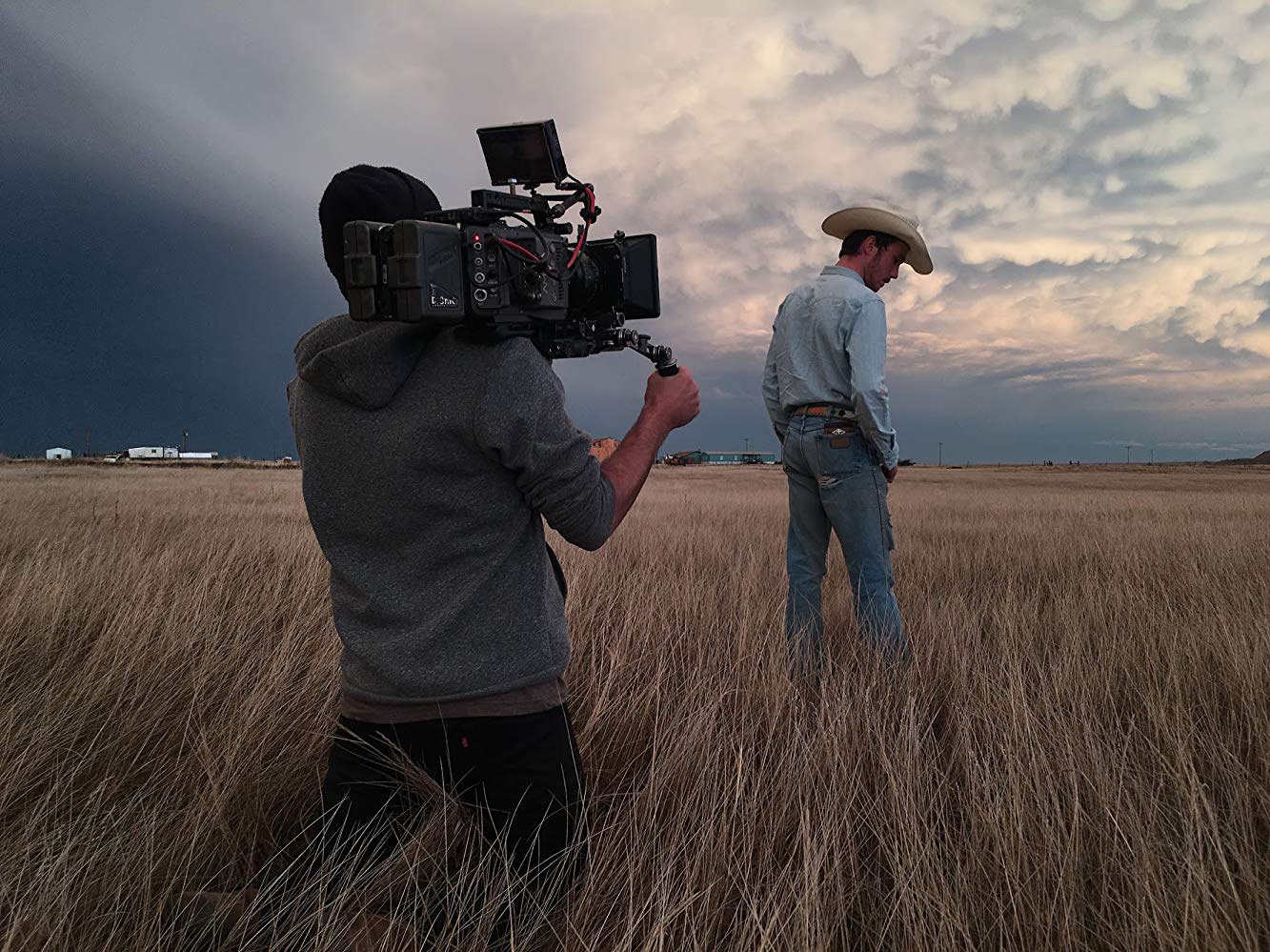
1. Shoplifters

I can’t think of a better example to explain what a Director does in a movie.
In Shoplifters, writer/editor/producer and director Hirokazu Kore-eda coordinated a group of non-related actors, including two children (one being 7 years old), to react to each other like a real family.
(A lot of stories have done that!!)
True. But we can always spot the fulcrum where immersion breaks.
Not here.
And that’s essential for the message Kore-eda-san is transmitting. They have to make you smile along when they smile, so that you feel the same sadness when they do.
The director is not trying to trick you to go on one line of thought. From the start he produces environments for his scenes that are overflowing with things and thoughts. He puts you there, in the middle of the complexity that is family.
If you empathize (not necessarily sympathize) with these fictional characters, with all their believable flaws and mistakes laid bare, and you find yourself harmonized to this imperfect mosaic, his job as a Director was successful.

- Shoplifters
- The Rider
- Minding the Gap
- Shirkers
- Burning
- Cold War
- First Man
- A Star Is Born
- The Favourite
- Mission: Impossible – Fallout
- The Ballad of Buster Scruggs
- Shadow
- Wildlife
- A Quiet Place
- Spider-Man: Into the Spider-Verse
- Lifeboat
- Free Solo
- Let the Sunshine In
- Vice
- Lean on Pete
- The Tale
- You Were Never Really Here
- Mandy
- Revenge
- Eighth Grade
- Leave No Trace
- Thoroughbreds
- American Animals
- Disobedience
- BlacKkKlansman
- Widows
- Private Life
- A Simple Favor
- Coco
- Green Book
- Zama
- If Beale Street Could Talk
- Roma
- Sorry to Bother You
- Black Panther
- Thunder Road
- The Old Man & the Gun
- Can You Ever Forgive Me?
- In the Fade
- Annihilation
- The Insult
- Game Night
- Everybody Knows
- Jane
- A Private War
- Black Sheep
- Support the Girls
- The Children Act
- Avengers: Infinity War
- Ocean’s Eight
- Bad Times at the El Royale
- Hostiles
- Woman Walks Ahead
- Bao
- 22 July
- A Night at the Garden
- The Post
- Solo: A Star Wars Story
- Isle of Dogs
- Mary and The Witch’s Flower
- Blockers
- Ant-Man and the Wasp
- Deadpool 2
- Incredibles 2
- The Death of Stalin
- Animal Behaviour
- Dark River
- First Reformed
- Bohemian Rhapsody
- All the Money in the World
- Outlaw King
- Bumblebee
- Ready Player One
- Beirut
- Fantastic Beasts: The Crimes of Grindelwald
- Black Mirror: Bandersnatch
- Dragon Ball Super: Broly
- The Young Karl Marx
- Tomb Raider
- Jurassic World: Fallen Kingdom
- Sicario: Day of the Soldado
- The Cloverfield Paradox
 Opinion Seed