After playing videogames for so many years, it becomes easier to get jaded about art direction, plot points or even the challenge of the gameplay.
I tend to be very open-minded about that stuff, since I consider myself very genre-agnostic and always give a chance to new experiences.
Still, I felt that jadedness creeping in while playing Ni no Kuni II: Revenant Kingdom, the new game from Level-5, sequel to the critically acclaimed Wrath of the White Witch.
Was this lingering feeling enough to cloud my critical perspective? I think not, and hopefully I came out the other side a better reviewer of these experiences.
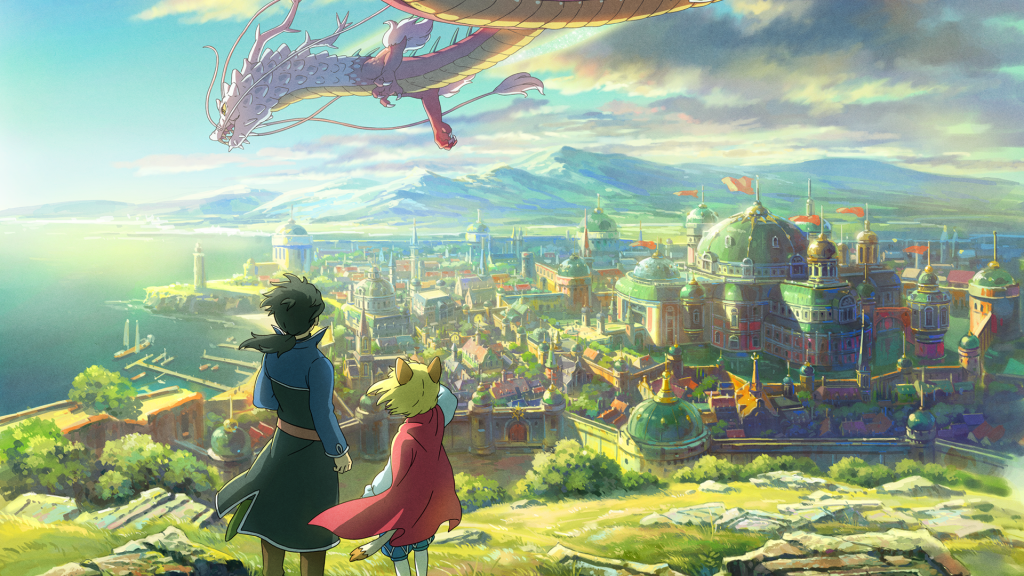
Immediately, the game is making it hard to be analytical about it. The visual art is splendid, with the Studio Ghibli chops of Yoshiyuki Momose (Mononoke-hime, and Sen to Chihiro no kamikakushi) coming to fruition in beautifully animated imagery and in scenes full of character.
Contrary to the first game, Ghibli was not involved in production. However, Level-5 retained the lessons of that past collaboration, and with the accolades of visual effects and animation brought forth by Momose, the final aesthetic of Revenant Kingdom is an uncanny homage to references like Totoro or Nausicaä.
Equally impressive is the cel-shaded technology employed to convert that art into a videogame. The way the tech team used shadows to convey dynamic lighting, smoothed-out a possible polygonal feel that would certainly hurt the artistic vision, or even how they tried juxtaposing different styles without ever hurting framerate or performance in general, was really innovative and ingenious. I bet Hayao Miyazaki would nod respectfully.
I was very impressed with the coherence of this amalgamation of implementations. The battle scenarios use different kinds of textures that instead of contrasting, help ground the action. The chibby visual choice for the over-world exploring never felt like a trope, but had proper weight and care. And many other details, like hair and grass physics, filled this world with an organic density that immersed you in it.
Another magnanimous contribution to this work came from the composer Mamoru Fujisawa (better known by his alias, Joe Hisaishi). The legendary musician/conductor is responsible for the iconic soundtracks of Ghibli films, and does not disappoint with this foray into the games medium.
Sure, there are moments where one can sense that he struggled with the need of delivering music that is not timed, but must continue until the player’s agency dictates that it’s time to progress. Those old habits from the movie industry were noticeable very rarely, and I was pleasantly surprised by how bold, diverse and fresh the score sounded, especially if we take into account that Joe Hisaishi has nothing to prove and could have easily phoned in his contribution.
On other note, but still refreshing, the real-time controls for exploration and combat are very pleasant. The movement and animations are properly weighted and, despite the colorful and fantastical nature of the surrounding canvas, the input feedback strikes a very nice balance between freedom and stickiness to the land. It is quite evident that this wasn’t a random byproduct. You can sense that the same attention that was given to the textures in the battle fields and the over-world was also coherently applied to the physics’ engine.
This precision in the controls, that is always welcomed and hard to pull off, ended up hurting the game indirectly.
You see, if you have very precise control over the action and the combat is not challenging, the result is a very easy game; maybe, too easy.
And that’s why the ‘ebenezer scrooge’ inside me started to influence my opinion about this game in a direction that I couldn’t quite compute.
Yes, the game is not at all challenging. But holding a grudge against the whole product because I had expectations and preparation for a certain degree of difficulty seems illogical and unfair.
The battles were still very enjoyable to play, and there was enough variety in enemy design, attacks and spells that it never reached a point of saturation. As a matter of fact, if the encounters were easy but long or if the game demanded grinding, the lack of challenge could have turned this into a boring game. Not the case!
Additionally, the real-time encounters were just one of three gameplay systems tied to progression.
Since you are role-playing as Evan Pettiwhisker Tildrum, a young king in the making, the developers implemented two more layers of action: real-time strategy battles with your troops, and a kingdom building simulator.
Both have the basic depth to make you pay attention to decisions and offer fun and contextual moments to complement the in-person combat.
The RTS battles have a nice rock-paper-scissors mechanic that can generate some wild swings even for the confident player. And the ‘town’ building is more than a mini-game. It demands recruiting of citizens by the player, through exploration of the outside world (smart way to nudge you into doing side missions), said recruiting is important because you can only learn the best abilities taught in the buildings you choose to erect by allocating the people with best affinity to it. More, those citizens can level-up, your buildings can level-up (generating more abilities to learn), and all this upgrading and construction is dependent on a resources’ pool that is restrictive.
All in all, Ni no Kuni II is as easy to recommend as it is easy to play. Be warned: it isn’t a game for you, at this moment, if you are looking for an experience that challenges your gaming dexterity. Still, please consider giving it a chance when you are looking for a relaxing journey in a world with all the delightfulness and allegorical care of Ghibli movies.
Like in Miyazaki’s films, don’t rush in labeling the experience being offered by tasting its audiovisual archetypes and then completing the fairytale in your mind. No.
This game has a fantastical and fantastic look, sounds melodic, yet, like the surprising variety of gameplay systems it keeps coherently unearthing, it will also surprise you with some well-placed notes and visual statements that direct the world-building and narrative pace towards a poignant allegory that hits near to home.

 Opinion Seed