
This is a ranked list of all the 2017 movies I’ve seen until the date of this publication. There are a few cases of 2016 regional-limited releases, but since I only got to see them, here in Portugal, in 2017 they go on the list. On the contrary, 2017 awards’ season films that I only saw in 2018 also go on the list. I know this is a bit incoherent, but the main purpose of this list is to do an analysis of what was cinema like in 2017 for me, using the most recent releases as talking points.
Additionally, I will also give out awards for achievement in 10 categories I consider the cornerstones of modern cinema: Costume/Makeup (as 1), Stunt/VisualFX (as 1), Production, Sound, Music, Acting, Screenplay, Editing, Cinematography and Direction.
I sincerely hope this is as enjoyable to read and intellectually stimulating as it was for me to write it. Thank you for your time, in advance 🙂
43. Guardians of the Galaxy Vol. 2
The first movie, in 2014, was one of the most influential pictures of all-time. That’s why Vol.2 is so low on this list.
“Vol.1” is the biggest responsible for the current state of superhero films. Their market life cycle should already be on the decline since Jon Favreau worked on Iron Man (2008); still, almost 10 years later, this genre not only continues to garner critical and commercial consensus but also seems to be getting fresher and bolder by the day.
Hiring young and rebellious directors like Taika Waititi (Thor: Ragnarok), Ryan Coogler (Black Panther) or Anna Boden and Ryan Fleck (Captain Marvel – 2019) is the reason why this product is still very much alive in our cultural zeitgeist. Which in itself is a feat, since commercial art, more than ever, is becoming less enduring due to the democratization and meritocracy platforms brought upon us by the digital revolution.
Being able to sustain a style, a trend for more than 5 years in the current climate is remarkable. We, as consumers, no longer have the patience to be fatigued by an aesthetic because there are a myriad of platforms that give us better and more innovative alternatives to spend our free-time. That’s why “Vol.1” was such a hit. We had never seen a superhero movie like that: funny and full of color.
Since then, the lines of our discourse have been even more cemented: Marvel is a jolly good time and DC is too self-serious. And this narrative is still getting some projects funded on one side and cancelled on the other.
Guardians 2 is not a bad movie. It’s simply underwhelming that the piece that started this conversation was only able to produce a familiar sensation in 3 years of development, while movies like Ant-Man or Deadpool with both hellish productions because of the “Guardians-effect” managed to come out with much more interesting takes on the Vol.1 formula than even Vol.2.
42. Alien: Covenant
One thing has to be given to Covenant, it has an ambitious vision. Yet, that’s pretty much it. Tons of promise, lightweight on the delivery.
Technically, the movie is competent to the level we should all demand from Sci-fi nowadays. Looking at you The Cloverfield Paradox (¬、¬).
However, despite the visual art cohesion, the movie is all over the place in terms of screenplay and editing. It’s a clear case of a project that is trying to punch above its weight and the final product ends up suffering because of this lack of identity.
Sure, Ridley Scott is very good at convincing you that the rules of his stories make sense, at the same time, that’s precisely a reason to be disappointed with this one. You get me in the world-building, make me curious to know more, and then deliver a very vapid tale of rampant AI that lacks character-development on the human side to make me care about the thriller parts, and also relies too heavily on MacGuffin narrative to generate awe at the state of this universe.
41. Ingrid Goes West
One of the first mistakes that is made when analyzing a movie is jumping straight to story and meaning. And while this is a very human tendency to have, since art and culture are rooted in the urge to tell a tale or find a safe haven in which to open up about the social significance of a certain behavior/event. Cinema, as an audiovisual expression, is much better at conveying meta-narratives than the traditional course of action of fables and allegories. Film is more concerned with message than meaning: how to photographically and musically communicate those same human footprints and stamp certain frames on the audience’s mind, that then become references for social living and analyzing.
What the respected biologist, Professor Richard Dawkins, coined as memes and Memetics.
And I made this mistake after seeing Ingrid Goes West.
I’ve been trying to get better at analyzing movies, but it was difficult to not fall to that temptation. This is a movie about the perils of social-media and the personality/influencer cults that arise from these synthetic networks. And I knew what to write after the “about” in the last sentence because this film is screaming too much that it has that meaning, instead of focusing its energy on how to transmit a message.
There are moments when this line of communication is clear and coherent. And those glimpses show the promise of this movie. Nice cinematography, editing and acting. But suddenly, the direction goes back to the clamoring of ‘I have something important to say about this subject’, and all the intimacy is lost due to some over-acting and over-stylized production choices.
Still, I’m not losing hope on Aubrey Plaza, Elizabeth Olsen and O’Shea Jackson Jr., three of the most promising american young actors.
40. Logan Lucky
There’s not much to say about this film that the trailer doesn’t state in the first 10 seconds: it’s a Soderbergh movie in line with his previous work in the heist genre.
In Ocean’s he tried to make you care about the characters by giving them smarts and composure from the get-go. Here he is trying a different angle – which works – however, like in Ocean’s their thought-to-action chain always feels that is serving puzzle-solving first and world-building second.
I think Logan Lucky, fundamentally, is grounded on better narrative premises about its characters than the other heist movies from Soderbergh. He used to rely too heavily on the action-hero trope in movies that were more about efficiency. That was his shtick, and it was novel enough to sell. In this movie, he tapped into a more nuanced trait: everyone knows someone who is really smart and capable but, because of contextual roadblocks, was never able to translate those skills into a balanced professional life.
The praises end here. As always, the movie ends up diverting to the entertainment factor of the puzzle, forgetting to guide the characters’ arcs to their pathos.
I recommend a 2016 movie that has similar premises about its characters but delivers on its promise of clashing ability with roadblocks. Why people end up robbing? Hell or High Water (2016).
39. An Inconvenient Sequel: Truth to Power
Undisputedly, this is a must-watch documentary.
It’s low on this list because I had some issues with its structuring and editing, which harmed the impact of its very important message. The time allotted for some events or the choice of revealing some personal details about Al Gore were well-intentioned, to give an in loco perspective of the struggle this situation should not be facing. However, it could have resonated even more on an emotional level if the documentary allowed for the photography and visual representation of intelligent science to do what they do best: impress.
Then, the humanism of Al Gore would land as an empathic linchpin. Like in the first doc 13 years (!!!) ago and 2016’s Before the Flood, by Leonardo DiCaprio.
38. Last Flag Flying
This movie feels like that old couch you’ve been planning on replacing, but the known quantity of comfort is tricking you into being risk-averse.
Richard Linklater (Boyhood and the Before trilogy) designed a very american film here. Framing on character exposition, drama sprinkled with light humor and group-dynamics throughout a journey from indoor to indoor.
It’s not bad per se, just uninteresting. Leave it on if you are channel surfing during a winter afternoon. Cranston’s cringe is serviceable.
37. Baby Driver
WTF just happened here Edgar Wright?!
You are one of most refreshing Directors out there and, all of a sudden, you decide to write a movie that is a glorified mtv clip? I never thought I would associate “style over substance” to one of your movies.
Your films are so bold, confidently pairing humor with tension and written with twists and turns that serve the characters’ journeys.
What a shame. Baby Driver is technically faultless: the camera knows its role, the soundtrack dances accordingly and the editing translates the beat. Even so, the film lacks juice. The characters don’t have personality and the narrative seems to be only serving a pre-conceived idea of what a good guy in a crime scenario should go through.
It’s a stylish version of one of those movies. But Wright was never one to settle for change from the inside. He is still a reference for outside-the-box.
Well, everyone has the right to misfire once in a while.
36. Free Fire
Simple formula: Film stars + having fun + shooting at each other + for 1h30 + inside the same warehouse = Fun movie.
35. Good Time
Ranking this movie was tough. It was, simultaneously, an eye catching and eye rolling experience. On one hand, the Safdie brothers are trying some interesting stuff with cinematography and editing, on the other hand that same experimentation produced too many immersion-breaking moments that never let the narrative find its landing place.
It’s clear that the floaty nature of the pace was an artistic decision, however, that served very little besides making you think about filmic techniques.
The movie follows Robert Pattinson’s character struggle to acquiesce to the mountain of societal pressures. And while his performance is very good, the bombardment of audiovisual effects keeps severing any connection the actor is trying to build with the audience.
Still, I will keep an eye towards the Safdies next project.
34. Battle of the Sexes
A film about Women showing the world the ridicule of paternalism and grandfathering, ends up also having much better female performances than male acting.
Emma Stone adds one more “Great” to her growing portfolio and Steve Carell sneakily delivers another overrated presence.
Stone’s work is so immaculate that, despite Carell’s, this movie could be in awards’ contention if not for a lack of identity. In the end, the screenplay could never decide if the vehicle being used was the homosexuality of Billie Jean or the all-around strength of her personality.
33. The Beguiled
I’m a bit angry at this movie.
Firstly, it has a trailer like this, promising a plot device that is never used. And no, it’s not a trick to mess with your head, it’s just bad marketing.
Second of all, from the beginning of the film it is quite evident that we are in the presence of a very special work by the photography department. And that’s precisely why I’m frustrated with this picture. Such gorgeous art, coupled with the narrative promise of that trailer would, probably, result in a very strong movie.
Not to mention the quality of the cast.
It’s difficult to envision a time when I no longer care for Sofia Coppola’s movies. I will always crave for the next Lost in Translation.
This time, she lost a chance for another Great.
32. Star Wars: Episode VIII – The Last Jedi
Boy, did Rian Johnson go for it, huh?
In a vacuum, this is a very good movie. But what the hell was The Force Awakens for?
Despite how disappointingly safe the first movie was, it showed promising signs about this new trilogy: the new characters – Rey, Finn, Poe and Kylo.
The Last Jedi is precisely the opposite of Awakens, the new characters either stagnate (Kylo) or regress (Rey and especially Finn). And the familiar ones like Luke and Leia are served surprisingly layered arcs, that are met by good performances by their respective actors. Harrison Ford’s was vapid in the first movie, but Hammill and Fisher are a delight here.
One can argue that if you complained about the unoriginality of Awakens it is not fair to accuse The Last Jedi of cutting ties with its predecessor’s narrative. Well, don’t be edgy just for the sake of it, right?
When you come forward to write a story, even if it needs to be divided for a more comfortable reading, you should always have a common thread that laces the books together.
Here, the first book was clearly about how new characters interpret and interact with an old mythology. Then, without any foreshadowing, this trilogy has become about showing how the fight between the Rebels and the Empire doesn’t matter, the Force doesn’t matter, and what really matters is the class struggle in the Galaxy?!
I would buy that as a very interesting twist on the pre-conceived ideas we have about Star Wars, but not like this.
It would make sense if this was the first movie of this new trilogy. Build that world and class-struggle premise from the beginning and use the heroes and villains as witnesses of such social dynamics in the galaxy.
The Last Jedi is trying to do two things at the same time and fails at them individually and as a sum of parts. It seems like Rian Johnson wanted so badly for this movie to be about that twist on the formula and say something deeper than good vs evil, that it ended up rebelling too obviously against the first movie.
I liked way more this version of Star Wars than Abrams’, but I can’t pretend the first movie doesn’t exist.
31. Okja
Here’s one of those cases where a movie has a substantial amount of good components, yet, the final product leaves something to be desired.
This is the same feeling I was left with when I saw Snowpiercer, the previous movie from Korean director Bong Joon-ho. Don’t get me wrong, Okja is a better film; still, there’s a lingering sensation that an even greater one is trying to surface from the combination of these techniques and moments.
Okja has nice editing and writing that flush-out three very good performances from Ahn Seo-Hyun, Tilda Swinton and Paul Dano. The directing is good all-around but it stands-out even more when one of them is on screen.
The Music is very strong and intelligently incorporated.
All in all, I liked it, but I only recommend it for people who like the work of those actors or are curious about a non-doc take on the food industry.
30. Score: A Film Music Documentary
“John Williams made me realize Film Music could be as great as the Classical Composers” – Hans Zimmer.
I will just keep citing remarks from the trailer to make my point. So, PLEASE watch this doc and go get some nice goosebumps.
“Hans Zimmer revolutionized what we do.”
“There is a chemical high.”
“Pirates, it’s like Led Zeppelin played by an orchestra.”
“Film Music is the Symphonic music of today.”
“Film Music has changed fairly radically.”
“There’s sort of a new renaissance going on.”
“It’s so visceral, it’s incredibly powerful.”
29. War for the Planet of the Apes
If you saw the previous two movies, you should see the conclusion. This trilogy deserves it.
However, I can’t hide being a bit disappointed with this culmination. From the cornerstones, in Rise, where you understand Caesar personality because of the family that adopted him; to the lore and world-building of Dawn, where you gradually start to piece together the catalysts that led to the alternative future written by Pierre Boulle; you had in this trilogy a reference to how properly structure a sci-fi tale and how to design a story where your narrative hooks have the proper time and space to breath and be effective.
It saddens me to reach the end of this road and be left with ethereal thoughts roving my imagination or a desire to read Boulle’s original work, but no frames stamped in my brain of larger-than-life problems solved by Caesar on the big screen. Everything converged to a very anthropomorphic resolution, and it seemed that even in an alternative reality where Apes are the dominant species, Joseph Campbell’s “hero journey” is still the formula for writing a train of behaviors.
Well, we will always have these performances by Andy Serkis to start a conversation why Stunt and Voice Acting are not recognized as legitimate arts by Academies.
28. Thor: Ragnarok
This is what is called an alignment of stars. Not because of the A-listers in the credits, but due to the combination of unrelated factors that happened to converge in the making of this movie.
First, we have Marvel Studios full-steam on the aesthetic brought about by Guardians of the Galaxy (2014), and the openness that comes with. In this case, giving the reigns of a valued IP – original Avenger – to a director that is known to be very experimental. His name, Taika Waititi.
Secondly, a much needed face-wash to the identity of Thor, and the norse mythology take that previous movies had adopted. Despite all the pre-conceived ideas one might have about Viking culture, their religion was one of the least self-serious in human history. Jokes, color and repudiation of a brown machismo were core tenets of its supernatural constructs.
Hence, this third movie of the Thor storyline is a delight to watch. Waititi took the Guardians’ formula and improved it, Chris Hemsworth goes to the level of Rush (2013) and shows us that he is capable of more than just being physical, and Cate Blanchett prevents the film from ever becoming an hyperbole.
The only complaint I have about this movie is that, in the end, this is a better version of a style Marvel, rightly, doesn’t want to let go.
27. Logan
What an interesting film…
I was genuinely surprised with the design choices in here. Not only were they trying to combine a cinema vérité feel to noir sensabilities, in an X-Men movie, but also there is a clear path towards nihilism and a deconstruction of defeat in its screenplay.
They don’t totally deliver on either fronts, but came close, and if they did, this movie would be much higher on this list and probably an all-time great of its genre.
Still, I recommend seeing this film because everything makes so much sense for the characters of Wolverine and Charles Xavier. This culmination to their mythos is brilliantly grounded. And Hugh Jackman and Sir Patrick Stewart are, as always, very up for the task.
26. Atomic Blonde
Yes, a Cold War Movie with spies.
However, this one is not boring or pseudo-intellectual. The suspense and twists are only there to drive the story forward; the narrative is punched through your nose with a terrific sense of styyyle.
From the aesthetic chosen by the director of photography, the visual effects that paint but not distract, to the fighting sequences that manage to walk that thin line between dance and real strife; this is a simple movie that works because it has confidence on its own identity.
Calling this film “Jane Wick” is a disservice to the directorial debut of David Leitch (stunt coordinator of movies like Bourne, V for Vendetta or John Wick) and to the poignant presence of Charlize Theron. She is shutting-up those misogynistic trolls that say women can’t be leads in action flicks. Well, a lot of Bonds had way less charisma than Lorraine here.
25. Detroit
I know, this is way too low. An underrated movie of 2017.
At the same time, I can’t help but feel disappointed with it. Not because of its technical or artistic components, but because I expect disruption out of Kathryn Bigelow.
She revitalized war-movies. A woman, singlehandedly, reenergized one of the most iconic film genres, known for cementing a lot of memes that support the occidental patriarchy.
So, when it was announced that this visionary was going to put her transformative hands on the civil rights subject, I had high hopes. That’s one of the genres in more need of a different lift-up. The message is clearly not going through.
Detroit does not transmit that boost. It’s very well filmed, with the camera intimacy and character development Bigelow has accustomed us to. But, in the end, it is missing some of those “The Hurt Locker or Zero Dark Thirty” scenes where the paradigm was clearly shifted. She made you look at war on a cerebral and not historical level. I wanted that this movie tackled racism on a more reptilian way and less the typical structural perspective.
If we don’t acknowledge that racism needs to be fought from an early age like impoliteness or laziness, we will keep have social structures built by mannerless, indolent and intolerant people.
24. Wonder Woman
It makes me happy to see that we can still have movies about good vs evil and have a hard time being jaded about it.
Patty Jenkins (director) and Gal Gadot (Diana) team-up to present us with an honest realization of what is to look at the wrongs we are capable of generating as a species, and have the clear-mindedness to correct them and turn the world into a better place.
It reads naïve because we’ve been indoctrinated into thinking that, by maximizing our individual golden rules, societies will tend to correct themselves. This personal unaccountability and faith that producing wealth will magically lead to a better reality is what desensitizes us to destruction, hunger and death.
We built our societies on cornerstones of righteousness. So, we assume that this organizational machine will mathematically tend for those principles and deter the bad from creeping in.
By positioning Diana as an exotic presence and casting Gadot (non anglo-saxon) as her conduit for expression, Jenkins shows us War, not from the eyes of a hero, but from the perspective of someone who doesn’t have an instruction manual that predicts outputs from a list of inputs.
Wonder Woman is powerful not due to her physicality but because she sees reality as an amalgamation of building blocks that can be, actively, put together to rise to a good cause.
As I said, it makes me happy that there are still people making blockbuster films where the message is ‘never do something, as an adult, that your child-self wouldn’t do’.
23. Molly’s Game
Not bad for a first foray into directing by the acclaimed screenwriter Aaron Sorkin.
And it is a Sorkin movie alright: Biography, Drama and lot of words are all present. He is one of the best in the business at capturing human depth of stand-offish personalities by meticulously placing discourse and diatribe in the right contexts.
Rhythm is the key, i.e., the cavalcade of expensive words is distributed in a way that makes you feel smart and not overwhelmed. And what a better artist to translate this to the screen than Jessica Chastain.
She is the current queen of portraying intelligent women that are a force of nature, because she is, first and foremost, one of those.
This is a very old-school movie and fails to impress, but is worth seeing just for Chastain’s performance. She acts with such gravitas and range that it becomes difficult to distinguish between dramatization and organically natural. And you know what’s more impressive? It’s not one of her best works.
22. Forushande
The more I think about this film, the more I like it.
I definitely respect it for using “murder-mystery” tropes to serve as beacons in an analysis of Iranian socio-cultural dynamics. This design is not new to Asghar Farhadi’s movies. Even so, it has yet to outlast its welcome as a narrative vehicle.
Moreover, this film (The Salesman) is trying something different with its culmination than the other two works I’ve seen from the director: Darbareye Elly (About Elly – 2009) and Jodaeiye Nader az Simin (A Separation – 2011). While the previous two were exploring themes like ambiguity and doubt, and how culture fills in the gaps. This movie gives you closure, but asks if you are satisfied.
My favorite work of Farhadi is Darbareye Elly. However, in a few months could be Forushande since Elly started as the least favorite and gradually became a reference I always go back to when thinking about these subjects. Maybe I will end up looking at this blog post and ask ‘what was I thinking’.
Well, that’s the fun in all of this, to think granularly about the relative contributions within a specific context. In this case, how I relate 2017’s landscape to prior years and to what I expect from each genre and auteur.
21. Beatriz at Dinner
One of the surprises of the year.
Not only is this film reacting to the Trump election in a non-forced way, but also it manages to have a very striking message at its core. The end alone makes this one of the best screenplays of the year.
Earlier, when I pointed out that The Last Jedi failed in its mission of tackling social issues, Beatriz at Dinner came to mind. With incomparably less resources, this movie does a very sober cross-examination on the causes and consequences of financial inequality.
We are not in the presence of simple generalizations about poor vs rich. No, Miguel Arteta (the director) is focused on motivations and perspectives. What do people care about? What do they take out of life? Is that really the best way to put income and economic growth to use?
This movie is more complex than it seems. Starting with Salma Hayek’s career performance and John Lithgow’s stretching of our expectations. Come for the Trump movie, stay for the exhibit on sustainable development and the effects of an overwhelming weight of hopelessness.
20. Wind River
The writer of Sicario and Hell or High Water is getting his feet wet for the first time in the direction department, here in Wind River.
And what a first run. We can already speak of a Taylor Sheridan style, not as creative crutches that he tends to fall back to, but as a distinct savviness to know how to meld story flow with visual compositions in case-by-case scenarios.
There is an aura of classicism and minimalism in his touch and, with this directorial debut, one can look forward to this throwback encapsulation brought forward to XXI century sensibilities.
The writing is, once again, very good. The camera is very coherent for a first-timer. And even the sound and music are handled with care.
Finally, there is another aspect of Sheridan’s potential that glimmers in this movie. How he draws the best out of his actors. It has been evident for a while that Jeremy Renner and Elizabeth Olsen are the future of this artistic field, be that as it may, they are at a very high level in this picture. Performances that are completely in line with the mood of each scene.
19. The Big Sick
The best romantic comedy of all time.
There, I said it.
One caveat, though: it’s a little bit cheating since it’s based on real events that transpired in the tumultuous beginning of Emily V. Gordon (writer) and Kumail Nanjiani’s (writer/actor) relationship.
Still, you don’t get rom-coms better than this. The humor is on-point and never over-the-top (in an age where comedians are always trying to shock more than their collegues, Nanjiani is doing something that is efficient without being safe). The romance is chemical and ethereal because it comes from shared attraction to idiosyncrasies and not to Hollywood ideas of happily-ever-after.
It really is good at conveying a sense of journey and development through events, that you feel the languish and the laughter.
18. Darkest Hour
Oscar bait right?
I would be the first to answer ‘yes’ to that question since I find bio-pics to be one of the stalest genres in all of cinema.
Not this one.
Yes, Gary Oldman is freakin’ phenomenal, but that’s not the reason why I think this film is doing better than other biographical movies. As much as I respect Oldman’s body of work, here, the director (Joe Wright) and the cinematographer (Bruno Delbonnel) shine the brightest.
The fabric of the majority of the shots is remarkably exquisite. They are, in all of their essence, historical. I found myself being transported to that time and place with little to no effort, and this smoothing effect comes from the collaboration between light, camera angles and character positioning.
One of the clear examples that communicate that hospitality from the Director and the DP is a shot from the beginning of the film, where Churchill lights a cigar in bed even before the shutters are opened, and when the first rays of light come into that room you suddenly realize that you are already there.
17. I, Tonya

Another bio-pic in the Top 20?! I must be going soft.
Well, this one was even easier to rank after determining where Darkest Hour would land.
The acting is better, the Costume/Makeup art is the best of the year, and the filmmakers had to work a lot more to build a worthy dramatization of Tonya Harding than Winston effin Churchill during WWII.
I must dedicate another paragraph to talk about the performances. You will probably remember this movie because of Allison Janney’s slashing portrayal of Tonya’s mother, but I should remind you that Margot Robbie is a 27-year-old Australian that is just starting to get her first lead roles. She looks in complete control of her craft and it’s scary to notice that she had more that could have been given, if the director wanted.
16. Lady Bird
In a year where, finally, serious issues like harassment and wage gap that target women came to the spotlight of the collective consciousness, it gets even more revolting that Michelle Williams got paid 0.07% of what Mark Wahlberg earned for the reshoots of All the Money in the World (ironic coincidence of a title) when, first, Williams is a much better actor than Wahlberg, but also because three talented women decided to present us with one of the best movies of the year.
Laurie Metcalf is the best supporting role of the year (female and male combined), Saoirse Ronan (23 yo) is the best female lead of the year and Greta Gerwig (34 yo) not only passed with flying colors in her first big project as a director, but also gave us one of the best works in direction of 2017.
We, as building blocks and acting agents of state and civil society, must continue to fight for fairness and equity in opportunities, not because, if given that chance, women produce equal and better results than men (that’s statistically obvious), but because it’s right.
15. Blade Runner 2049
Blade Runner 2049 is an accomplishment.
Not only did it manage to correct some of the wrongs of its cult prequel, but also made noir work in 2017. I have some issues regarding the originality of the narrative and the tropes its message is structured around. Still, this story is a take on the best part of the first movie, and the metaphor being transmitted is still very relevant and juicy on its own.
Additionally, it’s a technical marvel and will serve as visual reference for science-fiction films to come. The cinematography has bravado without losing elegance, the music is very pleasant to the ear (maybe too much pleasant, for what is on screen), and the directing is of the quality Denis Villeneuve has accustomed us to: actors have proper timings while maintaining personality and tact.
2049 also presents us with two great performances: Harrison Ford gives us one of his best, and Ana de Armas grabs her first blockbuster role with an astounding solidity and feel.
In the end, despite minor remarks, I highly recommend this movie. It’s a proof that industrial and introspective are not mutually exclusive and that spectacle is an appropriate trojan horse to push people into thinking about complex subjects.
14. Get Out

I couldn’t relate to Get Out on a level that many people, in the US, did.
However, I respect the hell out of this film!
Excuses could be made in respect to the lack of connection between me and this movie. ‘I don’t like horror/thrillers.’ It’s true; I find them a bit overrated and cheap when it comes to triggering a reaction from an audience. What is also true is that I am a white european male. Getting what Get Out is all about and understanding how it revolutionized “civil rights” filmmaking is not so immediate for a person like me.
I know better now. The way Jordan Peele (writer/director) grabbed the elements of horror movies, toned them down, sprinkled in a tasteful level of comedy (Key & Peele, anyone?) and wrote an elegant but provocative satire about white paternalism and grandfathering is as genius as it reads.
When I was watching the film, I wasn’t able to put a finger on why, if this was a thriller with comedic elements, wasn’t I scared or laughing…
That’s the point of the all movie. To make you feel uncomfortable with the lack of a formulaic affirmation. The film undulates between two states – tension and smirk – with a brilliant precision. It doesn’t want to entertain or distract. It wants to test how you internalize the sociocultural skit and how you self-judge your response to it.
This film did the unthinkable, in my view. It showed that there are still some avenues to explore in the horror genre, and managed to change the paradigm and raise the bar of civil rights movies.
Bravo!
13. Lady Macbeth
It might read as lazy what I am about to write, since I could base this opinion on the quality of the shots’ composition or the performance of first-big-project Florence Pugh; still, this is a case where hyperbole is useful.
Lady Macbeth is one of the best portrayals of two of our most primal instincts: sexual desire and survivalist egocentrism.
12. The Killing of a Sacred Deer
The previous film from the Greek duo Yorgos Lanthimos and Efthimis Filippou had also an animal symbology in its title – The Lobster.
More interestingly, of course, is that both are tackling “sacred” subjects of our meticulously structured civilization. Both have a very innovative way of building a soft canvas around a blatant crux. It’s as if Lanthimos and Filippou hand-pick the most characteristic traces of utopias and dystopias and force the compatibility. The result is very unique, to say the least.
In The Lobster they are putting monogamy to the test. Here, in The Killing of a Sacred Deer they are shaking the foundations of organized medicine.
As I described above, the wrapping around the punch-line is quasi surreal, at the same time, it’s precisely that type of alien environment that dilates your pupils to the statement being made. It’s shock not to jump-scare you but to bold the fragility of our trust in the institutions.
On a different note, I will use this text to remind the reader that we should not take Colin Farrell and Nicole Kidman for granted, since they are at the peak of their games, especially after they started to embrace less commercial roles.
And a final salute to the young Barry Keoghan (25 yo) who is astonishing in this film. One of the best performances of the year.
11. A Ghost Story
Fuck, how did you climb up here? I don’t agree with you! As a matter of fact, I get enraged at your premise. For that, I will block you from reaching the Top 10.
…
But I can’t block you from my mind. You went for it. You made the unquestionable question.
…
Does our life matter, in the grand scale of time?
…
That’s a third ontology that never occupied my head, since I always reduced the ways people interpret the nature of reality to one of two ways, and the myriad of conceptualizations about life and death were just different positions in a gradient defined by those two points:
Everyone wants their existence to be meaningful (we can’t help it – genes and ego are the true rulers), but different people, or the same person in a different context, have found alternative ways to cope with the unavoidability of death. Some find meaning in the journey and in the foot-print they leave in everyone and everything that interacted with them. Others need something more structured, hence the pantheon of religions throughout history.
But a third referential?!
One where you are meaningless because, even if you meant something to someone, they are meaningless too.
…
I can’t let A Ghost Story rise any further in this ranking, partly because I whole-heartily refuse to accept its corollary and, obviously, because I think there were better movies in 2017.
Perspective and relativity are very important tools endowed in our evolved brains. They help us curtail the dangers of excessive anthropocentrism, narcissism and egoism. Alternatively, excess of relativization can become even more destructive, due to the germination of entropic tendencies like nihilism and anarchism. And since the Universe tends to reduce the entropy of its systems, the path towards nothingness becomes a self-fulfilling prophecy.
Nevertheless, nice try A Ghost Story.
Oh, great soundtrack and cinematography also 😉
10. The Square
Paraphrasing Ruben Östlund, the writer/director of this film: The Square is a meta-narrative on how a movie designed as a sum of youtube-like sketches about social desensitizing becomes itself a continuum of personally damaging escapism.
Sounds pseudo-intellectual? That’s his point. The film is intellectual by saying that you can only go deep on a subject if you learn to laugh about yourself first. Then, from that innocence your eyes will look at the world with a knack for finding detail and connections.
I don’t need to say anything more. Go have a laugh. With style.
9. The Lost City of Z

Even I am surprised that this film is so high.
It doesn’t do anything particularly special. But its overall competence and ambition left a lasting appeal in my senses. I will never forget the settings delivered by this movie and the different aesthetics that came along with them.
This is another glaring example on how ridiculous it was that, for years, The Academy did not recognize the achievement in Production Design. Producers do a lot more than just coming up with the money or coordinating costume designers or makeup artists.
Dede Gardner has since won 2 Oscars for Moonlight and 12 Years a Slave and garnered nominations for The Big Short, Selma and The Tree of Life. All in all, she is one of the best Producers in cinema and The Lost City of Z oozes that same pedigree from the very first scenes.
Additionally, this is a very credible representation of the trade-offs that come with an explorer spirit. History tends to mythologize these figures, but that energy rises from the same source as obsession. Charlie Hunnam is impeccably on-character throughout the film, which is remarkable since the plot covers a lot of time and places. It’s almost impossible to not share his dreams and ambitions because he is a stalwart of convictions. Still, it’s the weight on Hunnam’s face that sells his performance and puts him alongside bigger names as a top male lead in the industry.
The Lost City of Z is a globe-trotting journey that captures your imagination, and the adventures those characters go in are beautifully served by set designs that wipe away all the risk-aversion one might have and make an aspiring Indiana Jones out of you.
8. John Wick: Chapter 2

It’s so rare for a sequel to deliver on the promise of a film like the first John Wick.
Let’s be honest, the first movie didn’t become a cult hit because John only shoots the real amount of bullets those guns are engineered to carry, and not the infinity-ammo cheat of other action movies.
No, John Wick is already a cult classic of its genre because Derek Kolstad wrote lore for a type of movie that is afraid of it and dedicated some slots of screenplay to world-building.
Yup, a shoot’em up more layered than Shakespeare in Love and Crash combined.
Nonetheless, the majority of those nuances in the narrative were only glimpses to a cinematic universe that, more often than not, turn into smoke and mirrors or even collapse under self-imposed unrealistic expectations.
Color me surprised that these “sons of a gun” DID double-down on the flushing-out of said lore. John Wick’s car and suit have their own storylines!
They go even deeper in the flourishment of this network of hitmen/women, by revealing more information how the hotel system works, what’s the hierarchy, where do the coins that John has in his basement come from and what are their purpose.
I know all of this reads as very languid blocks to support your world-building on. Please trust me when I say that it all makes artistic sense.
Starting with the above mentioned John Wick’s Basement, it becomes clear that these melting pots of non-explicit lore were designed with a vision behind them. The way Chad Stahelski and David Leitch (directors of the first movie, Leitch had a minor role in Chapter 2 because of Atomic Blonde) combined the different contributions of the Visual Effects team, the Sound and Music teams, the cinematographer and Keanu Reeves himself, all converged to realize frames that suggest that if that simple Basement could talk, it would have a story to tell.
That’s just a small example on how to use the strengths of film to develop characters and worlds without the luxury of hours and hours like TV series. Cinema storytelling done right is treating the audience like adults who don’t need exposition spoon-fed to them. Focus on painting your story-boards with a semi-palpable decoration, and environmental storytelling will steadily exude from your frames.
Paraphrasing Guillermo del Toro, TV has grown so much in recent years, but it has yet to reach a level where you close your eyes and have memorable shots stamped in your mind.
John Wick: Chapter 2 is much more than an action movie with guns. It has that other type of shots that Guillermo was referring to.
7. Kimi no Na wa.
Do not immediately move away from this film, the moment you see that it betakes the over-used gimmick of switching bodies.
It may surprise you, but these filmmakers have done right by it.
In Your Name. (english title) the switcheroo is interestingly serving more ourselves in the audience than the characters on screen. It’s kind of a stylistic trap to make you crave for a deus ex machina solution to end this fictional story, and not make you feel robbed when it is indeed applied.
I, usually, don’t fall for these types of plot devices. Good writing is the art of solving a seemingly unsolvable narrative thread without resorting to miraculous puppeteer strings.
I fell for this one.
But let me explain why. Like I said, the switch and deus ex mechanics are intelligently working in tandem to increase the resonance that you, as an outside witness, have with those two characters. They react to the switching, but it’s your response that matters more for Makoto Shinkai (writer/director). He wants to make you comfortable around them, because the switched personality shares the same outsider perspective as the audience. And because of the type of crafting this film went through to, in terms of story-board and set design, cinematographic feel and even editing, make an animation movie capture the sensibilities of live-action without losing the strengths of anime; you naturally find yourself immersed in their livelihoods.
So, when the time comes to employ deus ex machina, you welcome it. You care for these characters’ lives, not because you know things about them, like their names, but because you got to know them on a more fundamental level. Their dreams, fears and passions.
6. Ah-ga-ssi

An erotic film by Park Chan-wook (Oldeuboi and Bakjwi). Who doesn’t want that?
You’re in for a surprise if you are expecting an Oldboy concentrated to the sex scenes.
The Handmaiden (english title) retains Chan-wook’s finger-print, but not only is it toying with your expectations about this director’s movies, it also is delivering something new to the genre. Well, maybe this last sentence is the true definition of Chan-wook’s career.
Like in previous films by this auteur, it is difficult to be very opinionated about them without spoiling the impact of their messages. However, Ah-ga-ssi is so good in other departments besides screenplay that I can write just a bit more.
This film has impressively varied photography. The transitions between sets, either from indoors to outdoors or even from room to room, are always stunning because they all have some distinctive mark. That attention to detail is delivered by a scarily proficient camera work.
The acting is splendid. Kim Min-hee and Kim Tae-ri create such distinctive identities that lend even more juxtapositions to the narrative flow. Of course part of the credit has to go to the director, but those two actresses really found something special between them. Isolated were very good, but together… Magical.
Last, but definitely not least, the Sound and Music. What a delight to the senses. A masterful job in mixing and editing, so that even whispers are meaningful and could be smoothly transitioned to music. This playing with sounds emitted from people or small everyday objects and how they can be organically integrated in a musical score is a technique that more movies should copy. Particularly, kissing.
It worked really well for kisses.
5. Call Me by Your Name

Filming a movie in Italy has its perks. Especially for the director of photography.
And that’s precisely why this is one of the best 5 films of 2017. The fact that the most beautiful part about it was not the bucolic vistas. It was the beautiful love between Oliver and Elio.
I could supplement this critique by talking about the eye of Luca Guadagnino (director) for how to extract the best out of the natural beauty of his birth-country, or gush about the loveliness of the soundtrack, or even dedicate a whole paragraph to the best adapted screenplay of the year (James Ivory). In the end, this film is an instant-classic because of three performances and a particular scene.
Armie Hammer (Oliver), Timothée Chalamet (Elio) and Michael Stuhlbarg (Elio’s father) are all phenomenal, and Timothée is, without a doubt, the best performance of the year.
Hammer’s work helps a lot in lending credence to a character that breaks expected plot usages for tall and virile presences in movies about male homosexuality.
Stuhlbarg is responsible for the second best scene of 2017. Just watch the film until the end.
And Chalamet is glorious. I don’t use the expression ‘perfect’ because the amazing of his craft was how he incorporated improvisation in his act, so that the nano imperfections gave a complete humanity to his role. I can’t stress enough how wondrous is this performance. He takes us on an emotional journey just by changing micro expressions in his face. The way he uses his body seems like he was reading our thoughts. No over-acting, everything makes sense.
He’s just 22! Superb. Simply superb…
4. Phantom Thread

I have a confession to make… And I hope readers don’t stop following this blog after that.
Hum… I… Hum… I find Daniel Day-Lewis… And… Paul Thomas Anderson… Just a bit… Hum… Overrated…
Yeah, I know. It probably is my fault. They’re very good. I just had a hard time grasping the “best occidental cinema has to offer” statement and all that comes with it.
Until this film.
Now, I can confidently say I’ve seen greatness in them. DDL has a presence on screen that is only possible if the whole world considers you great, and PTA just taught me cinema in 2h.
Ok, let’s tone down the hyperbole so that it doesn’t seem I did a 180 on how I previously analyzed their works. DDL is known for his method-acting, still, I never sensed more than immaculate acting from him. I always left feeling like heart and roughness were missing. His granularity was strangely suave. I get it; the ultimate artist doesn’t need to sign his/her work. Even so, I would argue that what distinguishes art from other stupendous human endeavors, like science, for example, is that art should risk losing some epistemological thinking if that means gaining some cosmic randomness.
In Phantom Thread, I saw a DDL that scratched, a little bit, the bubble of professional craftsman. It probably resulted in a less successful performance by him; at the same time, it added up to the contribution of art in the proliferation of a rage against human fate.
PTA, from his side, I always looked at that body of work with a metaphor in my head. A musician that, because he/she already knows how to play all the instruments, wants so badly to re-invent music.
His films are magnanimous treaties on how to revolutionize cinema. However, one way or the other, I never could shake the feeling that there was some kind of disconnect between content and style in his images.
Not in Phantom Thread. The interplay between object arrangement and texture were much more than a study on how humans create and perceive artistic imagery. It delivered a quasi-inspirational recognition that visual perception is better served when the focus is representation and not reconstruction of a multi-scaled hierarchy of layers.
But enough talk of the men that worked on this movie. Since, the women were, if not more, equally important to its artistic depth. Lesley Manville is Acting with all the essence and principles I can convey with that capital letter, and Vicky Krieps is the reason this performance by DDL worked so great. Krieps (not an A-lister) didn’t let this film be a farewell tour of DDL’s signature moves (he has gone on record to say this was his last movie). She pushed back! Not in a rebellious way. On the contrary, she elevated herself to the pantheon of Method and showed him a different take. Which was almost a meta-narrative of this film.
To conclude, I saved the highest of the highlights for last. The Score. In a year particularly good for music in movies, I was a bit surprised that the unidimensionality of this original soundtrack was the pinch that I needed to choose between so many great scores. Jonny Greenwood gently captured a lightning in a bottle and made a rare feat, music that aligned Perfectly to the visual aesthetic for every-single-second of this film.
3. Three Billboards Outside Ebbing, Missouri
It was a tough decision to end up putting this film in the podium.
I am conscious of the fact that it doesn’t have as great acting or writing like Call Me by Your Name or the masterclass in audiovisual tools of cinema like Phantom Thread. All that being true, I can’t be insensible to the other fact that, besides being a great movie on its own, I simply prefer it to the other 2.
It probably is a mistake to put it alongside the silver and gold of this ranking, since it’s clearly leagues below them (but so are #4 and #5) and also because it is not fair for Martin McDonagh (writer/director) and the rest of the cast & crew to generate some kind of ‘Best Picture’ hype, as they couldn’t be more blunt about not wanting that publicity – this type of humor is way more Oscar repellent than Oscar bait.
Still, somewhat unexpectedly, 3 Billboards got VIP tickets in the mail for seats in the awards’ season hype-train and not only rode it since the Globes in January, but also got extra perks when stopped in the stations of the Screen Actors Guild and the BAFTAS.
Suddenly, a technically evolved version of In Bruges (same writer/director) was getting traction to win the biggest prize in cinema. What?! Where was this Academy in 2008 when cinephiles sang the praises of a dramedy about a guilt-stricken hitman in a belgian city?
Well, I know where part of the 2018 Academy was in 2008. Not there. There’s a reason why I wrote ‘somewhat unexpectedly’ above, and why first-timers and indie-darlings like Get Out and Lady Bird not only got deserved recognition with several nominations, but also had bigger traction as possible winners than a movie with Spielberg, Hanks and Streep.
The explanation is simple but very welcome. Quoting the Academy itself (2017): “Beginning later this year, each new member’s voting status will last 10 years, and will be renewed if that new member has been active in motion pictures during that decade. (…) The Academy also vows to add three more governor seats to be occupied by men or women of color for the standard three-year term, as well as adding more diverse members to its executive and board committees. (…) The Board of Governors of the Academy of Motion Picture Arts and Sciences vows to commit to doubling the number of women and diverse members of the Academy by 2020.”
That’s why 3 Billboards was surprisingly positioned to win it all. While old white men connect better with Titanic, The King’s Speech, Chicago, Argo and Dances with Wolves, a younger and more diverse generation of members can stomach the flurry of political incorrectness of McDonagh’s films.
More interesting, though, were the generalized reactions of traditional media, so accustomed to earn a living by bashing the usual Oscar-bait frontrunner for Best Picture, that started a smearing campaign designed around an apparently obvious “oscar-baitedness” of 3 Billboards.
Huh?
You can’t have it both ways people. If you spend your professional energy fighting for change in Hollywood, you should now write positive articles about these signs of transition, and not turn those same signs into something they’re not, just to fit an immutable narrative pre-chosen for a career.
Not long ago, we didn’t have 10 slots for Best Picture nominees. We had 5. And if change was not occurring, we wouldn’t have Three Billboards Outside Ebbing, Missouri in those 5 and The Post and Darkest Hour would be the clear favorites.
Things are getting better. Yes, we still had a ridiculous 38th nomination to John Williams for an original soundtrack with very little originality. And yes, 3 Billboards did not deserve to win Best Picture and be officially declared the standard-bearer of cinema in 2017.
However, there’s zero reason to start calling this film the Crash 2.0. First, bearing that weight was not self-imposed because this wasn’t a movie designed to please any jury. Secondly, and more important, the hype existed because this is a very good film.
The cinematography is criminally underrated, the soundtrack is one of 2017’s best (country/folk works really well in movies), the writing’s quality is not news for who follows McDonagh’s career, and the acting is an all-star game: Woody Harrelson, Sam Rockwell and Frances McDormand make this film better than many Best Picture winners throughout history.
2. The Shape of Water
Welcome to the big leagues.
The number one and number two films of this list are on a different level than the rest. In a superlative year for movies across the board, these two majestically raised a platform to a very special universe. Masterpiece.
If so, how come this movie doesn’t have at least 1 of the 3 green trophies still available below its title? Coincidence. It happens that the 3 strongest aspects of The Shape of Water are precisely the categories in which #1 is mesmerizingly timeless. Interestingly, I would argue that #2 is an all-around better film. #1, on the other hand, dispenses touching every department in favor of a thunderous contribution to 3 disciplines that make cinema unique.
HEY! HEY! I’M HERE TOO! You were saying… That I am a masterpiece… and…
Oh! Sorry. Didn’t mean to use your time on the spotlight to gush about another movie.
Like I was saying… The Shape of Water is a near-perfect film. To prove it, I will go through the 10 categories I attributed trophies to and write 10 paragraphs describing what this movie achieves in each department. Since I think those are the 10 cornerstones of cinema, if any film excels at all of them, well, that’s perfection.
Costume/Makeup – The best work of this department was done to who mattered most: Doug Jones (Amphibian Man) and Sally Hawkins (Elisa Esposito). For the allegory to completely resonate, the Amphibian Man’s design should toe the line between terrene and out of space and time. They nailed it. And, not less important, Elisa’s makeup should take advantage of Hawkins’ non-hollywood-star beauty. Probably the best less-overstated contributions in a Fantasy film.
Stunt/VisualFX – Refer to the scene of the flooded bathroom. It’s magical how it never distracts from the message of the screenplay at that point.
Production – This is another trophy that could easily go to The Shape of Water, instead of The Lost City of Z, and if I had into account absolute metrics, it would, since the first cost less 10.5 million $ to produce than the latter. Nonetheless, in the case of these budget sizes, both films are better served if we look at those figures in relative terms. It’s quite a feat for Z to show us all that diversity with only 30 million. At the same time, 19.5 for delivering the most intricately gorgeous set designs cinema has to offer grades this category another perfect for The Shape of Water.
Sound – Elisa is mute and the Amphibian Man doesn’t speak; still, this movie never sounds empty. The mixing was like an embrace, always covering a range suitable for the size of the set. And the editing was completely on point, knowing when to give the stage to the actors’ silence, the ambient sound or the beautiful soundtrack.
Music – Beautiful. Alexandre Desplat never takes a day off. The way he melded classical orchestration with jazz accompanied perfectly the visual aesthetic of a world that looked 20th-centurish and future-utopic. As a side note, Guillermo del Toro (writer/director) is an avid supporter of videogames, and one of his favorites is Bioshock. If you look and listen closely, you will find the inspirational roots of this film in that game’s audiovisual tonalities and atmosphere.

Acting – Have I mentioned that the protagonists of this love story don’t say a word to each other? Yeah… Michael Shannon and Richard Jenkins are also really good.
Screenplay – A different kind of love story. An allegory, to be more precise. A movie about loving movies. This is a film for all of those that feel pushed aside by society for being passionate about something or someone that is not deemed “normal” and for spending time in that place, escaping a “normality” that feels alien. When he looks at me, he doesn’t know how I am incomplete, he sees me as I am…
Editing – This movie is evidently strong in many categories, and because of that the premise and world never feels bogus; the rules are given to you in an artistically coherent way. But what is more striking in all of this work, is that the Editing is sooo phenomenal that they could have a different product telling the exact same message just by delivering the transitions between frames that the Edition team worked on.
Cinematography – Speaking of frames, I gotta give it to Guillermo. The man says cinema is way better at encapsulating images in your mind than TV, and he delivers. What a sight to behold: framing, composition, light, color, content, design, vision, style, you name it… Perfect.
Direction – I won’t use this final paragraph to give another justification for the Masterpiece statement. The point has been made. Instead, I’ll just say this: I am genuinely happy for Guillermo del Toro. People who know his body-of-work, and the struggles he has faced to get financing for his “not normal” projects and ideas, must be radiant that he got to create this film in particular. This work is a cinematic masterpiece, but what really matters is that this culmination of blood, sweat and tears is a very personal exteriorization of an artist, of a person. Only Guillermo del Toro could have realized this vision, because it came from the depths of his heart.
1. Dunkirk



Expectation is the first step towards disappointment.
Christopher Nolan’s movies are up there when it comes to my own personal hype. It started with Memento, which was, for a very long time, my favorite movie. I never saw Insomnia (bucket list, of course) and Batman Begins didn’t knock my socks off, probably because I didn’t have a history with the character. But then, The Prestige, The Dark Knight and Inception?! That’s a cinematic 1-2 punch with a Knock-Out. It was decided, Chris Nolan was my favorite Director of all-time and Memento maintained its belt due to the pseudo-intellectual justification of “I was there from the beginning”.
As you can see, Dunkirk was up against some tough competition. Many critics say it’s Nolan’s best movie. For me, it’s still early to say. Memento was too long on that spot because of the tinted glasses of nostalgia, and Interstellar is a movie I love more each time I rewatch it. But there’s one judgment I can confidently make about Dunkirk: it’s his magnum opus. Not in the present-day definition of the term, but in the historical one, when “master piece” was literally a piece of work produced by a journeyman to obtain membership on a guild of master craftsmen. That’s what Dunkirk is: a Director in complete control of his craftsmanship, producing visual art that is clean of all temptations to please the ego, of the viewer and of the director himself. This movie, from start to finish, lives on a type of equilibrium that is very difficult to manage; the type of balance where image and story intersect and never give up on each other.
One could say that, by being 1h30 long, Dunkirk lends itself better to that type of focus. But that would be a big analytical disservice. We all know Nolan loves to treat his audience as adults capable of assimilating 3h narratives. This film has its length, not due to a priori conventions, but because it serves the pace; primarily the pace he wants the audience to feel in their bodies.
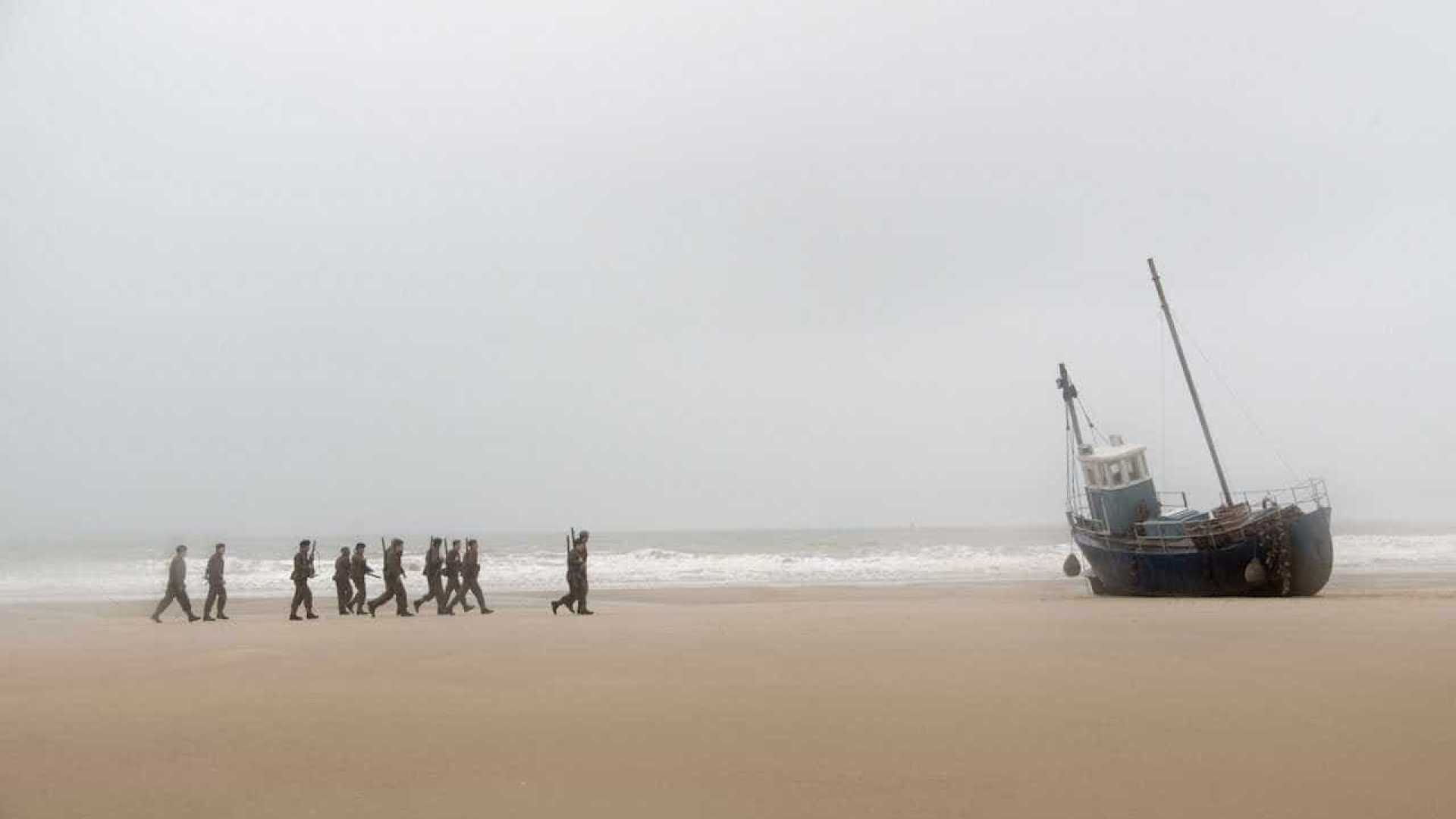
The movie is about the defeat of Britain, in France, during World War II. And instead of building a screenplay around the melodrama that lead to the defeat, Nolan focused on the real drama of the boots on the ground. It’s not a movie where introspection and personal growth contrast with the action, to make you connect as a viewer. There is no time for that. You will understand that retreating, despite not being the most glamorous of military maneuvers, is very intense for the psyche of the defeated soldiers, the families back home waiting for their safe return, and even the commanding brass organizing said retreat. It’s a scenario showing that, in war, anything that can go wrong will go wrong.
Survival is used in this film much more than a trope to serve as conduit to human nature; it is the narrative’s metronome. By choosing to do a film that is, in its entirety, an intense event, your link to the characters and context does not come from the calm moments in the rollercoaster, but from well-acted and properly angled moments of fear, stress and intense focus. That’s why the actors didn’t need to speak a lot, that’s why the movie didn’t need to be 2 hours long. You can relate faster to primal than to melancholy. It’s in your biology.
In addition to this core structure, Nolan and another one of his long-time partners in crime – the editor Lee Smith – decided to flourish the story with a three-pronged timeline. Toying with time to give an even more subjective experience to the audience is nothing new to Nolan’s portfolio. Yet, the work done here, from a writing (Nolan) and editing (Smith) perspectives, is something that would make Hitchcock proud, since he was the first to present to western audiences the Kuleshov Effect, a mental phenomenon demonstrated by Soviet filmmaker Lev Kuleshov, in early 20th century, that arises from time and point-of-view manipulation during montage.
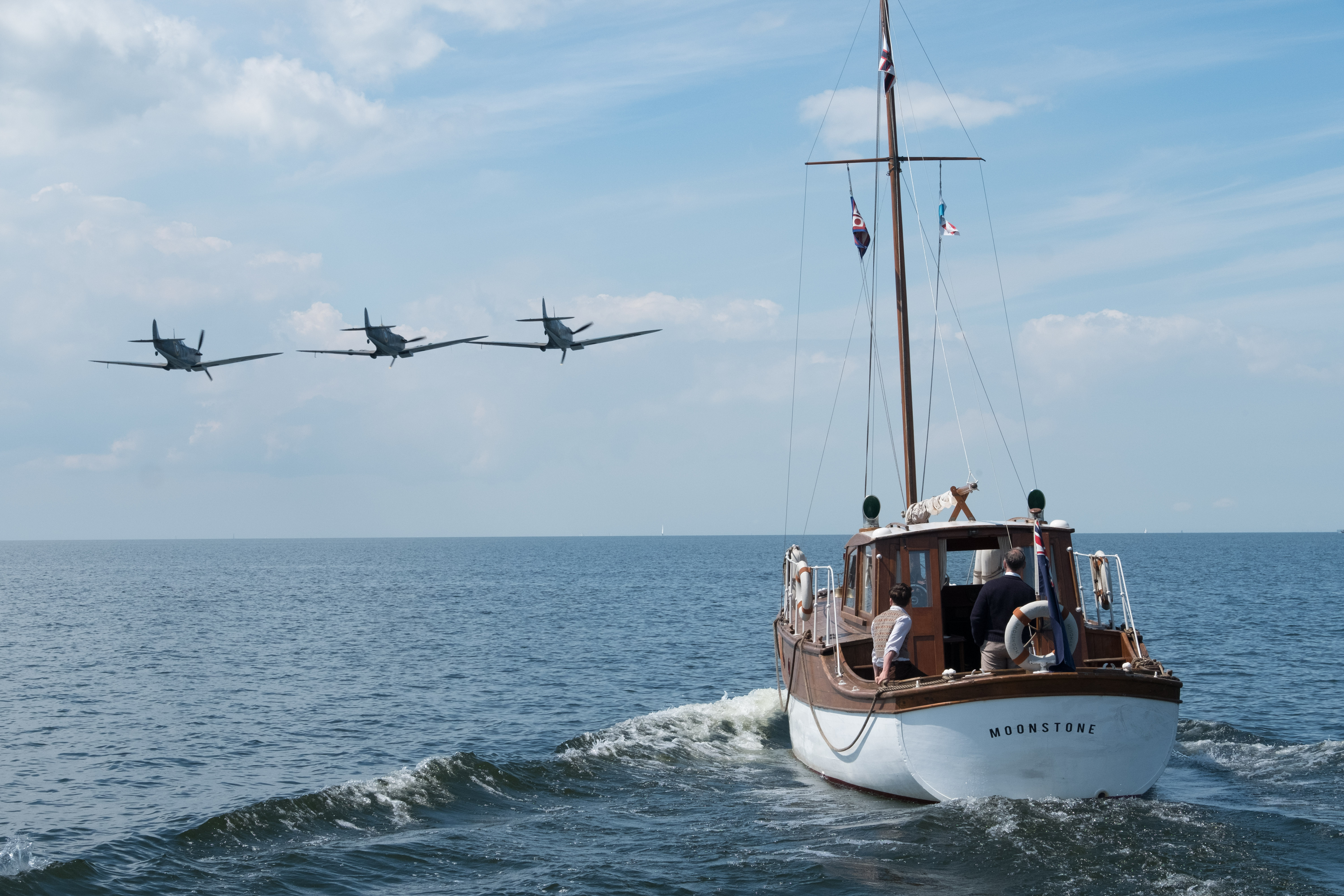
In Dunkirk, the play is very simple, but it works. You are dealing with 3 timelines: 1 week on the beach with characters like the ones of Fionn Whitehead, Harry Styles and Sir Branagh, 1 day on the sea with Barry Keoghan, Tom Glynn-Carney and Sir Rylance, and 1 hour in the air with Tom Hardy. It’s very intuitive that the day is the last day of the week and the hour is the last hour of the day. And this honesty is what makes it work. Usually Nolan and Smith would use the Kuleshov Effect to twist your brain and make you feel like a smart adult by the end of the movie. This time, the effect is choreographed to make you feel directed towards the action happening in France. People on land, on boats and on planes are all converging to a point, and you go with them. This cinematic flourish is completely coherent with the themes of the movie: in loco, close to every agent experience, independent lines, in war, have to deal with the same chaos; so, you have to help each other and never surrender your mind. It would be easy for Nolan to add a 4th timeline and cast Sir Michael Caine to play Churchill behind a desk saying captivating things. That would make it more similar to other war movies, but completely incoherent with what is aimed here.
Lastly, but definitely not least, I have to tip my hat to Hoyte Van Hoytema, the Director of Photography. The first time I saw any promotional material about this movie was on Twitter: stills of the city of Dunkirk. And my first reaction was one of surprise. I knew the quality of Van Hoytema from Interstellar and Her (two very different styles). My surprise was centered on the amount of color I was seeing in those photographs. War movies are not colorful, I thought. But then, I re-centered my frame of mind on what Nolan had done before with other genres. I knew color was going to be done right in this context. And I was not wrong.
The use of color and light, by the swiss DP, serves many different purposes during the movie, all with a common thread: complement the production design with vivid frames, in order to extend a tactile and organic hand to the audience, welcoming them to this world. With a realistic color scheme, the producer and the director don’t need to visually explain every nook and cranny of the geometry in the frame. Color supersedes shapes and contours; ergo, you don’t need to make a dark theme (war) even darker to capture the attention of the public.
Another aspect that Van Hoytema magnificently adds to this movie is smooth variation in shots. Not only does he talk the same language of intimacy and zooming-in on the characters, but he also manages to smoothly transition to panoramas that make you see the surroundings those same characters are facing. The highlights of this cinematographic feat are the choices he made to expose the converging of the 3 timelines. Sublime.
If by now, I have not convinced you to see this movie; I don’t know what is missing. The production is on the scale of 3 hour epics, the music is trailblazing new ways of ingraining itself unto the storytelling, the actors convey so much without the safety of long phrases, the edition and cinematography work in tandem to give you an image-reel that is both welcoming and relentless, and, of course, the screenplay and the direction are revolutionary and very fresh.
Christopher Nolan might never win an Oscar (like Stanley Kubrick), but he cements his membership on the guild of master craftsmen with this movie. How can a director build two such different and great movies, back-to-back, like Interstellar and Dunkirk? One is showing us how the human will can be bigger than the grandness of space, the other is focused on small acts that make a difference in a chaotic scenario. And even if you don’t identify yourself with Nolan’s past work, I recommend seeing this movie. It’s short, trimmed of all fat, a new benchmark for a genre you certainly have seen a film or two, very grounded in reality, and, above all, a team of filmmakers that are confident and in complete control of their craft.
- Dunkirk
- The Shape of Water
- Three Billboards Outside Ebbing, Missouri
- Phantom Thread
- Call Me by Your Name
- Ah-ga-ssi
- Kimi no Na wa.
- John Wick: Chapter 2
- The Lost City of Z
- The Square
- A Ghost Story
- The Killing of a Sacred Deer
- Lady Macbeth
- Get Out
- Blade Runner 2049
- Lady Bird
- I, Tonya
- Darkest Hour
- The Big Sick
- Wind River
- Beatriz at Dinner
- Forushande
- Molly’s Game
- Wonder Woman
- Detroit
- Atomic Blonde
- Logan
- Thor: Ragnarok
- War for the Planet of the Apes
- Score: A Film Music Documentary
- Okja
- Star Wars: Episode VIII – The Last Jedi
- The Beguiled
- Battle of the Sexes
- Good Time
- Free Fire
- Baby Driver
- Last Flag Flying
- An Inconvenient Sequel: Truth to Power
- Logan Lucky
- Ingrid Goes West
- Alien: Covenant
- Guardians of the Galaxy Vol. 2
 Opinion Seed