First of all, it goes without saying that this is a personal listing and ranking. For example, you won’t find The Legend of Zelda: Breath of the Wild or Super Mario Odyssey on this list since I don’t own a Switch (one day, maybe). PLAYERUNKNOWN’S BATTLEGROUNDS isn’t also ranked because I don’t play on PC. That’s just psyche-induced: desk=work, couch=leisure.
Notwithstanding, I’ve been playing and analyzing videogames for many years; ergo, I’m capable of spotting a gem without touching it. Those 3 names are design masterpieces and, hopefully, one day I’ll be able to put that opinion to the test.
Even without those 3 experiences, I can safely say that 2017 was the best year in gaming since, probably, 2007 (Mario Galaxy, Bioshock, Portal, Call of Duty 4, Halo 3, Mass Effect, Crysis and Rock Band).
There have been other notable years like 2010 (Mario Galaxy 2, Mass Effect 2, Red Dead Redemption, Bayonetta, LIMBO and Super Meat Boy) or 2015 (The Witcher 3 and Bloodborne); still, 2017 was special.
2017 was a year of great impact: Japanese console games are having a renaissance, after a big part of that industry decided to skip last generation to chase the illusive margins of the mobile market; Female protagonists finally reached the spotlight due to nuance in writing and acting and not to curves in the body; Indie developers are getting visibility in store-shelves with new approaches in pricing; and, above all, we are entering the final third of a generation that reminded us how gaming is the most vibrant and innovative commercial art field, and because of that environment, we are witnessing more and more dream projects come into fruition.
2017 was the year of quality in many different genres. It would be hard for even the biggest specialist to not find something to enjoy.
Now, to the ones I played, AND COMPLETED:
10. Tekken 7
The last iteration I owned was 3. That game is one of my favorites of all-time. So much fun and nostalgia attached to it. I even bought my first arcade stick to play it better. 20 years later, I decided to see how that old friend was doing.
It hasn’t changed much, which is good and bad. The formula that captivated me all those years ago is still capable of giving me enjoyable moments, but I would have loved to see a transformation more in line to what Mortal Kombat went through in 2011.
There are some nice additions that bring the franchise to a more modern standard: a more active camera around the fighters, some slow-motion clashes and even a super-move for each character that elevates the stakes.
Harada-san’s team also worked on a story mode that has some events of cinematic spectacle. But it’s a bit shallow and leagues behind of what NetherRealm Studios has been producing.
9. Horizon Zero Dawn

The first testament that 2017 was a great year for videogames. In a normal year, a game like Horizon would have cracked my top 3.
I really enjoyed this new world, this new character and all the gameplay mechanics around hunting Robot Dinosaurs. It’s filled with stunning vistas and you are constantly being surprised by some innovative designs and aesthetics.
As a first foray into the open-world RPG template, Guerrilla has already nailed a bunch of tough components that make one great: Aloy is a delight to move around, the shooting feels great and the enemy AI is a fair challenge.
Only a few blemishes with the ending of the story and the melee combat keep it from being higher on this list. Still, congratulations to everyone at Guerrilla. It’s risky to change direction, and not only did you pull it off, but also managed to introduce some new standards to the genre.
8. Uncharted: The Lost Legacy


Yes, a Naughty Dog’s game not in the top 3. And no, it’s absence from the podium is not related to it not being a “mainline” game. As a matter of fact, I liked Lost Legacy a lot more than Uncharted 4.
This “smaller” project corrected some grievances I had with “4”: the length of the story is much more in line with the narrative pace, the historic and archaeological tidbits are better flushed-out because you aren’t constantly moving from one place to the next, and the combat encounters were better implemented into the larger areas, by simply adding a gun with a silencer.
The rest you know: best action sequences in the industry.
7. Yakuza 0
I had my doubts regarding this franchise. The combat seemed dated, the world roaming looked very strangling, and, all-around, I couldn’t shake the feeling of design archaism.
I was wrong. It is precisely that out-of-time direction and vision that gives this game its flavor.
Yakuza is a beat ‘em up done right for the XXI century. The combat is, like I suspected, not very deep; however, the designers masked that with a variety of cinematic finishers that make a lasting impression most of the times.
The open-world is, without a doubt, small. At the same time, it does not feel underwhelming in terms of exploration potential. The intentional claustrophobia of the “sandbox” generates a strange comfort, where you have the sensation that the city is embracing you into its culture.
Really neat.
Every block has some attention-grabbing shop. And the most exciting enterprise is happening inside. This game is worth a purchase just for the mini-games you can play in these shops.
When it comes to the main missions, the novelty factor is gradually replaced by anticlimactic sensations. Don’t get me wrong, the story and cinematics are on-par with the good crime dramas of other mediums.
The problem is in the contribution of the “game” part to the narrative.
Much of the character development of the two Yakuza you role-play comes from the arc they go through with other Yakuza. Friendships, Respect and Rivalries are very well portrayed due to excellent writing and acting.
But when it’s time to pick-up the controller, all the exhilaration you are feeling to face that character is slowly metamorphosed to disappointment.
The controls and the fighting gameplay are doing that.
As I said above, the combat is not very deep. And even if both Yakuza have huge skill-trees in their respective four styles, all that potential is thrown to waste due to poor controls and animations, either in service of you or your enemy.
So, when you realize that, at the end of almost every story beat, you are going to fight another boss with many hit-points, some several times, you become less and less engaged in the gameplaying parts.
Still, the “AAA” production, cinematography and screenplay make this game a must-buy.
6. Pyre
This could have been my Game Of The Year.
That tells you how much disappointed I was with its ending.
The world is so exceptionally written, the lore has captivating layers, the characters you meet have thought-provoking dialogue, the gameplay loop is superbly used in service of the narrative, the music is Darren Korb’s best… I don’t have any more adjectives to praise this near-masterpiece.
Why Kasavin? Why?! I was ready to proclaim you as one of the best writers in videogames. Well, you are. And Supergiant Games is still safe as one of my favorite developers. But man, that ending…
5. Hellblade: Senua’s Sacrifice

Another game I had tempered expectations for. I was curious with some concepts they revealed throughout development, but the gameplay part had me worried.
Then, I put-on my over-ear headphones, like they recommend before starting the game, and suddenly… I was even more worried about the gameplay; because they had something special here.
The combat is not great. However, you rapidly understand that Hellblade is not that type of game. The lack of depth is intentional. And Senua controls better than it looked in the promotional videologs.
This is a game about mental-health induced fragility, having to deal with that while facing challenges and, most importantly, having the strength to face that same health disorder.
Senua is not fighting hulking male warriors like a hunter in Bloodborne because she always starts in a position of disadvantage. The crux of the game is to, precisely, go along with her in this journey of leveling the playing field.
Besides the audio design and mixing, which are a new standard for games, the visual art is also a great contribution to the ambiance the game needs to convey. The consulting Ninja Theory did with neuroscientists and patients clearly helped in the portrayal of these diseases.
Additionally, the game introduces a warning of a permadeath mechanic that keeps you on your toes til credits role. This whole game is one of the prime examples how this art field can contribute to a better understanding of certain subjects, through interactivity.
4. What Remains of Edith Finch
I did not like The Unfinished Swan. To a point that I convinced myself to not buy Finch after seeing its announcement.
I’m so happy I didn’t listen to my “Scrooge” self.
Finch is the best game of its genre.
It tells a whimsical but meaningful story, it has the best controls I’ve experience in these 1st-person adventure games, and it’s filled with ingenious and impactful gameplay scenarios.
For example, I prefer the narrative thread of Gone Home, but Giant Sparrow was way more ambitious and their design roadmaps and Direction are operating on another level.
Since it’s only 2 hours long, writing about the gameplay hooks would be almost spoilerish. Play it. No preconceived ideas. Think of it as an interactive movie from Annapurna.
3. Nioh

How is this game not my #1? More… How is this game not my All-Time number one?!
My dream game has a simple formula: Samurais + FromSoftware combat.
This is it! It’s not FromSoftware’s but it’s pretty damn close. 2017 was weird.
Being a “Souls clone” did not hurt Nioh. On the contrary, not only helped it become a very strong gameplay experience, but also showed that there are ways to deduce different and interesting design choices out of that formula.
The game has the control fidelity of Miyazaki’s games, and they added even more depth to the combat in a way that is meaningful even for players who have the tendency to min-max.
Like in Souls games, most of the world-building is done through carefully crafted level and item-design that are coupled with texts that flush-out the lore, and in Nioh they managed to include even more diverse locales and beautifully modeled weapons and armor, all entangled in a narrative that despite its contextual disarray ended up as a very serviceable “Dances with Wolves” or “The Last Samurai”.
Nioh is a very long game, and despite some rehashing of enemies and scenarios, it never felt too long. I come out of it wishing for more elements of Souls, but also for Souls to have more of those elements of Nioh that made me greatly enjoy it on its own.
And maybe that’s the biggest compliment I can give Nioh: you immediately see its influences, but rapidly know you are experiencing something also unique. I reckon it will be difficult for many “Souls clones”, and there will be a bunch of them in the coming years, to do it in such a special way.
2. Persona 5


I played Persona 5 for 133 hours and 8 minutes.
For 60€, there aren’t a lot of audiovisual products that give that amount of content to the consumer. Yet, what stood out the most from this experience was how Persona manages to keep itself fresh and varied throughout the hours. When staleness starts to naturally creep in… BANG! Some immaculately-written character is introduced, or a new meaningful side activity is unlocked.
And what a stylish piece this is!
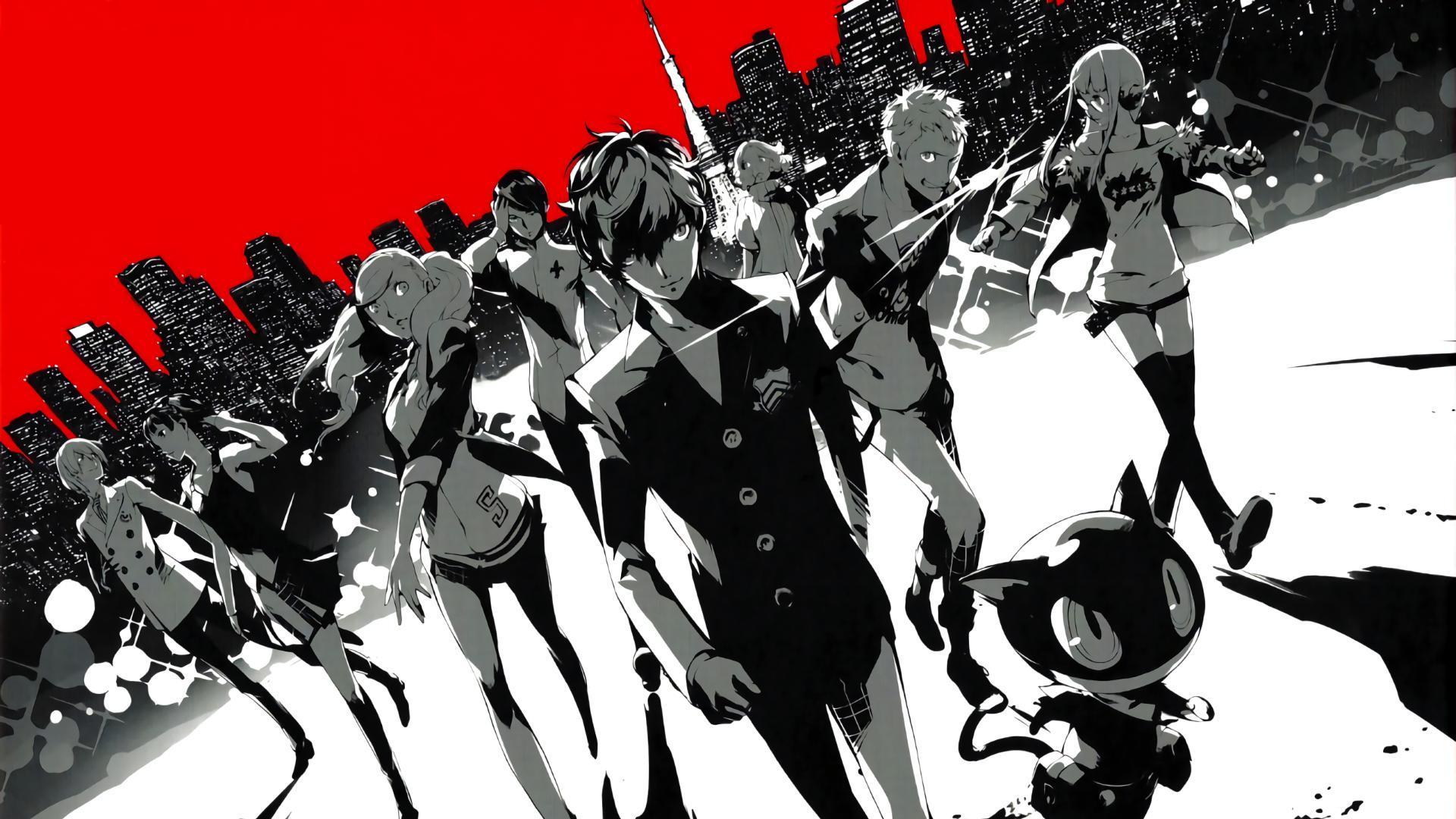
The anime-look is not a convention; it’s an identity that oozes from the screen with such bravado that one is instantly engulfed in its rules. This artistic confidence helps a lot in establishing connections with the different characters and, by so, with the meta-narrative.
A smart use of primary and secondary colors, coupled with aggressive lines in the geometry, rapidly tell you how’s it going to be: Are you in for this cool as hell train ride? And if you are still on the fence, listen to this groovy jazz-rock and tell me if you don’t want to go on an adventure with these cats.
And even if all these stylistic choices don’t appeal to you, either because you don’t like anime or fantasy, I have one last proposal: adult, strong and nuanced socio-political writing.
All the stylish effects, redesigned mythological creatures and on-the-clock action and choices, all fill-in an impressive (100+ hours) canvas where important political issues are painted and discussed on.
You will have conversations with your Confidants where topics like sexual harassment, work-force exploitation and money laundering are addressed with care.
As well as, an active role in a narrative that questions the player what is the meaning of social reform and the best way to achieve it, with cleverly implemented twists to make you go deeper than the typical notions of “good” and “bad”, and think about human nature and the philosophical conflicts that arise from that core.
1. NieR:Automata



Appearances deceive.
And even though I consider myself a person that respects that trap, I never expected that beneath the surface of a videogame with high-heels and samurai swords I would come across a narrative built on robust philosophical arguments about consciousness, self-discovery, life and History.
This is what happened to me in NieR:Automata, the new videogame from Yoko Taro, in collaboration with Platinum Studios: after a few hours, and some plot points revealed, I started to question if I had just witnessed a very well-written conversation about some mainstays of the work of the philosopher Georg Hegel. Couldn’t be; I certainly was mistaken. I could not remember the last time I had experienced a movie or a non-academic book that tackled such subject matters. A few more hours in, I find myself facing a gigantic machine with a centipede-like design with interconnected cores. Its name: Hegel.
NieR:Automata’s story and subject matters are not hidden in some kind of esoteric narrative.
Yoko Taro and his team had the rare courage to be very direct and descriptive about the topics they wanted to address. But man, doesn’t this game illustrate its message in an incredibly stylish canvas!
In the first 15 minutes, you know what type of a ride this is going to be. The Music (from composer Keiichi Okabe) is immediately front and center. And deservedly so; as past works of the composer, not only it’s filled with substance and variety but also knows how to naturally transition from moment to moment.
I really can’t make any justice to this phenomenal soundtrack with words:
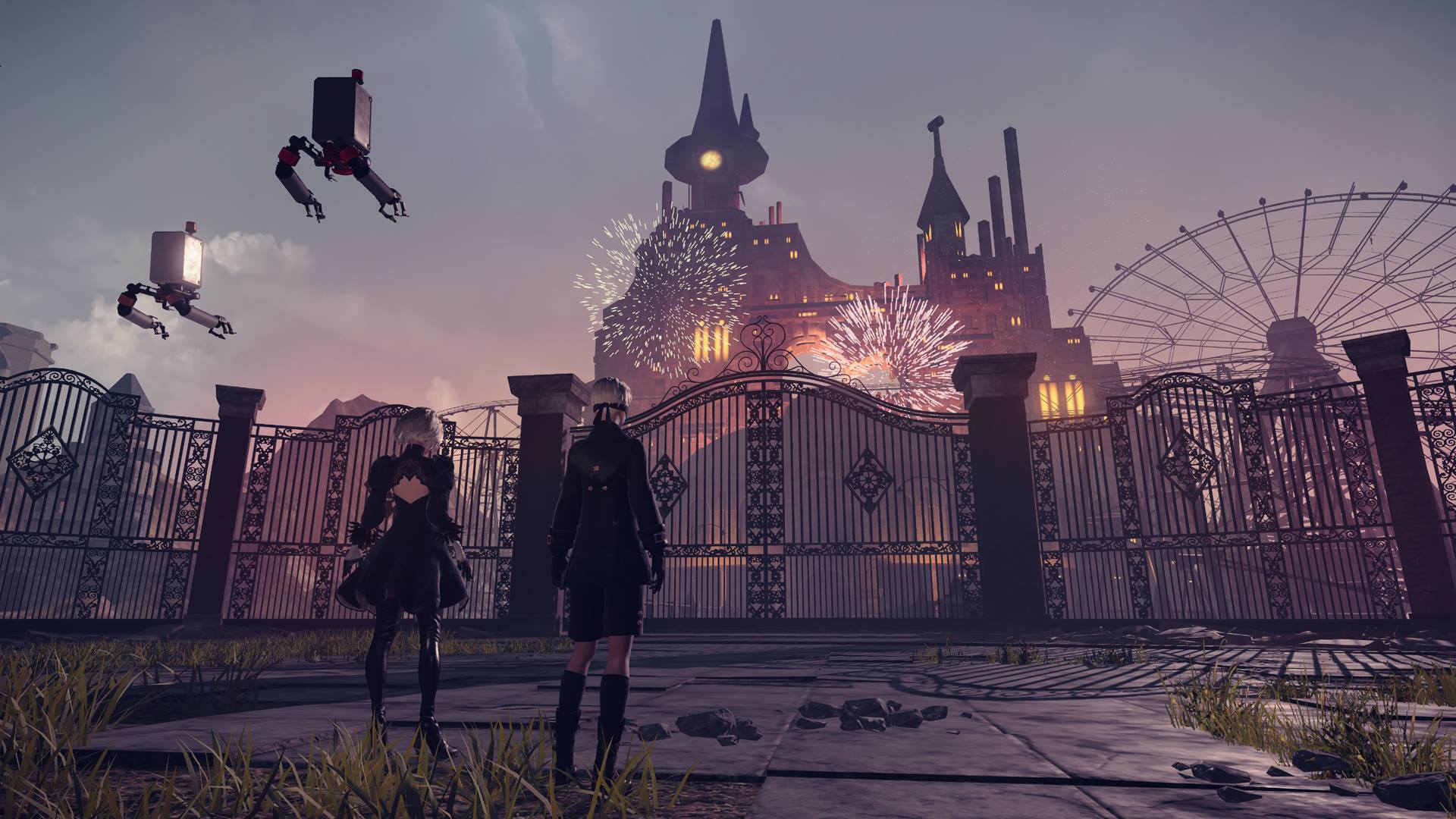
Then, you start to notice the level of detail of the character models and the machinery that is part of the story.
All the world building feels very truthful because of its design work. Even background choices like the color palette are very well implemented, as the focus on a fewer amount of tonalities than the typical Japanese game gives Automata a distinct look, that is in line with the context the characters find themselves in.
Yet, this is a deceptive minimalism.
They still manage to introduce a lot of contrasts and saturated scenarios. NieR proves that beige and brown can also have style.
Speaking of style, the battle encounters feel impeccably smooth. But you don’t even need to reach your first confrontation to notice how properly weighted the controls are. People who have experience with previous character-action titles from Platinum know what I am talking about. And I would argue that the level of 1-to-1 feedback between motor input on the controller and actions on the screen is so responsive and beautifully choreographed that newcomers to the genre will hardly find a better Platinum game in this regard.
The combat is not as varied and challenging as some other games in the portfolio of these developers, but as new weapons and special attacks are discovered through open exploration or story directed roaming, the player finds himself with a significant amount of tools to introduce creativity on how to tackle different characteristics of the enemies.
In the end, the combination of beautifully complex animations, the properly weighted pace and the on-screen coolness makes this game one of the best Platinum has ever done and I have to tip my hat to the collaboration between the martial-arts team, the motion-capture team and the animation team.
So, how did they implement all that amazing art into the world and moment-to-moment progression you find yourself in?
I stand by the following answer: NieR:Automata is one of the best directed stories I have ever experienced in all of entertainment.
What starts of as a very archetypal Anime structuring, with some occasional comments on “feelings vs machines”, gradually becomes a very fulfilling story, centered on meticulously built arguments about the meaning of History, about life not being just a chain of events but a process of self-discovering, what is consciousness and, more importantly, where does it stem from.
All these might read has very vague and quasi pseudo-intellectual premises that tons of other entertainment products have built their messages on, but I have read my fair share of Hegel, Nietzsche and Sartre to, at least, be comfortable saying that Yoko Taro and his team did their homework and managed to land very difficult and complex rationales into this game with incredible grace.
By now, you know: I am ecstatic for having had the privilege of experiencing this amazing art work.
This game is really special and I am still astonished by how it manages to deal with complex philosophical inquiries and maintain a striking sense of style. More! The style is in complete coherence with the transcendental arguments being made.
Sci-fi, more often than not, can’t beat that trade-off: it’s either edginess and immense sense of wonder or using machines as metaphors for humanity’s evolution, having the latter serious epistemological problems masked by strong concepts filled with rhetoric.
NieR:Automata shows us that you don’t have to deal with the trade-off if you suggest a new, well-articulated, paradigm. If The Matrix was praised for teaching Plato’s Allegory of the Cave with a lot of style, Automata should be lauded for threading in much more complex ideas.
 Opinion Seed