
Restarting…
Creating art is, like any other human endeavor, an iterative process. Guerrilla Games, the Dutch studio where the Killzone franchise was born, knows that maxim too well.
For years, this team of developers has been honing their videogame craft by adding to their portfolio 6 Killzone games. What started as a budget project coming from a country with no videogames’ industry, quickly became a brand Sony Worldwide Studios could rely on, to pitch their new consoles’ tech.
Amidst this safe zone of success, flickers an ember integral to art-creating: boredom.
It is essential for the health of the artist, and of the creative process itself, that this boredom is addressed not as an expected nuisance of the day-to-day grind, but as a signal. Your body is exteriorizing what your mind is already cooking. If you are getting tired of your current project, it means your subconscious is working on something at a faster pace. Everything around you seems stale because your imagination has already started the race.
For Guerrilla, this flame begun in 2010. They were wrapping-up production of Killzone 3 and, suddenly, the flicker started. What started as a fundamental question “Are we going to continue making Killzone games?”, quickly became a healthy urge to do something else. It seems a simple turn of events, but it takes real courage to ask that question about a financially successful product.
That openness led, 7 years later, to Horizon Zero Dawn. A new Intellectual Property of Playstation; a 3rd-person action game, where you role-play Aloy, a young woman that lives in an open-world filled with Machines resembling Dinosaurs and Animals from the Pleistocene, while the humans are still transitioning from hunting and gathering to settled agriculture.
Very different from Killzone, huh?
Did this artistic risk pan out?
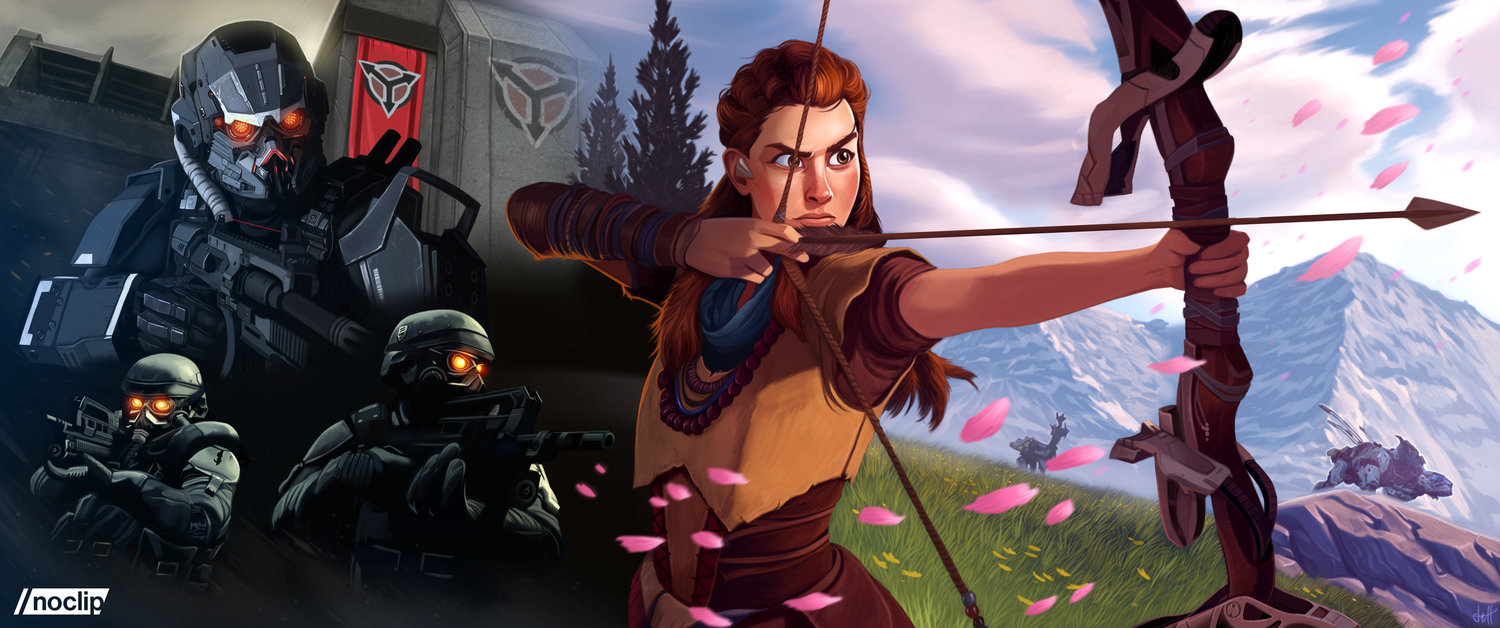
One aspect of this new IP that isn’t very surprising is the Art Direction. Yes, the tonalities are different from the ones throughout the Killzone franchise (in Shadow Fall there were some common denominators, due to engine sharing), yet the technical expertise when it comes to the use of light and saturated colors was always a staple of this studio. Additionally, human and machine animations remain very thought-out and deliberate like in previous games of this team. Aloy is a joy to control and the robot-dinosaurs’ behavior always looked plausible.
Still, I would be doing Horizon Zero Dawn, and Guerrilla for that matter, a disservice by only describing the visual prowess of this game in comparison to their past work. Not only HZD is filled with creativity, but also it is astonishing how they managed to render a big open-world that is beautiful and rarely drops any frames. Usually, in these “sandboxes”, there is a trade-off between looks and performance. Not here!
No wonder Hideo Kojima (creator of the Metal Gear franchise) decided to ask for the collaboration with GG in his next game (Death Stranding).
Really, I should stop writing about this topic and simply show you:
To complement those mesmerizing visuals, the audio and sound design are really good. For example, you quickly learn that fighting machines by mindlessly hacking and slashing is not the best strategy; you start to respect these foes, and what better way to convey these intimidating presences by combining lens-flare with synthetic calls. This pairing of light and sound is crafted in a way that becomes second nature to your senses when you are exploring the world. It never felt out-of-place.
Another aspect I found to be well mixed is the way the soundtrack lowers in volume whenever you are exploring the wilderness for a while. This effect is subtle but helps a lot with immersion. In this genre of games, I find it very satisfying to travel by vehicle or mount and absorb the environments throughout the journey. In HZD, more often than not, I was going from point A to point B on foot, gawking at all the geography and flora, in part due to the naturalistic approach of the mixing.
Speaking of the Score, Horizon’s is tough to judge. It isn’t very memorable; however, that’s a consequence of a stylistic choice where music was incorporated to serve as a mere extension of the environment. The different tracks are not there to be audio cues, but to be another characteristic of a context or culture. This generated some robust sounds that, by being low-key and minimalistic, were hard to fully appreciate.
All in all, the Audio is good; it just pales in comparison with the visual spectacle. With the exception of the main theme: it’s catchy and goes in tandem with the cool cutscenes:
The blending of audiovisual art with technical achievement produced the following formula: believable Hunter gatherer + dense Explorable world + Robot Dinosaurs.
This is one of the prime examples of how hard game design truly is. It took 7 years for a very experienced studio to nail a gameplay loop that seems to jump at you from that formula: fight and hunt the robot dinosaurs that are scattered throughout the world and collect their synthetic parts.
It took time, but GG did nail it. Aloy controls splendidly, another reason why I found myself doing without a mount for traversal, her animations are technically immaculate, the way she collides with rocky formations or bushes feels natural to a point you learn to use the environment as a combat partner.
And you will need every strategic advantage you can get against these adversaries. From machines resembling herbivores to giants on top of the food-chain, every single “species” behaves uniquely and was designed to be meaningful in the ecosystem. As I wrote above, after a few encounters you understand that even the smallest Watcher is a point of conflict on how you approach a zone.
Watchers are easy to defeat, but if one detects you, the bigger machines in the area will go agro. Herbivores are also on the easier side; however, a herd stampeding is a natural escalation. And the Predators, despite ramping up in difficulty, are a delight to confront.
This joy that occurs while you are facing bigger machines resides in one of the most interesting core mechanics of the game: targeting body-parts that can be used as ammunition.
There are several layers to this mechanic. Before or during engagement, you start by analyzing the machine with a tool you have – a Focus – and from that scouter different types of information are detailed. The removable portions become highlighted in the machine for a short period of time, parts that are susceptible to elemental attacks (fire, ice and shock) turn to a more saturated version of their distinctive color, and hidden compartments in the body will make you smile to the attention of detail.
Machine encounters are satisfying because there is always some degree of strategy, without micro-managing, and the audiovisual feedback you receive every time you remove a component from their synthetic bodies never felt old.
You can immobilize them by exploiting their elemental weaknesses or placing traps, use that opportunity to strip them of their shielded plates, and then land devastating finishing blows. Or you can brute-force it with explosive rounds but, even then, you have to find an equilibrium between bombing them enough to break the metallic protections and removing the parts that will serve as crafting materials for the scarce explosive rounds.
For example, there are a few Robots that have weak points hidden under their bellies; so, if you want to dance more than plan, you have to be cool to pull it off, like aiming and shooting while sliding under giants.
Despite these descriptors that certainly read as very enthusiastic, I have a few negatives to report. First, the melee combat is not good. The majority of the work was put into the shooting controls and interface, which is not surprising if you take into account that Guerrilla cut their teeth making 1st-person shooters. And it wouldn’t be a problem if there weren’t human vs human encounters.
These scenarios are not the problem per se, since they actually have positive impacts in combat diversity and in flushing-out the lore about the different human cultures in the world. The issue I had with the melee, in the human fights, was that it didn’t feel impactful.
Design-wise it is clear that Aloy vs Machine was the cornerstone of the gameplay. And they were right to do so; it is the hook of the game. However, by introducing Aloy vs Human a problem becomes noticeable: if Aloy is capable of single-handedly taking down huge robots, the only way of making the Human fights engaging is by making her face many adversaries at once. GG smartly constructed these encounters in ways that nudge the player to act as a stealthy sniper with her bow or as a silent ninja with spear take-downs. This driving of the situation masks an incoherence. Until the moment you are spotted.
When the human enemies detect you, they converge to your position. The first instinct is to fend them off with melee attacks. And that feels bad. When you are facing machines, the melee strike serves as a “back-off!” or a knock-down to expose their weak spots. By being one resource in a bigger-picture strategy, you don’t notice its lack of depth. But employing that against humans feels plastic and boring.
The same move that takes down giants, sometimes, doesn’t kill a way smaller person, and their animations don’t seem to acknowledge the hit.
So, what you end up doing to avoid that blandness is using your bow-and-arrow. Don’t get me wrong, the shooting in Horizon feels great. Pulling the string takes the right amount of time, the audiovisual feedback of that pulling, the arrow flying and hitting the target is one of the best in videogames’ history, if not the best. And they even added a slow-motion mechanic that enhances the sensory impact of the action.
However, partly because it feels so good, you will find yourself shooting a lot of arrows. And, I thought I would never say this, since bow-and-arrow is my favorite “power fantasy” in videogames, I got tired of doing it.
It’s a minor issue, because you have other efficient tools at your disposal (that’s what I ended up doing), and the machine combat is so deep and varied that it’s hard to envision someone not exploring the best weapons for the highlighted weak-points. Yet, I was a bit surprised to find myself not in love with the Bow.
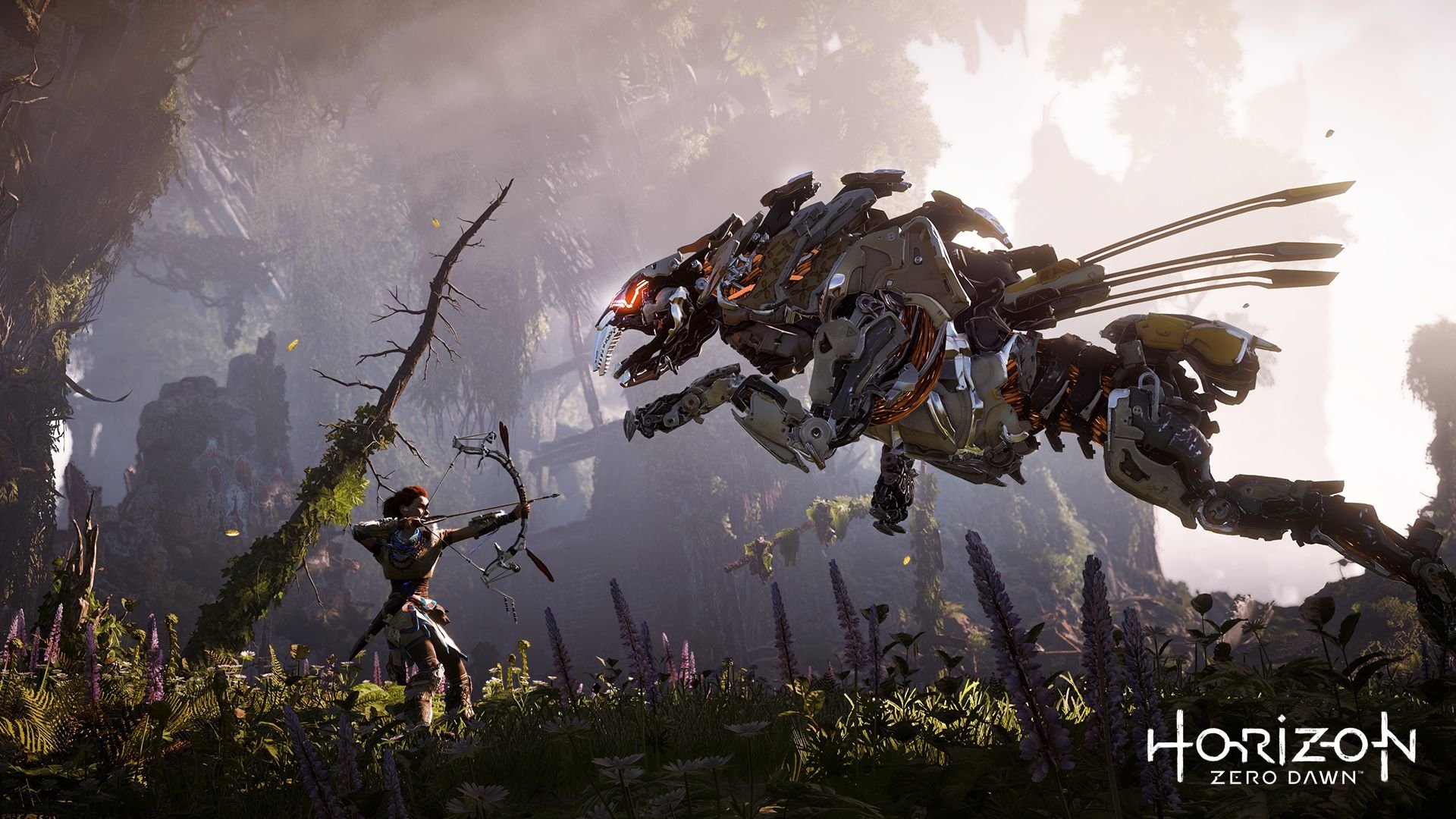
One aspect of Horizon that is not very surprising is the story.
The premise is, without a doubt, original. Instead of going for high sci-fi in far-future Space exploration or a post-apocalyptic dystopian near-future, Guerrilla took inspiration from some concepts of both themes and came to a “post-post-apocalyptic” world where Nature and Machines seem to live in harmony, and Humanity is no longer the dominant presence.
The story is not surprising because, if you have consumed a fair amount of Fiction, you know how this one will end after some plot points are revealed. Still, it is worth finishing because it’s very well written, and there are a few twists that are innovative for the genre.
Speaking of revelations, Aloy and the actress portraying her – Asly Burch – deserve a standing ovation. In an industry plagued by misogynistic products, in part due to Nintendo’s choice of placing their consoles in the “Blue” toys aisle after the 1983 crash, but also because some Men suck at using their brains to counter their animalistic tendencies, it’s not only refreshing but also important for an Artistic Field I respect so much to portray Women’s perspectives on action and narrative.
I did not gel with Aloy. But that’s ok. That’s my personality; and that didn’t prevent me from acknowledging that the character is layered and that her arc makes sense. I think it’s a testament to how well developed the character is, that I felt something for her. Not the feelings the writers probably intended, but the essence of good writing sprouts from the truthfulness of the lives being created. And Aloy always felt honest to the plot.
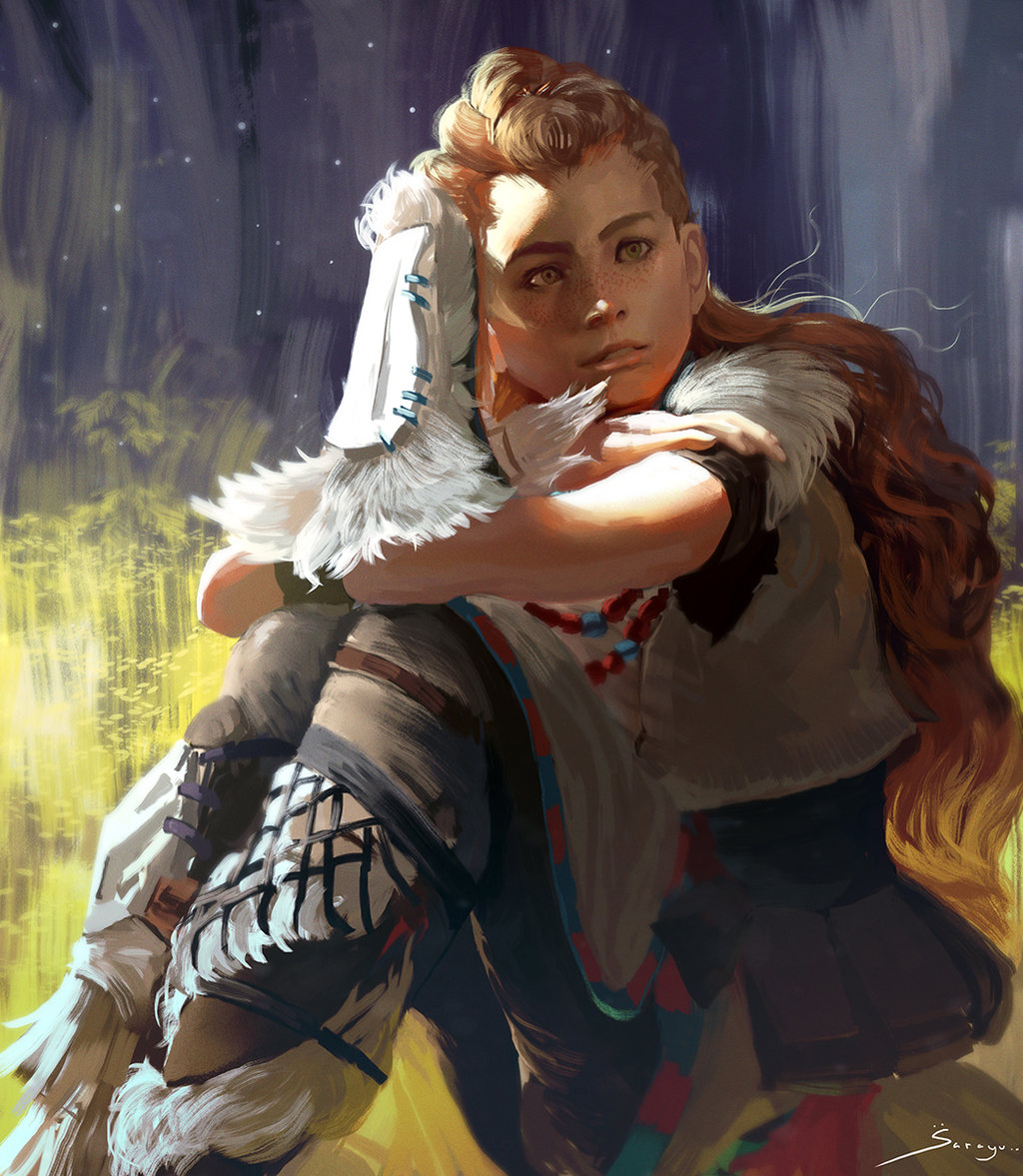
In tandem with the imbalance I found in the combat, I also have to address some misgivings I had with the other characters.
With so much attention and craft dedicated to Aloy, the other people living in this world had to be a bit more complex because, if not, they would contrast too much with her and not for the best of reasons.
I know the writers wanted for Aloy to stand-out in a world filled with superstition and primitive thinking. However, “simple folk” are just as capable of generating heart-throbbing storylines and conundrums. The Witcher 3’s side-quests are proof that such can be done.
And I’m not describing the typical “villager” you fetch some errands for. No, I’m talking about main-cast ones. Their facial expressions contrasted too much with Aloy’s fourth-wall breaking animations. Their dialogue was a bit stiff, and their motivations were lacking in the instinctual department.
It’s a pity, since the game is filled with proofs that Guerrilla can write and design many genuine characters at once. As you uncover information about how the world had come to be this way, you will interact with written, audio and video logs that portray some very interesting people.
Other aspects I found in need of some polish were Costumes and Makeup. Both have amazing artstyle, particularly the facial makeup. What I mean by polish is related to how those features were implemented. For as much exotic trying to be conveyed, some of the typical exuberances did not look organic to the bodies and got in the way of gestures and conversations.
These are also minor gripes, in the grand scheme of things. Overall, the world and its inhabitants share an aesthetic that never lends itself to immersion breaking and, despite being the first foray of GG into this genre of game, the attention to detail is already present.
I really liked this Open-World. Ok, it’s breathtakingly beautiful, and that helps. Be that as it may, I rarely walk in these games. I either use a mount or quick-travel. In Horizon, I walked from place to place most of the time. The size of the map also lends itself to that: it’s small enough for objectives to have reasonable distances between them, and it’s big enough to have geographical and meteorological variety so you don’t get visually fatigued.
Enemy placement is also very well thought-out. Groups of Machines can be dangerous, especially when you are dealing with combinations of different types. The designers knew this, since you never feel that you are losing because of some unfair programming that occurs in the background. The different challenges, that you see marked in the map, are the type of overwhelming that makes you be in awe and crave for the next encounter. This keeps you moving and exploring, and gain a different appreciation for the world as you start to develop a contextual awareness. You pay attention to everything: enemy groups’ composition, their routes, topography, vegetation; mesmerizing!
Finally, I should talk about the progression. Aloy’s journey is meaningful. Everything works together to build a very strong theme of Learning. She learns new abilities that are very useful to her (and the player), she learns about other tribes and cultures and starts to have some nuance in her reactions, and she also learns about her and the world’s past, which generates growth in her intellect and agenda.
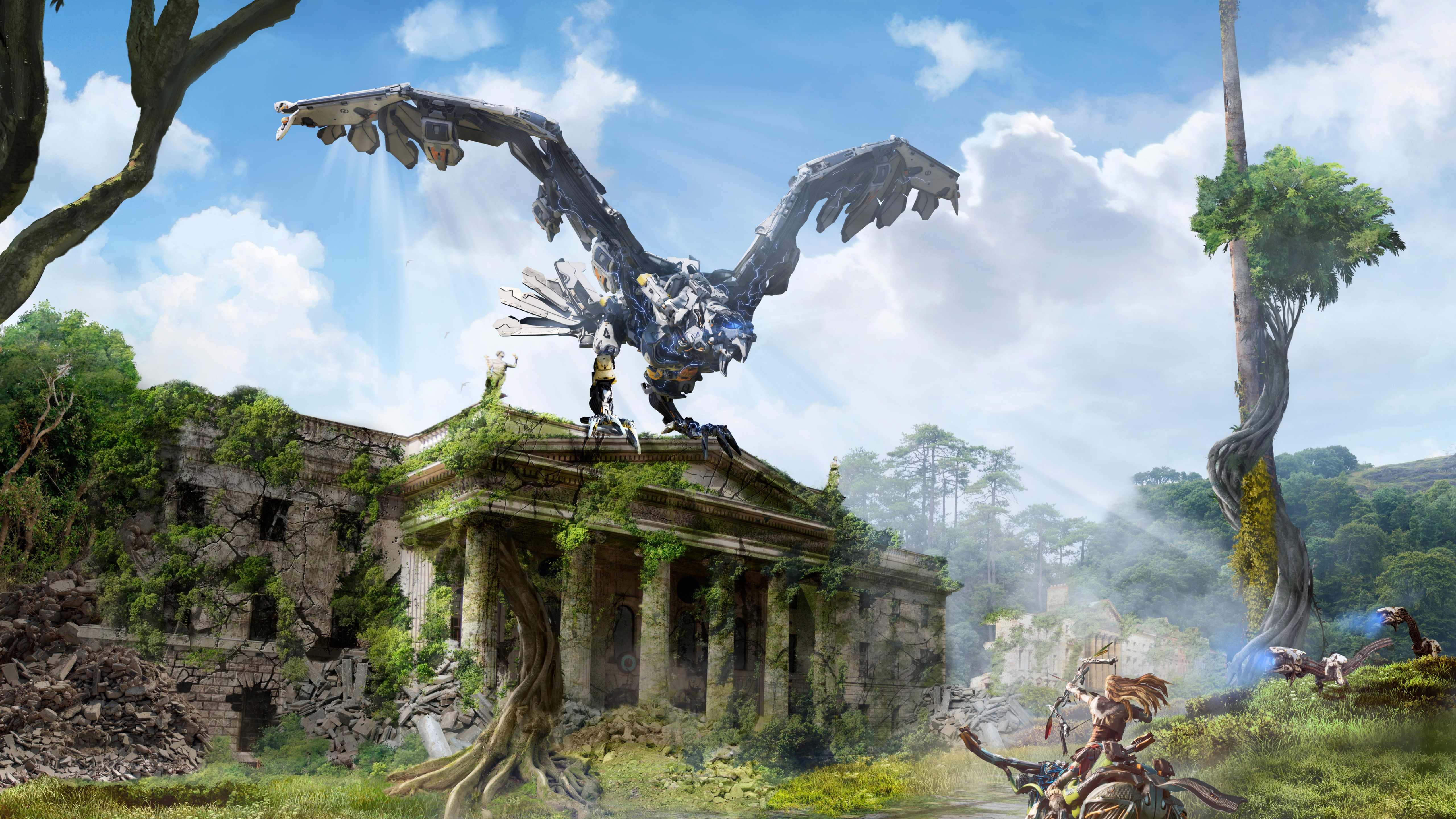
Horizon Zero Dawn was a risky project. Now, that the game is out, one can be cynical and spew jargon that removes any perspective on the endeavor itself: AAA, 1st party exclusive, open-world, collectathon, robot dinosaurs, feminism, etc.
The fact remains that HZD was made by a studio that worked on linear First-Person-Shooters for years. Games that were filled with a brown machismo that sold to a type of audience. And, despite sharing some technical idiosyncrasies here and there, Horizon couldn’t have a more different Vision.
First of all, no matter how hard a Publisher wants to have an Open-World IP in their portfolio, financing one is as big a headache as the size of that map. If the world is to be believable it has to be naturalistically populated, and those assets cost a lot of money.
Moreover, Guerrilla Games went an extra mile and decided they wanted to create a new technological standard for this genre of games. Betting on beauty and expecting that the framerate wouldn’t get a dip still blows my mind. I archived so many moments with “Photo Mode”.
Another choice that payed off tremendously is the Female Lead. Aloy is the perfect character for this world and this game’s message. In just one game, she cemented herself as one of the most charismatic characters in this artistic field. I had my misgivings with her personality, but it’s undeniable how strongly written and acted she is.
The story is also very well written and has some nice surprises for the genre. I did not like the ending and found some of the main missions to be a bit repetitive. At the same time, the blandest missions, in terms of gameplay, were the ones with better narrative threads. It kinda balanced out.
All in all, I highly recommend Horizon Zero Dawn. In principle, I feel very strongly about supporting such a product; a change in direction for a cash-cow is always hard to pull-off, but should be encouraged for the sake of artistic innovation. And Guerrilla Games did it.
It has sections that need some polish; conversely, the design choices were very sound for a first iteration. The engine they created is able to produce stunning environments with steady performance, the shooting mechanic is already very refined and fun to control, and the Robot Dinosaurs’ behavior is one of the strongest cornerstones in the medium.
I am curious for the next adventure of Aloy.

 Opinion Seed