Become Human
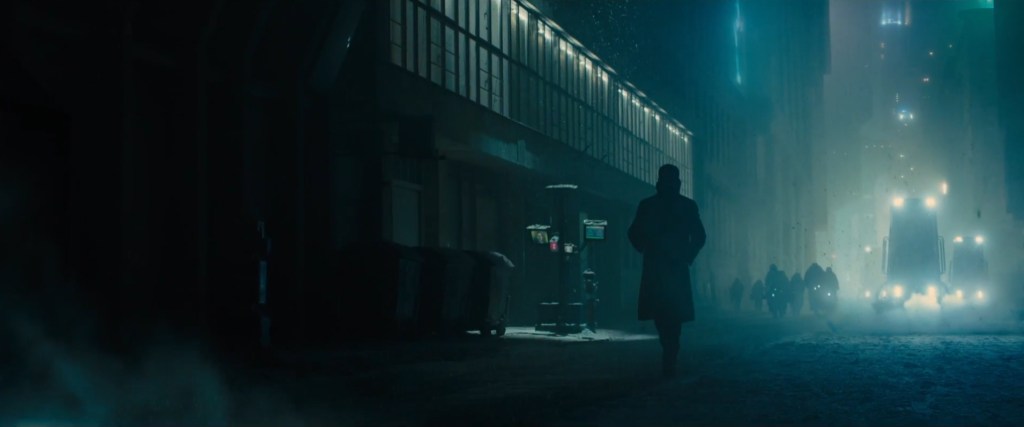
The original Blade Runner (1982, based on the 1968 novel Do Androids Dream of Electric Sheep?) was set in a dystopian Los Angeles in 2019. It is timely then to be presented with its sequel. Timely in the sense of comparing the original’s 2019 with reality’s 2017, but also to refocus ourselves on the analyses and predictions of science fiction thinkers, in order to rationalize the potential and consequences of Artificial Intelligence in years to come.
Ridley Scott, Hampton Fancher and David Peoples adapted the Philip K. Dick’s novel to the big-screen by grounding the narrative on a neo-noir aesthetic that lent itself perfectly to the bleak themes rendered by the cyberpunk movement. More than three decades later, studying and politicizing those concepts should be of paramount importance. We are amidst a Revolution, and what’s scary is not the unknown, the unimaginable disruption in human development that Silicon and Digital will bring; the worrisome part is the pace. The discoveries’ timeline has been completely elasticized: from fire to wheel was way longer than from telescope to space shuttles. Shorter intervals mean that the notions of ancient and modern are losing relevance by the day.
This is where movies like Blade Runner 2049 gain an extra layer of resonance, beyond the artistic one. Science and Technology can show us the future, but since humans have a double-edged dose of insatiability, the quest for improvement and greatness always leaves hazardous byproducts. It is the responsibility of our brightest minds to also have the vision of those reactions and make us think about our future actions.
Did the sequel to one of the first films to address these issues manage to add to the discourse and elevate its own cinematographic genre? Partially, but not completely.
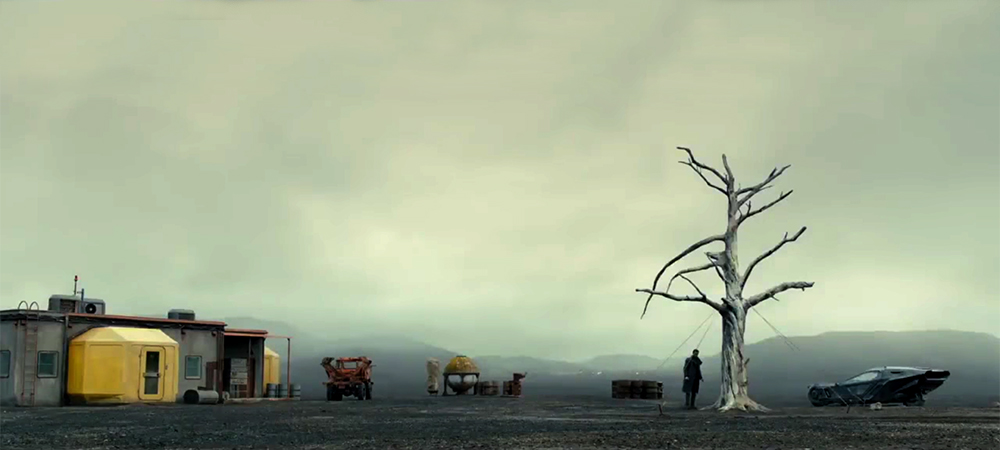
Blade Runner 2049 is a magic trick. And I say that in a complimentary way. In the first movie, the pitch was to sell a world through idiosyncrasies: make the audience believe that such scenario could end up occurring, since the places and the people living in them were not alien to our current lives (the sauce that feeds cyberpunk). The same core idea still exudes from 2049 but the production team was more ambitious this time.
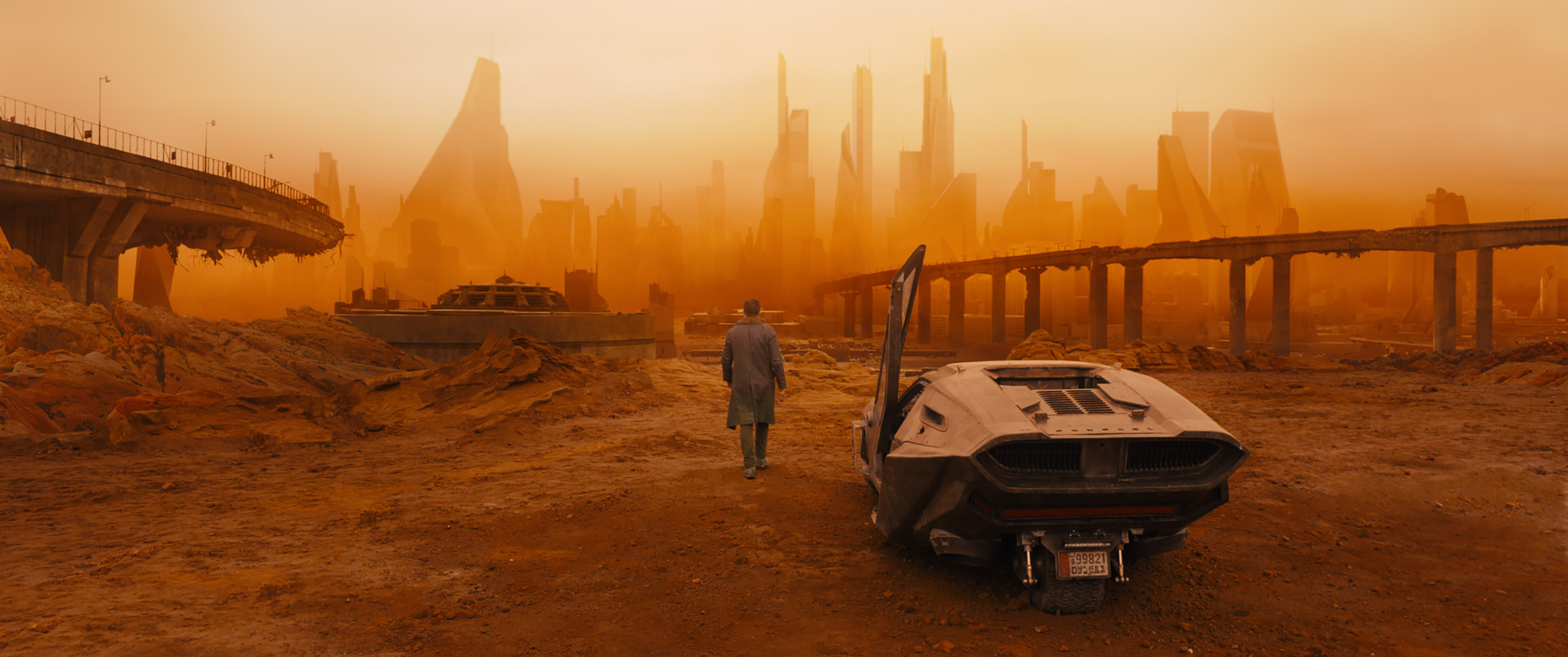
This sequel reveals more locations than the first movie, which is a more effective way of flushing out the world and the lore, while losing some of the grunge and personality of the first film. Still, 2049’s sets maintain a plausibility feel that helps lending credence to the near-future narrative. From isolated ruins to working industrial complexes, great care was given to the design of each location, in particular to the importance of making clear which places were close-quarters and which were open spaces. That was the magic trick: variety coupled with proper spacing gave the illusion of a bigger world than the one on camera.
Additionally, 2049, despite being 30 years after the first story, keeps true to the formula of realistic passage of time. Costumes and makeup are very synergetic, meaning that each individual looks to belong in that world, and his/her aspect came to be from a natural progression of fashion and utilitarianism and not from some extraterrestrial influence.
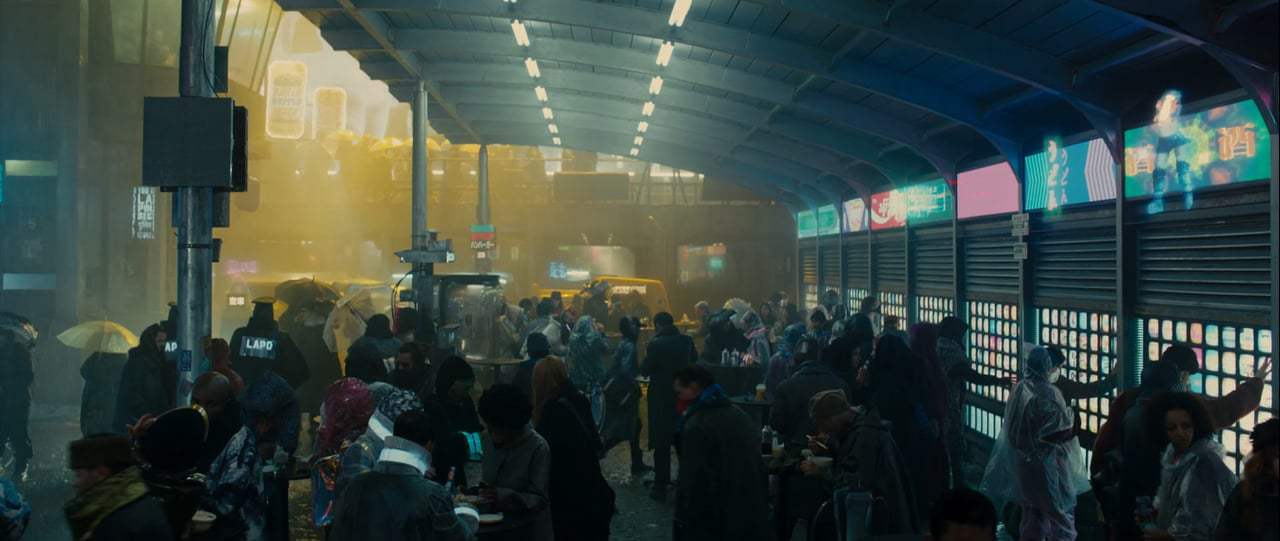
Other visual quirks that gave credibility to the production were the minimalistic lines in the architecture (interior and exterior). In recent years, we witnessed the advent of simplicity and basic geometry in the design of our buildings, furniture and utensils. The visionaries behind 2049 chose to ground the audience through that familiar referential.
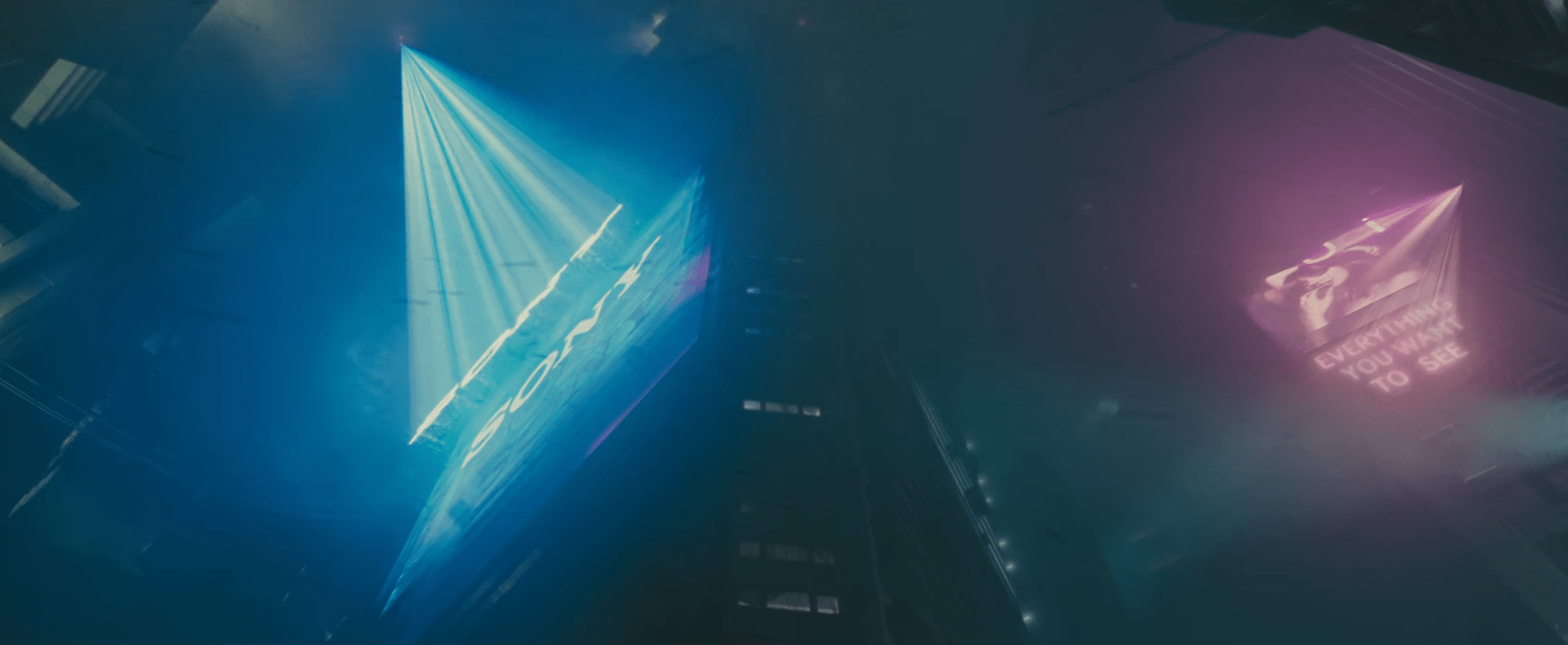
At the same time, there was a visual choice that, in my opinion, hurt the way in which the movie’s very accomplished cinematographer (Roger Deakins) could have contributed even more to the beauty of the film. I know that lens flare from neon sources is in the holy scriptures of cyberpunk, but this movie could have used some restraint in that department. There were moments when the shot had the perfect blend of industrial and organic, and suddenly a trace of light tips the balance in favor of distraction, and nothing more.
Another accomplished contribution to this movie came from the Music department. Hans Zimmer gives a hand to his disciple Benjamin Wallfisch (the main composer), since the legacy of Vangelis (first movie) could be too heavy for the young musician. This partnership of master and apprentice already gave great technical fruits, this year, in Dunkirk, with the caveat of Zimmer being the main composer on that movie.
The Score of Blade Runner 2049 is very good, probably even better than Dunkirk’s. Yet, it does not have the same narrative impact as in Christopher Nolan’s film. Melodically, it touches all the right notes to envelop the themes and pictures being presented. Methodically, it makes some mistakes that break immersion and can even lead to sensorial misalignments with the story being told.
Despite the minor gripes I have with some track choices for particular scenes, it’s still a great original soundtrack to listen outside the movie, and part of those issues are more due to sound mixing and editing than to composition.
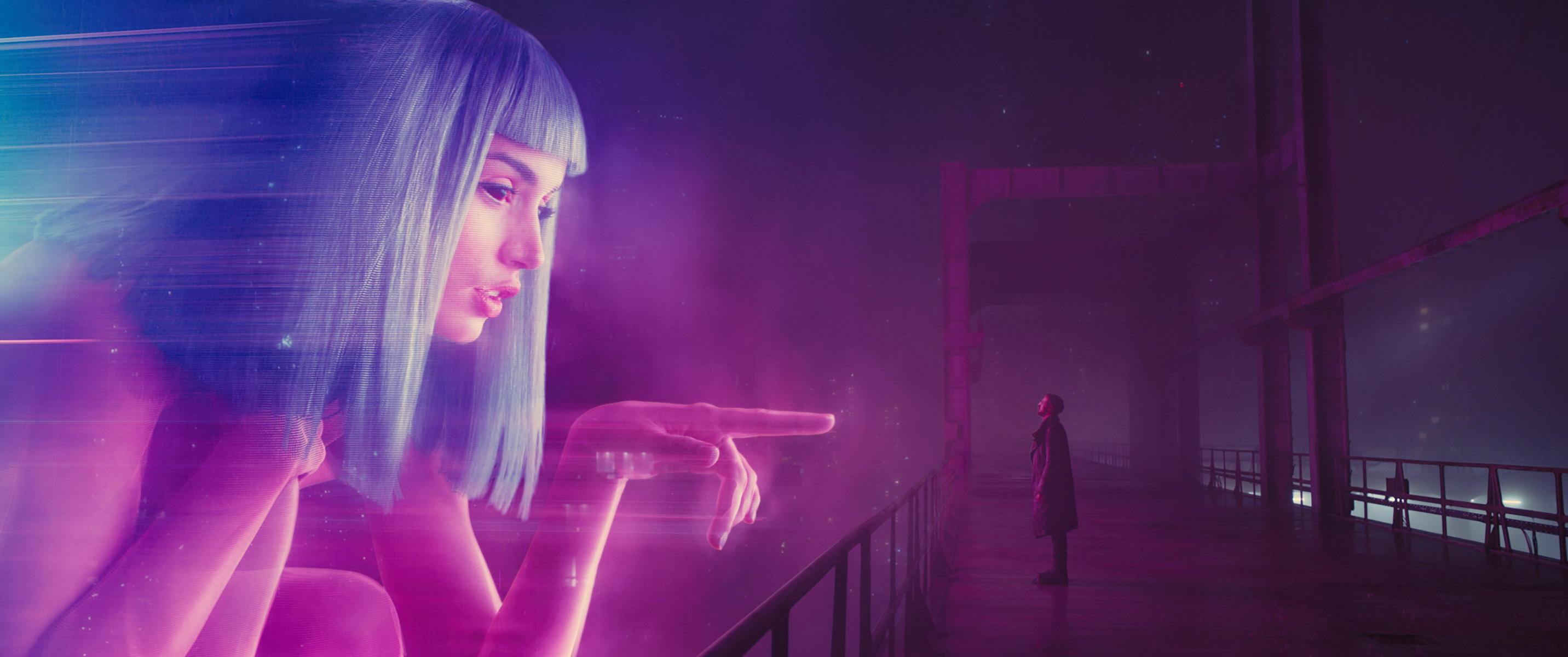
So, I was surprised that a movie in which Zimmer plays a part doesn’t have flawless audio. I was even more surprised that Harrison Ford was not the most overrated actor on a movie of his.
– Disclaimer: I find H. Ford to be very good at a particular archetype, but passable at other roles. –
Acting in 2049 is good, not great. Particularly, bearing in mind the quality of the cast: Ryan Gosling, Robin Wright and Jared Leto, just to name the A-listers. Gosling plays the role of ‘K’, an Android Blade Runner tasked of eliminating other Androids (they are called Replicants in this universe). As a bioengineered being, it is expected of the actor to walk a thin line between robotic and evolved. Gosling delivers, but it is curious that the same actor played a metaphorically similar role, years ago, in the movie Drive and did it better.
Robin Wright plays the part of Chief of the Blade Runner Division. The actress has moments of depth and nuance that left me feeling that the she could have given more to the character, but the character was not written to the level of the performer, ending up as a bit predictable and bland. What a pitty.
Jared Leto is the mastermind villain – Niander Wallace, the CEO of a very influential corporation, who wants to expand interstellar colonization by reproducing Replicants. And I have to say that Mr. Leto, after Dallas Buyers Club, has not delivered the type of performances one should expect from an award-winning actor. In 2049, the problem is not entirely on Leto’s shoes. Wallace is, by far, the least interesting character of the story; especially if you take into account that the action scenes of the movie happen because of his orders. Still; he is completely unnecessary to the narrative crux and Leto does not come close to saving the character. His performance is too on-the-nose and pseudo-intellectual.
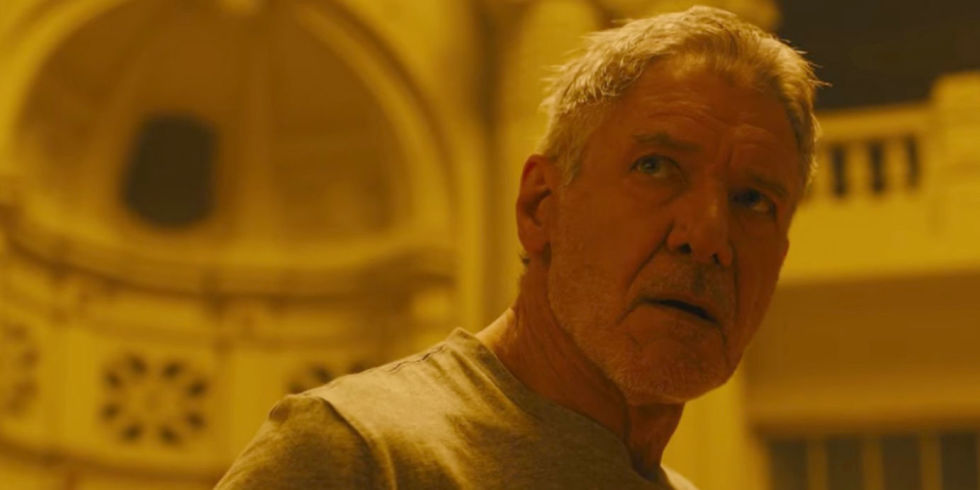
Now, two actors do save the movie from a theatrical point of view: Harrison Ford and Ana de Armas. The american actor reprises his role of the first movie – Deckard – but, this time, with his posture stabilized on a coherent facet. Ford is, in my opinion, the worst part of the first film partly because he was too stuck to the profile that had made him famous, and when asked to deliver a completely different archetype he swings from one facet to the next, never communicating the rock-solid characterization the script clearly demanded. Three decades later, Ford presents us with one of the best performances of his career. It’s neither overly pulpy (like the bulk of his roles), nor heavy with fretfulness (like in the latest Star Wars and other parts in later years). He brings a composure that pulls the movie in the intended direction, and the intelligent pacing of his acting transposes the themes into a less ethereal dimension.
Ana de Armas, the holographic AI named Joi, is the shining star of this movie. If Ford is the bedrock of the movie, the cuban actress is the brain. This movie makes you think about complex concepts like reality, perception and memory thanks to Joi. Her interventions are so strong and reflective that one might question who is the lead when Joi and ‘K’ are directly or indirectly involved. Tremendously well-written and acted. Bravo!
Speaking of writing, I should start analyzing the screenplay, since it’s clearly the most divisive cornerstone of this artistic product. First, from what I said above, it is evident that the script left something to be desired when it comes to characters portrayed by some great actors. Some of the blame should also go to the Director (Denis Villeneuve) since he’s the bridge between script and scene, but I bet the weakest link was Hampton Fancher – the screenwriter of the first movie who returns three decades later having only written two more scripts for the big-screen since then. And Villeneuve has recently directed some of the most robust character-driven movies out there.
Secondly and thirdly, the divisive points: story and message. The story is a divisive point because I think it’s as genius as it is unoriginal. It’s brilliant because Fancher took the most interesting perspective of the first film – the rampant and introspective Replicant Roy Batty – and wrote a new story from that point of view (with new characters). As a result of that inspiration, the new movie falls into a trap of unoriginality. More than 30 years have passed, and simply changing the angle of the storytelling structure is not enough. No matter how good the first one was, it is very palpable that the Director, Cinematographer and even the Editor (Joe Walker) were creatively shackled and that the movie never reaches its true potential.
The other aspect I see as very divisive is the message the narrative proposed itself to land. It’s a clean land. Way cleaner than the one in the first movie, as the several re-cuts throughout the years suggest. And I must commend this team of filmmakers for building such a streamlined vehicle to transport such grandiose ideas about human nature. But that’s where this creative endeavor fell flat: in anthropocentrism. Blade Runner and other works of the 80’s like Akira and Ghost in the Shell were revolutionary because they used transhumanism as a clean slate to have a discourse about the bases of humanism. In essence, cyberpunk was an adult and futuristic take on the fable of Pinocchio: a wooden puppet that dreamed of becoming a real boy.
In 2017, Blade Runner 2049 delivers a very gratifying and well-articulated metaphor about life, family and legacy, yet, it never adds up to the discussion about intelligence in AI alongside conjecturing on what might motivate androids to create a post-human world. 2049 only contributes with a disappointing human-centric school of thought: More human than human. That’s still too much focus on Geppetto. If, even in fiction, we can’t decentralize ourselves and try to envision scenarios of non-human motivations and instincts, I bet dystopias can definitely occur, but not in the close-minded way these movies are portraying them.
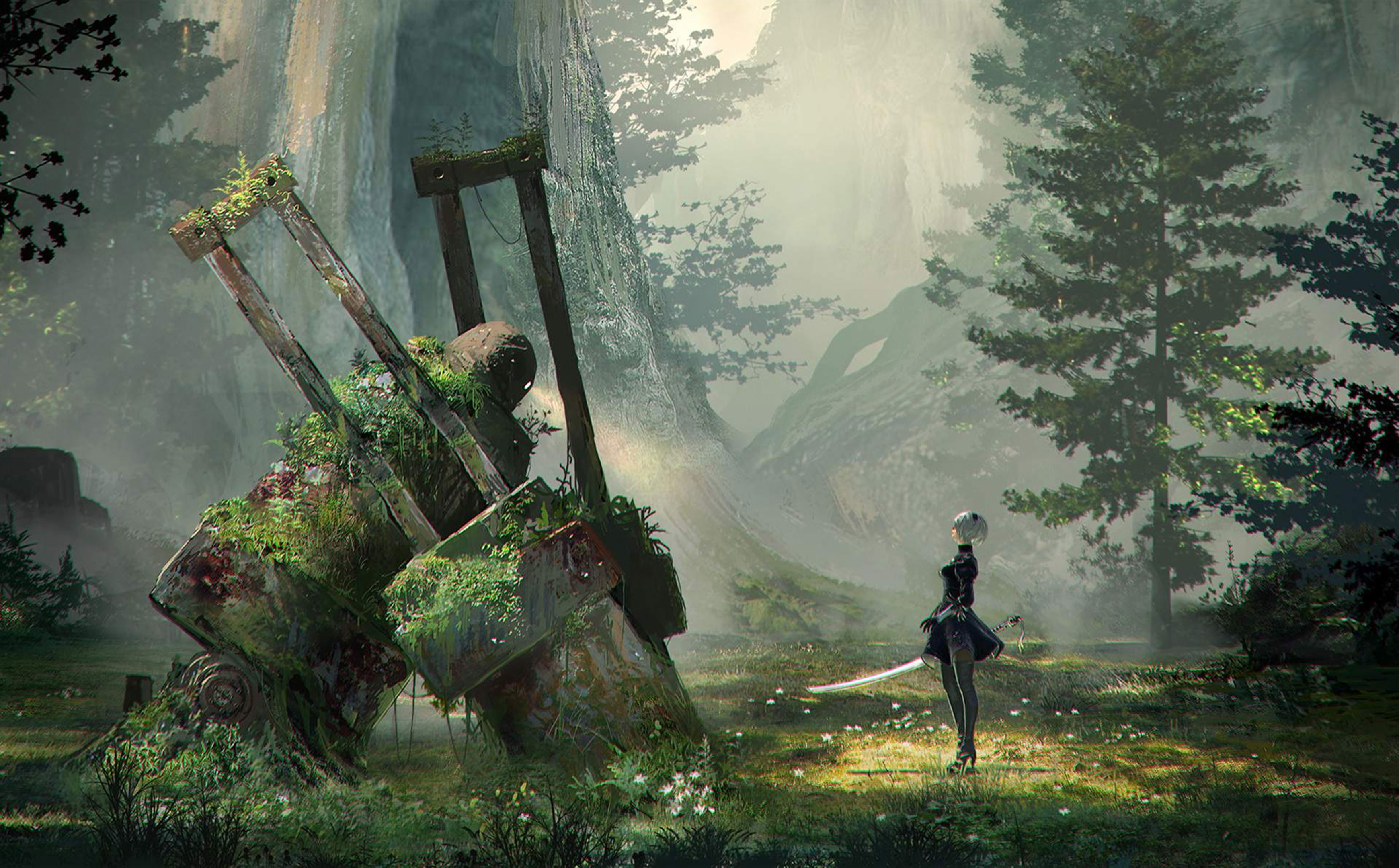
I suggest two works of fiction that are better starting points for those discussions about imagining what will drive Artificial Intelligence: the TV series Westworld and the videogame NieR Automata.
Narrative aside, 2049 is a cinematic tour de force. Every 10 minutes or so you are reminded that photographic techniques and technology have come a long way since 1982. It is clear from the get-go that the vision for the art direction is very modern. Deakins and Villeneuve had already worked together in Sicario and Prisoners, and it shows. The images on the screen have meticulous composition, a minimalism that never felt empty. Every element in the shot had a part to play in the storytelling. And besides the bad usage of lens flaring, color and light were always tonally right. Even when they were more saturated, they never felt superimposing.
However, I have to confess that I was a bit disappointed to not see Bradford Young’s name in the director of photography credits. Don’t get me wrong, Deakins is a legend, but the work Young and Villeneuve put together in Arrival was so fresh for its genre, that I would have loved to see Young’s techniques applied to this science-fiction movie. Particularly, the panorama shots. In my opinion, Deakins’ angles gave too much importance to the characters, while Young’s panorama shots in Arrival did a better job at showing how science and technology are dictating how the characters are positioned. For example, the original movie of Ghost in the Shell also captured this effect really well.
Lastly, let’s talk about Editing. Joe Walker has also worked with Villeneuve in previous projects and, with the exception of the Wallace storyline, the movie has great montage. The Director was given appropriate time to flush-out characterizations and let the world breathe around them. Really well done. If the film feels a bit longer than it should, I am convinced that would be solved by taking Leto’s character out of the script and make it an invisible force that pushes the plot forward.
The movie needs to be long, because the themes it’s addressing should not be exposed merely through dialogue but also through environmental constructs, and long-form cinema is one of the best formats for that type of messaging. This film should be seen on the big-screen!
Blade Runner 2049 is an accomplishment. Not only did it manage to correct some of the wrongs of its cult prequel, but also made noir work in 2017. I have some issues regarding the originality of the story and the tropes its message is structured around. Still, the story is a take on the best part of the first movie, and the metaphor being transmitted is still very relevant and juicy on its own.
Additionally, it’s a technical marvel and will serve as visual reference for science-fiction films to come. The cinematography has bravado without losing elegance, the music is very pleasant to the ear (maybe too much pleasant, for what is on the screen), and the directing is of the quality Denis Villeneuve has accustomed us to: actors have proper timings while maintaining personality and tact.
2049 also presents us with two great performances: Harrison Ford gives us one of his best, and Ana de Armas grabs her first blockbuster role with an astounding solidity and feel.
In the end, despite minor remarks, I highly recommend this movie. It’s a proof that industrial and introspective are not mutually exclusive and that spectacle is an appropriate trojan horse to push people into thinking about complex subjects.

 Opinion Seed