For the French.
Expectation is the first step towards disappointment. And Christopher Nolan’s movies are up there when it comes to my own personal hype. It started with Memento, which was, for a very long time, my favorite movie. I never saw Insomnia (bucket list, of course) and Batman Begins didn’t knock my socks off, probably because I didn’t have a history with the character. But then, The Prestige, The Dark Knight and Inception?! That’s a cinematic 1-2 punch with a Knock-Out. It was decided, Chris Nolan was my favorite Director of all-time and Memento maintained its belt due to the pseudo-intellectual justification of “I was there from the beginning”.
Memento is no longer my favorite movie. Recently, I rewatched Inception and came to the realization that the second is the movie Nolan wanted the first to be, but he didn’t have the resources for that kind of vision and endeavor. At the same time, there is another Nolan movie that is on a different type of ranking; The Dark Knight is on that list you wish you could wipe from your memory, in order to be surprised again. And what about Interstellar?! You rightly ask, because that is a film-making achievement: a proof that spectacle and introspection can be done right together, while complex themes like Gravitational Waves (2017’s Nobel Prize in Physics) and human virtuosity raise the cornerstones of a narrative in very elegant ways.
As you can see, Dunkirk was up against some tough competition, since it is impossible for a fan like me to not compare them. Many critics say it’s Nolan’s best movie. For me, it’s still early to say. Memento was too long on that spot because of the rose-tinted glasses of nostalgia, and Interstellar is a movie I love more each time I rewatch it. But there’s one judgment I can confidently make about Dunkirk: it’s his magnum opus. Not in the present-day definition of the term, but in the historical one, when “master piece” was literally a piece of work produced by a journeyman to obtain membership on a guild of master craftsmen. That’s what Dunkirk is: a director in complete control of his craftsmanship, producing visual art that is clean of all temptations to please the ego, of the viewer and of the director himself. This movie, from start to finish, lives on a type of equilibrium that is very difficult to manage; the type of balance where image and story intersect and never give up on each other.
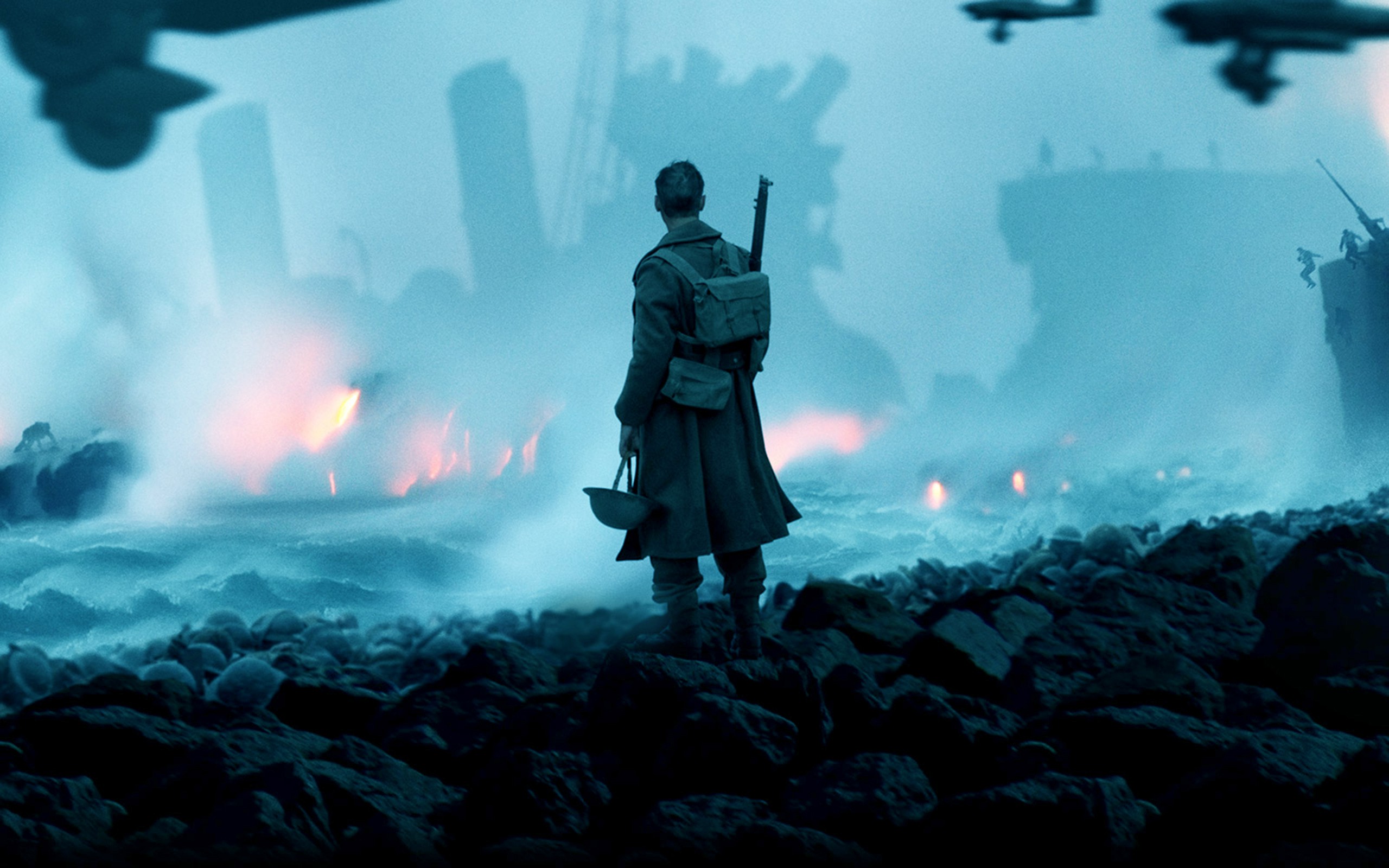
One could say that, by being 1h30 long, Dunkirk lends itself better to that type of focus. But that would be a big analytical disservice. We all know Nolan loves to treat his audience as adults capable of assimilating 3h narratives. This film has its length, not due to a priori conventions, but because it serves the pace; primarily the pace he wants the audience to feel in their bodies.
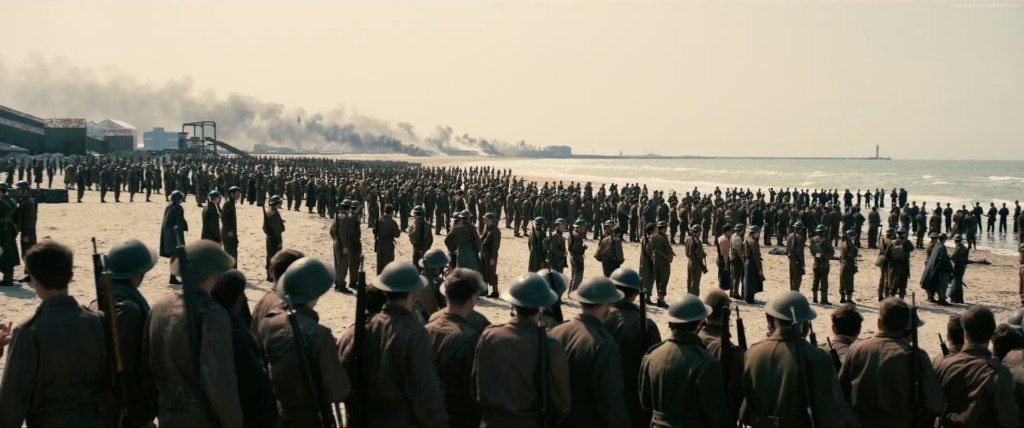
It all starts with Production. I’ve seen Dunkirk twice on the big-screen and, every time it cut to credits, I never felt craving for more 30 or even 5 minutes. And that sense of peace and applause comes from what Production had been serving me for the last hour and a half. The detail of every set tells a story in itself. You don’t need two hours to comprehend the context; the tactile feel Emma Thomas (producer) and her husband (Nolan) design their environments around is a refreshing take on a genre (Historical) that usually puts the spotlight on big speeches and big explosions. The first step towards transposing your audience to the beach of Dunkirk comes from environmental storytelling. Giving primacy to timeless human idiosyncrasies, like wet foot-wear near the sea, appetizing red jam on bread after a stressful event, or simply prioritizing the inside architecture of a boat or plane instead of their grandiose but less intimate outside shapes, made every minute in Dunkirk feel well-lived.
At the same time, we are talking about a War movie (WWII), and while the highlight of this film is the design of its claustrophobia-inducing fabric, there are a few, perfectly placed, moments where the Military Machine makes its presence be felt on the narrative. This juxtaposition works wonders, not only because the jump from organic to metallic helps the audience empathize with the stress and fear each character is going through, but also the visual effects are so coherent with the physics and geometry of the scenario, that the density of those moments can only be attributed to the real chaos that emerges from a military conflict, and not from some supernatural force of evil that is pulling the strings of destruction (like in many War movies).
To help create that dense atmosphere, it is imperative to mention Nolan’s partner in crime, Hans Zimmer. The german composer had already secured for himself a place on the Film Music Hall-of-Fame with masterpieces like the Lion King and Gladiator’s scores, but it is undeniable that this artistic entanglement with Christopher Nolan gave a new meaning to the concept of Original Soundtrack. One simply has to watch a clip of Zimmer’s live concerts and it is easy to understand why his peers say he raised the bar to a “modern Opera” level.
Hans Zimmer works on Nolan’s scripts. Like classical composers wrote plays to entertain kings and queens – what we now call Opera – the fact that Zimmer is having input on the visual component of the audiovisual product leads to scenes where the prominence of sound is not distracting but rather a whole new type of narrator. This editing symbiosis leads to better results from the sound mixing department, since the music is ingrained in the screenplay roadmap, the different sonorities are not just thematic fits like in many OSTs but they are also voices that are part of that world-building.
Dunkirk’s soundtrack is not Zimmer’s best; still, it has one track that belongs among his all-time greats (you will know when you hear it, and I must preface this comment by adding that such track was co-written with Zimmer’s young protégé Benjamin Wallfisch). Yet, this score is, without a doubt, the most important of Zimmer’s career. While Interstellar’s was a great step in showing how music can meld itself into descriptors and nano-stories within the screenplay, Dunkirk’s is far more important because one of the cornerstones of this movie is the parsimonious dialogue. Characters don’t speak much, by design, so the score has to lead. Its crescendos, aggressive and dense interventions are not there due to the composer’s curriculum flexing its muscles or even the expectations one might have about War movies; they are there to do the talking. You don’t hear much human voice, but the music is telling you why they don’t talk. It’s like Zimmer and Nolan, by collaborating, are creating a new genre of Musical.
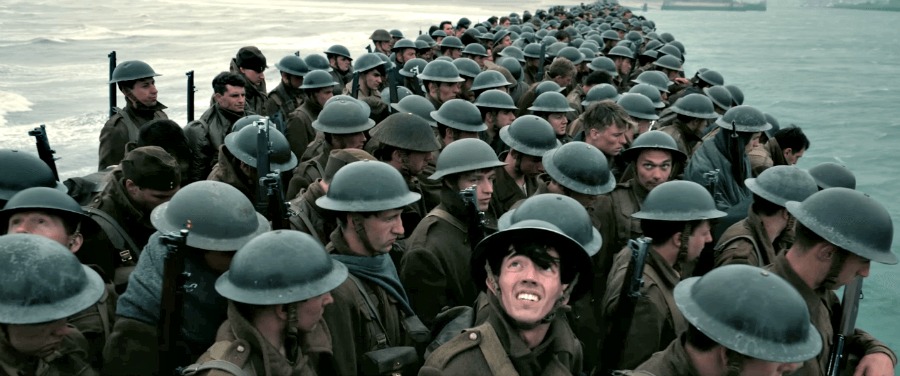
I bet a lot of actors were expecting to add “iconic military speech” to their portfolio when their agents delivered them the Dunkirk script. Boy, were they wrong. At the same time, what were they expecting? We are talking about Chris Nolan here. The guy does not stick to conventions.
This does not mean that they didn’t get to shine. In fact, I would argue that it is much tougher to grab an audience when you don’t have something grandiose or smart to recite. Fionn Whitehead plays a young soldier named Tommy and, despite being the character with most screen-time, speaks very little. The majority of his performance is observe and react, as if the screenwriters wanted him to be a vessel for the audience to attach to. A conduit for people to connect with the circumstances those soldiers were in. And he does a great job. Not on the level of near-mute performances like Elijah Wood in The Lord of the Rings, DiCaprio in The Revenant or Tom Hardy in Mad Max, but still, his facial and corporeal acting contributed a lot to grounding the movie and giving it the tactile feel I mentioned above.
Speaking of Tom Hardy, once again, the british actor graces us with a methodical and immaculate performance behind a mask; this time, a Spitfire’s pilot mask. He really is at the top of his game and helps lend a lot of credibility to the action. What his character does during the plot never feels archetypal, and it would be easy to feed the audience a war hero. No. Farrier (his character) does military feats because he is good at his job. Christopher Nolan has done super-heroes right, here he is doing competence and prowess right, and Tom Hardy’s eyes convince you of that.
More actors should be credited: Aneurin Barnard and Harry Styles contrast really well when they share the screen, Barry Keoghan and Tom Glynn-Carney give us the perspective of young civilians that are not yet at the age of serving but have friends who are, and both spend time interacting with an older person and his views about the War: Mark Rylance. And I know Sir David Mark Rylance does not need a long exposition about his greatness. But like Tom Hardy, he does so much with so little. From the way he meticulously utters his lines to the posture he chooses for different moments, it is impossible for the audience to not empathize with the civilians’ part in this story.
I would like to mention three more names: Jack Lowden and Cillian Murphy do great jobs as depictions of two totally different ways of dealing with defeat, and Sir Kenneth Charles Branagh who serves as the calibration point of this movie. Sir Branagh plays the role of the Navy Commander responsible for the evacuation of Dunkirk beach, and he is the emotional anchor of this narrative. If, for some reason, all the actors above did not convince you of the gravity of this moment in history, Commander Bolton will certainly give you a jolt of humanism and timely remind you of what, and not particularly who, was being fought.
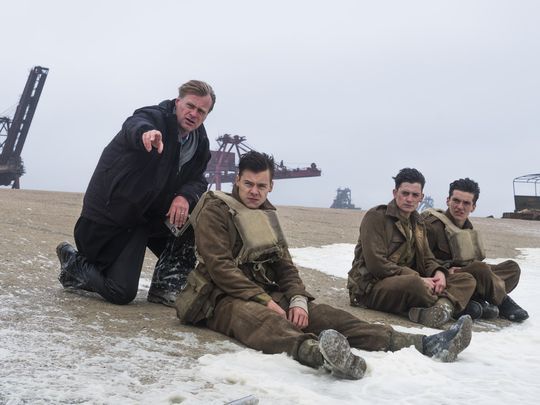
Above, I said that all these actors should not have been surprised with the type of script they had to work with, because C. Nolan tends to deviate from the norm. Still, this is a really DIFFERENT war movie. One hour and a half is not enough screenplay for the typical structure of historical pictures: our hero-figure lives a fragile or turbulent life, war ensues, the central character does not know or want to fight, big explosions occur, defeat, our hero-figure grows as a character, evil is ready to strike again, big speech, big explosions again, victory. This is not an old cliché. Just a year ago, that was precisely the experience I had with an Academy Award nominated picture: Hacksaw Ridge. I clearly remember saying: “Man, I wish someone reinvented the formula on war movies, they’ve been the same for the last 30 years.”
I don’t have Nolan on speed-dial; but, of course, he would be the one to do it. This screenplay, directing and editing are on a whole different level. Normally, you remember the helicopters playing Die Walküre in Apocalypse Now, D-Day in Saving Private Ryan, or even the 75 soldiers single-handedly rescued by Desmond Doss in Hacksaw Ridge. And even if the rest of these movies are all-time classics, the fact remains that they all share Joseph Campbell’s monomythical structure of “The Hero with a Thousand Faces”. We all cite these specific events of those movies, not only because they are amazing, but also due to the fact that, by following “The Hero’s Journey” narrative pattern, they need those moments of grandeur in order to make the more intimate ones effective as emotional anchors.
Dunkirk has a different structure. And I’m not talking about the signature play with timelines that Nolan uses to adorn the story being told (more on that later). The structure chosen to support the narrative was elegantly built on a simple concept: let’s make a war movie where we are listening to Wagner, while landing on Normandy, and saving wounded on Okinawa the entire time.
The movie is about the defeat of Britain, in France, during World War II. And instead of building a screenplay around the melodrama that lead to the defeat, Nolan focused on the real drama of the boots on the ground. It’s not a movie where introspection and personal growth contrast with the action, to make you connect as a viewer. There is no time for that. You will understand that retreating, despite not being the most glamorous of military maneuvers, is very intense for the psyche of the defeated soldiers, the families back home waiting for their safe return, and even the commanding brass organizing said retreat. It’s a scenario that shows that, in war, anything that can go wrong will go wrong.
Survival is used in this film much more than a trope to serve as conduit to human nature; it is the narrative’s metronome. By choosing to do a film that is, in its entirety, an intense event like the 3 examples I gave from other movies, your link to the characters and context does not come from the calm moments in the rollercoaster, but from well-acted and properly angled moments of fear, stress and intense focus. That’s why the actors didn’t need to speak a lot, that’s why the movie didn’t need to be 2 hours long. You can relate faster to primal than to melancholy. It’s in your biology.

In addition to this core structure, Nolan and another one of his long-time partners in crime – the editor Lee Smith – decided to flourish the story with a three-pronged timeline. Toying with time to give an even more subjective experience to the audience is nothing new to Nolan’s portfolio. Yet, the work done here, from a writing (Nolan) and editing (Smith) perspectives, is something that would make Hitchcock proud, since he was the first to present to western audiences the Kuleshov Effect, a mental phenomenon demonstrated by Soviet filmmaker Lev Kuleshov, in early 20th century, that arises from time and point-of-view manipulation during montage.
In Dunkirk, the play is very simple, but it works. You are dealing with 3 timelines: 1 week on the beach with characters like the ones of Fionn Whitehead, Harry Styles and Sir Branagh, 1 day on the sea with Barry Keoghan, Tom Glynn-Carney and Sir Rylance, and 1 hour in the air with Tom Hardy. It’s very intuitive that the day is the last day of the week and the hour is the last hour of the day. And this honesty is what makes it work. Usually Nolan and Smith would use the Kuleshov Effect to twist your brain and make you feel like a smart adult by the end of the movie. This time, the effect is choreographed to make you feel directed towards the action happening in France. People on land, on boats and on planes are all converging to a point, and you go with them. This cinematic flourish is completely coherent with the themes of the movie: in loco, close to every agent experience, independent lines, in war, have to deal with the same chaos; so, you have to help each other and never surrender your mind. It would be easy for Nolan to add a 4th timeline and cast Sir Michael Caine to play Churchill behind a desk saying captivating things. That would make it more similar to other war movies, but completely incoherent with what is aimed here.
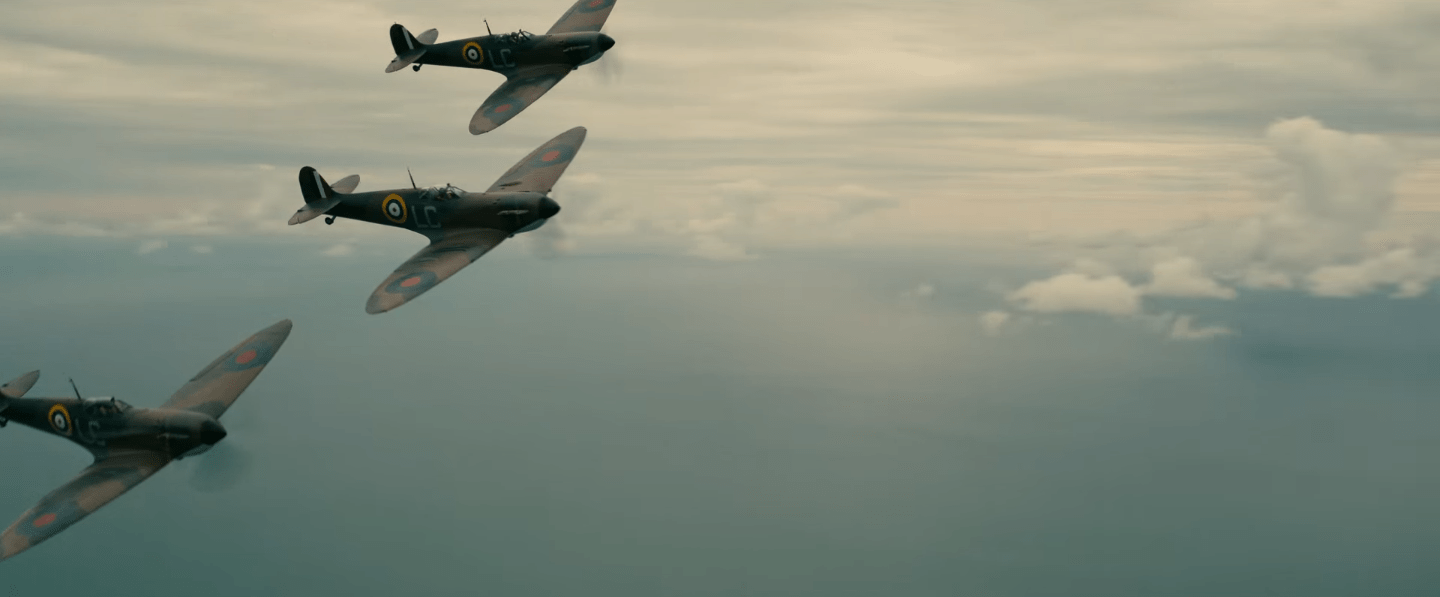
Lastly, but definitely not least, I have to tip my hat to Hoyte Van Hoytema, the Director of Photography. The first time I saw any promotional material about this movie was on Twitter: stills of the city of Dunkirk. And my first reaction was one of surprise. I knew the quality of Van Hoytema from Interstellar and Her (two very different styles). My surprise was centered on the amount of color I was seeing in those photographs. War movies are not colorful, I thought. But then, I re-centered my frame of mind on what Nolan had done before with other genres. I knew color was going to be done right in this context. And I was not wrong.
The use of color and light, by the swiss DP, serves many different purposes during the movie, all with a common thread: complement the production design with vivid frames, in order to extend a tactile and organic hand to the audience, welcoming them to this world. With a realistic color scheme, the producer and the director don’t need to visually explain every nook and cranny of the geometry in the frame. Color supersedes shapes and contours; ergo, you don’t need to make a dark theme (war) even darker to capture the attention of the public.
Another aspect that Van Hoytema magnificently adds to this movie is smooth variation in shots. Not only does he talk the same language of intimacy and zooming-in on the characters, but also he manages to smoothly transition to panoramas that make you see the surroundings those same characters are facing. The highlights of this cinematographic feat are the choices he made to expose the converging of the 3 timelines. Sublime.
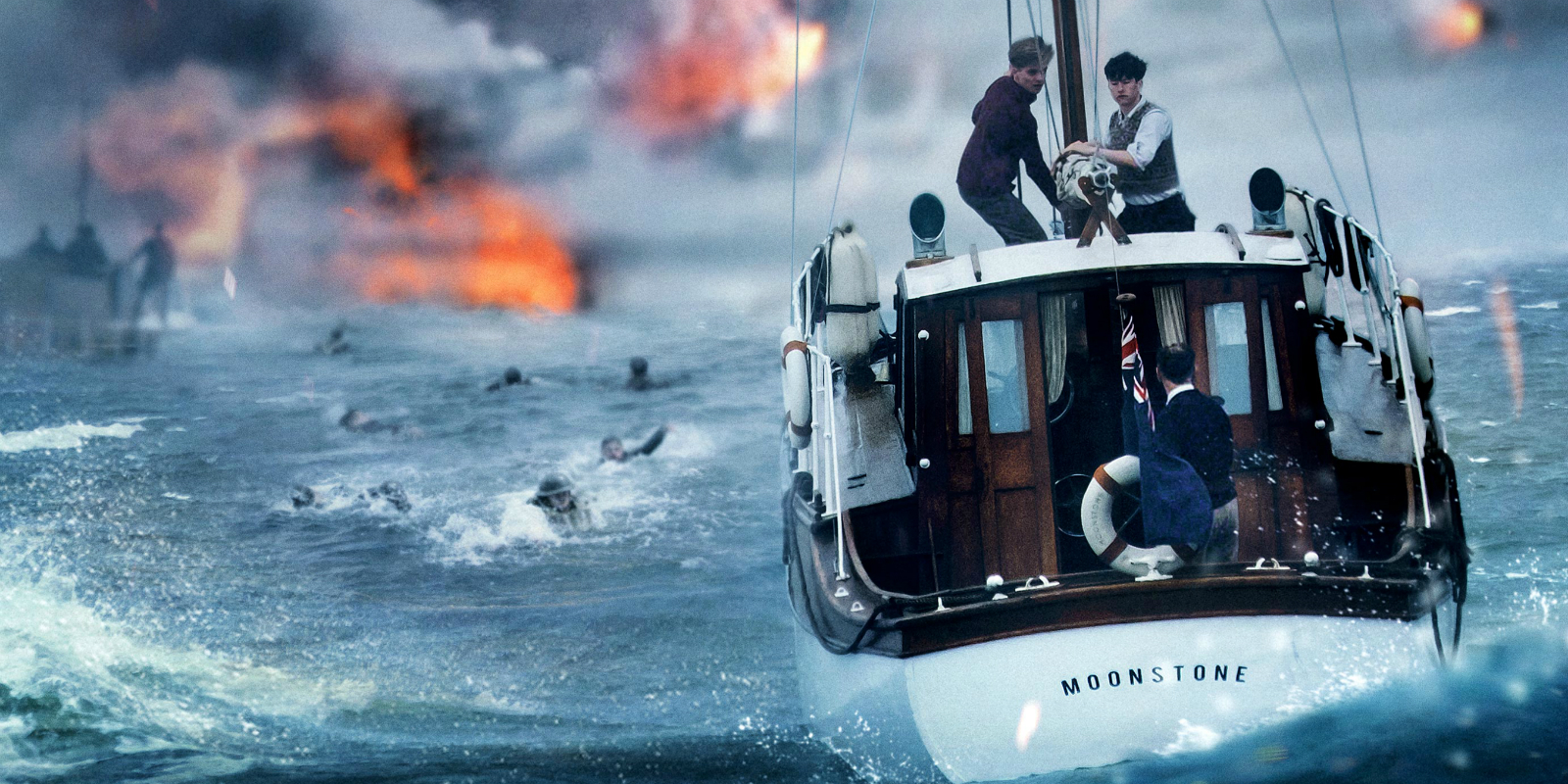
If by now, I have not convinced you to see this movie; I don’t know what is missing. The production is on the scale of 3 hour epics, the music is trailblazing new ways of ingraining itself unto the storytelling, the actors convey so much without the safety of long phrases, the edition and cinematography work in tandem to give you an image-reel that is both welcoming and relentless, and, of course, the screenplay and the direction are revolutionary and very fresh.
Christopher Nolan might never win an Oscar (like Stanley Kubrick), but he cements his membership on the guild of master craftsmen with this movie. How can a director build two such different and great movies, back-to-back, like Interstellar and Dunkirk? One is showing us how the human will can be bigger than the grandness of space, the other is focused on small acts that make a difference in a chaotic scenario. And even if you don’t identify yourself with Nolan’s past work, I recommend seeing this movie. It’s short, trimmed of all fat, a new benchmark for a genre you certainly have seen a film or two, very grounded in reality, and, above all, a team of filmmakers that are confident and in complete control of their craft.

 Opinion Seed